


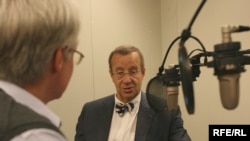
Estonian President Toomas Hendrik Ilves visited RFE/RL in Prague on May 12 to participate in ribbon-cutting ceremonies for the organization's new broadcast headquarters. Correspondent Charles Recknagel took the occasion to ask Ilves how he assesses the progress of democracy and human rights in the former Soviet world.
RFE/RL: President Ilves, you have a unique position of living precisely on the border of the EU and Russia. And Estonia and the other Baltic states have the experience of having been a part of the Soviet Union. That makes you an observer per force, and par excellence, of Moscow. Where do you see the political trajectory going in Russia, and how would you characterize the style of government that has developed there?
Toomas Hendrik Ilves: We are not on the border of the EU and Russia; we are the EU. So that's what our perspective consists of, a firmly European view of things. Clearly, the direction that our neighbor has taken when it comes to respect for freedom of speech and human rights is a step back from what everyone hoped.
The term that has been invented to describe this originally was "managed democracy," but that was kind of a public relations failure so now it is "sovereign democracy." In general, when you have adjectives put in front of the word democracy then you have to watch out. "People's democracies," we know what those were, [so] "sovereign democracy" as opposed to democracy is something that concerns us.
From our perspective, it is very difficult to tell where things are going. Clearly, the error that many of us made -- I include myself among them, but I think it was something that we all fell for -- was the identification of communism, strictly communism, with a lack of human rights and a [lack of] free markets and freedom of speech. We should have thought back to the 1930s; we should have looked at what was going on in Germany and in Italy, where you had capitalism but you did not have human rights and freedom of speech.
We, of course, couldn't foresee that things would go in that direction, that we would have unreined capitalism and a stifling of political opinion and alternative views.
I think that is the big question that we face today: How we deal with it? Too many people, I think, in the West have said, "Oh well, there is capitalism so what else is [needed] there, let's do business." And that kind of thinking we see perhaps too much of in the West. The fundamental values that united us in the Cold War don't seem to be as strong in the West as we thought, because you see calls to ignore lack of human rights, a stifling of freedom of speech, in order to make a dollar or to make a euro.
'Cause For Concern'
RFE/RL: Would you say, then, that the West has essentially abandoned the Russian human rights struggle simply because of the appearance of normalcy which has come with capitalism and an open market?
Ilves: Well, I think that we in the West would not say yes. But if you talk to the people in the human rights movement in Russia -- in Memorial or the journalists under severe pressure today in Russia itself -- they are the ones who actually say that the most and point the finger of blame for hypocrisy on the part of the West for not paying attention to what is going on.
Let's be honest, the Cold War forced us to have a certain amount of backbone, moral rigor, that it was, with very few exceptions, unacceptable to just try to make a buck when you were dealing with a totalitarian, communist regime. And, then of course it was not that easy to do it anyway because they were not capitalist.
But [today] I think that we have this spectrum of opinion on this that is very broad. There are also national interest issues here regarding energy which lead to some countries caring less about these issues, about human rights. There are personal interest issues on the part of some people that we have seen and, in fact, we end up with an odd situation in which the former communist countries which have the empirical and experiential knowledge of what it means to have lack of human rights, lack of freedom of speech, in some ways are -- how to put this politely -- well, in any case, I would say that many of us feel that talking about those very same issues is not popular and in fact almost looked down upon by some of our colleagues in the European Union because it is viewed as somehow antiquated or out of place to talk about human rights and freedom of speech -- and I think that is a cause for concern, actually.
RFE/RL: Western governments have left much of the task of pressing for human rights to multistate organizations which subscribe to certain standards and then seek to verify that member states observe those standards in practice. The verification process, in turn, is seen to be a kind of positive pressure which over time encourages recalcitrant members to change their behavior. An example is the Organization for Security and Cooperation in Europe (OSCE) which, in part, monitors elections for how well they meet democratic standards. How do you rate their strengths and failings of this approach?
Ilves: Any consensus-based organization, as the OSCE is, will lead to a common denominator; and the common denominator when it comes to democracy is fairly low. Since it is a consensus-based organization, that means it suffices for only one country to veto and that means you can't go very far.
Specifically, where the problems have come in is in a sub-organization to the OSCE, the ODIHR, which monitors elections. That is what has turned out to be so unpopular in countries where democracy is not where it should be, or where democracy is something other than what we know it to be in the West. And we can see very strong pressure on ODIHR to cease its actions and not to monitor elections, and threats to cut off funding to the OSCE if ODIHR continues to find that elections are not free and fair.
Well, what is the alternative? There is not much, especially since the other main organization that actually monitored human rights consistently was the Council of Europe, which was a normative organization. As opposed to the OSCE, which was consensual, the Council of Europe was normative, it had its principles and if you followed them you were OK and if you didn't follow those principles you were not.
But that has succumbed to political expediency, I would say, especially in the last six or seven years under the leadership which it had where, unfortunately, when you have people running an organization that have business interests in countries without democracy it leads to dubious decisions. So the Council of Europe has given up on its norms, and we don't really have any organization that is all inclusive, that includes these countries that have democracy problems, where these democracy problems can be discussed and what we really only have is countries that are democratic that worry perhaps sometimes about lack of democracy in countries that are not but the organizations themselves that include everyone are stymied.
[Former Czech] President [Vaclav] Havel wrote just yesterday in "The Herald Tribune" a piece on this same issue. Where are we? I mean, we have human rights organizations being chaired or run by countries whose own record, by any standard -- at least for an Estonian or a Czech -- is rather dubious.
RFE/RL: When you speak to your colleagues in the EU, what do you suggest might be a better way to proceed?
Ilves: Well, first of all is to pay attention to what is going on and not to sweep it under the carpet in the name of political expediency. And that basically is all that I can really suggest.
RFE/RL: Thank you. Is there anything else you would like to add as a final thought?
Ilves: Well, I would say that I am here for the opening of the new RFE/RL building and, as someone who worked here for nine years during the most exciting period, I think, in the history of RFE/RL, which was from 1984 to 1993, that it is great to be back here and that I find what the radio does remains highly important -- especially if you look at the Freedom House report on press freedom that appeared last week or two weeks ago, where you get a fairly depressing picture that maybe the job of the radios is not complete and that the outcome of our work in the 1980s and throughout that period was not as wonderful as we would like to think since of the 28 countries of the postcommunist, post-Soviet space, [only] eight have completely free media today. I am very proud that Estonia and Latvia and Lithuania and Poland and the Czech Republic are countries with completely free media and Estonia has the most free media, in that rating at least, of all of the postcommunist countries.
But that means there are 20 countries that do not have a free media [in] the target area of [RFE/RL] in the1980s. And if you look at the numbers, it is only 18 percent of the people that were in the broadcast area. Eight-two percent of the people that we were broadcasting to in 1988, '86, '89, today remain in an un-free press environment. And that's depressing.
RFE/RL: President Ilves, you have a unique position of living precisely on the border of the EU and Russia. And Estonia and the other Baltic states have the experience of having been a part of the Soviet Union. That makes you an observer per force, and par excellence, of Moscow. Where do you see the political trajectory going in Russia, and how would you characterize the style of government that has developed there?
Toomas Hendrik Ilves: We are not on the border of the EU and Russia; we are the EU. So that's what our perspective consists of, a firmly European view of things. Clearly, the direction that our neighbor has taken when it comes to respect for freedom of speech and human rights is a step back from what everyone hoped.
The term that has been invented to describe this originally was "managed democracy," but that was kind of a public relations failure so now it is "sovereign democracy." In general, when you have adjectives put in front of the word democracy then you have to watch out. "People's democracies," we know what those were, [so] "sovereign democracy" as opposed to democracy is something that concerns us.
From our perspective, it is very difficult to tell where things are going. Clearly, the error that many of us made -- I include myself among them, but I think it was something that we all fell for -- was the identification of communism, strictly communism, with a lack of human rights and a [lack of] free markets and freedom of speech. We should have thought back to the 1930s; we should have looked at what was going on in Germany and in Italy, where you had capitalism but you did not have human rights and freedom of speech.
We, of course, couldn't foresee that things would go in that direction, that we would have unreined capitalism and a stifling of political opinion and alternative views.
I think that is the big question that we face today: How we deal with it? Too many people, I think, in the West have said, "Oh well, there is capitalism so what else is [needed] there, let's do business." And that kind of thinking we see perhaps too much of in the West. The fundamental values that united us in the Cold War don't seem to be as strong in the West as we thought, because you see calls to ignore lack of human rights, a stifling of freedom of speech, in order to make a dollar or to make a euro.
'Cause For Concern'
RFE/RL: Would you say, then, that the West has essentially abandoned the Russian human rights struggle simply because of the appearance of normalcy which has come with capitalism and an open market?
Ilves: Well, I think that we in the West would not say yes. But if you talk to the people in the human rights movement in Russia -- in Memorial or the journalists under severe pressure today in Russia itself -- they are the ones who actually say that the most and point the finger of blame for hypocrisy on the part of the West for not paying attention to what is going on.
Let's be honest, the Cold War forced us to have a certain amount of backbone, moral rigor, that it was, with very few exceptions, unacceptable to just try to make a buck when you were dealing with a totalitarian, communist regime. And, then of course it was not that easy to do it anyway because they were not capitalist.
But [today] I think that we have this spectrum of opinion on this that is very broad. There are also national interest issues here regarding energy which lead to some countries caring less about these issues, about human rights. There are personal interest issues on the part of some people that we have seen and, in fact, we end up with an odd situation in which the former communist countries which have the empirical and experiential knowledge of what it means to have lack of human rights, lack of freedom of speech, in some ways are -- how to put this politely -- well, in any case, I would say that many of us feel that talking about those very same issues is not popular and in fact almost looked down upon by some of our colleagues in the European Union because it is viewed as somehow antiquated or out of place to talk about human rights and freedom of speech -- and I think that is a cause for concern, actually.
RFE/RL: Western governments have left much of the task of pressing for human rights to multistate organizations which subscribe to certain standards and then seek to verify that member states observe those standards in practice. The verification process, in turn, is seen to be a kind of positive pressure which over time encourages recalcitrant members to change their behavior. An example is the Organization for Security and Cooperation in Europe (OSCE) which, in part, monitors elections for how well they meet democratic standards. How do you rate their strengths and failings of this approach?
Ilves: Any consensus-based organization, as the OSCE is, will lead to a common denominator; and the common denominator when it comes to democracy is fairly low. Since it is a consensus-based organization, that means it suffices for only one country to veto and that means you can't go very far.
Specifically, where the problems have come in is in a sub-organization to the OSCE, the ODIHR, which monitors elections. That is what has turned out to be so unpopular in countries where democracy is not where it should be, or where democracy is something other than what we know it to be in the West. And we can see very strong pressure on ODIHR to cease its actions and not to monitor elections, and threats to cut off funding to the OSCE if ODIHR continues to find that elections are not free and fair.
Well, what is the alternative? There is not much, especially since the other main organization that actually monitored human rights consistently was the Council of Europe, which was a normative organization. As opposed to the OSCE, which was consensual, the Council of Europe was normative, it had its principles and if you followed them you were OK and if you didn't follow those principles you were not.
But that has succumbed to political expediency, I would say, especially in the last six or seven years under the leadership which it had where, unfortunately, when you have people running an organization that have business interests in countries without democracy it leads to dubious decisions. So the Council of Europe has given up on its norms, and we don't really have any organization that is all inclusive, that includes these countries that have democracy problems, where these democracy problems can be discussed and what we really only have is countries that are democratic that worry perhaps sometimes about lack of democracy in countries that are not but the organizations themselves that include everyone are stymied.
[Former Czech] President [Vaclav] Havel wrote just yesterday in "The Herald Tribune" a piece on this same issue. Where are we? I mean, we have human rights organizations being chaired or run by countries whose own record, by any standard -- at least for an Estonian or a Czech -- is rather dubious.
RFE/RL: When you speak to your colleagues in the EU, what do you suggest might be a better way to proceed?
Ilves: Well, first of all is to pay attention to what is going on and not to sweep it under the carpet in the name of political expediency. And that basically is all that I can really suggest.
RFE/RL: Thank you. Is there anything else you would like to add as a final thought?
Ilves: Well, I would say that I am here for the opening of the new RFE/RL building and, as someone who worked here for nine years during the most exciting period, I think, in the history of RFE/RL, which was from 1984 to 1993, that it is great to be back here and that I find what the radio does remains highly important -- especially if you look at the Freedom House report on press freedom that appeared last week or two weeks ago, where you get a fairly depressing picture that maybe the job of the radios is not complete and that the outcome of our work in the 1980s and throughout that period was not as wonderful as we would like to think since of the 28 countries of the postcommunist, post-Soviet space, [only] eight have completely free media today. I am very proud that Estonia and Latvia and Lithuania and Poland and the Czech Republic are countries with completely free media and Estonia has the most free media, in that rating at least, of all of the postcommunist countries.
But that means there are 20 countries that do not have a free media [in] the target area of [RFE/RL] in the1980s. And if you look at the numbers, it is only 18 percent of the people that were in the broadcast area. Eight-two percent of the people that we were broadcasting to in 1988, '86, '89, today remain in an un-free press environment. And that's depressing.