




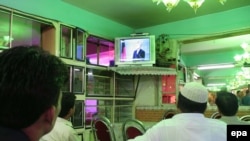
KABUL (RFE/RL) -- When the dust had settled, there was no clear winner among the three Afghan presidential candidates who participated in a live televised debate on August 16, but their participation was being celebrated as a sign of democratic progress.
The two-hour debate, in which incumbent President Hamid Karzai squared off against challengers Ashraf Ghani and Ramzan Bashardost, was broadcast live by the Afghan state television channel RTA and RFE/RL's Radio Free Afghanistan.
It was also broadcast live by seven independent Afghan TV stations and numerous radio stations across the country, making it one of the most viewed media events in recent Afghan history.
RFE/RL's Radio Free Afghanistan queried experts and everyday Afghans about their impressions of the event:
"Dr. Bashardost was speaking very critically. Dr. Ashraf Ghani was answering all the questions incisively and was putting forward concrete plans. Karzai was criticizing the problems of his own administration while proposing new initiatives."
-- Afghan analyst Nasrullah Stanekzai
"This debate laid a foundation for democratic deliberations. This was a nice initiative and as you heard from your listeners, it was widely welcomed. I hope that this discussion will not end with the debate and, whoever is elected, we will be able to remind him of his promises, so that we can see how they have acted upon their own promises. Continuous discussion and debate are critical for preserving democracy and the rule of the people."
-- Afghan parliamentarian Shukaria Barakzai
"All the candidates expressed their views. And if I can tell you the truth, I see a conflict between what these people say and do. We have seen a lot of people making tall tales, but they failed in the real world. Ramzan Bashardost does not even speak our language, but he always speaks the truth, and his hands are not stained with the blood of the innocent."
-- Kandahar resident Haji Ghulam Nabi Sayed
"This debate was very interesting. It would have been even better if Dr. Abdullah Abdullah had also participated. This was not good for him and it upset a lot of people in Afghanistan. Dr. Ashraf Ghani's pronouncements were highly informative. In second place, Karzai also said good things."
-- Kabul resident Sharafuddin Totakhel
"How can I vote? I voted in the past, but what they did for me? So why should I vote now? How can I trust them? Nobody has talked to me about my problems and the work I need so much. Nobody has talked to me about how I can have a better tomorrow free of all these problems."
-- Khair Muhammad from northeastern Badkhshan Province,
who has been forced to look for work in neighboring Kunduz
"I really liked the debate because the head of the current government participated in it. The way these candidates criticized each other is a sign of the strength of democracy and the freedom of speech in our country."
-- Noor Mohammadi, a journalism student at
Balkh University in Mazar-e Sharif
The two-hour debate, in which incumbent President Hamid Karzai squared off against challengers Ashraf Ghani and Ramzan Bashardost, was broadcast live by the Afghan state television channel RTA and RFE/RL's Radio Free Afghanistan.
It was also broadcast live by seven independent Afghan TV stations and numerous radio stations across the country, making it one of the most viewed media events in recent Afghan history.
RFE/RL's Radio Free Afghanistan queried experts and everyday Afghans about their impressions of the event:
"Dr. Bashardost was speaking very critically. Dr. Ashraf Ghani was answering all the questions incisively and was putting forward concrete plans. Karzai was criticizing the problems of his own administration while proposing new initiatives."
-- Afghan analyst Nasrullah Stanekzai
"This debate laid a foundation for democratic deliberations. This was a nice initiative and as you heard from your listeners, it was widely welcomed. I hope that this discussion will not end with the debate and, whoever is elected, we will be able to remind him of his promises, so that we can see how they have acted upon their own promises. Continuous discussion and debate are critical for preserving democracy and the rule of the people."
-- Afghan parliamentarian Shukaria Barakzai
"All the candidates expressed their views. And if I can tell you the truth, I see a conflict between what these people say and do. We have seen a lot of people making tall tales, but they failed in the real world. Ramzan Bashardost does not even speak our language, but he always speaks the truth, and his hands are not stained with the blood of the innocent."
-- Kandahar resident Haji Ghulam Nabi Sayed
"This debate was very interesting. It would have been even better if Dr. Abdullah Abdullah had also participated. This was not good for him and it upset a lot of people in Afghanistan. Dr. Ashraf Ghani's pronouncements were highly informative. In second place, Karzai also said good things."
-- Kabul resident Sharafuddin Totakhel
"How can I vote? I voted in the past, but what they did for me? So why should I vote now? How can I trust them? Nobody has talked to me about my problems and the work I need so much. Nobody has talked to me about how I can have a better tomorrow free of all these problems."
-- Khair Muhammad from northeastern Badkhshan Province,
who has been forced to look for work in neighboring Kunduz
"I really liked the debate because the head of the current government participated in it. The way these candidates criticized each other is a sign of the strength of democracy and the freedom of speech in our country."
-- Noor Mohammadi, a journalism student at
Balkh University in Mazar-e Sharif