

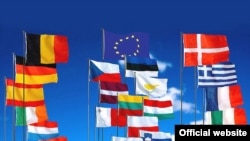
Asked by the German daily "Die Welt" if the European Union was right to take in 10 new members five years ago, EU enlargement commissioner Olli Rehn gave an answer which was as cryptic as it was revealing.
"Enlargement has led to greater stability and benefitted all parties economically," Rehn said, adding "Now we must get to know each other better and develop more understanding for one another."
On one level, matters are straightforward. Enlargement can quite uncontroversially be shown to have been a good thing all round. No one suffered in the process. There has been no mass exodus of eastern workers to the west.
True, the EU has not managed to streamline its decision-making procedures, as Rehn noted. But it was three of the old member states -- France, the Netherlands, and Ireland -- who consecutively rejected the EU's new constitution, now known as the Lisbon Treaty.
The economic case for enlargement remains strong.
"The overwhelmingly positive impact on the European internal market has proved to be the principal argument in favor of enlargement," Czech Deputy Prime Minister for European Affairs Alexandr Vondra told a celebratory conference in Prague last month. He quoted a report released by the European Commission stating that the accession of 12 new countries in 2004 and 2007 has added 0.5 percentage points to the annual GDP growth of each "old" member state and 1.75 percentage points to that of the "new" countries.
Public Questions
But the incremental accretion of economic advantage doesn't really address the whys and wherefores of enlargement as they appear in the minds of the European public. In most of the "old" European Union, the term enlargement is most often associated with the word "fatigue."
There is ample "enlargement fatigue," but no "enlargement ecstasy" or even "enlargement enthusiasm" among Western European voters.
The standard tack is to blame the public -- directly or indirectly. The public doesn't understand the benefits -- or absence of downsides -- of enlargement, or rather they have not been satisfactorily been explained to it, which amounts to the same thing.
But that explanation is far too simplistic. Among other things, it fails to explain why the public thinks the way it does about enlargement.
The problem is that EU enlargement has always been a "top-down" project. It was launched in a political decision by Western European governments in the mid-1990s, predicated on two complementary but only partially conscious impulses: the desire to right the historical wrongs of the Cold War, and a hope of stabilizing Eastern Europe. Neither motive caught the imagination of the Western public, at least not for long.
Cultural Problem
Instead, in the mid-1990s the seeds were sown of the process which eventually culminated in the French, Dutch, and Irish rejections in referendums of the EU's constitutional treaty. There is little doubt the referendums represent only the tip of the iceberg in terms of the public mood in Western Europe.
The root of the problem is cultural. The wider public in the "old" EU does not appear to accept the view ostensibly held by their governments that the common "European" denominator of the bloc -- insofar as one exists -- can be extended to (or bestowed on) countries by an act of political will. Instead, "European-ness" is overwhelmingly seen as a received identity, which represents a certain concept of society at a given time in a given place.
There is a certain parallel here with the EU's great precursor, the Roman Empire. Its expansion proceeded in discrete stages, by means of the imposition first of a new administrative and infrastructural "logic" on conquered territories, whose "Romanization" then followed incrementally, as it were, over the centuries.
'Liberal Empire'
The EU, which sometimes prides itself on being the first "liberal empire" in the world, conquers by attraction, rather than force. But it faces an essentially identical problem of assimilation. The extension of EU internal market rules and consumer rights legislation to new countries, even the lifting of borders under the Schengen Treaty, does not in and of itself make these countries "European."
On the contrary, one could argue that there exists widespread support in Western Europe for the view that "European-ness" is not a common geographical denominator but a phenomenon to which different societies in Europe have different -- and hierarchical -- access.
True, there is the sharing of sovereignty, held by one of the leading EU ideologists Robert Cooper to be definitive of a qualitatively new, "post-modern" European identity. But Cooper may be reading too much into the ceding of sovereignty inherent in the acceptance of common market rules. EU member states still jealously cling to the two main founts of thoroughly "modern" statehood: taxation -- which provides a country's finances -- remains very much a national prerogative, and foreign policy-making – the expression of the state's intentions on the international arena – is common only in name within the EU.
Solidarity, often said to be pivotal to the "European" concept of society, remains notional at best at interstate level. The EU's annual budget amounts to no more than 1 per cent of the bloc's combined annual GDP.
Roller-Coaster Ride
"Europe" remains very much a concept rooted in shared tradition. As such, it stands in stark contrast to the United States, whose centralized government is rooted in "self-legislated freedom," to quote Slovenian thinker Slavoj Zizek.
Any movement in the foreseeable future towards a more federalist European Union is precluded -- as noted by the American Oxford scholar Larry Siedentop -- by the absence in Europe both of a shared language and of the strong U.S. tradition of individual autonomy. What serious political "federalism" there exists in Europe today appears to be the function of a historically contingent self-effacing Germany.
It may have seemed five years ago (or two years ago, in the case of Romania and Bulgaria) that 10 postcommunist countries crossed a civilizational boundary by acceding to the European Union. In reality, that boundary today still runs through the EU, and cataclysms remain conceivable which could reopen old wounds and possibly even destroy the political superstructure that currently bridges the chasm between "old" and "new" Europe. Even under the best of scenarios, discounting the impact of the resurgence of Russia and the effect it is having on the stability of the EU's immediate neighbors, potential pitfalls remain legion.
Most immediately, the EU must find a way to prevent much of its east from succumbing to ghettoization as a result of the global recession. Economies from Estonia to Bulgaria are relinquishing the relative economic gains they have made over the past five to 10 years.
They once again see the gap with Western Europe living standards widen, with especially the economies of the Baltic countries slated to shrink by up to 15 percent this year alone.
The mere psychological effects of this roller-coaster ride, which saw Eastern European populations join the EU at the height of an unprecedented consumer bubble only to be plunged again into what for many will be a lifetime of servitude to a mountain of personal debt, are difficult to overstate. Unavoidably, these effects are bound to spill over into European politics, further complicating them.
The views expressed in this commentary are the author's own and do not necessarily reflect those of RFE/RL
"Enlargement has led to greater stability and benefitted all parties economically," Rehn said, adding "Now we must get to know each other better and develop more understanding for one another."
On one level, matters are straightforward. Enlargement can quite uncontroversially be shown to have been a good thing all round. No one suffered in the process. There has been no mass exodus of eastern workers to the west.
True, the EU has not managed to streamline its decision-making procedures, as Rehn noted. But it was three of the old member states -- France, the Netherlands, and Ireland -- who consecutively rejected the EU's new constitution, now known as the Lisbon Treaty.
The economic case for enlargement remains strong.
"The overwhelmingly positive impact on the European internal market has proved to be the principal argument in favor of enlargement," Czech Deputy Prime Minister for European Affairs Alexandr Vondra told a celebratory conference in Prague last month. He quoted a report released by the European Commission stating that the accession of 12 new countries in 2004 and 2007 has added 0.5 percentage points to the annual GDP growth of each "old" member state and 1.75 percentage points to that of the "new" countries.
Public Questions
But the incremental accretion of economic advantage doesn't really address the whys and wherefores of enlargement as they appear in the minds of the European public. In most of the "old" European Union, the term enlargement is most often associated with the word "fatigue."
There is ample "enlargement fatigue," but no "enlargement ecstasy" or even "enlargement enthusiasm" among Western European voters.
The standard tack is to blame the public -- directly or indirectly. The public doesn't understand the benefits -- or absence of downsides -- of enlargement, or rather they have not been satisfactorily been explained to it, which amounts to the same thing.
But that explanation is far too simplistic. Among other things, it fails to explain why the public thinks the way it does about enlargement.
The problem is that EU enlargement has always been a "top-down" project. It was launched in a political decision by Western European governments in the mid-1990s, predicated on two complementary but only partially conscious impulses: the desire to right the historical wrongs of the Cold War, and a hope of stabilizing Eastern Europe. Neither motive caught the imagination of the Western public, at least not for long.
Cultural Problem
Instead, in the mid-1990s the seeds were sown of the process which eventually culminated in the French, Dutch, and Irish rejections in referendums of the EU's constitutional treaty. There is little doubt the referendums represent only the tip of the iceberg in terms of the public mood in Western Europe.
The root of the problem is cultural. The wider public in the "old" EU does not appear to accept the view ostensibly held by their governments that the common "European" denominator of the bloc -- insofar as one exists -- can be extended to (or bestowed on) countries by an act of political will. Instead, "European-ness" is overwhelmingly seen as a received identity, which represents a certain concept of society at a given time in a given place.
There is a certain parallel here with the EU's great precursor, the Roman Empire. Its expansion proceeded in discrete stages, by means of the imposition first of a new administrative and infrastructural "logic" on conquered territories, whose "Romanization" then followed incrementally, as it were, over the centuries.
'Liberal Empire'
The EU, which sometimes prides itself on being the first "liberal empire" in the world, conquers by attraction, rather than force. But it faces an essentially identical problem of assimilation. The extension of EU internal market rules and consumer rights legislation to new countries, even the lifting of borders under the Schengen Treaty, does not in and of itself make these countries "European."
On the contrary, one could argue that there exists widespread support in Western Europe for the view that "European-ness" is not a common geographical denominator but a phenomenon to which different societies in Europe have different -- and hierarchical -- access.
True, there is the sharing of sovereignty, held by one of the leading EU ideologists Robert Cooper to be definitive of a qualitatively new, "post-modern" European identity. But Cooper may be reading too much into the ceding of sovereignty inherent in the acceptance of common market rules. EU member states still jealously cling to the two main founts of thoroughly "modern" statehood: taxation -- which provides a country's finances -- remains very much a national prerogative, and foreign policy-making – the expression of the state's intentions on the international arena – is common only in name within the EU.
Solidarity, often said to be pivotal to the "European" concept of society, remains notional at best at interstate level. The EU's annual budget amounts to no more than 1 per cent of the bloc's combined annual GDP.
Roller-Coaster Ride
"Europe" remains very much a concept rooted in shared tradition. As such, it stands in stark contrast to the United States, whose centralized government is rooted in "self-legislated freedom," to quote Slovenian thinker Slavoj Zizek.
Any movement in the foreseeable future towards a more federalist European Union is precluded -- as noted by the American Oxford scholar Larry Siedentop -- by the absence in Europe both of a shared language and of the strong U.S. tradition of individual autonomy. What serious political "federalism" there exists in Europe today appears to be the function of a historically contingent self-effacing Germany.
It may have seemed five years ago (or two years ago, in the case of Romania and Bulgaria) that 10 postcommunist countries crossed a civilizational boundary by acceding to the European Union. In reality, that boundary today still runs through the EU, and cataclysms remain conceivable which could reopen old wounds and possibly even destroy the political superstructure that currently bridges the chasm between "old" and "new" Europe. Even under the best of scenarios, discounting the impact of the resurgence of Russia and the effect it is having on the stability of the EU's immediate neighbors, potential pitfalls remain legion.
Most immediately, the EU must find a way to prevent much of its east from succumbing to ghettoization as a result of the global recession. Economies from Estonia to Bulgaria are relinquishing the relative economic gains they have made over the past five to 10 years.
They once again see the gap with Western Europe living standards widen, with especially the economies of the Baltic countries slated to shrink by up to 15 percent this year alone.
The mere psychological effects of this roller-coaster ride, which saw Eastern European populations join the EU at the height of an unprecedented consumer bubble only to be plunged again into what for many will be a lifetime of servitude to a mountain of personal debt, are difficult to overstate. Unavoidably, these effects are bound to spill over into European politics, further complicating them.
The views expressed in this commentary are the author's own and do not necessarily reflect those of RFE/RL