




Georgia's relations with the European Union and NATO have come to a near standstill.
Visits by senior Georgian officials to Brussels, once frequent and regular, have become a rare event.
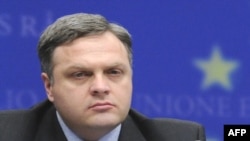
A delegation headed by Deputy Prime Minister Giorgi Baramidze visiting NATO headquarters on February 4 was the first of its kind to reach Brussels this year.
 The EU and NATO have concluded they have nothing to gain from continuing to antagonize Russia. Both organizations have taken steps to resume dialogue with Moscow, which was broken off over its conduct in Georgia -- without having secured any concessions from Russia.
The Georgian leadership appears to have acquiesced to the West's slackening resolve, now limiting its efforts to making sure the issue does not wholly disappear from the agenda.
'Pledge' Secured
After a meeting of the NATO-Georgia Commission in Brussels, Baramidze said he had secured a "pledge" from the alliance to keep Georgia on the agenda in its contacts with Russia.
"What is very important," Baramidze said, "is the pledge to keep the question of Georgia, the question of Georgia's territorial integrity and the necessity to de-occupy an inalienable part of our territory, at the very top of NATO's agenda when it comes to negotiations, discussions, or meetings with Russia."
NATO has repeatedly criticized Russia's recognition of Abkhazia and South Ossetia as independent states. An alliance spokesman recently said that Moscow would be in violation of international law if it stationed warplanes in the breakaway provinces and vessels of Russia's Black Sea Fleet in Abkhazia's ports. However, the alliance in January resumed meetings -- albeit informally -- of the NATO-Russia Council, which had been suspended since the war.
Georgia was not on the agenda of EU-Russia talks that took place in Moscow on February 6 between Russian officials and European Commission President Jose Manuel Barroso, who traveled to the Russian capital with nine of his commissioners.
The EU on February 5 did issue a statement, however, saying it is "seriously concerned" at Russian plans to build up its military presence in Abkhazia and South Ossetia. The statement, authored by the bloc's Czech Presidency, said the plans would be "a serious violation of the principle of Georgia's sovereignty and territorial integrity," and "in contradiction with the spirit of the August and September 2008 cease-fire agreements and jeopardize stability and security in the region by further increasing tensions."
This was preceded by a petition handed by the EU to the Russian Foreign Ministry in Moscow on February 2 voicing the same concerns privately.
'Docking Installation'
In late January, EU ambassadors in Brussels had raised the issue with the Russian ambassador to the EU, Vladimir Chizhov. Officials tell RFE/RL that Chizhov had sought to allay concerns, saying Russia is not building a new naval base but merely a "docking installation" for one ship.
But crucially for Tbilisi, the EU does not plan to follow up these concerns with anything more substantial.
The bloc's member states have concluded the EU stands to gain nothing from alienating Russia any further. A joint letter published in "Le Monde" on February 3 by French President Nicolas Sarkozy and German Chancellor Angela Merkel says Moscow's violation of international law in Abkhazia and South Ossetia has "created a problem of confidence with Russia" -- but nothing more.
Accordingly, debate within the bloc is limited to issues like whether a confidential petition is sufficient or should be accompanied by a public show of displeasure in the shape of a presidency declaration.
Essentially the same applies to NATO, with the crucial difference being that the European allies are keen to hear the considered view of the Obama administration.
Georgian officials are aware of these strictures.
Grigol Vashadze, Georgia's foreign minister, struck a forlorn tone on February 4, conceding Georgia is in "no position" to dictate terms to either NATO or the EU.
"We are in no position and we don't have the slightest desire to regulate NATO's or any other international organization's relationship with Russia," Vashadze said. "It's their sovereign right to have a relationship at a level they might consider necessary."
High-Water Mark
Georgia's own relationship with NATO has suffered a setback in the aftermath of the war.
The NATO-Georgia Commission, set up in September 2008, is liable to represent the high-water mark for the country's ambitions in the foreseeable future. Germany and France have ruled out putting Georgia on the path toward membership by denying it a Membership Action Plan (MAP). The new U.S. president, Barack Obama, may also find his ambition to sign new arms control agreements with Russia could involve a price when it comes to further NATO expansion, anathema to Moscow.
Baramidze said on February 4 that allies had praised Georgia's "substantial and very important progress." However, even the limited cooperation NATO is holding out to Georgia is formally on hold, as alliance sources say an alternative plan, the Annual National Program (ANP), is not expected to materialize before April.
Paradoxically, in this instance, it is not Georgia that is seen as the problem but a fellow MAP hopeful, Ukraine. Many NATO nations see Georgia and Ukraine as progressing in tandem toward NATO membership. As a result, any malaise on Ukraine's part regarding its ANP will have a knock-on effect on Georgia.
The EU, for its part, is holding out to Georgia the prospect of joining its Eastern Partnership, to be formally unveiled next month -- and limited to an eventual free-trade agreement and visa-free travel arrangements.
Visits by senior Georgian officials to Brussels, once frequent and regular, have become a rare event.
A delegation headed by Deputy Prime Minister Giorgi Baramidze visiting NATO headquarters on February 4 was the first of its kind to reach Brussels this year.

The Georgian leadership appears to have acquiesced to the West's slackening resolve, now limiting its efforts to making sure the issue does not wholly disappear from the agenda.
'Pledge' Secured
After a meeting of the NATO-Georgia Commission in Brussels, Baramidze said he had secured a "pledge" from the alliance to keep Georgia on the agenda in its contacts with Russia.
"What is very important," Baramidze said, "is the pledge to keep the question of Georgia, the question of Georgia's territorial integrity and the necessity to de-occupy an inalienable part of our territory, at the very top of NATO's agenda when it comes to negotiations, discussions, or meetings with Russia."
NATO has repeatedly criticized Russia's recognition of Abkhazia and South Ossetia as independent states. An alliance spokesman recently said that Moscow would be in violation of international law if it stationed warplanes in the breakaway provinces and vessels of Russia's Black Sea Fleet in Abkhazia's ports. However, the alliance in January resumed meetings -- albeit informally -- of the NATO-Russia Council, which had been suspended since the war.
We are in no position and we don't have the slightest desire to regulate NATO's or any other international organization's relationship with Russia. It's their sovereign right to have a relationship at a level they might consider necessary.
The EU on February 5 did issue a statement, however, saying it is "seriously concerned" at Russian plans to build up its military presence in Abkhazia and South Ossetia. The statement, authored by the bloc's Czech Presidency, said the plans would be "a serious violation of the principle of Georgia's sovereignty and territorial integrity," and "in contradiction with the spirit of the August and September 2008 cease-fire agreements and jeopardize stability and security in the region by further increasing tensions."
This was preceded by a petition handed by the EU to the Russian Foreign Ministry in Moscow on February 2 voicing the same concerns privately.
'Docking Installation'
In late January, EU ambassadors in Brussels had raised the issue with the Russian ambassador to the EU, Vladimir Chizhov. Officials tell RFE/RL that Chizhov had sought to allay concerns, saying Russia is not building a new naval base but merely a "docking installation" for one ship.
But crucially for Tbilisi, the EU does not plan to follow up these concerns with anything more substantial.
The bloc's member states have concluded the EU stands to gain nothing from alienating Russia any further. A joint letter published in "Le Monde" on February 3 by French President Nicolas Sarkozy and German Chancellor Angela Merkel says Moscow's violation of international law in Abkhazia and South Ossetia has "created a problem of confidence with Russia" -- but nothing more.
Accordingly, debate within the bloc is limited to issues like whether a confidential petition is sufficient or should be accompanied by a public show of displeasure in the shape of a presidency declaration.
Essentially the same applies to NATO, with the crucial difference being that the European allies are keen to hear the considered view of the Obama administration.
Georgian officials are aware of these strictures.
Grigol Vashadze, Georgia's foreign minister, struck a forlorn tone on February 4, conceding Georgia is in "no position" to dictate terms to either NATO or the EU.
"We are in no position and we don't have the slightest desire to regulate NATO's or any other international organization's relationship with Russia," Vashadze said. "It's their sovereign right to have a relationship at a level they might consider necessary."
High-Water Mark
Georgia's own relationship with NATO has suffered a setback in the aftermath of the war.
The NATO-Georgia Commission, set up in September 2008, is liable to represent the high-water mark for the country's ambitions in the foreseeable future. Germany and France have ruled out putting Georgia on the path toward membership by denying it a Membership Action Plan (MAP). The new U.S. president, Barack Obama, may also find his ambition to sign new arms control agreements with Russia could involve a price when it comes to further NATO expansion, anathema to Moscow.
Baramidze said on February 4 that allies had praised Georgia's "substantial and very important progress." However, even the limited cooperation NATO is holding out to Georgia is formally on hold, as alliance sources say an alternative plan, the Annual National Program (ANP), is not expected to materialize before April.
Paradoxically, in this instance, it is not Georgia that is seen as the problem but a fellow MAP hopeful, Ukraine. Many NATO nations see Georgia and Ukraine as progressing in tandem toward NATO membership. As a result, any malaise on Ukraine's part regarding its ANP will have a knock-on effect on Georgia.
The EU, for its part, is holding out to Georgia the prospect of joining its Eastern Partnership, to be formally unveiled next month -- and limited to an eventual free-trade agreement and visa-free travel arrangements.