
Friday, May 25, 2012


Features

Germany To Serbia: It's Time To Toe EU Line On Kosovo

German Foreign Minister Guido Westerwelle will look to throw the EU's weight around in Belgrade.
TEXT SIZE - +
By Daisy Sindelar
When it comes to Kosovo, Serbia and the West occupy alternate realities. Serbia continues to insist Kosovo's independence is not a done deal. The West, with growing impatience, says it is.

Guido Westerwelle, the German foreign minister, will become the latest Western diplomat to urge Serbia to leave its reality behind when he travels to Belgrade on August 26 as part of a three-day Balkans tour.

He's got more muscle than most. Germany holds the key to two issues close to Belgrade's heart -- money and its EU bid.

"Germany is the No. 1 trade partner of Serbia. It's the No.1 provider of international assistance. And it's the fourth-largest investor," says Irena Cerovic, a Serbian political analyst currently based in Berlin.

"In addition, it has a certain weight within EU decision-making," she adds. "Germany is one of the countries that is concerned about the speed of the process of enlargement, and Westerwelle has repeatedly said that it is not going to be speeded up."

UN Resolution

Westerwelle's trip -- which includes additional stops in Croatia, Bosnia-Herzegovina, and Kosovo -- was planned more than six months ago. But it falls at a pivotal moment in the long and complicated arc of Serbia-Kosovo relations, as Belgrade attempts to reopen the debate on Kosovo's status by putting forward a resolution at the UN General Assembly next month.

The resolution, which dismisses unilateral secession as an "acceptable way for resolving territorial issues," calls on the UN's 192 member states to return to the question of whether Pristina's 2008 independence declaration was legal.
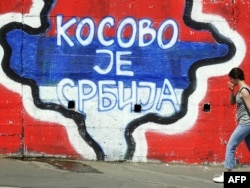
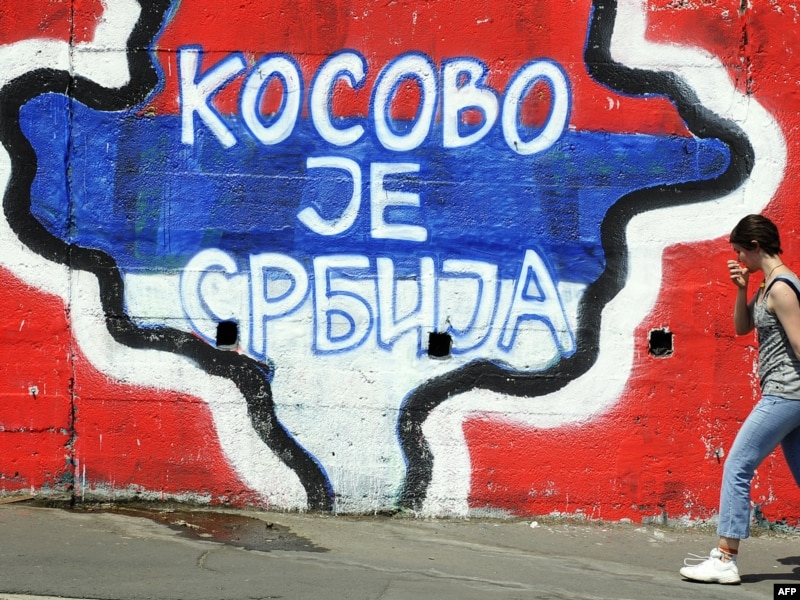
A map of Kosovo painted on a wall with the words "Kosovo is Serbia" in Belgrade.
The General Assembly, which needs to muster a two-thirds majority for a resolution to pass, is not expected to bite. For many countries, any remaining debate on the issue was closed with last month's ruling by the International Court of Justice (ICJ) supporting the declaration as legal.

Even so, the resolution has rankled many Western UN members, who see Belgrade's fixation on Kosovo as a tiresome impediment to progress in the Balkans. To that end, analysts and officials expect Westerwelle to ask Belgrade officials to soften the tone of the resolution, if not scotch it altogether.

Serbian officials have indicated they are open to talks on revising the resolution, but have flatly refused to withdraw it. Deputy Prime Minister Bozidar Djelic, in an interview earlier this week, said reaching an agreement would be the "best" outcome. But, he added, "we cannot accept the point of the document itself to be changed."

Plain Speaking

Germany -- which is among the 22 EU countries to have recognized Kosovo independence -- has yet to ratify Serbia's Stabilization and Association Agreement, a key step toward accession. Analysts say this is one example of leverage that Westerwelle could employ during his talks to persuade Belgrade officials to tone down the UN resolution.

Westerwelle's spokesman, Stephan Bredohl, told Deutsche Welle the minister "won't put too much pressure on Serbia." But he added that Germany was "very clear" on Kosovo, adding, "Germany has accepted its independence, and it's very important for us that if Serbia wants to join the European Union, it needs to be constructive and toe the EU's line."

Some pro-European Serbs would actually welcome tougher talk, since EU incentives like visa-free travel have thus far failed to inspire greater cooperation on key issues like Kosovo and the handover of Ratko Mladic to the International Criminal Tribunal for the former Yugoslavia (ICTY) in The Hague.

Andrej Nosov, the president of the Heartefact Fund, a pan-Balkan civil society foundation, says the EU has so far played the role of an indulgent parent -- and risks spoiling an already stubborn child.

"EU policy is somehow responsible for this existing mood, because EU policy has always been like, 'We have a little kid, and the kid is Serbia, and he's getting to be worse and worse in school. But we won't put pressure on him. We did that before and it didn't work. We're going to take him on a nice vacation instead' -- you know, the visa policy -- 'and then we're going to go next time and buy him a bicycle and other things,'" Nosov says.

Kosovo -- Or The EU

Serbia is not required to recognize Kosovo's independence in order to proceed with its EU bid. But its continued failure to hand over Mladic, the alleged mastermind of the 1995 Srebrenica massacre, has slowed its path toward Europe, as has what many see as its lackadaisical approach toward rudimentary reforms.

Belgrade's reluctance on such issues has prompted speculation that Serbia, having already achieved the high-priority goal of visa-free travel, may be content to live without EU membership. The steady progress of its fellow ex-Yugoslav republic Croatia, which is expected to join the EU in 2012, appears to have stirred no envy in the halls of power in Belgrade.
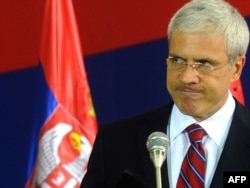
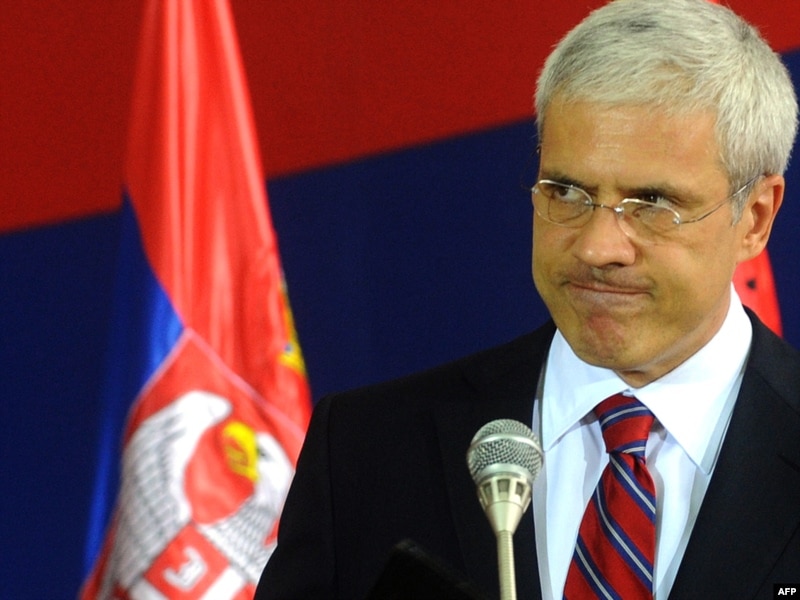
Serbia's Boris Tadic seems unlikely to risk political suicide over Kosovo.
But recent polls show that the Serbian public ranks EU membership high on its list of priorities, with Kosovo coming in far lower. Cornelius Adebahr, a Balkans expert with the German Council on Foreign Relations, says that despite outstanding issues like Mladic, the Serbian government has been disciplined in its attempts to meet EU standards.

"It's true that Serbia -- because it's such an important country in the region -- can sometimes play a card and maybe get off better than other states would," Adebahr says. "But it still has the issue of Mladic, it still has the issue of cooperation with the ICTY. It's not off the hook."

Even if Serbia's commitment to Europe remains on track, it is uncertain how far it can proceed without abandoning its preoccupation with Kosovo's status. President Boris Tadic, who rose to power on the slogan "Both Kosovo and the EU," may be reluctant to toy with the formula before Serbia's next elections, scheduled for 2012.

Analysts agree it will take an exceptionally strong politician to step forward and acknowledge that Kosovo has irreversibly broken with its past life as part of Serbian territory. Tadic, whose Democratic Party is eager to hold on to power in the face of a resurgent wave of nationalist opposition, is unlikely to be the man to make that move.

"I think that would be a good thing, and it should have been done a long time ago," Tim Judah, the Balkans correspondent for "The Economist," tells RFE/RL's Balkan Service. "But no Serbian leader has either believed that or been strong enough to do it. I think Tadic has the potential to do it. But whether he has the courage to do it -- that I don't know."

'New Reality'

Even if Serbia remains unwilling to rewrite its broad narrative on Kosovo, Westerwelle and others hoping to redirect Belgrade's attention, in the short term, to pressing pragmatic issues affecting day-to-day relations between Belgrade and Pristina. The situation of ethnic Serbs in northern Kosovo remains an issue of mutual concern; energy supplies, transportation, and border control are critical questions as well.

"Basically the Kosovo issue will stay open for many, many decades in the future," says Dusan Janjic, the coordinator of the Belgrade-based Forum for Ethnic Relations and the recent founder of a new social-democratic party. "But I'm hoping that soon will come a new leadership in Serbia which will accept the new reality. Meaning, not to say that the Kosovo issue is solved, that it's over, but basically to accept the existence of the new governmental structures in Kosovo, to accept the reality that Serbs and Albanians are neighbors and that they have to cooperate."

Something that might hasten the arrival of such a "new reality" would be additional countries recognizing Kosovo's independence. Currently, 69 countries formally recognize Kosovo. Officials in Pristina had spoken hopefully of a wave of fresh recognitions in the wake of the ICJ ruling. Some analysts, including Janjic, have speculated that a handful of countries -- including Greece, one of five EU holdouts -- may be close to adding their names to the list.

Such a move could lend dramatic momentum to Kosovo's quest for international legitimacy, including UN and EU membership. Adebahr at the German Council on Foreign Relations can't confirm an imminent move by Greece, but says it would be "more likely" than the other four holdouts to cross over.

"This would certainly change the game enormously," he says. "It may be something like the first domino of the remaining five to fall. I'm not saying that the other four would then follow suit immediately, but that would certainly change the dynamic in favor of Kosovo."

RFE/RL's Balkan Service contributed to this report

This forum has been closed.
Comment Sorting
Comments page of 2
    Next 
by: No EUphoria from: Serbia
August 25, 2010 19:23
This is a amazing piece of propaganda, driven by USA/EU interest to corner Serbia to accept second Albanian state in the Balkans. Kosovo will stay in limbo for a long time since Albanians are encouraged by the West to provoke, manipulate and irritate Serbia and Serbs with their "state". There are still more than 200 thousand Serbs internally displaced from Kosovo. In Pristina only 68 Serbs currently live from over 40 thousand before NATO occupation. Serbia will not allow creation of Great Albania neither now nor in decades. Since there's no more carrot from EU for Serbia other than empty phrases, there's no reason to bow to this blackmail. Serbia will not enter EU if EU represents a bunch of manipulating, hypocritical countries. No thank you.
In Response

by: Damir from: Slovenia
August 26, 2010 22:39
Excellent my friend, I agree 100% with you, especially you observation about carrot. Thanks and god bless you.
In Response

by: Lucas from: Bologna - Madrid
August 27, 2010 08:24
I am sorry Mr. You mention 200.000 Serbs living within Kosovo, but may I remind you that those 200.000 Serbs make less than 10% of the population of Kosovo? Who should we listen to? the minority's (the <10%) will or the majority's (90%)?
doesn't look very difficult to me!
In Response

by: BS Buster
August 27, 2010 12:57
So now areas that suddenly have a change in ethnic demography can just flat out secede with no valid opposition to consider?

How did the Albanians become a majority in that region over the past 130 years or so?

- migration from Albania (much of it that's reasonably considered as illegal)

- ethnic cleansing of non-Albanians (mostly Serbs)

- Comparatively higher birth rate than others (not a crime).

Compared to other nations with disputed land claims, the Serb historical case for Kosovo is a good one. In addition, the human rights situation in Serbia minus Kosovo appears better than Kosovo.
In Response

by: someone
August 27, 2010 16:18
If you read what he said, those 200.000 Serbs are NOT living within their homes in Kosovo. They are victims of ethnic cleansing. Listen to people whose homes and property have been there for centuries and give them back!
In Response

by: Karl from: USA
August 27, 2010 15:36
Agreed. EU/NATO/US propaganda at its best/worst. Europe has such a wonderful history of peacefully integrating ethnic minorities into its nation/states. Just ask the Polish Germans in Silesia and Pommerania, the French Alsatian Germans, the French and Spanish Basque, The German Italians of Northern Italy, ad infinitum. It seems that the EU/NATO/US have forgotten the last 100 years of their history and now feel so superior to all other regions that they demand the imposition of their territorial imperatives worldwide. The German right-wing is particularly out of touch with reality. Germany has a large Muslim minority of second class citizens. It has troops in Afghanistan. It is a major player in the "War on Terror." So why does it demand that Serbia surrender its territory to Islamic Terrorist? Why does it demand that Bosnia and Herzegovina become a "unified country" (Read accede to the domination of Bosnia by other Islamists) before gaining EU favor? Why is it that Germany, with all these truths, opposes Muslim Turkey's aaccession into the EU? Westerwelle, who obviously wants to be German Chancellor, should, as we say in the USA, STFU!
In Response

by: BS Buster
August 28, 2010 05:13
Here's a better article on the subject:

Westerwelle's Big Adventure
http://original.antiwar.com/malic/2010/08/27/westerwelles-big-adventure/


by: Pete Ludwig from: plud@aol.com
August 25, 2010 20:25
Serbia knows, as a small country how to protect its interest. Serbia endured a brutal German/Nazi occupation but was not broken. Just as Israel, Serbia will "never again" allow foreigners to control its people.
Serbia has leverage over EU that is why EU has been gentle on the Serbs. If nationalists gain power and try to take Kosovo by force-Nato will not interfere as Russia made clear it will not tolerate any military action against Serbia.
Kosovo cannot function as independent country as it depends for Serbia for trade, electricity, fuel and access to EU. Serbia has leverage and that makes Germany mad.
In Response

by: Anonymous from: USA
September 08, 2010 15:44
If nationalists gain power in Serbia and attempt to retake Kosovo by force, it would be political and military suicide for Serbia and the nationalists. Also, Russia does not have the military or economic capability to intervene against NATO military action in Serbia now anymore than it did in 1999. Russia surely wouldn't be happy, but would be left with diplomacy, threats against NATO allies closer to Russia and energy politics as options. Don't get me wrong. I have no sympathy for an independent Kosovo with its mafia government, but neither Serbia or Russia is in any position to do anything about it militarily at this time. In a few decades, who knows...

by: Sergio from: Italy
August 25, 2010 22:23
Kosovo and Metohia is a NATO occupied land and sooner or latter will have to be returned to its wright-full owner, Serbia. I hope sooner. My suggestion to the Foreign Minister of Germany is: Leave Serbia alone, haven't you Germans done too much pain to Serbian people in WWI and WWII??? Mind your business Mr. Foreign Minister.

by: Peter from: USA
August 26, 2010 01:20
If Germany is pro Kosovo let them open their borders to the Albanians.
In Response

by: bitr
August 26, 2010 18:31
Germany rightfully belongs to the Albanians.

by: BS Buster
August 26, 2010 02:01
At last notice, five EU member states refuse to acknowledge the faulty premise for Kosovo becoming separate from Serbia.

Kudos to those five states and the majority of the international community, who haven't gone along with the flawed neocon/neolib advocacy that's supported by Soros.

by: BS Buster
August 26, 2010 02:01
At last notice, five EU member states refuse to acknowledge the faulty premise for Kosovo becoming separate from Serbia.

Kudos to those five states and the majority of the international community, who haven't gone along with the flawed neocon/neolib advocacy that's supported by Soros.
In Response

by: Andrew from: Auckland
August 27, 2010 06:47
BS, I agree with the fact that an alternative solution for Kosovo should have been found, such as greater autonomy for Kosovar Albanians within a federal Serbia, rather than splitting off what is a historic part of Serbia.

However I would like to ask why you are such a hypocrite when it comes to the separatist regions in another small country, Georgia.

You seem to support Russian support and recognition of separatists who committed massive ethnic cleansing against Georgians in these two historic areas of Georgia.
In Response

by: BS Buster
August 27, 2010 13:04
No hypocrisy on my part unlike the Western neolibs, neocons and Soros, who recognize Kosovo's independence, unlike other disputed former Communst lands..

The difference has to do with how Georgia acted in August of 2008. On the other hand: since the wars of the 1990s, Moldova, Serbia and Azerbaijan have refrained from major military activity in the disputed lands they claim.

For the Russian government, this is a noticeable enough difference. The Russian recognition of Abkhazia's and South Ossetia's independence came shortly after the Georgian government strike.

That saId, I think Russia would've been arguably better off to have refrained from recognizing Abkhazia's and South Ossetia's independence.
In Response

by: Andrew from: Auckland
August 28, 2010 08:19
Well BS, you are not too well informed about what happened in the lead up to the war.

I was in Georgia in 2008, and I was watching Georgian villages get bombarded several days prior to the "Georgian government strike" when they came under mortar and artillery fire from separatist positions.

The Georgians were in a 'damned if they do, damned if they don't" position.

By the way, the IFFC report acknowledges these attacks on Georgian civilians (many of whom were ethnic Ossetians by the way) by separatists, but says Georgia should have "shown more restraint" which is rather a pathetic way of saying Georgia should let itself get slapped around by mass murderers so that the EU can have a peaceful time of things.

In addition, please note that the Georgian action was actually very restrained compared with the ethnic cleansing and mass murder committed by the separatists.

In short, you are a complete hypocrite, and a fool to boot.
In Response

by: BS Buster
August 28, 2010 09:35
Andrew

The "fool" (to use your level of discourse) is yourself.

Your claim of being in Georgia in 2008 lacks merit on what you say and don't say. Hitler was in Germany during the 1930s and and WW II era 1940s. Sane people don't readily accept his takes on his spin of what was going on in Germany and elsewhere.

Not so pro-Russian west European researchers of that situation formally conclude that the Georgian government started the 2008 war. Prior to that situation, there were limited crossfire exchanges between both sides. Before the Georgian government's strike on South Ossetia, Georgia's government was noticeably upgrading its military and making brazen claims about needing to takeover South Ossetia and Abkhazia. According to a former key aide of Saakashvili's, the Georgian president had a clear plan for attack to achieve this objective. Mind you, this former aide is considered more negative than Saakashvili in his views about Russia than the Georgian president.

Kudos to Russia for having stopped the armed Georgian government attack in a way that didn't cause as much collateral damage when compared to some other conflicts of recent note.

In short, your babbling flunks.

In Response

by: BS Buster
August 28, 2010 11:23
As a follow-up to my last set of submited comments (not yet posted as of the submission of this set of comments): seeing how someone arrogantly and ignorantly accused me of being a "hypocrite," let me once again reiterate:

No hypocrisy on my part unlike the Western neolibs, neocons and Soros, who recognize Kosovo's independence, unlike other disputed former Communst lands..

The difference has to do with how Georgia acted in August of 2008. On the other hand: since the wars of the 1990s, Moldova, Serbia and Azerbaijan have refrained from major military activity in the disputed lands they claim.

For the Russian government, this is a noticeable enough difference. The Russian recognition of Abkhazia's and South Ossetia's independence came shortly after the Georgian government strike.

That saId, I think Russia would've been arguably better off to have refrained from recognizing Abkhazia's and South Ossetia's independence.

In Response

by: Andrew from: Auckland
August 29, 2010 09:25
Really BS, you are full of it.

The Russian government was already moving towards formal recognition months prior to the war, and was already appointing Russian citizens to positions of authority in both governments.

There was the unilateral decision to open consulates in both provinces in January 2008, the provision over 20 years of advanced weaponry and training, and the propping up of separatist administrations through direct injections of cash. Russia has for the last 20 years provided around 90% of the operating budgets of both administrations.

You claim that Serbia has historic claims to Kosovo. Well Georgia has far older and just as valid claims to Abkhazia and South Ossetia.

In addition, the Russian support of ethnic cleansing of the Georgians in Abkhazia 1992-94 and the ethnic cleansing of Georgians in South Ossetia in 2008 show the real face of Russians and the vermin such as yourself that support their actions.

You also forget that the report stated that Georgia was the victim of multiple provocations from both Russia and the separatists, including armed attacks, and that Georgia DID have a legitimate right to retaliate, but should have shown more "restraint".

Tell me BS spouter, did you actually read the whole report? Like the part where it mentioned that the Russian claims about Georgian actions such as the supposed 2000 dead Ossetian civilians (actually 163) were deliberate falsifications on the part of the Russian administration, and that all of Russia's actions, bith military and political, were completely illegal.

Try learning to read BS spouter.
In Response

by: BS Buster
August 29, 2010 13:19
Unlike yourself, I'm "full of" reason and truth Andrew.

In point of fact, a number of Kremlin connected Russian foreign policy politicos were surprised by Russia's independence recognition of Abkhazia and South Ossetia. Note that the independence recognition came shortly after the Russian counterattack to the Georgian government's strike on South Ossetia. The evidence is clear on these two points.

My claim about Kosovo is correct. Abkhazia unlike Kosovo had a period in history of being its own independent entity.

Your calling others besides myself "vermin" is akin to the crude propaganda imagery carried out by Nazi and Soviet propagandists. if anything, folks like yourself are greater examples of vermin. This is exhibited by the way in which you gloss over Georgian nationalist transgressions. There's a reason why the Abkhaz and South Ossetians prefer Russia over Georgia.

As for being off on casualty claims, one can reference the bloated fatalities regarding the wars of the last decade in Bosnia and Kosovo. The Georgian government (especially Saakashvili) engaged in making things up. CNN had someone on the ground who confirmed Georgian military action which the Georgian government claimed wasn't happening.

So much for your BS.


In Response

by: Andrew from: Auckland
August 30, 2010 06:29
Come on BS spouter, Russian recognition of Abkhazian and South Ossetian "independance" was widely expected even before the war, just look at Russia's actions.

Your claim that it came as a surprise is more of your usual rubbish.

"Russia is tightening its pressure on Georgia, using its influence over Abkhazia and South Ossetia as a lever. Why, and where is Europe, asks Robert Parsons.

What does it take to persuade the European Union that what Russia is doing in Georgia's breakaway provinces of Abkhazia and South Ossetia merits more than a gentle reproach?

Moscow has been escalating its efforts to bring these territories - which broke free of Tbilisi's control in the wars of 1992-93 - even more closely under its wing. But the best Brussels has been able to muster is a brief statement from Dmitrij Rupel, the foreign minister of Slovenia, which holds the European Union's rotating presidency until July 2008. The EU, it said, would not take sides in the conflict but would work towards a peaceful solution.

Georgians can only react to such equivocation with incredulity. For since March 2008, Russia has intensified the pressure on Georgia with a series of moves that Tbilisi interprets - almost certainly correctly - as an attempt to provoke it into hasty action.

Moscow has unilaterally lifted trade sanctions on Abkhazia and South Ossetia imposed under the rubric of the post-Soviet regional body, the Commonwealth of Independent States (CIS); it has come within an ace of recognising the two territories' independence; it has increased its troop presence in Abkhazia without consulting Georgia (as it is obliged to do by the Moscow ceasefire agreement of 1994); one of its Mig-29s appears to have shot down a Georgian drone over the Black Sea; and it has threatened Georgia with military action.

Out of touch

Russia's pretext for these aggressive measures is that it is obliged to protect its citizens in Abkhazia and South Ossetia. But its concern here is fictive, for this Russian "diaspora" is an artificial creation: Moscow has spent the last few years distributing Russian passports in both areas to virtually anyone who wants one.

In any case, what would Russia protect these people from? The Russian foreign minister Sergei Lavrov has accused the Georgians of reinforcing its forces on the Abkhaz border - a claim contradicted on the ground by the United Nations Observer Mission in Georgia (Unomig), which said there was at present no evidence of such a build-up along the border or in the Kodori gorge, an area inside Abkhazia which is under the control of Georgian forces.

In light of all this, there can be little wonder that Georgia feels betrayed by Europe. The government of Mikheil Saakashvili - who won a second term as Georgia's president in the election of January 2008, four years after the "rose revolution" that swept him to power - is far from perfect; but, encouraged by the west and under the most trying of circumstances, it is seeking to lay the basis for western democratic values. In doing so, it has earned the relentless enmity of a Russia committed to its very different ideological vision of "sovereign democracy".

Europe, faced with this reality, might have been expected to offer Georgia resolute support. Instead, it is prevaricating, troubled by its conscience perhaps more concerned not to offend the Kremlin."

http://www.opendemocracy.net/article/georgia-abkhazia-russia-the-war-option
In Response

by: Andrew from: Auckland
August 30, 2010 06:42
MOSCOW “LIFTS” THE ECONOMIC SANCTIONS ON ABKHAZIA
Publication: Eurasia Daily Monitor Volume: 5 Issue: 44March 7, 2008 12:00
By: Vladimir Socor
On March 6 Russia’s Ministry of Foreign Affairs announced a unilateral decision by Russia to lift the economic sanctions against Abkhazia. The Ministry also requested the Commonwealth of Independent States Executive Committee to ask CIS member countries to lift those sanctions as well. At the same time, Russia continues to enforce its commercial embargos, transport blockades, and visa restrictions against the rest of Georgia.

In its substance, Russia’s move brings no changes to the situation on the ground in Abkhazia. Those sanctions had long become inoperative. Russia’s ongoing economic annexation of Abkhazia never stumbled against those sanctions, and it could continue henceforth even if Moscow had not erased the sanctions from the paper they are worth.

In its procedure, the move confirms Moscow’s disrespect for the CIS and arbitrary use of that cover on behalf of Russian policies. The economic sanctions on Abkhazia were based on a unanimous decision by the 12 presidents of the CIS member countries in January 1996. Under that agreement (“Decision by the Council of CIS Heads of State on Measures to Settle the Conflict in Abkhazia. Georgia”), all member countries were to ban trade, financial, transportation, communications, and other ties with Abkhazia at the state level -- that is, by ministries and state-owned entities in the member countries. Georgia’s then-president Eduard Shevardnadze persuaded Russian counterpart Boris Yeltsin to push through that decision, with genuine support from CIS member countries apprehensive about potential secessionist trends at home or in neighboring states.

It now turns out that one ministry of foreign affairs -- albeit a more equal one that the other 11 -- can unilaterally announce Russia’s withdrawal from an agreement signed by 12 presidents; and, at a still lower level, ask a CIS bureaucratic office to ask other heads of state individually to withdraw from the collective decision without further ado. Moscow has no intention to submit its proposal for approval by the same forum that took the decision in the first place -- namely, a CIS presidential summit. Russian President Vladimir Putin had such an opportunity at his February 21-22 valedictory CIS summit in Moscow, but declined.

http://www.jamestown.org/single/?no_cache=1&tx_ttnews[tt_news]=33441

In Response

by: Andrew from: Auckland
August 30, 2010 06:43
It now turns out that one ministry of foreign affairs -- albeit a more equal one that the other 11 -- can unilaterally announce Russia’s withdrawal from an agreement signed by 12 presidents; and, at a still lower level, ask a CIS bureaucratic office to ask other heads of state individually to withdraw from the collective decision without further ado. Moscow has no intention to submit its proposal for approval by the same forum that took the decision in the first place -- namely, a CIS presidential summit. Russian President Vladimir Putin had such an opportunity at his February 21-22 valedictory CIS summit in Moscow, but declined.


According to the Duma’s CIS Affairs Committee chairman Alexei Ostrovsky, Russia had to move unilaterally because certain CIS member countries, concerned about active or potential secessionism, could have blocked a collective decision to lift the sanctions on Abkhazia (Utro.ru, March 4). Ostrovsky’s committee supports the lifting and other hostile moves against Georgia.


During the years since 1996, the sanctions against Abkhazia gradually lapsed in practice, to the point of falling into oblivion both locally and internationally. During Putin’s second presidential term, sometimes with his direct encouragement from nearby Sochi, choice economic assets in Abkhazia were taken over unlawfully and often below value by Russian state and private business entities. Many of those assets belong legally to the Georgian state and to Georgian expellees who continue holding legal title to those properties.


Trade between Russia and the Abkhaz-controlled territory across the Psou River faced few impediments, other than extortion by Russian and Abkhaz troops controlling that passage for all these years. Russian arms flowed, covertly but officially authorized for the most part, to the Russian-led Abkhaz forces across the border. In one high-profile episode in 2004, Vladimir Zhirinovsky handed over to the Abkhaz a gunboat, aboard which he landed in the port of Sukhumi.


Russia handed over its citizenship en masse (and waiving the requirements of the Russian law on citizenship) to Abkhazia’s population, many of whom moved to Russia for work. When Russia imposed the ban on Georgian (and Moldovan) wine in 2006, it promptly allowed the import of wine from Abkhazia. Given Abkhazia’s small wine output, Moscow’s move was symbolic and designed to demonstrate the complete lapse of the already forgotten sanctions.


Yet Russia did use economic sanctions against Abkhazia in late 2004-early 2005 when the local population elected Sergei Bagapsh as president by a narrow margin against Raul Khajimba. Each candidate had been supported by one faction in Russia’s intelligence services. Ultimately, Moscow dictated the outcome whereby Bagapsh became “president” and Khajimba “vice-president.” But, to coerce the Abkhaz into that solution, Russia imposed an embargo on the main Abkhaz export -- namely, the locally grown citrus fruit in the winter season for Moscow and other Russian cities. Russia’s cabinet of ministers took that decision directly. However, Russian authorities did not refer to the 1996 sanctions in the context of 2004-2005. It was an ad hoc, unilateral measure, potentially repeatable without any “multilateral” CIS cover.


Both Bagapsh and Khajimba were quick to hail Moscow’s March 6 decision to lift the old sanctions. For its part, Russia’s First Deputy Minister of Foreign Affairs Andrei Denisov claims that this decision “does not change Russia’s position on Georgia’s territorial integrity” (Itar-Tass, March 6). If that position remains -- as Moscow officially insists -- that Russia recognizes that territorial integrity, then the moves on the ground in Abkhazia demonstrate how Russia can prevent a country from exercising its sovereignty, behind a purely verbal recognition of that integrity and sovereignty.
In Response

by: Andrew from: Auckland
August 30, 2010 06:50
The thing that makes you vermin, BS spreader, is that you are a genocide denier, you actively spout Serbo-Russian racist propaganda, and deny that the Serbs ever did anything wrong.

Please explain why the Croats, Bosnians, Slovenians, Albanians, and even the Macedonians cannot stay even in good neighborly relations with the Serbs?

Could it be the deliberate and planned ethnic cleansing of their people by Sebian ultra nationalists, the same scum that you hero worship.

For your information, more Ossetians live in Tbilisi than in Tshkinvali, they have a high rate of intermarriage, and serve in the Georgian Police and Military, alongside Georgians, Armenians, and Azeri's.

I personally know several who served in the Georgian armed forces in 2008, and they felt that they were liberating their home town from a racist (which it is) Russian puppet government.

You dribble on about "Georgian nationalism", have you ever actually been there? Have you ever talked to any minorities there?

I have, and I have also been on the other side of the line too, and there is no comparison between the racist apartheid style separatist administrations, and the growing democracy of the Georgian state.
In Response

by: Andrew from: Auckland
August 30, 2010 13:00
As for "full of reason and truth" well Hitler and Stalin both thought that too.

Unfortunately like them you are a proponent of racism, mass murder, ethnic cleansing, and genocide.

And you are a liar too.

From April 17 2008

III. RECENT RUSSIAN MOVES

Yesterday’s decree is the latest in a series of recent acts by Moscow that have raised profound concerns about Russia’s goals in the region. These include:

March 6: Russia withdraws from the 1996 CIS sanctions regime, which prohibits military support of the separatist regime, as well as economic and trade relations.

March 21: The Duma adopts a resolution calling on the government to consider “the expediency of recognizing the independence” of the Georgian separatist regions of Abkhazia and South Ossetia. The resolution also urges the Kremlin to intensify efforts aimed at the protection of Russian citizens in the separatist regions.

April 3: President Putin, in a letter to the two separatist leaders, vows to continue with the de facto recognition of Abkhazia and South Ossetia through means that are “not declarative, but practical”—such as the lifting of sanctions and yesterday’s establishment of legal links.

April 8: The Russian justice ministry sends a letter to its Georgian counterpart stating Moscow’s intent to “closely cooperate, hold talks, and make legal-related decisions with the Abkhaz authorities.”

IV. KEY POINTS OF THE RUSSIAN DECREE

Putin’s decree authorizes Russian state agencies to:

Cooperate with counterpart agencies in Abkhazia and South Ossetia;

Organize cooperation in trade, economic, social, scientific, and cultural areas, and include Russian regions in the process;

Define a list of documents issued by Abkhaz and South Ossetian state agencies to individuals that will be recognized by counterpart state agencies in Russia;

Recognize legal entities registered under the laws of Abkhazia and South Ossetia;

Provide legal assistance in the field of civil, family, and criminal law;

Russian Foreign Ministry local representations in the Krasnodar district (at the Abkhaz border) and in Russia’s North Ossetian Republic (at the border with South Ossetia) will perform, if necessary, consular functions by providing assistance to residents of Abkhazia and South Ossetia.
In Response

by: BS Buster
September 02, 2010 12:48

RFE/RL Editors: Please note my submitted comments on page two to this thread. I'm re-submitting the below comments in a slightly edited manner while nevertheless pointing to a hypocrisy in how Andrew initiated the kind of diatribes you now find objectionable when thrown back at him. I don't appreciate double standards. BSB

Andrew, your long winded screeds amount to empty calories.


Dmitry Babich had a detailed article in Russia Profile specifically naming Kremlin connected Russia foreign policy politicos who expressed surprise by the Russian independence recognition move, as well as indicating a not so enthusiastic support of it. I can dig that article up and provide the particulars. If i were to do so, I suspect that you would go on believing what you want to.

You overlook why South Ossetians and Abkhaz prefer Russia over Georgia. The main reason having to do with Georgian nationalist transgressions.

There's no denying that the Georgian military was being enhanced in the years prior to its strike on South Ossetia. This was done as Georgian officials spoke of the need to takeover South Ossetia and Abkhazia. As previously noted, one of Saakashvili's former key staff people said that the Georgian president had a plan for such an attack. Note that the person making this claim is if anything considered more hard-line on Russia than Saakashvili.

FYI, the Croats and Slovenians as well as the Croats and Bosnian Muslims have had issues with each other. In the Balkans, the Albanians have had issues with Greeks, Slavic Macedonians and Serbs. During the Bosnian Civil War, there were instances of Serbs, Croats and secular Muslims fighting against the fundamentalist Izetbegovic regime. Serbia minus Kosovo shows more multiethnic tolerance than Albanian dominated Kosovo and some other parts of the Balkans.

Yes, I've spoken to people of different ethnic groups from the former Georgian SSR, in addition to having studied that area - inclusive of some back and forth with academic and media people more knowledgeable, intelligent and objective than yourself. I'm therefore aware that your spin is inaccurate. On another point you raise, there're instances of different former Georgian SSR groups living peacefully together as well as the opposite.

So much for your claims.
In Response

by: Andrew from: Auckland
September 03, 2010 04:44
Really BS,

What evidence have you provided that the recognition took Russia watchers by surprise?

The posts I gave are from several months prior to the war, when western analysts were becoming increasingly concerned that Russia was going to recognize then annex the separatists, and pointed to Russia's creeping annexation policies.

Russia warned prior to the Kosovo declaration of independence that it would retaliate in kind and talked openly about Abkhazia and South Ossetia.

The Russian Duma passed a resolution as mentioned above that the Russian government should recognize Abkhazia and South Ossetia several months prior to the war.

Considering that the Duma is simply a rubber stamp for Putin, one can only see this as preparing the ground.

Your arguments are, as usual, without foundaton.
In Response

by: BS Buster
September 03, 2010 18:30
I made specific reference to the stated point of surprise among Kremlin connected Russian foreign poolicy elites. Upon request, I offered to provide further specfics from the referenced article.

As for precdictions from the West and elsewhere on such matter, they can prove wrong. In this instance, the Russian recognition primarily resulted as a reply to the Georgian government's strike on South Ossetia. That Russia was increasing its diplomatic standing in the two disputed former Georgian SSR territories before the strike on South Ossetia is moot. This can be done without the definite intention of a future independence recognition.

Hence, "your arguments are, as usual, without foundaton."


by: urnrg from: Canada
August 26, 2010 03:37
Kosovo is the Serbian gestalt.

by: Peggy from: Australia
August 26, 2010 04:11
The way I see it is that even if Kosovo is recognised by the remaining five countries there is still the rest of the world and therefore Serbia should never capitulate.
If Serbia does love Kosovo let it not be because Serbia agreed but because it was taken away by the dominant powrs of the day. Let history judge these powers of today any way fit.


by: vmd from: Canada
August 26, 2010 07:03
One major problem with this article is the continued emphasis on Serbia's "unwillingness" to hand over Mladic. This is simply not true. Even the ICTY prosecutor, Serge Brammertz, recognized Belgrade's efforts to track down and arrest Mr. Mladic (if indeed, he is currently located in Serbia). This is one of the reasons SAA has been put in effect. This article is very misleading, please pay more attention to such matters in the future.
In Response

by: BS Buster
August 26, 2010 12:44
RFE/RL's coverage of former Yugoslavia is geared in favor of overly partisan anti-Serb agendacrats.


by: jknight from: london
August 26, 2010 08:57
Germany, the USA and UK will not be satisfied until Serbia has been wiped off the map. No doubt they are lobbying for Sandzak to be given to Bosnia Hercegovina, the Presevo Valley to Kosovo / Albania and Vojvojdina - inclluding Belgrade - to Hungary
Comments page of 2
    Next 

Most Popular


Being Discussed Now

Ashton's Wardrobe Diplomacy With Iran Gets Noticed

Latest Comment (3 total)

Jay: Very interesting. It shows the length the clerical establishment can go to claim ... More

Iraq Releases Russian Bikers

Latest Comment (1 total)

Mamuka: I think these explorers should get together with the adventurers who hiked into ... More

Serbia President-Elect To Visit Brussels

Latest Comment (1 total)

Mamuka: So that's one vote for first trip to Moscow and one vote for ... More