

It's been an up-and-down year for the Nabucco natural gas pipeline.
Just as work on the long-stalled project seems set to finally begin, some shift -- usually at the hand of Russian energy giant Gazprom -- alters the commercial landscape and Nabucco's chances appear to recede.
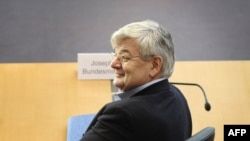
But the pipeline's supporters have just selected a big name in European politics to help push the project toward realization -- Joschka Fischer, the former head of Germany's Green Party and the country's foreign minister from 1998-2005.
Fischer faces some serious obstacles in jump-starting Nabucco -- the would-be cornerstone in Europe's drive to kick its Russian energy habit, which has failed to attract commitments from suppliers and consumers alike.
Not least among them is the fact that Nabucco's rival pipeline projects have a powerful lobbyist all their own -- Fischer's former boss, ex-Chancellor Gerhard Schroeder, who has spent four years on the payroll of Russian energy giant Gazprom.
Isn't It Ironic?
Federico Bordonaro, a senior analyst at the Italy-based security assessment group equilibri.net, says Nabucco's selection of Fischer makes sense but is still a "bit ironic."
 Former German Chancellor Gerhard Schroeder"Joschka Fischer was for a long time an important personality in Mr. Schroeder's government in Germany," Bordonaro says. "When Schroeder was chancellor of Germany, Fischer was foreign minister. And because Schroeder was appointed by the Russians as a lobbyist inside Gazprom, having Joschka Fischer on the Nabucco side is like having part of Germany with the Euro-Atlantic vision of the energy game in Eurasia -- as opposed to Schroeder's side, which is actually pro-Russian, if we want to speak in these terms."
Schroeder has been key in helping Gazprom push forward on the Nord Stream project, a natural gas pipeline that aims to eventually deliver some 55 billion cubic meters (bcm) from Russia to Germany via the Baltic Sea.
Nord Stream is due to become operational in 2011 and reach full capacity the following year. Germany -- and Schroeder -- has helped override any official resistance to the project within the European Union.
But it is another Schroeder-backed Gazprom project that presents Nabucco with its main competition -- South Stream.
Gazprom, whose frequent disputes with transit country Ukraine have it exploring alternative export routes, is hoping to use South Stream to carry a third of its gas deliveries to Europe by 2015. Under the terms of a new deal with Italy's Eni, South Stream's capacity could reach 63 bcm annually.
Russia is now actively courting supplier states like Azerbaijan, Iran, and Turkmenistan -- as well as a key transit country, Turkey -- to sign on to the South Stream project.
'Well-Established...Network'
Fischer's daunting task, as Bordonaro explains it, is to convince those countries and others to throw their support instead behind the 31-bcm-capacity Nabucco, which traverses roughly the same route and would draw on many of the same suppliers.
 Path of the Nabucco pipeline"Joschka Fischer has a vision of Europe as a federal entity. His aim has always been that of creating a strong, united Europe predicated on federalism. And also Joschka Fischer is one of the most favorable pro-Turkey members of the German political landscape," Bordonaro says.
"And because Turkey is absolutely key to the Nabucco project, I think that another big reason for appointing Mr. Fischer was his already well-established diplomatic network, contacts with Turkey but also with other southeastern European countries such as Bulgaria and Romania," he says.
Though South Stream promises to deliver twice as much gas to Europe as Nabucco, the Nabucco project still offers something the Gazprom scheme can't -- an opportunity for the EU to reduce its dependence on Russian natural gas.
Some 25 percent of the EU's gas imports already come from Russia. January's gas cutoff during a Kyiv-Moscow transit dispute served as a painful reminder to many officials in Brussels to avoid greater reliance on Russian energy.
Uphill Battle
Even so, Fischer faces an uphill battle. Several Southeastern European countries envisioned as potential Nabucco partners have already signed deals with Gazprom on South Stream.
Azerbaijan this week signed a deal to sell an unspecified amount of gas to Russia; last week another supplier, Kazakhstan, said it would have no extra gas to sell to Nabucco in the near future.
Still, there have been signs of progress. Five transit countries for the Nabucco natural gas pipeline -- Turkey, Bulgaria, Romania, Hungary, and Austria -- are due to sign an intergovernmental agreement in Ankara on July 13 to allow it to pass through their territories. Germany will also attend the signing ceremony, as an observer.
It remains to be seen whether Fischer's addition to the Nabucco team will keep the project on track for its anticipated 2014 launch date. But Bordonaro praises the appointment as a savvy and logical move -- much as Schroeder's was for Gazprom.
"The Germans have tried to become the dominant diplomatic element in Brussels and Strasbourg, and it was interesting to note in the last four or five years that many key posts in the European Union -- especially in the industrial sector and the commercial sector and financial sector -- were occupied by Germans," Bordonaro says.
"So I think that when both the Russians and the other players want to find a lobbyist, they very naturally look at Germany first. In this respect, I am not surprised that Schroeder and Fischer were the two [chosen]," he said.
Just as work on the long-stalled project seems set to finally begin, some shift -- usually at the hand of Russian energy giant Gazprom -- alters the commercial landscape and Nabucco's chances appear to recede.
But the pipeline's supporters have just selected a big name in European politics to help push the project toward realization -- Joschka Fischer, the former head of Germany's Green Party and the country's foreign minister from 1998-2005.
Fischer faces some serious obstacles in jump-starting Nabucco -- the would-be cornerstone in Europe's drive to kick its Russian energy habit, which has failed to attract commitments from suppliers and consumers alike.
Not least among them is the fact that Nabucco's rival pipeline projects have a powerful lobbyist all their own -- Fischer's former boss, ex-Chancellor Gerhard Schroeder, who has spent four years on the payroll of Russian energy giant Gazprom.
Isn't It Ironic?
Federico Bordonaro, a senior analyst at the Italy-based security assessment group equilibri.net, says Nabucco's selection of Fischer makes sense but is still a "bit ironic."

Schroeder has been key in helping Gazprom push forward on the Nord Stream project, a natural gas pipeline that aims to eventually deliver some 55 billion cubic meters (bcm) from Russia to Germany via the Baltic Sea.
Nord Stream is due to become operational in 2011 and reach full capacity the following year. Germany -- and Schroeder -- has helped override any official resistance to the project within the European Union.
But it is another Schroeder-backed Gazprom project that presents Nabucco with its main competition -- South Stream.
Gazprom, whose frequent disputes with transit country Ukraine have it exploring alternative export routes, is hoping to use South Stream to carry a third of its gas deliveries to Europe by 2015. Under the terms of a new deal with Italy's Eni, South Stream's capacity could reach 63 bcm annually.
Russia is now actively courting supplier states like Azerbaijan, Iran, and Turkmenistan -- as well as a key transit country, Turkey -- to sign on to the South Stream project.
'Well-Established...Network'
Fischer's daunting task, as Bordonaro explains it, is to convince those countries and others to throw their support instead behind the 31-bcm-capacity Nabucco, which traverses roughly the same route and would draw on many of the same suppliers.
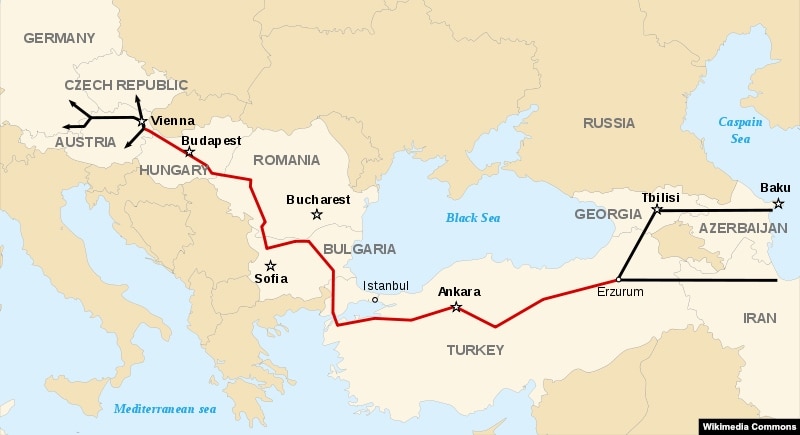
"And because Turkey is absolutely key to the Nabucco project, I think that another big reason for appointing Mr. Fischer was his already well-established diplomatic network, contacts with Turkey but also with other southeastern European countries such as Bulgaria and Romania," he says.
Though South Stream promises to deliver twice as much gas to Europe as Nabucco, the Nabucco project still offers something the Gazprom scheme can't -- an opportunity for the EU to reduce its dependence on Russian natural gas.
Some 25 percent of the EU's gas imports already come from Russia. January's gas cutoff during a Kyiv-Moscow transit dispute served as a painful reminder to many officials in Brussels to avoid greater reliance on Russian energy.
Uphill Battle
Even so, Fischer faces an uphill battle. Several Southeastern European countries envisioned as potential Nabucco partners have already signed deals with Gazprom on South Stream.
Azerbaijan this week signed a deal to sell an unspecified amount of gas to Russia; last week another supplier, Kazakhstan, said it would have no extra gas to sell to Nabucco in the near future.
Still, there have been signs of progress. Five transit countries for the Nabucco natural gas pipeline -- Turkey, Bulgaria, Romania, Hungary, and Austria -- are due to sign an intergovernmental agreement in Ankara on July 13 to allow it to pass through their territories. Germany will also attend the signing ceremony, as an observer.
It remains to be seen whether Fischer's addition to the Nabucco team will keep the project on track for its anticipated 2014 launch date. But Bordonaro praises the appointment as a savvy and logical move -- much as Schroeder's was for Gazprom.
"The Germans have tried to become the dominant diplomatic element in Brussels and Strasbourg, and it was interesting to note in the last four or five years that many key posts in the European Union -- especially in the industrial sector and the commercial sector and financial sector -- were occupied by Germans," Bordonaro says.
"So I think that when both the Russians and the other players want to find a lobbyist, they very naturally look at Germany first. In this respect, I am not surprised that Schroeder and Fischer were the two [chosen]," he said.