



(RFE/RL) -- The start of World War II in Europe is generally regarded as September 1, 1939 -- the date when German Nazi troops invaded Poland from the north, south, and west on the pretext that Poland had first attacked a radio station in Germany.
Two weeks later -- under the secret terms of a Nazi-Soviet accord, the Molotov-Ribbentrop Pact -- Soviet troops invaded and occupied eastern parts of Poland.
It was at the then-German border town of Glewitz -- now a town in Poland called Gliwice -- that the Nazis fabricated an attack on a radio station in an attempt to portray Poland as an aggressor.
Andrzej Jarczewski, a historian and the caretaker of the massive wooden radio station tower at the center of the so-called "Gliwice provocation," says that German soldiers broke into the radio station building, locked its staff in a basement and executed a Polish prisoner on site as "proof" of the false attack.
"The Gliwice provocation, which was prepared a day ahead of the start of World War II, was supposed to tell England and France that Poland was the aggressor -- because in that case, France wouldn't have to help Poland," Jarczewski says.
"According to agreements between Poland, France, and Britain, France and Britain were required, in the case of German aggression, to take action within two to three days and start a full front within 15 days," Jarczewski adds. "So the message that Poland was the aggressor would have greatly secured the Western border of Germany” against an attack by France and Britain.
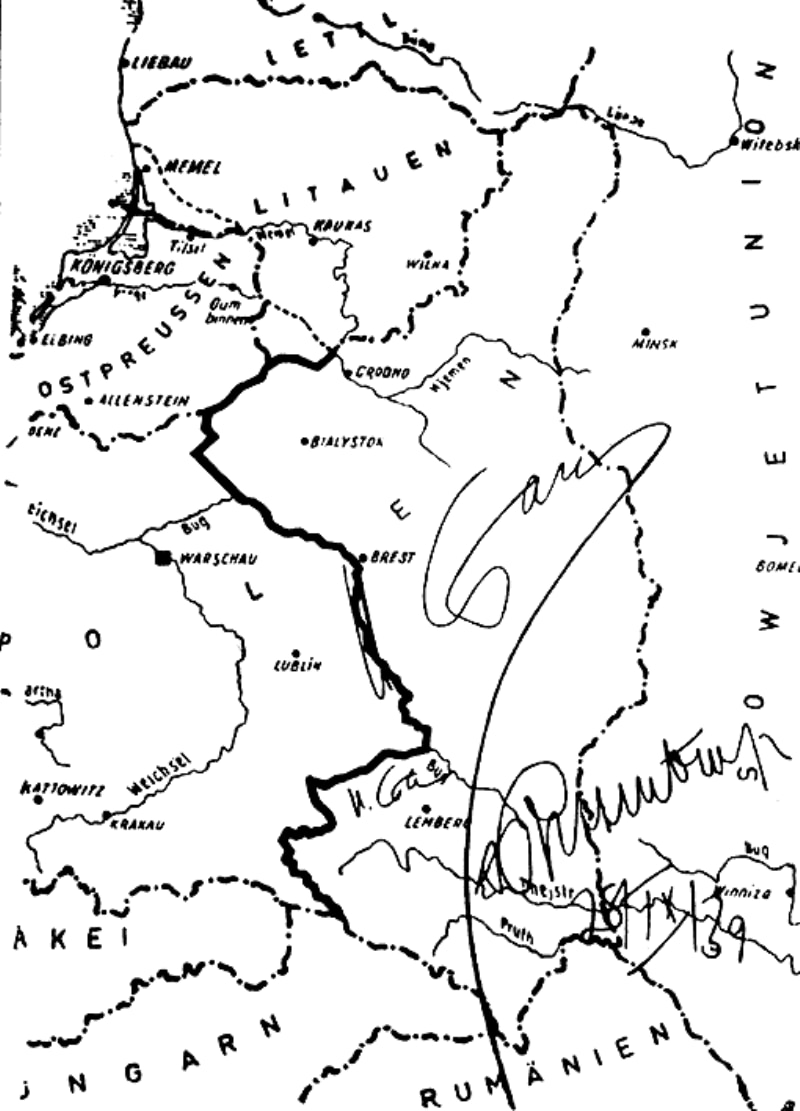
 The map of Molotov-Ribbentrop Pact's secret protocol, signed by StalinSeventy years later, the Nazi claim that Poland started World War II by attacking Germany is considered laughable. But debate continues about the role of the Molotov-Ribbentrop Pact -- including the map in its secret protocol showing how the two sides had agreed to divide Eastern Europe into Nazi and Soviet spheres of influence.
Opposing Accounts
Many in Russia today continue to believe the Soviet-era claim that Soviet troops went into Poland to help defend against the Nazi invasion rather than as part of a pre-agreed Nazi-Soviet plan.
The Kremlin continues to stress that Soviet forces played a decisive role in the defeat of the Nazis once Hitler declared war on the Soviet Union in June 1941. That was the start of what Moscow refers to as the Great Patriotic War, in which 20 million Soviet citizens were killed while fighting fascism.
Russian President Dmitry Medvedev in recent weeks has criticized those who interpret World War II as "some kind of confrontation between totalitarian systems" -- suggesting they are revisionists akin to those who deny the Holocaust.
Speaking in Israel on August 18, Medvedev said: "Our task today is to make sure that real history is not distorted for the sake of any particular political scenarios. We cannot put up with any countries casting doubt on the decisive role of the Soviet Union in the defeat of Nazism or questioning the horrors of the Holocaust."
It is within the context of these debates about history that Polish Prime Minister Donald Tusk invited Russian Prime Minister Vladimir Putin, German Chancellor Angela Merkel, and others to a commemorative ceremony in Gdansk on September 1 to mark the anniversary of the Nazi invasion.
 Polish Prime Minister Donald Tusk opens a World War II exhibition in Gdansk early on September 1.Early this morning, officials placed wreaths at the foot of the monument to the defenders of Gdansk's Westerplatte peninsula, as an honor guard looked on. The ceremony marked the exact time of the war's opening shots, when the German battleship "Schleswig-Holstein" shelled a tiny Polish military outpost where the Polish navy's arsenal was housed.
"Westerplatte is a symbol, a symbol of the heroic fight of the weaker against the stronger," said President Lech Kaczynski said. "It is proof of patriotism and an unbreakable spirit. Glory to the heroes of those days, glory to the heroes of Westerplatte, glory to all of the soldiers who fought in World War II against German Nazism, and against Bolshevik totalitarianism."
Prime Minister Donald Tusk echoed that praise, while warning of the dangers of forgetting the war's lessons.
"We meet here to remember who started the war, who the culprit was, who the executioner in the war was, and who was the victim of this aggression," Tusk said.
"We meet here to remember this, because we Poles know that without this memory, honest memory about the truth, about the sources of World War II, Poland, Europe and the world will not be safe."
Putin and Merkel will take part in commemorations later in the day.
Putin signaled in an opinion column he wrote in the August 31 edition of the Polish daily newspaper "Gazeta Wyborcza" that he will try to calm Russia's ongoing disputes with Poland about World War II.
Most significantly, Putin condemned the Molotov-Ribbentrop Pact as "immoral" and acknowledged the massacre of some 22,000 Polish military officers by the Red Army in 1940 in the Katyn Forest – an act that the Kremlin had for decades blamed on the Nazis.
Putin wrote that it is the duty of today's leaders to "remove the burden of distrust and prejudice left from the past in Polish-Russian relations."
Still, while saying that "any kind of collusion with the Nazi regime was morally unacceptable" and had no prospect of practical implementation, Putin also criticized Western historians -- saying they take individual episodes out of their historical context and apply double standards in modern politics.
Putin then goes on to blame the earlier 1938 Munich Agreement between Germany, Britain, France, and others for pushing the Soviet Union into its so-called nonaggression pact with Nazi Germany. He says it was the Munich accord that "destroyed all hope of the creation of a united front in the struggle against fascism."
Now, Putin said, it is time to "turn the page and start to write a new one."
But with Putin expected to repeat some finger-pointing at the West during his anniversary speech in Gdansk on September 1, it remains to be seen whether the Russian prime minister's remarks will help improve relations with Poland or cause relations to deteriorate further.
For her part, German Chancellor Merkel has said she will meet with Putin and other world leaders not "as enemies, but as partners."
Speaking in her latest weekly radio speech, Merkel said the Gdansk ceremony would be a day of "sorrow for the suffering" and "remembrance for the guilt that Germany acquired from the start" of the war. But she says it also will be a day of "gratitude and trust" for postwar reconciliation.
With agency reports
Two weeks later -- under the secret terms of a Nazi-Soviet accord, the Molotov-Ribbentrop Pact -- Soviet troops invaded and occupied eastern parts of Poland.
It was at the then-German border town of Glewitz -- now a town in Poland called Gliwice -- that the Nazis fabricated an attack on a radio station in an attempt to portray Poland as an aggressor.
Andrzej Jarczewski, a historian and the caretaker of the massive wooden radio station tower at the center of the so-called "Gliwice provocation," says that German soldiers broke into the radio station building, locked its staff in a basement and executed a Polish prisoner on site as "proof" of the false attack.
"The Gliwice provocation, which was prepared a day ahead of the start of World War II, was supposed to tell England and France that Poland was the aggressor -- because in that case, France wouldn't have to help Poland," Jarczewski says.
"According to agreements between Poland, France, and Britain, France and Britain were required, in the case of German aggression, to take action within two to three days and start a full front within 15 days," Jarczewski adds. "So the message that Poland was the aggressor would have greatly secured the Western border of Germany” against an attack by France and Britain.
Opposing Accounts
Many in Russia today continue to believe the Soviet-era claim that Soviet troops went into Poland to help defend against the Nazi invasion rather than as part of a pre-agreed Nazi-Soviet plan.
The Kremlin continues to stress that Soviet forces played a decisive role in the defeat of the Nazis once Hitler declared war on the Soviet Union in June 1941. That was the start of what Moscow refers to as the Great Patriotic War, in which 20 million Soviet citizens were killed while fighting fascism.
Russian President Dmitry Medvedev in recent weeks has criticized those who interpret World War II as "some kind of confrontation between totalitarian systems" -- suggesting they are revisionists akin to those who deny the Holocaust.
Speaking in Israel on August 18, Medvedev said: "Our task today is to make sure that real history is not distorted for the sake of any particular political scenarios. We cannot put up with any countries casting doubt on the decisive role of the Soviet Union in the defeat of Nazism or questioning the horrors of the Holocaust."
It is within the context of these debates about history that Polish Prime Minister Donald Tusk invited Russian Prime Minister Vladimir Putin, German Chancellor Angela Merkel, and others to a commemorative ceremony in Gdansk on September 1 to mark the anniversary of the Nazi invasion.

"Westerplatte is a symbol, a symbol of the heroic fight of the weaker against the stronger," said President Lech Kaczynski said. "It is proof of patriotism and an unbreakable spirit. Glory to the heroes of those days, glory to the heroes of Westerplatte, glory to all of the soldiers who fought in World War II against German Nazism, and against Bolshevik totalitarianism."
Prime Minister Donald Tusk echoed that praise, while warning of the dangers of forgetting the war's lessons.
"We meet here to remember who started the war, who the culprit was, who the executioner in the war was, and who was the victim of this aggression," Tusk said.
"We meet here to remember this, because we Poles know that without this memory, honest memory about the truth, about the sources of World War II, Poland, Europe and the world will not be safe."
Putin and Merkel will take part in commemorations later in the day.
Putin signaled in an opinion column he wrote in the August 31 edition of the Polish daily newspaper "Gazeta Wyborcza" that he will try to calm Russia's ongoing disputes with Poland about World War II.
Most significantly, Putin condemned the Molotov-Ribbentrop Pact as "immoral" and acknowledged the massacre of some 22,000 Polish military officers by the Red Army in 1940 in the Katyn Forest – an act that the Kremlin had for decades blamed on the Nazis.
Putin wrote that it is the duty of today's leaders to "remove the burden of distrust and prejudice left from the past in Polish-Russian relations."
Still, while saying that "any kind of collusion with the Nazi regime was morally unacceptable" and had no prospect of practical implementation, Putin also criticized Western historians -- saying they take individual episodes out of their historical context and apply double standards in modern politics.
Putin then goes on to blame the earlier 1938 Munich Agreement between Germany, Britain, France, and others for pushing the Soviet Union into its so-called nonaggression pact with Nazi Germany. He says it was the Munich accord that "destroyed all hope of the creation of a united front in the struggle against fascism."
Now, Putin said, it is time to "turn the page and start to write a new one."
But with Putin expected to repeat some finger-pointing at the West during his anniversary speech in Gdansk on September 1, it remains to be seen whether the Russian prime minister's remarks will help improve relations with Poland or cause relations to deteriorate further.
For her part, German Chancellor Merkel has said she will meet with Putin and other world leaders not "as enemies, but as partners."
Speaking in her latest weekly radio speech, Merkel said the Gdansk ceremony would be a day of "sorrow for the suffering" and "remembrance for the guilt that Germany acquired from the start" of the war. But she says it also will be a day of "gratitude and trust" for postwar reconciliation.
With agency reports