




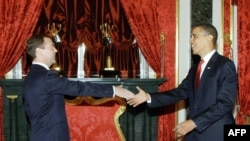
U.S. President Barack Obama took office promising to try to mend ties with Russia, part of his strategy to overhaul foreign policy by engaging countries around the world. His pledge has caused serious concern in Eastern Europe that Washington would weaken its support in favor of better relations with Moscow. It's also raised doubts Obama's policy will get the support it needs in Western Europe, where opinion on Russia is divided.
In a three-part series on U.S.-Russia relations, RFE/RL asks how the "reset" is playing on the ground and how it's affecting Europe. (See Part 2 and Part 3.)
By Gregory Feifer
The official "reset" of relations between the United States and Russia took place in July. That's when Barack Obama first traveled to Moscow to detail a policy already outlined by Vice President Joe Biden and Secretary of State Hillary Clinton.
In a speech delivered steps away from the Kremlin, the U.S. president criticized Moscow's "old assumptions," among them Russia's drive to compete with the United States by carving out an opposing sphere of influence.
"These assumptions are wrong," he said. "In 2009, a great power does not show strength by dominating or demonizing other countries. The days when empires could treat sovereign states as pieces on a chessboard are over."
But six months into his first term, it's not clear whether Obama's reset has effected any real policy change in Washington, while the Kremlin has continued ratcheting up tensions with its pro-Western neighbors.
In his speech last July, Obama singled out Georgia, the U.S. ally invaded by Russia last year in a war that sent relations with Western countries spiraling to Cold War lows.
No Trade-Offs
It was a nadir after years of deepening strain, during which Washington came to see Moscow's approach to foreign policy as a "zero-sum game," in which what's good for one country is believed to be bad for the other.
Michael McFaul, the U.S. National Security Council's senior director for Russian and Eurasian affairs, is the chief architect of Obama's Russia policy. Speaking to reporters ahead of July's summit, he said Washington had no illusions about the worldview of Russian officials.
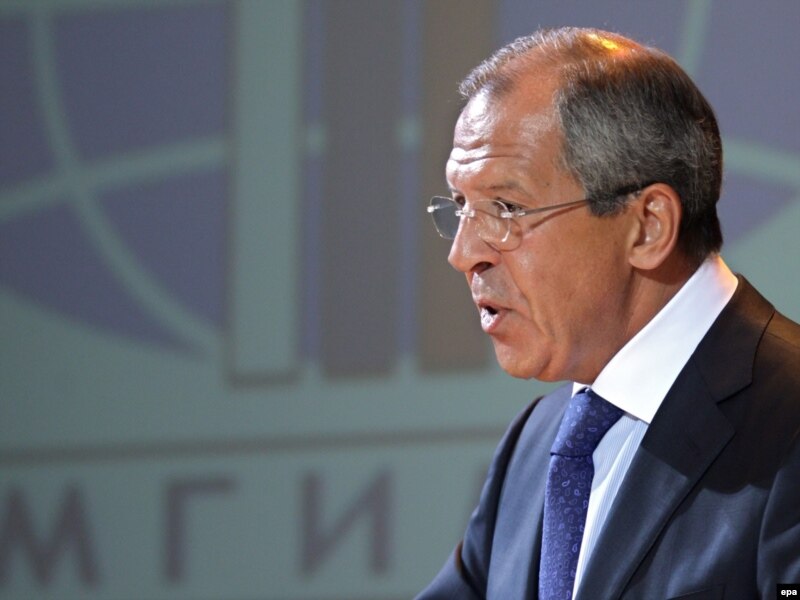
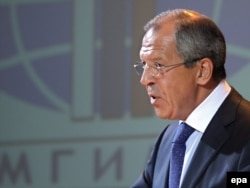 Russia's Lavrov has said relations have improved."The United States is considered an adversary," he said. "I'm sure many would use harsher words among themselves when they talk about us. And they think that our No. 1 objective in the world is to make Russia weaker, to surround Russia, to do things that make us stronger and Russia weaker."
McFaul said the United States would begin seeking to move past the current impasse in relations through a new kind of realism. Washington, he said, would present its stand on contentious issues "very explicitly," before trying to find "ways that we can have Russia cooperate on things we define as our national interests."
Among the most divisive disagreements is Russia's furious objection over the drive by pro-Western Ukraine and Georgia to join NATO. McFaul said Washington would not "reassure or give or trade anything with the Russians" over NATO expansion.
"We are not in any way, in the name of the reset, abandoning our very close relationship with these two democracies, Ukraine and Georgia," he said.
Opening Up
Obama's Russia policy is part of a wider strategy of seeking engagement with countries from Latin America to the Middle East by showing greater respect and urging that all sides can benefit more by increasing cooperation than seeking competition.
Harvard University's Marshall Goldman says the notion of a reset has already diminished tensions between Moscow and Washington. "Obama's looking at a whole range of issues from afresh," he says. "So this may be an important turning point in world history."
Russian President Dmitry Medvedev welcomed Obama's overtures during the summit in July.
"The new administration headed by President Obama is showing its willingness to change the situation and build more effective, reliable, and ultimately more modern relations," he said. "We are ready to play our part."
On September 8, Russian Foreign Minister Sergei Lavrov wrote in a newspaper article that U.S.-Russia ties had significantly improved, partly thanks to Obama's visit. "We see that the desire for confrontational policies is falling, especially in the Euro-Atlantic community," he wrote.
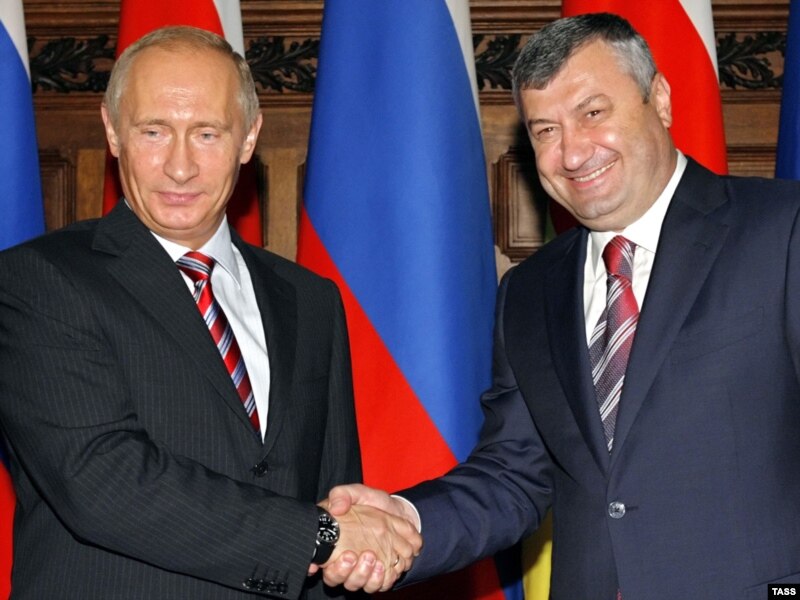
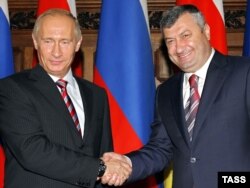 Russian Prime Minister Vladimir Putin (left) with South Ossetia leader Eduard Kokoity -- no compromise in sightBut Russia has recently taken a series of actions that are prompting doubts about Washington's ability to engage Moscow. In August, the Kremlin increased its military presence in Georgia's pro-Moscow breakaway regions, Abkhazia and South Ossetia, violating a European Union-brokered cease-fire.
Soon after, the Kremlin drafted legislation to make it easier to send troops abroad to "defend Russian citizens" and "prevent aggression against another state."
In Moscow, political analyst Kirill Rogov says Obama's charm offensive hasn't had any visible effect on relations. He says appeals to respect common values fall on deaf ears when it comes to authoritarian leaders such as Russia's.
"For them, politics is always played along zero-sum rules," he says. "That means the results of Obama's [reset] policy may be very disheartening, even though the idea itself may seem laudable."
Is Ukraine Georgia All Over Again?
Some see the Kremlin's latest actions as a dark signal of intent to take a stand over the next possible geostrategic battleground between Russia and the West: Ukraine.
Medvedev recently called for new leadership in Russia's pro-Western neighbor, prompting accusations the Kremlin wants to influence the outcome of a presidential election there next January -- and stirring speculation Moscow may be angling for a diplomatic or even military conflict.
Rogov says Russia's designs on the former Soviet republic don't end at objections to Ukraine's joining NATO.
"The Kremlin believes Ukraine must be made part of the Russian sphere of influence," he says. "That's how they understand it, and that's going to be a major problem in relations [with the United States]."
Rogov says the impasse between Washington and Moscow over what actions are permissible in Ukraine and other former Soviet republics threatens to derail Obama's reset policy.
But others in Moscow downplay Ukraine's importance, dismissing accusations the Kremlin's actions have been overly confrontational.
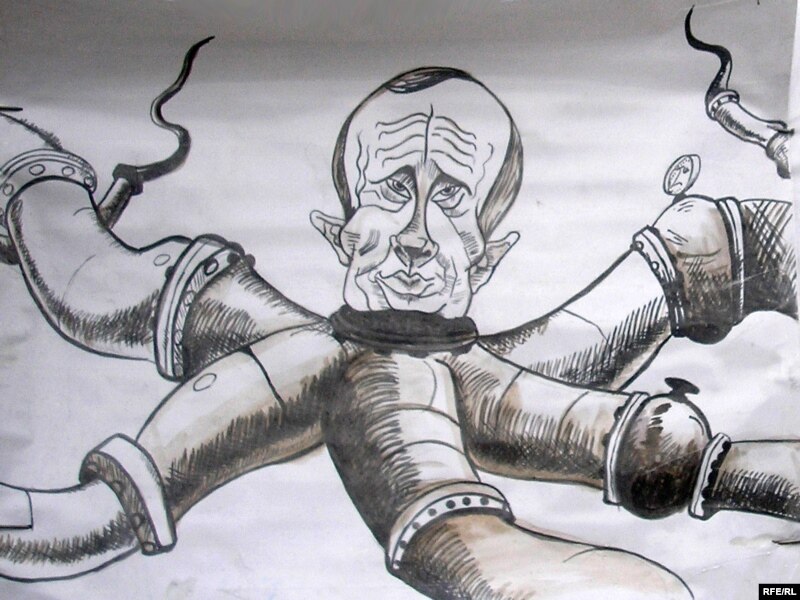
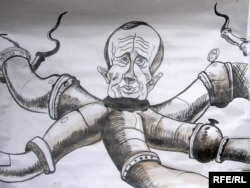 Ukrainian-Russian relations continue to be tense, especially on the issue of natural gas.Viktor Kremenyuk of Moscow's U.S.A. and Canada Institute says Russia is only addressing the security threat it sees from possible NATO expansion. He questions the Western insistence that values, not spheres of influence, should drive foreign policy. "If we shared similar values," he says, "I don't think we could have the same problems."
"We are different," Kremenyuk continues. "And this is something like a challenge, because with these different values, can we still live together? This is the real question."
Kremenyuk says any success of Obama's reset hinges on the positive outcome of talks to reach a new nuclear arms pact by the end of the year. Both sides say they want they want to sign a deal that would replace the 1991 START agreement, which expires in December.
Most analysts agree there has yet to be a confrontation or crisis in relations that would expose a difference in the way Washington interacts with Moscow. But there are serious doubts about whether the president's trip to Moscow last July really started a process that can pull relations with Russia from the depths they reached during the Bush administration.
The second part in this series looks at fears in Eastern and Central Europe that Washington will do little to fight Moscow's drive to reassert its influence in the former Soviet bloc.
In a three-part series on U.S.-Russia relations, RFE/RL asks how the "reset" is playing on the ground and how it's affecting Europe. (See Part 2 and Part 3.)
By Gregory Feifer
The official "reset" of relations between the United States and Russia took place in July. That's when Barack Obama first traveled to Moscow to detail a policy already outlined by Vice President Joe Biden and Secretary of State Hillary Clinton.
In a speech delivered steps away from the Kremlin, the U.S. president criticized Moscow's "old assumptions," among them Russia's drive to compete with the United States by carving out an opposing sphere of influence.
"These assumptions are wrong," he said. "In 2009, a great power does not show strength by dominating or demonizing other countries. The days when empires could treat sovereign states as pieces on a chessboard are over."
But six months into his first term, it's not clear whether Obama's reset has effected any real policy change in Washington, while the Kremlin has continued ratcheting up tensions with its pro-Western neighbors.
In his speech last July, Obama singled out Georgia, the U.S. ally invaded by Russia last year in a war that sent relations with Western countries spiraling to Cold War lows.
No Trade-Offs
It was a nadir after years of deepening strain, during which Washington came to see Moscow's approach to foreign policy as a "zero-sum game," in which what's good for one country is believed to be bad for the other.
Michael McFaul, the U.S. National Security Council's senior director for Russian and Eurasian affairs, is the chief architect of Obama's Russia policy. Speaking to reporters ahead of July's summit, he said Washington had no illusions about the worldview of Russian officials.
McFaul said the United States would begin seeking to move past the current impasse in relations through a new kind of realism. Washington, he said, would present its stand on contentious issues "very explicitly," before trying to find "ways that we can have Russia cooperate on things we define as our national interests."
Among the most divisive disagreements is Russia's furious objection over the drive by pro-Western Ukraine and Georgia to join NATO. McFaul said Washington would not "reassure or give or trade anything with the Russians" over NATO expansion.
"We are not in any way, in the name of the reset, abandoning our very close relationship with these two democracies, Ukraine and Georgia," he said.
Opening Up
Obama's Russia policy is part of a wider strategy of seeking engagement with countries from Latin America to the Middle East by showing greater respect and urging that all sides can benefit more by increasing cooperation than seeking competition.
Harvard University's Marshall Goldman says the notion of a reset has already diminished tensions between Moscow and Washington. "Obama's looking at a whole range of issues from afresh," he says. "So this may be an important turning point in world history."
Russian President Dmitry Medvedev welcomed Obama's overtures during the summit in July.
"The new administration headed by President Obama is showing its willingness to change the situation and build more effective, reliable, and ultimately more modern relations," he said. "We are ready to play our part."
On September 8, Russian Foreign Minister Sergei Lavrov wrote in a newspaper article that U.S.-Russia ties had significantly improved, partly thanks to Obama's visit. "We see that the desire for confrontational policies is falling, especially in the Euro-Atlantic community," he wrote.
Soon after, the Kremlin drafted legislation to make it easier to send troops abroad to "defend Russian citizens" and "prevent aggression against another state."
In Moscow, political analyst Kirill Rogov says Obama's charm offensive hasn't had any visible effect on relations. He says appeals to respect common values fall on deaf ears when it comes to authoritarian leaders such as Russia's.
"For them, politics is always played along zero-sum rules," he says. "That means the results of Obama's [reset] policy may be very disheartening, even though the idea itself may seem laudable."
Is Ukraine Georgia All Over Again?
Some see the Kremlin's latest actions as a dark signal of intent to take a stand over the next possible geostrategic battleground between Russia and the West: Ukraine.
Medvedev recently called for new leadership in Russia's pro-Western neighbor, prompting accusations the Kremlin wants to influence the outcome of a presidential election there next January -- and stirring speculation Moscow may be angling for a diplomatic or even military conflict.
Rogov says Russia's designs on the former Soviet republic don't end at objections to Ukraine's joining NATO.
"The Kremlin believes Ukraine must be made part of the Russian sphere of influence," he says. "That's how they understand it, and that's going to be a major problem in relations [with the United States]."
Rogov says the impasse between Washington and Moscow over what actions are permissible in Ukraine and other former Soviet republics threatens to derail Obama's reset policy.
But others in Moscow downplay Ukraine's importance, dismissing accusations the Kremlin's actions have been overly confrontational.
"We are different," Kremenyuk continues. "And this is something like a challenge, because with these different values, can we still live together? This is the real question."
Kremenyuk says any success of Obama's reset hinges on the positive outcome of talks to reach a new nuclear arms pact by the end of the year. Both sides say they want they want to sign a deal that would replace the 1991 START agreement, which expires in December.
Most analysts agree there has yet to be a confrontation or crisis in relations that would expose a difference in the way Washington interacts with Moscow. But there are serious doubts about whether the president's trip to Moscow last July really started a process that can pull relations with Russia from the depths they reached during the Bush administration.
The second part in this series looks at fears in Eastern and Central Europe that Washington will do little to fight Moscow's drive to reassert its influence in the former Soviet bloc.