


The children at one Sarajevo kindergarten were waiting excitedly a few days ago for Grandfather Frost to drop by with gifts and treats, as he had done for the last 50 years. But the school's director, Arzija Mahmutovic, was having none of it.
"You have to understand," she said on local television, "Muslims do not want Grandfather Frost because he has never existed in the tradition of Bosniaks...." So, instead of Grandfather Frost, Auntie New Year appeared and the kids got their goodies.
Other Sarajevo schools, though, continued to welcome Grandfather Frost, and he even participated in a demonstration on the capital's main avenue. "Grandfather Frost is an international, apolitical symbol," Sanel Huskic, who played the role at the demonstration, said. "People are attempting to further divide the citizens of Bosnia-Herzegovina along ethnic lines by kicking Grandfather Frost out of the kindergartens. We need to learn to be more tolerant. Anyone who wants Grandfather Frost should be able to have him."
How can someone like Grandfather Frost be transformed into a divisive figure? And why are important issues forgotten amid squabbling over who should hand out treats to children? The arguments about Grandfather Frost, on both sides, really have nothing to do with this tradition and everything to do with the endless discussion of history, the never-ending story of the Balkans.
Looking Behind The Titles
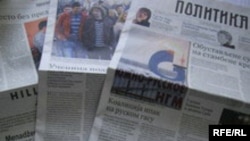
Just a glance at the titles of some of the main newspapers in the region is enough to demonstrate why these countries remain divided even as they search for their true identities. The main daily in Macedonia is "New Macedonia," reflecting the country's struggle for recognition. After all, Greece blocked Macedonia's NATO membership bid last year over the long-standing dispute between the two over Macedonia's name. Bulgaria is still offering Bulgarian passports to any Macedonian citizen. Serbia does not recognize the Macedonian Orthodox Church. And so on.
A bit to the west, the main daily in Montenegro is "Victory." Montenegrins pride themselves on being citizens of the first recognized state in Balkan history -- their 1878 independence from the Ottoman Empire having been achieved by the valor of its military. In Bosnia, the main newspaper is "Liberation." The country has always been controlled by outsiders -- either the Ottomans or the Habsburgs or, in the postwar period, by Tito's Yugoslavia. Identity is a problem there too.
In Kosovo, the leading paper is "Rebirth." Ethnic Albanians there have long cherished the dream of seeing their nation reborn. They were the first to settle the Balkan Peninsula and have been systematically pushed back ever since.
In Serbia, identity has never been an issue -- or so most Serbs think. They think in terms of governing rather than being governed and so their main daily is simply called "Politics." The main paper in Croatia -- a country that has always thought of itself as belonging more to Europe than the Balkans -- is just "News." Further north, Slovenia has always been a communications crossroads. People there could watch Austrian and Italian television even in communist times and even back then they found ways to adopt Western ways of doing things. Their main daily now is "Work."
This list of newspapers, then, from the south through the Balkans to the northwest is impressive and speaks volumes -- "New Macedonia," "Victory," "Rebirth," "Liberation," "Politics," "News," and "Work." With the exception of Slovenia, these countries are all still overshadowed to some extent by their pasts. They have no capacity for leaving history to the historians.
Nenad Pejic is an associate director of broadcasting at RFE/RL. The views expressed in this commentary are the author's own and do not necessarily reflect those of RFE/RL
"You have to understand," she said on local television, "Muslims do not want Grandfather Frost because he has never existed in the tradition of Bosniaks...." So, instead of Grandfather Frost, Auntie New Year appeared and the kids got their goodies.
Other Sarajevo schools, though, continued to welcome Grandfather Frost, and he even participated in a demonstration on the capital's main avenue. "Grandfather Frost is an international, apolitical symbol," Sanel Huskic, who played the role at the demonstration, said. "People are attempting to further divide the citizens of Bosnia-Herzegovina along ethnic lines by kicking Grandfather Frost out of the kindergartens. We need to learn to be more tolerant. Anyone who wants Grandfather Frost should be able to have him."
How can someone like Grandfather Frost be transformed into a divisive figure? And why are important issues forgotten amid squabbling over who should hand out treats to children? The arguments about Grandfather Frost, on both sides, really have nothing to do with this tradition and everything to do with the endless discussion of history, the never-ending story of the Balkans.
Looking Behind The Titles
Just a glance at the titles of some of the main newspapers in the region is enough to demonstrate why these countries remain divided even as they search for their true identities. The main daily in Macedonia is "New Macedonia," reflecting the country's struggle for recognition. After all, Greece blocked Macedonia's NATO membership bid last year over the long-standing dispute between the two over Macedonia's name. Bulgaria is still offering Bulgarian passports to any Macedonian citizen. Serbia does not recognize the Macedonian Orthodox Church. And so on.
A bit to the west, the main daily in Montenegro is "Victory." Montenegrins pride themselves on being citizens of the first recognized state in Balkan history -- their 1878 independence from the Ottoman Empire having been achieved by the valor of its military. In Bosnia, the main newspaper is "Liberation." The country has always been controlled by outsiders -- either the Ottomans or the Habsburgs or, in the postwar period, by Tito's Yugoslavia. Identity is a problem there too.
In Kosovo, the leading paper is "Rebirth." Ethnic Albanians there have long cherished the dream of seeing their nation reborn. They were the first to settle the Balkan Peninsula and have been systematically pushed back ever since.
In Serbia, identity has never been an issue -- or so most Serbs think. They think in terms of governing rather than being governed and so their main daily is simply called "Politics." The main paper in Croatia -- a country that has always thought of itself as belonging more to Europe than the Balkans -- is just "News." Further north, Slovenia has always been a communications crossroads. People there could watch Austrian and Italian television even in communist times and even back then they found ways to adopt Western ways of doing things. Their main daily now is "Work."
This list of newspapers, then, from the south through the Balkans to the northwest is impressive and speaks volumes -- "New Macedonia," "Victory," "Rebirth," "Liberation," "Politics," "News," and "Work." With the exception of Slovenia, these countries are all still overshadowed to some extent by their pasts. They have no capacity for leaving history to the historians.
Nenad Pejic is an associate director of broadcasting at RFE/RL. The views expressed in this commentary are the author's own and do not necessarily reflect those of RFE/RL