



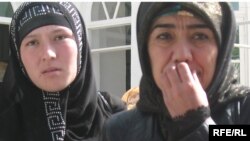
Iranian-American Azadeh Moaveni is the author of the best-selling memoirs "Honeymoon in Tehran" and "Lipstick Jihad." She spoke to RFE/RL correspondent Kristin Deasy about Iran's strict Islamic dress code on one hand, and the banning of Islamic headscarves in Uzbekistan on the other.
RFE/RL: Do you think that a lot of the politics related to Islamic dress are related to a "state project" in Iran, and possibly elsewhere?
Azadeh Moaveni: In Iran it's a very unique situation where you have the state trying to impose this revolutionary Islamic ideology from above, over a population that is much more secular and sophisticated to simply accept this or to identify with it. Iran is very unique in the Islamic world in this way. I think in much of the rest of the Islamic world you have a lot of secular regimes who are in many cases indifferent to how women dress and you have women, socially, becoming more conservative and taking the lead in wearing more conservative forms of hijab, whereas in Iran it's very much the opposite-it's the state imposing it from above, because this is certainly the project of the revolution, to create sort of model Islamic citizens.
RFE/RL: Does this put moderate religious women who defend modest wear but want to distance themselves from a state policy in a bit of an awkward position?
Moaveni: I think even many religious women are democratically-minded and open-minded enough not to want the state to impose religious dress for women who don't wish to wear it. So I think it's one of the issues that where women, secular [and] religious, spanning a lot of different backgrounds of belief and culture in Iran, agree that this is something that should be up to the individual woman. And I think there's a lot of comfort in the Iranian women's movement with looking at it that way.
RFE/RL: In Uzbekistan, they've gone the opposite route and are banning headscarves from schools. Is there so much frustration with the imposition of the headscarf in Iran that women there would see the new rule in Uzbekistan as a good thing?
Moaveni: Well, Iran has gone through many stages of all of this. Reza Shah, in the early part of the twentieth century, banned the wearing of the hijab in Iran as part of a state westernization and modernization project. And that created a lot of backlash. It's become very clear through...historical experience that neither really works because it's artificial, and imposes a sort of state agenda on what women are wearing.
I think that Iran has come a long way. I think that people realize that it needs to be an individual choice and that's really the only healthy, practical and long-term option. I mean, I'm sure there's a fringe of very secular women are so angry at having the hijab imposed on them for 30 years that they would say, yes, you know, that's fantastic that in Turkey and Uzbekistan, you know, they're banning it because there are people who feel that the state has to [...] keep Islam out of public life. But again, I think that would be a fringe. I think that most people are now aware, from real-life sort of experiences in the last century, that it's not a lasting solution, it's just going to create a backlash, it's going to be unstable. It's going to be unstable, culturally, to impose something one way or the other. The society, and the culture, needs to work it out.
RFE/RL: And in your view, what is the reason that, of all things, Islamic dress, women's dress, has become such a politicized issue in the last decade?
Moaveni: I think that Islam has a unique and very specific set -- a controversial set -- of prescriptions on how women should dress and behave. And I think that political Islam has made a point of working out a lot of its political and ideological issues through the issue of hijab. So a lot of times it's about other things, but it's an ideological project for the expansion of Shi'ism, or it's a very ambitious and a very pious fundamentalist agenda and part of that has to be, in a way, imposing a very conservative form of dress and women have to be part and parcel of that. Because in the strictest sense of Islamic ideology, you can't demolish the sort of buddhas of Afghanistan and wage jihad and let your women, you know, uncover their hair.
So I think it's very often a male, extremist political agenda that just has to have this sort of element along with it, unfortunately. I think a lot of the Arab Middle East women are taking up more Islamic dress independently as a way of sort of signaling their anger toward the West, you know sort of retreating into sort of a very pious version of Islam to sort of express their defiance and anger toward Western policies in the region, in their country and in Israel and Palestine, et cetera.
RFE/RL: Are twentysomethings in Iran seeing imposed Islamic fashion differently? Are they dressing differently?
Moaveni: I think that young Iranian women are more willing to experiment with Islamic dress because it's the only thing that's available to them, they're young, they want to look beautiful, they want to express themselves, their individuality, and so they do this through, you know, colorful hijab, and different kinds of tunics, and these sorts of things.
I think my mother's generation tends to be much more conservative there were a lot of women before the revolution who did not wear hijab and never felt as though they could sort of claim this as their own and experiment with it. I think that idea is very alien to them. They just wear a very staid or simple sort of headcovering -- what they need to go outside -- because to them, wearing sort of 'fashionable' Islamic dress is possibly abhorrent, because they reject the idea so entirely that they're not willing to even individualize it and create their own sort of style within it. I think that has fallen to the younger generation, who doesn't know anything else.
RFE/RL: Do you think that a lot of the politics related to Islamic dress are related to a "state project" in Iran, and possibly elsewhere?
Azadeh Moaveni: In Iran it's a very unique situation where you have the state trying to impose this revolutionary Islamic ideology from above, over a population that is much more secular and sophisticated to simply accept this or to identify with it. Iran is very unique in the Islamic world in this way. I think in much of the rest of the Islamic world you have a lot of secular regimes who are in many cases indifferent to how women dress and you have women, socially, becoming more conservative and taking the lead in wearing more conservative forms of hijab, whereas in Iran it's very much the opposite-it's the state imposing it from above, because this is certainly the project of the revolution, to create sort of model Islamic citizens.
RFE/RL: Does this put moderate religious women who defend modest wear but want to distance themselves from a state policy in a bit of an awkward position?
Moaveni: I think even many religious women are democratically-minded and open-minded enough not to want the state to impose religious dress for women who don't wish to wear it. So I think it's one of the issues that where women, secular [and] religious, spanning a lot of different backgrounds of belief and culture in Iran, agree that this is something that should be up to the individual woman. And I think there's a lot of comfort in the Iranian women's movement with looking at it that way.
RFE/RL: In Uzbekistan, they've gone the opposite route and are banning headscarves from schools. Is there so much frustration with the imposition of the headscarf in Iran that women there would see the new rule in Uzbekistan as a good thing?
Moaveni: Well, Iran has gone through many stages of all of this. Reza Shah, in the early part of the twentieth century, banned the wearing of the hijab in Iran as part of a state westernization and modernization project. And that created a lot of backlash. It's become very clear through...historical experience that neither really works because it's artificial, and imposes a sort of state agenda on what women are wearing.
I think that Iran has come a long way. I think that people realize that it needs to be an individual choice and that's really the only healthy, practical and long-term option. I mean, I'm sure there's a fringe of very secular women are so angry at having the hijab imposed on them for 30 years that they would say, yes, you know, that's fantastic that in Turkey and Uzbekistan, you know, they're banning it because there are people who feel that the state has to [...] keep Islam out of public life. But again, I think that would be a fringe. I think that most people are now aware, from real-life sort of experiences in the last century, that it's not a lasting solution, it's just going to create a backlash, it's going to be unstable. It's going to be unstable, culturally, to impose something one way or the other. The society, and the culture, needs to work it out.
RFE/RL: And in your view, what is the reason that, of all things, Islamic dress, women's dress, has become such a politicized issue in the last decade?
Moaveni: I think that Islam has a unique and very specific set -- a controversial set -- of prescriptions on how women should dress and behave. And I think that political Islam has made a point of working out a lot of its political and ideological issues through the issue of hijab. So a lot of times it's about other things, but it's an ideological project for the expansion of Shi'ism, or it's a very ambitious and a very pious fundamentalist agenda and part of that has to be, in a way, imposing a very conservative form of dress and women have to be part and parcel of that. Because in the strictest sense of Islamic ideology, you can't demolish the sort of buddhas of Afghanistan and wage jihad and let your women, you know, uncover their hair.
So I think it's very often a male, extremist political agenda that just has to have this sort of element along with it, unfortunately. I think a lot of the Arab Middle East women are taking up more Islamic dress independently as a way of sort of signaling their anger toward the West, you know sort of retreating into sort of a very pious version of Islam to sort of express their defiance and anger toward Western policies in the region, in their country and in Israel and Palestine, et cetera.
RFE/RL: Are twentysomethings in Iran seeing imposed Islamic fashion differently? Are they dressing differently?
Moaveni: I think that young Iranian women are more willing to experiment with Islamic dress because it's the only thing that's available to them, they're young, they want to look beautiful, they want to express themselves, their individuality, and so they do this through, you know, colorful hijab, and different kinds of tunics, and these sorts of things.
I think my mother's generation tends to be much more conservative there were a lot of women before the revolution who did not wear hijab and never felt as though they could sort of claim this as their own and experiment with it. I think that idea is very alien to them. They just wear a very staid or simple sort of headcovering -- what they need to go outside -- because to them, wearing sort of 'fashionable' Islamic dress is possibly abhorrent, because they reject the idea so entirely that they're not willing to even individualize it and create their own sort of style within it. I think that has fallen to the younger generation, who doesn't know anything else.