


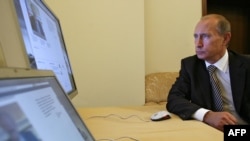
A new study is warning that the rights of people who use the Internet are increasingly at risk, with governments -- both repressive and democratic -- expanding their ability to monitor, censor, and punish Internet users.
The report, called "Freedom on the Net," was conducted by the Washington-based NGO Freedom House and was released at a conference of more than 1,000 bloggers in Berlin on April 1. The study examines barriers to access, limitations on content, and violations of users' rights in 15 countries during 2007 and 2008.
"What we've seen is that governments, particularly in repressive countries, are increasingly taking measures not only to censor content, but also to limit access to the technologies -- to control them, to shape some of the discussions," Robert Guerra, the project manager for Freedom House's Internet Freedom programs, tells RFE/RL. "And [they're] also trying to create points of view on the Internet and on forums that [are] very pro-government."
In 11 countries, online political content was targeted at least once during the time period covered in the study. Six countries sentenced bloggers to prison and five introduced new legislation to restrict online content. Methods of censorship and control were identified in every country.
Cuba received the lowest score in the study because of what Freedom House said was Havana's "near total control" over Internet access. Along with Iran, China, and Tunisia, Cuba received a ranking of "not free."
Pursuing Individual Users
The managing editor of the Freedom House study, Karin Karlekar, said Iran uses a wide variety of tools to limit citizens’ use of the Internet.
"Iran is one of the countries in the study which does employ the sort of systematic technical [content] filtering through the [Internet Service Providers)," Karlekar says. "It's one the countries that focuses on limiting broadband usage in order to cut down on the amount of videos or large amounts of content that people can download. And Iran also focuses on going after individual users."
The report says Iran uses intimidation, detention, and torture on bloggers. In 2008, Iranian authorities detained and questioned more than a dozen bloggers, and a bill to permit the death penalty for online activities has passed its first hurdle in the country’s parliament.
Omidreza Mirsayafi, an Iranian blogger, died on March 18 in Iran's Evin prison, where he had been jailed for allegedly insulting Iran's religious leaders and agitating against the government. Authorities say his death was a suicide, but watchdog groups have called for an independent inquiry.
Chinese authorities recently blocked the video sharing website "YouTube" after a video was posted that claimed to show a police officer fatally beating a Tibetan protester.
Along with Egypt, India, Kenya, Malaysia, and Turkey, Russia and Georgia both received a ranking of "partly free."
Behind The Scenes
According to the report, Russian authorities don't engage in significant site blocking or filtering, but they are increasingly removing content behind the scenes.
There has also been a rise in attacks and criminal cases targeting bloggers in Russia, Freedom House says, and the government is increasingly manipulating online discussion by funding its own propaganda websites.
In Georgia, where the Internet community is growing slowly, Karlekar said the war with Russia last August hurt online freedom.
"The war with Russia affected Internet freedom in terms of websites being shut down, and then also sort of systematic technical attacks against websites," Karlekar says. "That was one of the main issues in Georgia. Otherwise, the main limitations seen are more on the access on the infrastructure side."
Brazil, Britain, Estonia, and South Africa were ranked "free," but the study revealed that the situation in all four countries is far from perfect.
In Britain, for instance, Freedom House says there are growing concerns about the widespread retention of user data by service providers and the permissive environment for "libel tourism." That’s where individuals -- usually from authoritarian countries -- are allowed to sue authors whose work is available in Britain, whether in print or online.
The report does contain some good news.
With the exception of Britain, Internet freedom is more widespread than press freedom, especially in Russia and Georgia.
And in repressive states, Freedom House found that civic activism via the Internet is on the rise.
"Bloggers, activists are using the Internet for example to organize campaigns, to spread uncensored information," Karlekar says. "In Iran, several groups have used the Internet to sort of put forward ideas, or start campaigns, or petitions. So that's been a very positive source for openness and we see that probably continuing in the future."
The study found cases of citizens fighting back against government control with blogs that employ code words in place of sensitive keywords that might be picked up by censors, and with protests and advocacy groups organized through social networking sites like Facebook.
The report, called "Freedom on the Net," was conducted by the Washington-based NGO Freedom House and was released at a conference of more than 1,000 bloggers in Berlin on April 1. The study examines barriers to access, limitations on content, and violations of users' rights in 15 countries during 2007 and 2008.
"What we've seen is that governments, particularly in repressive countries, are increasingly taking measures not only to censor content, but also to limit access to the technologies -- to control them, to shape some of the discussions," Robert Guerra, the project manager for Freedom House's Internet Freedom programs, tells RFE/RL. "And [they're] also trying to create points of view on the Internet and on forums that [are] very pro-government."
In 11 countries, online political content was targeted at least once during the time period covered in the study. Six countries sentenced bloggers to prison and five introduced new legislation to restrict online content. Methods of censorship and control were identified in every country.
Cuba received the lowest score in the study because of what Freedom House said was Havana's "near total control" over Internet access. Along with Iran, China, and Tunisia, Cuba received a ranking of "not free."
Pursuing Individual Users
The managing editor of the Freedom House study, Karin Karlekar, said Iran uses a wide variety of tools to limit citizens’ use of the Internet.
"Iran is one of the countries in the study which does employ the sort of systematic technical [content] filtering through the [Internet Service Providers)," Karlekar says. "It's one the countries that focuses on limiting broadband usage in order to cut down on the amount of videos or large amounts of content that people can download. And Iran also focuses on going after individual users."
[Iran is] one the countries that focuses on limiting broadband usage in order to cut down on the amount of videos or large amounts of content that people can download. And Iran also focuses on going after individual users.
Omidreza Mirsayafi, an Iranian blogger, died on March 18 in Iran's Evin prison, where he had been jailed for allegedly insulting Iran's religious leaders and agitating against the government. Authorities say his death was a suicide, but watchdog groups have called for an independent inquiry.
Chinese authorities recently blocked the video sharing website "YouTube" after a video was posted that claimed to show a police officer fatally beating a Tibetan protester.
Along with Egypt, India, Kenya, Malaysia, and Turkey, Russia and Georgia both received a ranking of "partly free."
Behind The Scenes
According to the report, Russian authorities don't engage in significant site blocking or filtering, but they are increasingly removing content behind the scenes.
There has also been a rise in attacks and criminal cases targeting bloggers in Russia, Freedom House says, and the government is increasingly manipulating online discussion by funding its own propaganda websites.
In Georgia, where the Internet community is growing slowly, Karlekar said the war with Russia last August hurt online freedom.
"The war with Russia affected Internet freedom in terms of websites being shut down, and then also sort of systematic technical attacks against websites," Karlekar says. "That was one of the main issues in Georgia. Otherwise, the main limitations seen are more on the access on the infrastructure side."
Brazil, Britain, Estonia, and South Africa were ranked "free," but the study revealed that the situation in all four countries is far from perfect.
In Britain, for instance, Freedom House says there are growing concerns about the widespread retention of user data by service providers and the permissive environment for "libel tourism." That’s where individuals -- usually from authoritarian countries -- are allowed to sue authors whose work is available in Britain, whether in print or online.
The report does contain some good news.
With the exception of Britain, Internet freedom is more widespread than press freedom, especially in Russia and Georgia.
And in repressive states, Freedom House found that civic activism via the Internet is on the rise.
"Bloggers, activists are using the Internet for example to organize campaigns, to spread uncensored information," Karlekar says. "In Iran, several groups have used the Internet to sort of put forward ideas, or start campaigns, or petitions. So that's been a very positive source for openness and we see that probably continuing in the future."
The study found cases of citizens fighting back against government control with blogs that employ code words in place of sensitive keywords that might be picked up by censors, and with protests and advocacy groups organized through social networking sites like Facebook.

