





The streets of Tehran have gone quiet for the first time in more than 10 days. Instead of gathering in downtown squares by the tens or even hundreds of thousands, the protesters appear now to have been forced off the streets.
The last gathering, on June 22, saw just a few hundred assemble. The protest was quickly broken up with tear gas and shots in the air as helicopters hovered overhead.
Still more fearsome for those who dared to come out may have been the silhouettes of sharpshooters in the windows of nearby buildings and policemen taking pictures of the crowd. The pictures have been used by police for arrests after rallies have ended.
By official count, 17 people have died since the protests broke out immediately following the June 12 presidential election. State radio has said that some 457 people were arrested on June 20, when the confrontations between the protesters and the police and paramilitary Basij militia were fiercest.
Now, the government is raising the stakes for the protesters still higher by showing some of those who have been arrested on state television.
Public Confessions
On June 23, the television showed one detainee confessing to what amounts to collaboration with foreign powers against the Iranian state.
"I think we were provoked by networks like the BBC and VOA [Voice of America] to take such immoral actions," the young man said. His face was shown but he was not identified by name.
Similarly, a woman was shown saying she, too, "was influenced by VOA Persian [service] and the BBC because they were saying that the security forces were behind most of the clashes."
She said that after that "I was curious, I wanted to go out and see what was happening. I saw that it was us protesting who were making the riots. We set on fire public property, we threw stones, we attacked people's cars and we broke windows of people's houses."
 The arrested protesters claimed they were motivated by foreign broadcasts.
Her face was pixilated on the screen and her name wasn't given.
Iranian Interior Minister Sadeq Mahsuli said that rioters involved in postelection violence were funded by the CIA and the exiled opposition group the People's Mujahedin, or Mujahedin-e Khalq Organization.
The aired statements from the detainees come as a senior judiciary official said on June 23 that the legal system would make an example of those who had been caught.
"Those arrested in recent events will be dealt with in a way that will teach them a lesson," Ebrahim Raisi said.
Raisi said a special court had been set up to deal with the protesters. In Iran "special" courts often refers to revolutionary courts, which are tribunals outside of the usual civil court system.
Trials in revolutionary courts are behind closed doors and conducted by a single clerical judge who takes on the combined roles of prosecutor, defense lawyer, and jury. Sentences are usually multiple years in prison.
The judiciary, a conservative bastion, routinely brought reformist activists before such courts during the sharp conservative backlash that crippled the presidency of reformist Mohammad Khatami.
Avoiding Direct Confrontation
Raising the stakes further, Iran's best-trained and best equipped military force, the Islamic Revolution Guard Corps (IRGC), threatened on June 23 to intervene directly. Until now, crowd control has been left to the police and the Revolutionary Guard's subsidiary, the Basij militia.
 Will the protesters confront the security forces again?A statement on the Revolutionary Guard's website said protesters should "be ready for the decisive and revolutionary confrontation" with the IRGC, Basij, and other security forces. The IRGC is the political wing of the military, meaning that military force would be used against fresh protests.
Meanwhile, the intelligence department of the police has urged citizens to help officers identify leaders of protests.
With previous rally sites in Tehran now sealed off by police, the demonstrations against the presidential election results are moving toward safer forms of protests.
Nightly in Tehran, people go to their rooftops at dusk to shout their discontent. The slogan is "Allahu Akbar" (God is great), a watchword of the 1979 Islamic Revolution. The police are unable to move against those shouting because for decades the words have been used as an expression of loyalty to Iran's theocratic system.
Similarly, opposition protests are taking the form of turning on car lights simultaneously at a given time of day.
Backroom Battle For Power
The task for the government now is how to push the protesters completely out of sight.
The strategy is likely to focus on putting increased pressure on opposition leader Mir Hossein Musavi.
The editor of Musavi's newspaper, "Kalemeh Sabz" (Green Word) said that police have arrested 25 journalists and other staff. The paper was shut down about 10 days ago by officials.
On June 23, the head of the conservative parliament's Judiciary Committee, Ali Shahrokhi, said Musavi's call for "illegal protests" were "criminal acts."
Musavi, a former prime minister and a loyalist of Iran's theocracy, has insisted that peaceful protests are allowed under the Islamic republic's constitution.
Musavi's wife, Zahra Rahnavard, was quoted on her website as calling on the security forces to immediately release those detained at the election protests. She also said it is "my duty to continue legal protests to preserve Iranian rights."
The conservatives have also fired warning shots at a senior backer of Musavi, former President Akbar Hashemi Rafsanjani. Security forces briefly arrested four of Rafsanjani's female relatives over the weekend, including his daughter Faezeh, who has appeared at Musavi's rallies.
State television quoted Supreme Leader Ayatollah Ali Khamenei as saying on June 24 that Iran's establishment would not yield to pressure over the disputed presidential election.
All this may mean that the duel between reformists and conservatives now will increasingly move off the public stage and into the establishment's corridors of power.
But whether the conservatives can beat their challengers there as effectively as they have on the streets remains to be seen.
The establishment is deeply split over the political and economic future of the Islamic republic and the street protests are simply one measure of how deep the differences run.


The last gathering, on June 22, saw just a few hundred assemble. The protest was quickly broken up with tear gas and shots in the air as helicopters hovered overhead.
Still more fearsome for those who dared to come out may have been the silhouettes of sharpshooters in the windows of nearby buildings and policemen taking pictures of the crowd. The pictures have been used by police for arrests after rallies have ended.
By official count, 17 people have died since the protests broke out immediately following the June 12 presidential election. State radio has said that some 457 people were arrested on June 20, when the confrontations between the protesters and the police and paramilitary Basij militia were fiercest.
Now, the government is raising the stakes for the protesters still higher by showing some of those who have been arrested on state television.
Public Confessions
On June 23, the television showed one detainee confessing to what amounts to collaboration with foreign powers against the Iranian state.
"I think we were provoked by networks like the BBC and VOA [Voice of America] to take such immoral actions," the young man said. His face was shown but he was not identified by name.
Similarly, a woman was shown saying she, too, "was influenced by VOA Persian [service] and the BBC because they were saying that the security forces were behind most of the clashes."
She said that after that "I was curious, I wanted to go out and see what was happening. I saw that it was us protesting who were making the riots. We set on fire public property, we threw stones, we attacked people's cars and we broke windows of people's houses."

Her face was pixilated on the screen and her name wasn't given.
Iranian Interior Minister Sadeq Mahsuli said that rioters involved in postelection violence were funded by the CIA and the exiled opposition group the People's Mujahedin, or Mujahedin-e Khalq Organization.
The aired statements from the detainees come as a senior judiciary official said on June 23 that the legal system would make an example of those who had been caught.
"Those arrested in recent events will be dealt with in a way that will teach them a lesson," Ebrahim Raisi said.
Raisi said a special court had been set up to deal with the protesters. In Iran "special" courts often refers to revolutionary courts, which are tribunals outside of the usual civil court system.
Trials in revolutionary courts are behind closed doors and conducted by a single clerical judge who takes on the combined roles of prosecutor, defense lawyer, and jury. Sentences are usually multiple years in prison.
The judiciary, a conservative bastion, routinely brought reformist activists before such courts during the sharp conservative backlash that crippled the presidency of reformist Mohammad Khatami.
Avoiding Direct Confrontation
Raising the stakes further, Iran's best-trained and best equipped military force, the Islamic Revolution Guard Corps (IRGC), threatened on June 23 to intervene directly. Until now, crowd control has been left to the police and the Revolutionary Guard's subsidiary, the Basij militia.
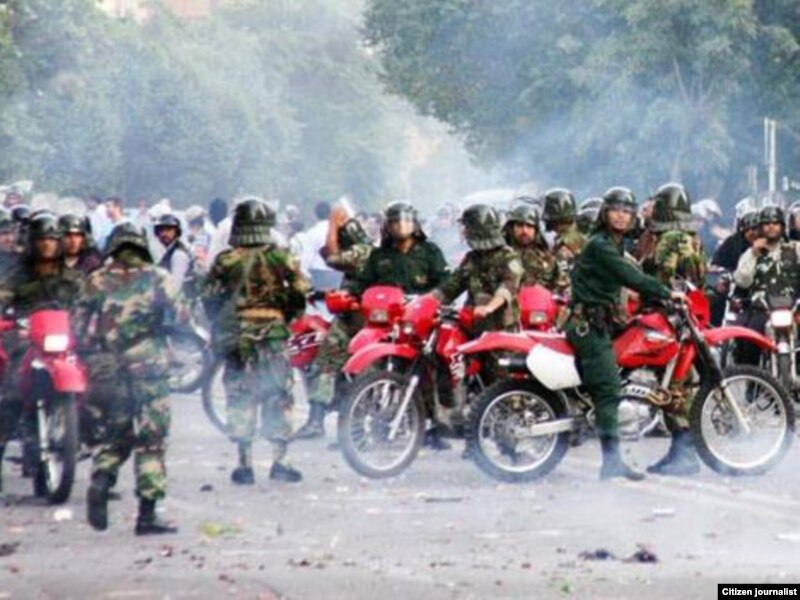
Meanwhile, the intelligence department of the police has urged citizens to help officers identify leaders of protests.
With previous rally sites in Tehran now sealed off by police, the demonstrations against the presidential election results are moving toward safer forms of protests.
Nightly in Tehran, people go to their rooftops at dusk to shout their discontent. The slogan is "Allahu Akbar" (God is great), a watchword of the 1979 Islamic Revolution. The police are unable to move against those shouting because for decades the words have been used as an expression of loyalty to Iran's theocratic system.
Similarly, opposition protests are taking the form of turning on car lights simultaneously at a given time of day.
Backroom Battle For Power
The task for the government now is how to push the protesters completely out of sight.
The strategy is likely to focus on putting increased pressure on opposition leader Mir Hossein Musavi.
The editor of Musavi's newspaper, "Kalemeh Sabz" (Green Word) said that police have arrested 25 journalists and other staff. The paper was shut down about 10 days ago by officials.
On June 23, the head of the conservative parliament's Judiciary Committee, Ali Shahrokhi, said Musavi's call for "illegal protests" were "criminal acts."
Musavi, a former prime minister and a loyalist of Iran's theocracy, has insisted that peaceful protests are allowed under the Islamic republic's constitution.
Musavi's wife, Zahra Rahnavard, was quoted on her website as calling on the security forces to immediately release those detained at the election protests. She also said it is "my duty to continue legal protests to preserve Iranian rights."
The conservatives have also fired warning shots at a senior backer of Musavi, former President Akbar Hashemi Rafsanjani. Security forces briefly arrested four of Rafsanjani's female relatives over the weekend, including his daughter Faezeh, who has appeared at Musavi's rallies.
State television quoted Supreme Leader Ayatollah Ali Khamenei as saying on June 24 that Iran's establishment would not yield to pressure over the disputed presidential election.
All this may mean that the duel between reformists and conservatives now will increasingly move off the public stage and into the establishment's corridors of power.
But whether the conservatives can beat their challengers there as effectively as they have on the streets remains to be seen.
The establishment is deeply split over the political and economic future of the Islamic republic and the street protests are simply one measure of how deep the differences run.
Iran Election Special
Iran Election Special
RFE/RL's Full Coverage
Following the disputed reelection of Iranian President Mahmud Ahmadinejad, supporters of Mir Hossein Musavi have taken to the streets to protest. Click here for news, blogs, and analysis of the presidential election and aftermath.Iran Election Diary
Iran Election Diary