




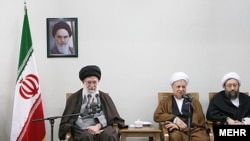
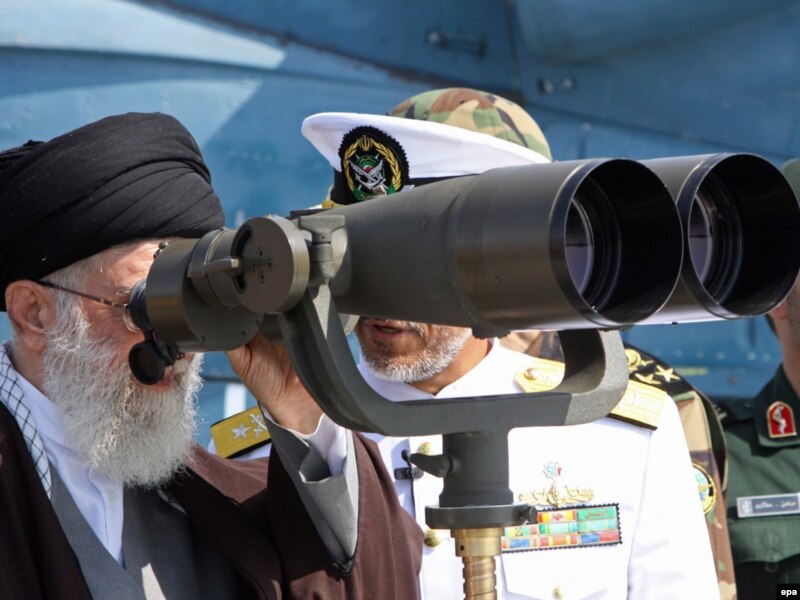
During the commissioning ceremony for Iran's first domestically built destroyer earlier this month, Supreme Leader Ayatollah Ali Khamenei denied that Iran seeks to possess nuclear weapons. He said that weapons of mass destruction are haram, or forbidden by Islam, in the Islamic republic.
The comments came just one day after the International Atomic Energy Agency (IAEA) announced that Iran might be working on a nuclear warhead and suggested for the first time that Tehran has either resumed such work or never stopped it, as U.S. intelligence agencies famously concluded it did in 2003.
Khamenei's latest remarks are not the first time he has used religious precepts to deny that Iran wants nuclear arms. In September 2004, as the IAEA Governing Council was debating Iran's nuclear program, a government spokesman announced that Khamenei had issued a fatwa banning the use of nuclear weapons.
Such a fatwa -- which was never published in any Iranian newspaper -- and similar statements are meant to persuade non-Muslims that Islam forbids the use of such weapons, but they carry no legal weight in Iran. In addition, Shi'ite tradition holds that only sources of emulation (marja) may issue religious rulings -- and Khamenei is not a marja. Although politically he is Iran's supreme leader, religiously he is considered a minor ayatollah.
Khamenei and many other Iranian officials have repeatedly emphasized the peaceful nature of Iran's nuclear program. However, in the face of mounting evidence to the contrary, these official declarations appear to fall within the old tradition of dissimulation known as taqiyyeh or ketman. In a political context, taqiyyeh is the concealment of one's beliefs and actions in potentially hostile situations; under it, a true believer must not allow the "infidel" to know what he is up to at any given time.
Some Shi'ite scholars attribute this practice to Imam Hassan, the second Shi'ite imam, who concealed his right to power and ceded the caliphate to the Umayyads in order to save Islam from devastating internal strife. The contrasting practice of tabiyeh (mobilization of forces) is attributed to Iman Hussein, the third iman, who rebelled against the Umayyads to restore to power the Holy House of Ali.
In addition, Khamenei's purported fatwa and other statements that nuclear weapons are banned by Islamic teachings fly in the face of his own earlier statements as president of Iran. In February 1987, when the country was still locked in a bitter war against Iraq, Khamenei told a gathering of Iranian nuclear scientists: "Regarding atomic energy, we need it now.... Our nation has always been threatened from outside. The least we can do to face this danger is to let our enemies know that we can defend ourselves. Therefore, every step you take here is in defense of your country and your revolution. With this in mind, work hard and quickly."
In 1988, Akbar Hashemi Rafsanjani -- the speaker of the Majlis and commander in chief of Iran's armed forces -- was even more explicit. In a speech to soldiers, he said: "With regard to chemical, bacteriological, and radiological weapons training, it was made very clear during the [Iran-Iraq] war that these weapons are very decisive. It was also made clear that the moral teachings of the world are not very effective when war reaches a serious stage and the world does not respect its own resolutions and closes its eyes to violations and aggressions that are committed on the battlefield. We should fully equip ourselves both in the offensive and defensive use of chemical, bacteriological, and radiological weapons."
Making A Case?
Current official statements that nuclear weapons are haram are also contradicted by arguments put forward by conservatives in state-run, pro-Khamenei newspapers. These commentators are clearly seeking to establish a plausible ideological basis to justify the acquisition of weapons of mass destruction.
This effort by hard-liners, including commanders of the Islamic Revolutionary Guards Corps (IRCG), to craft a viable deterrent posture based on Islamic tenets rests on what they call "Islam and the requirements of time" and "the unwavering principle of striving to gain power." From these concepts, they adduce that access to nuclear weapons is not merely allowed, but compulsory.
These thinkers argue that, in order to satisfy the needs of people in everyday life, Islam has both fixed and variable precepts. Some aspects of life -- both private and public -- do not change over time and therefore can be governed by immutable precepts. Other aspects change and, therefore, require variable guidance.
In response, they say, Islam has supplemented its unwavering principle with special secondary instructions that are articulated by mojtaheds (practitioners of independent legal judgment), who are responsible for recognizing the changing requirements of the times and establishing the links between humanity's fixed and varying needs.
Chapter And Verse
In reference to the Islamic admonition to gain power and remain strong at all times, the hard-liners quote Verse 60 of the Koranic surah of Al-Anfal (the Spoils of War), which says: "Against them, make ready your strength to the utmost of your power, including steeds of war, to strike terror in the enemies of Allah, your enemies, and others besides, whom you may not know, but Allah does know!"
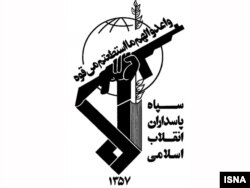 IRGC logo with Verse 60 of the Koranic surah on the "Spoils of War"In line with this verse, which appears on the emblem of the IRGC, Article 151 of the Iranian Constitution stipulates that the government must provide military training to all Iranians for the purpose of defending the country and the system of the Islamic republic.
In the minds of the hard-liners and IRGC commanders, this verse compels Muslims to resist their enemies with the utmost military and defensive power and, in today's world, that means nuclear weapons. Accordingly, from their point of view, learning how to make nuclear bombs is not haram, but wajib (mandatory).
(In January 2007, prominent Saudi cleric Aid al-Qarni also used the Al-Anfal surah to justify the acquisition of nuclear weapons, urging his country to do so in an article entitled "The Just Force.")
Iranian hard-liners stress that there is a major difference between having weapons of mass destruction and using them. They stress that the surah is speaking of deterrence when it mentions striking terror in the enemies of Allah. They argue that nuclear weapons have to power to neutralize "the evil intentions of arrogant powers" to attack Muslim countries and, therefore, contribute to the consolidation of peace and security.
As for the use of nuclear weapons, the hard-liners note that the Koran cautions against aggression and argue that such weapons could only be used to prevent further aggression from an enemy and only with the permission of the guardian of the cause of Muslims (vali-ye amr-e moslemim) and the supreme legal authority (vali-ye faqih). InIran, this means that Supreme Leader Khamenei has the right to authorize the use of nuclear weapons in his position as the supreme commander of the armed forces.
The hard-liners' argumentation on nuclear weapons, however, runs counter to the Islamic principle of jihad, which justifies waging a fair war with the aim of defending Islam against infidels.
Defending 'Red Lines'
Notwithstanding this contradiction, the promotion of nuclear deterrence by the hard-liners and the IRGC commanders stems in part from the devastating experience and traumatic memories of the Iran-Iraq war when an isolated Iran suffered tremendously at the hands of Saddam Hussein, who used chemical-weapons attacks to devastating effect. Since the end of that war, the IRGC has sought in all possible ways to achieve a credible, convincing deterrent posture.
In addition to the IRGC commanders, Iran's hard-line clerics and the military (artesh) leadership are fairly united in support of developing a nuclear-weapons capability. They generally agree that Iran must be able to mount a robust national defense if foreign aggressors cross Tehran's "red lines" and it must be able to make the cost of such aggression prohibitively high.
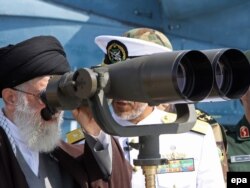 Supreme Leader Khamenei inspects Iran's first indigenously designed and developed guided-missile destroyer on February 19.However, senior military officers, who tend to be motivated more by nationalist sentiments than religious beliefs, argue the country's red lines must be defined by a clear national security doctrine that is not influenced by ideological and Islamic tenets. Only with such a clear doctrine would Iran be able to establish relations with its neighbors and other countries from a position of strength or, at least, parity, they argue.
Such a policy, the military argues, can bring about credible and lasting security arrangements in the region – based on international law and principles – that could ultimately make pave the way for a formally nuclear-free Middle East.
Risky Business
There has been no shortage of speculation about Iran's nuclear strategy. In light of what is known about Iran's nuclear program -- its problems and its progress -- the most likely scenario may be that Iran aims to create a "surge capacity." That is, it seeks to have the know-how, infrastructure, and personnel in place to develop nuclear weapons quickly, without actually possessing a nuclear arsenal. But it's likely that if Iran achieved such status, hard-liners and IRGC commanders would only increase their pressure and lobbying to take the next step and turn Iran into a full-fledged, nuclear-armed state.
Of course, even in such an event, Iran's nuclear arsenal would be small compared to that of the United States or, most likely, Israel. It could not force a U.S. withdrawal from the Middle East or impose its own security regime in the Persian Gulf. A small nuclear arsenal might boost Iran's bargaining power in some contexts, but it would not immunize Tehran from international isolation or allow it to behave as it pleases without fear of consequences.
Tehran would not be able to engage in nuclear brinkmanship indefinitely without a loss of credibility and a weakening of its deterrent. Deterrence is only effective if it is not allowed to fail.
In November 2005, Ali Larijani, who at the time was the secretary of the Supreme National Security Council, said: "If Iran becomes a nuclear [state], no one will any longer dare to stand up to it or challenge it, because the cost would be very high." Larijani's certainty notwithstanding, possessing nuclear arms might actually put Iran at much greater risk if the country's leadership failed to appreciate the limits of even such awesome weapons.
Hossein Aryan is deputy director of RFE/RL's Radio Farda. The views expressed in this commentary are the author's own and do not necessarily reflect those of RFE/RL
The comments came just one day after the International Atomic Energy Agency (IAEA) announced that Iran might be working on a nuclear warhead and suggested for the first time that Tehran has either resumed such work or never stopped it, as U.S. intelligence agencies famously concluded it did in 2003.
Khamenei's latest remarks are not the first time he has used religious precepts to deny that Iran wants nuclear arms. In September 2004, as the IAEA Governing Council was debating Iran's nuclear program, a government spokesman announced that Khamenei had issued a fatwa banning the use of nuclear weapons.
In a political context, 'taqiyyeh' is the concealment of one's beliefs and actions in potentially hostile situations; under it, a true believer must not allow the "infidel" to know what he is up to at any given time.
Such a fatwa -- which was never published in any Iranian newspaper -- and similar statements are meant to persuade non-Muslims that Islam forbids the use of such weapons, but they carry no legal weight in Iran. In addition, Shi'ite tradition holds that only sources of emulation (marja) may issue religious rulings -- and Khamenei is not a marja. Although politically he is Iran's supreme leader, religiously he is considered a minor ayatollah.
Khamenei and many other Iranian officials have repeatedly emphasized the peaceful nature of Iran's nuclear program. However, in the face of mounting evidence to the contrary, these official declarations appear to fall within the old tradition of dissimulation known as taqiyyeh or ketman. In a political context, taqiyyeh is the concealment of one's beliefs and actions in potentially hostile situations; under it, a true believer must not allow the "infidel" to know what he is up to at any given time.
Some Shi'ite scholars attribute this practice to Imam Hassan, the second Shi'ite imam, who concealed his right to power and ceded the caliphate to the Umayyads in order to save Islam from devastating internal strife. The contrasting practice of tabiyeh (mobilization of forces) is attributed to Iman Hussein, the third iman, who rebelled against the Umayyads to restore to power the Holy House of Ali.
In addition, Khamenei's purported fatwa and other statements that nuclear weapons are banned by Islamic teachings fly in the face of his own earlier statements as president of Iran. In February 1987, when the country was still locked in a bitter war against Iraq, Khamenei told a gathering of Iranian nuclear scientists: "Regarding atomic energy, we need it now.... Our nation has always been threatened from outside. The least we can do to face this danger is to let our enemies know that we can defend ourselves. Therefore, every step you take here is in defense of your country and your revolution. With this in mind, work hard and quickly."
In 1988, Akbar Hashemi Rafsanjani -- the speaker of the Majlis and commander in chief of Iran's armed forces -- was even more explicit. In a speech to soldiers, he said: "With regard to chemical, bacteriological, and radiological weapons training, it was made very clear during the [Iran-Iraq] war that these weapons are very decisive. It was also made clear that the moral teachings of the world are not very effective when war reaches a serious stage and the world does not respect its own resolutions and closes its eyes to violations and aggressions that are committed on the battlefield. We should fully equip ourselves both in the offensive and defensive use of chemical, bacteriological, and radiological weapons."
Making A Case?
Current official statements that nuclear weapons are haram are also contradicted by arguments put forward by conservatives in state-run, pro-Khamenei newspapers. These commentators are clearly seeking to establish a plausible ideological basis to justify the acquisition of weapons of mass destruction.
This effort by hard-liners, including commanders of the Islamic Revolutionary Guards Corps (IRCG), to craft a viable deterrent posture based on Islamic tenets rests on what they call "Islam and the requirements of time" and "the unwavering principle of striving to gain power." From these concepts, they adduce that access to nuclear weapons is not merely allowed, but compulsory.
These thinkers argue that, in order to satisfy the needs of people in everyday life, Islam has both fixed and variable precepts. Some aspects of life -- both private and public -- do not change over time and therefore can be governed by immutable precepts. Other aspects change and, therefore, require variable guidance.
In response, they say, Islam has supplemented its unwavering principle with special secondary instructions that are articulated by mojtaheds (practitioners of independent legal judgment), who are responsible for recognizing the changing requirements of the times and establishing the links between humanity's fixed and varying needs.
Chapter And Verse
In reference to the Islamic admonition to gain power and remain strong at all times, the hard-liners quote Verse 60 of the Koranic surah of Al-Anfal (the Spoils of War), which says: "Against them, make ready your strength to the utmost of your power, including steeds of war, to strike terror in the enemies of Allah, your enemies, and others besides, whom you may not know, but Allah does know!"
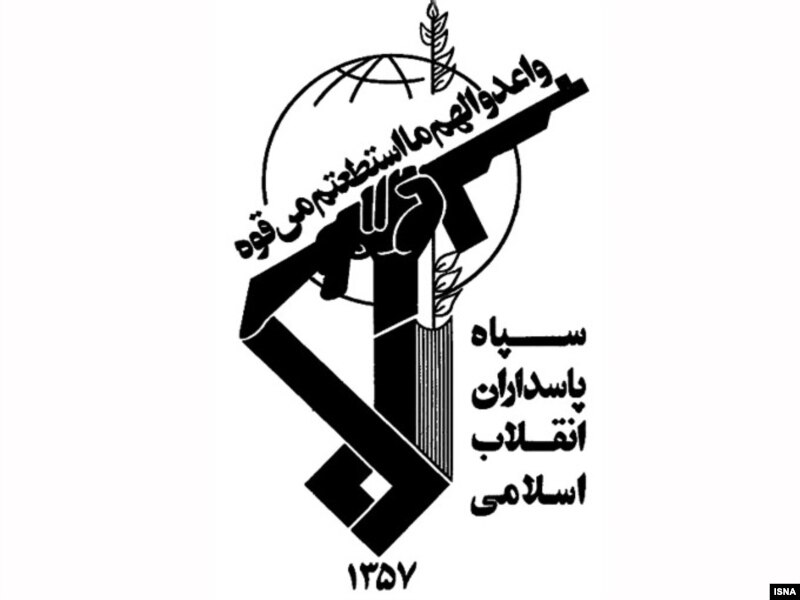
In the minds of the hard-liners and IRGC commanders, this verse compels Muslims to resist their enemies with the utmost military and defensive power and, in today's world, that means nuclear weapons. Accordingly, from their point of view, learning how to make nuclear bombs is not haram, but wajib (mandatory).
(In January 2007, prominent Saudi cleric Aid al-Qarni also used the Al-Anfal surah to justify the acquisition of nuclear weapons, urging his country to do so in an article entitled "The Just Force.")
Iranian hard-liners stress that there is a major difference between having weapons of mass destruction and using them. They stress that the surah is speaking of deterrence when it mentions striking terror in the enemies of Allah. They argue that nuclear weapons have to power to neutralize "the evil intentions of arrogant powers" to attack Muslim countries and, therefore, contribute to the consolidation of peace and security.
As for the use of nuclear weapons, the hard-liners note that the Koran cautions against aggression and argue that such weapons could only be used to prevent further aggression from an enemy and only with the permission of the guardian of the cause of Muslims (vali-ye amr-e moslemim) and the supreme legal authority (vali-ye faqih). InIran, this means that Supreme Leader Khamenei has the right to authorize the use of nuclear weapons in his position as the supreme commander of the armed forces.
The hard-liners' argumentation on nuclear weapons, however, runs counter to the Islamic principle of jihad, which justifies waging a fair war with the aim of defending Islam against infidels.
Defending 'Red Lines'
Notwithstanding this contradiction, the promotion of nuclear deterrence by the hard-liners and the IRGC commanders stems in part from the devastating experience and traumatic memories of the Iran-Iraq war when an isolated Iran suffered tremendously at the hands of Saddam Hussein, who used chemical-weapons attacks to devastating effect. Since the end of that war, the IRGC has sought in all possible ways to achieve a credible, convincing deterrent posture.
In addition to the IRGC commanders, Iran's hard-line clerics and the military (artesh) leadership are fairly united in support of developing a nuclear-weapons capability. They generally agree that Iran must be able to mount a robust national defense if foreign aggressors cross Tehran's "red lines" and it must be able to make the cost of such aggression prohibitively high.
Such a policy, the military argues, can bring about credible and lasting security arrangements in the region – based on international law and principles – that could ultimately make pave the way for a formally nuclear-free Middle East.
Risky Business
There has been no shortage of speculation about Iran's nuclear strategy. In light of what is known about Iran's nuclear program -- its problems and its progress -- the most likely scenario may be that Iran aims to create a "surge capacity." That is, it seeks to have the know-how, infrastructure, and personnel in place to develop nuclear weapons quickly, without actually possessing a nuclear arsenal. But it's likely that if Iran achieved such status, hard-liners and IRGC commanders would only increase their pressure and lobbying to take the next step and turn Iran into a full-fledged, nuclear-armed state.
Of course, even in such an event, Iran's nuclear arsenal would be small compared to that of the United States or, most likely, Israel. It could not force a U.S. withdrawal from the Middle East or impose its own security regime in the Persian Gulf. A small nuclear arsenal might boost Iran's bargaining power in some contexts, but it would not immunize Tehran from international isolation or allow it to behave as it pleases without fear of consequences.
Tehran would not be able to engage in nuclear brinkmanship indefinitely without a loss of credibility and a weakening of its deterrent. Deterrence is only effective if it is not allowed to fail.
In November 2005, Ali Larijani, who at the time was the secretary of the Supreme National Security Council, said: "If Iran becomes a nuclear [state], no one will any longer dare to stand up to it or challenge it, because the cost would be very high." Larijani's certainty notwithstanding, possessing nuclear arms might actually put Iran at much greater risk if the country's leadership failed to appreciate the limits of even such awesome weapons.
Hossein Aryan is deputy director of RFE/RL's Radio Farda. The views expressed in this commentary are the author's own and do not necessarily reflect those of RFE/RL