


Thirty years after the Islamic Revolution, the world is still trying to understand just what it was -- and is.
Was it an anti-Western revolution against the rule of the U.S.-backed shah, Mohammad Reza Shah Pahlavi?
Was it the first modern effort to establish a Muslim theocracy?
Or was it a simple takeover of a state by a single party?
Finding the answer would help explain why the Islamic Revolution -- now in its second generation -- remains resolutely anti-Western, entirely in the hands of its clerical leaders, and intolerant of dissent.
But categorizing what happened in Iran in 1979 has never been easy.
'White Revolution'
Stephen Kinzer, a former "New York Times" correspondent and the author of "All the Shah's Men: An American Coup and the Roots of Middle East Terror," says the seeds of the Islamic Revolution lay in another revolution -- the shah's program to modernize Iran as a second Turkey.
The shah's heavy-handed "White Revolution," Kinzer says, profoundly shocked his traditional society.
"This revolution was totally imposed from above. There was no effort to bring people into it. The shah was afraid to do that because once you allow people to express themselves openly, that is a process that can snowball and become a widespread demand for democracy," Kinzer says.
"So, the shah had this vision of trying to create a modern society in a nonmodern way. That is, he wanted to use sort of dictatorial methods to create what he thought would be a more open and tolerant and wonderful and productive and prosperous society. But that doesn't work. He was really out of touch with what ordinary Iranians wanted." Kinzer continues. "Why was this? Partly because, I think, he was very oriented to the West."
Opposition to the shah included figures all along the political spectrum.
There were secular intellectuals steeped in Third World liberation theory who equated the shah with Western exploitation.
There were Marxists advocating class struggle.
There were champions of constitutional monarchy.
And, less visibly, but ultimately most importantly, there was Iran's Shi'ite clergy, which traditionally had stood outside of politics.
Fate Was Sealed
Kinzer says the Shah was in little danger from his secular opponents, but that when the mullah's entered the arena, his fate was sealed.
 Iranians gather on the street in February 1979 during the Islamic Revolution."While the shah was in power, he systematically repressed all other forms of opposition. You could not have a real opposition political party or independent trade union or a student organization or professional group or chamber. You could not have independent newspapers," Kinzer says.
"The only place where you could hide if you wanted to be in the opposition was in the mosque," he added. "That brought people who were very much against the shah under religious influence and it guaranteed, as we can now see in retrospect, that when the shah would finally fall, religious power would replace him."
Ayatollah Ruhollah Khomeini, like all great revolutionaries, mobilized support by articulating a compelling concept. He argued that only Iran's religious strength could save the country from foreign exploitation and that Islamic law, Shari'a, offered everything necessary for good government and a just society.
Specifically, Khomeini argued that full implementation of Shari'a means Islamist jurists should rule the country. And that concept -- long known but dormant in Shi'ite theology -- became his call to arms.
The overwhelming majority of the other Shi'ite grand ayatollahs alive at the time reacted negatively to Khomeini's extending religion into politics. But Khomeini's taped speeches from exile in Iraq's holy Shi'ite city of Al-Najaf were widely distributed in Iran's mosques and brought him a huge following.
Surprising Innovation
Khomeini's concept of religious political leaders was a surprising innovation in Iran but not entirely his own.
Neil Partrick, a regional expert at the American University of Sharjah, says Khomeini was heavily influenced by the struggle of another Shi'ite ayatollah, Muhammad Baqir al-Sadr, in Iraq against Saddam Hussein.
"Perhaps the surprise about the extent to which [a political role for clerics] was, 1) a model but, 2), also a very successful political model in Iran and [even today] of influence beyond Iran, might be put down to the fact that the generation of this model as it took off throughout the 1960s was one that to some extent came from outside Iran," Partrick says.
"Most influential within this, of course, ironically perhaps, was Muhammad Baqir al-Sadr. This is not a model, of course that has eventually seen the light of day inside Iraq, even though the party that he founded, the Dawa Party, has obviously significantly influence. But ironically it became the model that was adopted, broadly speaking, by Ayatollah Khomeini," Partrick says.
Al-Sadr, the uncle of radical Iraqi Shi'ite cleric Muqtada al-Sadr, was executed by Hussein in 1980.
When the secularist and religious opposition came into the streets together, the shah was overwhelmed by the size of the protests. He left the country in January 1979. Khomeini, who had been deported from Iraq, returned to Tehran from Paris on February 1 and was welcomed by a crowd of several million.
Khomeini's first move was to reject the reformist prime minister appointed by the fleeing shah. That government collapsed on February 11. Then the ayatollah's clerical supporters set out to take power from the other parties in the revolution.
Parallel Government
They did so in the time-honored way -- by participating in a government of national unity but at the same time operating its own parallel government with neighborhood security committees, revolutionary tribunals, and armed militants.
The militants organized strikes and eliminated opponents until the official government was so weak it agreed to the constitution Khomeini wanted. He became supreme leader and theocratic bodies were created to oversee laws passed by the parliament and vet candidates for public office.
 Iranian students climb over the wall of the U.S. Embassy in Tehran on November 4, 1979.A milestone in the power grab was the storming of the U.S. Embassy in November 1979. After activists loyal to Khomeini took the American diplomats captive, the coalition government resigned over its powerlessness to manage the crisis. It was clear only one man mattered: Khomeini himself.
The U.S. broke relations, Iranian moderates were discredited, and the diplomats remained hostage 444 days.
By mid-1981, the revolutionary clerics' takeover was complete. Thousands of their opponents had been killed or jailed. The last coalition president, Abolhasan Bani-Sadr, was dismissed by Khomeini and fled to Paris.
Today, the Islamic Revolution remains firmly in power and Iran is the world's only theocratic state. Hard-liners and conservatives dominate a political arena strictly limited to loyalists and have driven off challenges by reformists. Critical newspapers are censored or closed and political activists are jailed.
Islamic Democracy
The Islamic Republic of Iran set out to create something new -- in its own words, an Islamic democracy -- that would be an alternative vision to Western democracy. But, despite initial Western fears it would spread, it has not.
Partrick says other Islamic groups regard the Islamic Revolution as a powerful symbol, but not as a model.
"What was established by Iran was a unique experiment in many ways," he says. "Although it had a wide political appeal initially, even beyond religious opinion, in terms of what it represented as a revolution, soon it consolidated its power as both Shi'a Islamic and indeed Persian in many aspects of its identification.
"Its primary influence and to some extent its renewed influence under [Iranian President Mahmud] Ahmadinejad is in many ways in symbolism -- this is putting aside, of course, its influence of financial and military support to certain groups -- the symbolism of defiance," Partrick says.
The threat of Islamic revolutions in Central Asia or the Middle East comes today from militant Sunni groups seeking a "caliphate," or idyllic return of Muslim society to the purity of its early days.
Some Salafist leaders say a caliphate would bridge the Shi'ite-Sunni divide, a goal that might suggest joint ventures with the Islamic Republic of Iran are possible. But while Tehran let some Al-Qaeda members escape to Iran with the collapse of the Taliban regime in Afghanistan, the two revolutions to establish Shari'a-based rule remain separate.


Was it an anti-Western revolution against the rule of the U.S.-backed shah, Mohammad Reza Shah Pahlavi?
Was it the first modern effort to establish a Muslim theocracy?
Or was it a simple takeover of a state by a single party?
Finding the answer would help explain why the Islamic Revolution -- now in its second generation -- remains resolutely anti-Western, entirely in the hands of its clerical leaders, and intolerant of dissent.
But categorizing what happened in Iran in 1979 has never been easy.
'White Revolution'
Stephen Kinzer, a former "New York Times" correspondent and the author of "All the Shah's Men: An American Coup and the Roots of Middle East Terror," says the seeds of the Islamic Revolution lay in another revolution -- the shah's program to modernize Iran as a second Turkey.
The shah's heavy-handed "White Revolution," Kinzer says, profoundly shocked his traditional society.
"This revolution was totally imposed from above. There was no effort to bring people into it. The shah was afraid to do that because once you allow people to express themselves openly, that is a process that can snowball and become a widespread demand for democracy," Kinzer says.
"So, the shah had this vision of trying to create a modern society in a nonmodern way. That is, he wanted to use sort of dictatorial methods to create what he thought would be a more open and tolerant and wonderful and productive and prosperous society. But that doesn't work. He was really out of touch with what ordinary Iranians wanted." Kinzer continues. "Why was this? Partly because, I think, he was very oriented to the West."
Opposition to the shah included figures all along the political spectrum.
There were secular intellectuals steeped in Third World liberation theory who equated the shah with Western exploitation.
There were Marxists advocating class struggle.
There were champions of constitutional monarchy.
And, less visibly, but ultimately most importantly, there was Iran's Shi'ite clergy, which traditionally had stood outside of politics.
Fate Was Sealed
Kinzer says the Shah was in little danger from his secular opponents, but that when the mullah's entered the arena, his fate was sealed.
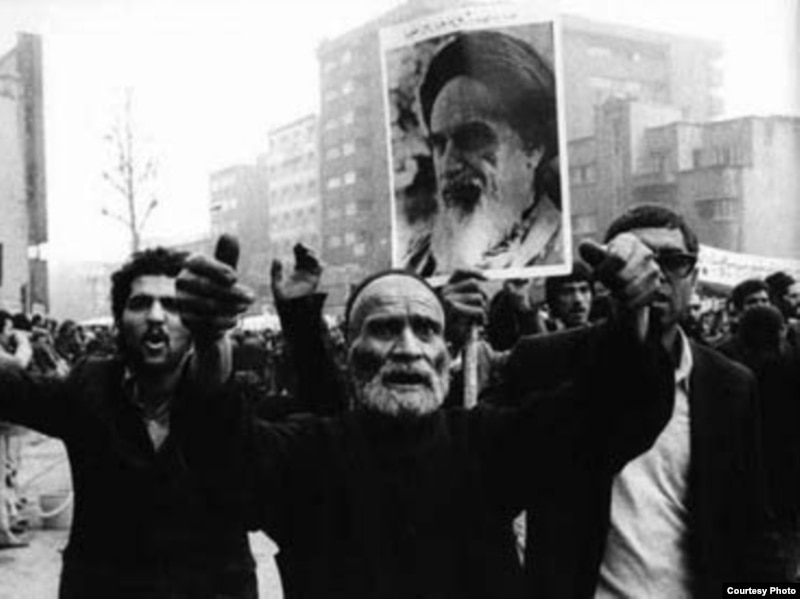
"The only place where you could hide if you wanted to be in the opposition was in the mosque," he added. "That brought people who were very much against the shah under religious influence and it guaranteed, as we can now see in retrospect, that when the shah would finally fall, religious power would replace him."
Ayatollah Ruhollah Khomeini, like all great revolutionaries, mobilized support by articulating a compelling concept. He argued that only Iran's religious strength could save the country from foreign exploitation and that Islamic law, Shari'a, offered everything necessary for good government and a just society.
Specifically, Khomeini argued that full implementation of Shari'a means Islamist jurists should rule the country. And that concept -- long known but dormant in Shi'ite theology -- became his call to arms.
The overwhelming majority of the other Shi'ite grand ayatollahs alive at the time reacted negatively to Khomeini's extending religion into politics. But Khomeini's taped speeches from exile in Iraq's holy Shi'ite city of Al-Najaf were widely distributed in Iran's mosques and brought him a huge following.
Surprising Innovation
Khomeini's concept of religious political leaders was a surprising innovation in Iran but not entirely his own.
Neil Partrick, a regional expert at the American University of Sharjah, says Khomeini was heavily influenced by the struggle of another Shi'ite ayatollah, Muhammad Baqir al-Sadr, in Iraq against Saddam Hussein.
What was established by Iran was a unique experiment in many ways.
"Most influential within this, of course, ironically perhaps, was Muhammad Baqir al-Sadr. This is not a model, of course that has eventually seen the light of day inside Iraq, even though the party that he founded, the Dawa Party, has obviously significantly influence. But ironically it became the model that was adopted, broadly speaking, by Ayatollah Khomeini," Partrick says.
Al-Sadr, the uncle of radical Iraqi Shi'ite cleric Muqtada al-Sadr, was executed by Hussein in 1980.
When the secularist and religious opposition came into the streets together, the shah was overwhelmed by the size of the protests. He left the country in January 1979. Khomeini, who had been deported from Iraq, returned to Tehran from Paris on February 1 and was welcomed by a crowd of several million.
Khomeini's first move was to reject the reformist prime minister appointed by the fleeing shah. That government collapsed on February 11. Then the ayatollah's clerical supporters set out to take power from the other parties in the revolution.
Parallel Government
They did so in the time-honored way -- by participating in a government of national unity but at the same time operating its own parallel government with neighborhood security committees, revolutionary tribunals, and armed militants.
The militants organized strikes and eliminated opponents until the official government was so weak it agreed to the constitution Khomeini wanted. He became supreme leader and theocratic bodies were created to oversee laws passed by the parliament and vet candidates for public office.

The U.S. broke relations, Iranian moderates were discredited, and the diplomats remained hostage 444 days.
By mid-1981, the revolutionary clerics' takeover was complete. Thousands of their opponents had been killed or jailed. The last coalition president, Abolhasan Bani-Sadr, was dismissed by Khomeini and fled to Paris.
Today, the Islamic Revolution remains firmly in power and Iran is the world's only theocratic state. Hard-liners and conservatives dominate a political arena strictly limited to loyalists and have driven off challenges by reformists. Critical newspapers are censored or closed and political activists are jailed.
Islamic Democracy
The Islamic Republic of Iran set out to create something new -- in its own words, an Islamic democracy -- that would be an alternative vision to Western democracy. But, despite initial Western fears it would spread, it has not.
Partrick says other Islamic groups regard the Islamic Revolution as a powerful symbol, but not as a model.
"What was established by Iran was a unique experiment in many ways," he says. "Although it had a wide political appeal initially, even beyond religious opinion, in terms of what it represented as a revolution, soon it consolidated its power as both Shi'a Islamic and indeed Persian in many aspects of its identification.
"Its primary influence and to some extent its renewed influence under [Iranian President Mahmud] Ahmadinejad is in many ways in symbolism -- this is putting aside, of course, its influence of financial and military support to certain groups -- the symbolism of defiance," Partrick says.
The threat of Islamic revolutions in Central Asia or the Middle East comes today from militant Sunni groups seeking a "caliphate," or idyllic return of Muslim society to the purity of its early days.
Some Salafist leaders say a caliphate would bridge the Shi'ite-Sunni divide, a goal that might suggest joint ventures with the Islamic Republic of Iran are possible. But while Tehran let some Al-Qaeda members escape to Iran with the collapse of the Taliban regime in Afghanistan, the two revolutions to establish Shari'a-based rule remain separate.
Iran's Revolution
30 Years After
Iran's Revolution
As Iran celebrates the 30th anniversary of its Islamic Revolution, RFE/RL looks at the legacy of the revolution and its effect on Iran and the world. More
Images Of The Iranian Revolution
Multimedia
Images Of Revolution
An audio slide show of Reza Deghati's iconic photos of the Iranian Revolution and the hostage crisis that followed. Play