




The prospects for the signing of a provisional peace agreement ending the two-decade-old Nagorno-Karabakh conflict have deteriorated dramatically over the past month.
Following the most serious cease-fire violation of the past two years, in which one Azerbaijani and four Armenian servicemen were killed in a nighttime raid on June 18, the peace talks are apparently deadlocked. But despite the rise in tensions, the presidents of Armenia and Azerbaijan failed to avail themselves of the opportunity to meet and talk on the sidelines of the recent informal CIS summit in Ukraine.
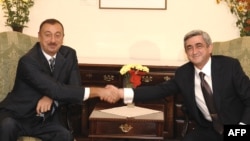
Between January 2009 and January 2010, Presidents Serzh Sarkisian and Ilham Aliyev met eight times to discuss the so-called Basic (or Madrid) Principles for resolving the conflict, reportedly reaching verbal agreement on the preamble to that document, which affirms their commitment to resolving the conflict peacefully.
Since then, however, further progress has apparently been blocked by disagreement over the timetable for implementation of the various components of the peace plan, including whether the decision on the future status of the unrecognized Nagorno-Karabakh republic should be taken before or after the withdrawal of Armenian forces from Azerbaijani territory. Armenia favors the former sequence, Azerbaijani insists on the latter. President Aliyev's early departure from St. Petersburg last month following his most recent meeting with Sarkisian reinforced the perception that the talks had reached deadlock.
Withdrawing When, Where?
The so-called Basic Principles were unveiled in June 2006 by the French, Russian, and U.S. co-chairmen of the OSCE Minsk Group that seeks to mediate a solution of the conflict. They were revised in late 2007 and late 2008. Armenian officials say Russian President Dmitry Medvedev presented a new revised version to Aliyev and Sarkisian in St. Petersburg last month, but the Azerbaijani Foreign Ministry promptly denied this.
 The complete texts of the revised versions have not been made public, but that has not prevent pundits in both Yerevan and Baku scrutinizing official summaries and paraphrases and debating the long-term political implications of what appear on the surface minor semantic changes.
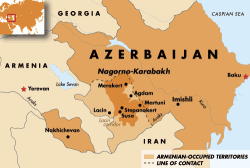
Successive versions of the Basic Principles all provide for the withdrawal of Armenian forces from seven districts of Azerbaijan bordering on Karabakh that they currently occupy; the deployment of international peacekeepers; the return to their homes of Azerbaijani displaced persons; and security guarantees for the Armenian population of Karabakh, including an overland link (the so-called Lachin corridor) connecting Karabakh with Armenia; and, finally, at some unspecified future date, a formal decision on the final legal status of Nagorno-Karabakh, in which the region's population would have the decisive say.
The 2009 version differs from the 2006 text in several key respects. The 2006 version envisaged that Armenian forces withdraw gradually from the Agdam, Fizuli, Djebrail, Zangelan, and Gubadli districts of Azerbaijan. It proposed unspecified "special modalities" for the two remaining districts, Lachin, which constitutes the vital "landline" corridor linking Karabakh with Armenia, and Kelbacar, which is sandwiched between Karabakh and Armenia.
By contrast, the most recent version apparently does not stipulate that the Armenian withdrawal should be gradual, or differentiate between Lachin and Kelbacar, on the one hand, and the other five districts on the other. It does call for "a corridor linking Armenia to Nagorno-Karabakh," but fails to define that land link.
The revised Madrid Principles also include one key element absent from the original Basic Principles -- "interim status for Nagorno-Karabakh providing guarantees for security and self-governance," with the region's "final legal status" to be determined "through a legally binding expression of will."
Azerbaijan has construed the ambiguity over the time frame for the proposed Armenian withdrawal as a major concession, and analysts in Baku have speculated about which districts will be liberated in what order.
Then last week, President Aliyev told representatives of the former Azerbaijani population of Nagorno-Karabakh the updated principles entail: the immediate withdrawal of Armenian forces from Agdam, Fizuli, Djebrail, Zangelan, and Gubadli, and from Lachin and Kelbacar over a period of five years, to allow for the putting in place of "more extensive security measures" to enable the former Azerbaijani population of those latter two districts to return.
Azerbaijani Foreign Minister Elmar Mammadyarov for his part told journalists on July 9 that Armenian forces would be withdrawn from the five districts bordering Karabakh "immediately after the peace agreement is signed." He explained that the five-year period for the Armenian withdrawal from Lachin and Kelbacar constitutes a compromise, insofar as former Armenian President Robert Kocharian had insisted on 10 years and President Sarkisian initially proposed seven, while Baku countered with three.
Questions Of Security
President Aliyev glossed over the security guarantees for the Armenian population of Karabakh, to which the Armenian leadership attaches primary importance. He said the highway linking Nagorno-Karabakh and Armenia will continue to function "as before." But he implicitly rejected the "special modalities" for it envisaged in the original, 2006 version of the Basic Principles.
Similarly unclear is the role of the international peacekeepers, and which countries will provide them. Aliyev said they will be deployed along the administrative borders of the Nagorno-Karabakh republic, and will remain there until "all sides reach agreement among themselves on security measures." Armenia wants peacekeepers to protect the Lachin corridor as well.
Aliyev and Mammadyarov both indicated that the concept of "interim status" for Karabakh is acceptable, provided that status does not violate Azerbaijan's territorial integrity. In other words, they rule out formal independence for Nagorno-Karabakh.
Mammadyarov said that the two sides are discussing with the Minsk Group creating a special committee on which Armenia, Azerbaijan, and France, Russia, and the United States as Minsk Group co-chairs would be represented. That committee would decide on how to determine the future status of Nagorno-Karabakh, given that the constitution of the Republic of Azerbaijan does not permit holding a localized referendum on one part of its territory. But Armenia would not agree to a nationwide referendum, as Azerbaijani votes against independence for Karabakh would far outnumber the votes of Karabakh's Armenian population in favor.
Mammadyarov also said the decision on the region's final status would take place only after the return to Karabakh of Azerbaijani internally displaced persons, and after "complete democratic stability" has been established there.
Armenia, however, is unwilling to relinquish at the outset its sole bargaining chip -- the occupied districts of Azerbaijan -- without gaining in return anything more than nebulous promises of "security" for the population of Karabakh and a referendum in 10-15 years' time that might offer only "broad autonomy" for the region within Azerbaijan.
Instead, it wants a binding decision on Karabakh's future status to precede the pullout of Armenian troops from Azerbaijani territory. Eduard Sharmazanov, the spokesman for Sarkisian's Republican Party of Armenia, told journalists in Yerevan on June 29 that "in our view, the sequence of steps must be as follows: as long as the issue of Nagorno-Karabakh's status is not resolved, all other issues are secondary."
Only Window Of Opportunity
The Karabakh-Armenian leadership for its part continues to insist that the region's independence and security are non-negotiable, and that progress toward a comprehensive peace agreement is contingent on its representatives returning to the negotiating table. Speaking in Brussels two months ago, President Sarkisian predicted that bringing Karabakh representatives into the ongoing talks under the Minsk Group aegis would "raise the negotiation process to a qualitatively new level," Armenian Public Television reported on May 26.
Baku, however, adamantly opposes the participation of Karabakh representatives in the peace talks at this stage.
Meanwhile, the risk remains that an isolated exchange of fire on the Line of Contact could spiral out of control and result in a brief but deadly conflict. Azerbaijan has still not acceded to the proposal, made first by the Minsk Group and endorsed in a report last fall by the International Crisis Group, that it should remove its snipers from front-line areas.
The current tensions pose a tough challenge to the OSCE Minsk Group mediators, who are to meet with the Armenian and Azerbaijani foreign ministers on July 16 in Almaty. Dennis Sammut, head of the London-based NGO LINKS that promotes trust and confidence-building measures between Armenia and Azerbaijan, recently warned that if the Minsk process collapses, it will take "years for an alternative to emerge and for the conflict sides to again reach the stage we are at today. It is vital that the window of opportunity that is now open should not be allowed to slam shut."
At the same time, Sammut also points to the need for a fresh approach to the issue of Nagorno-Karabakh's final status that would reconcile Baku's insistence on preserving Azerbaijan's territorial integrity with the Armenian insistence that the Armenians of Nagorno-Karabakh have the right to self-determination. Doing so, he said, would require that the international community adopts a more creative approach to the issue, even coming up with constitutional solutions for Nagorno-Karabakh that do not exist anywhere else in the world, but which would somehow satisfy both Armenians and Azerbaijanis.
Following the most serious cease-fire violation of the past two years, in which one Azerbaijani and four Armenian servicemen were killed in a nighttime raid on June 18, the peace talks are apparently deadlocked. But despite the rise in tensions, the presidents of Armenia and Azerbaijan failed to avail themselves of the opportunity to meet and talk on the sidelines of the recent informal CIS summit in Ukraine.
Between January 2009 and January 2010, Presidents Serzh Sarkisian and Ilham Aliyev met eight times to discuss the so-called Basic (or Madrid) Principles for resolving the conflict, reportedly reaching verbal agreement on the preamble to that document, which affirms their commitment to resolving the conflict peacefully.
Since then, however, further progress has apparently been blocked by disagreement over the timetable for implementation of the various components of the peace plan, including whether the decision on the future status of the unrecognized Nagorno-Karabakh republic should be taken before or after the withdrawal of Armenian forces from Azerbaijani territory. Armenia favors the former sequence, Azerbaijani insists on the latter. President Aliyev's early departure from St. Petersburg last month following his most recent meeting with Sarkisian reinforced the perception that the talks had reached deadlock.
Withdrawing When, Where?
The so-called Basic Principles were unveiled in June 2006 by the French, Russian, and U.S. co-chairmen of the OSCE Minsk Group that seeks to mediate a solution of the conflict. They were revised in late 2007 and late 2008. Armenian officials say Russian President Dmitry Medvedev presented a new revised version to Aliyev and Sarkisian in St. Petersburg last month, but the Azerbaijani Foreign Ministry promptly denied this.
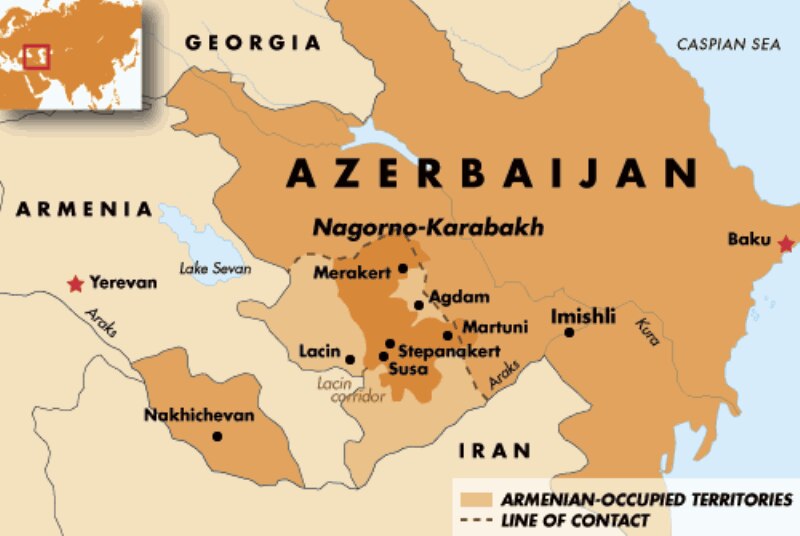
Successive versions of the Basic Principles all provide for the withdrawal of Armenian forces from seven districts of Azerbaijan bordering on Karabakh that they currently occupy; the deployment of international peacekeepers; the return to their homes of Azerbaijani displaced persons; and security guarantees for the Armenian population of Karabakh, including an overland link (the so-called Lachin corridor) connecting Karabakh with Armenia; and, finally, at some unspecified future date, a formal decision on the final legal status of Nagorno-Karabakh, in which the region's population would have the decisive say.
The 2009 version differs from the 2006 text in several key respects. The 2006 version envisaged that Armenian forces withdraw gradually from the Agdam, Fizuli, Djebrail, Zangelan, and Gubadli districts of Azerbaijan. It proposed unspecified "special modalities" for the two remaining districts, Lachin, which constitutes the vital "landline" corridor linking Karabakh with Armenia, and Kelbacar, which is sandwiched between Karabakh and Armenia.
By contrast, the most recent version apparently does not stipulate that the Armenian withdrawal should be gradual, or differentiate between Lachin and Kelbacar, on the one hand, and the other five districts on the other. It does call for "a corridor linking Armenia to Nagorno-Karabakh," but fails to define that land link.
The revised Madrid Principles also include one key element absent from the original Basic Principles -- "interim status for Nagorno-Karabakh providing guarantees for security and self-governance," with the region's "final legal status" to be determined "through a legally binding expression of will."
Azerbaijan has construed the ambiguity over the time frame for the proposed Armenian withdrawal as a major concession, and analysts in Baku have speculated about which districts will be liberated in what order.
Then last week, President Aliyev told representatives of the former Azerbaijani population of Nagorno-Karabakh the updated principles entail: the immediate withdrawal of Armenian forces from Agdam, Fizuli, Djebrail, Zangelan, and Gubadli, and from Lachin and Kelbacar over a period of five years, to allow for the putting in place of "more extensive security measures" to enable the former Azerbaijani population of those latter two districts to return.
Azerbaijani Foreign Minister Elmar Mammadyarov for his part told journalists on July 9 that Armenian forces would be withdrawn from the five districts bordering Karabakh "immediately after the peace agreement is signed." He explained that the five-year period for the Armenian withdrawal from Lachin and Kelbacar constitutes a compromise, insofar as former Armenian President Robert Kocharian had insisted on 10 years and President Sarkisian initially proposed seven, while Baku countered with three.
Questions Of Security
President Aliyev glossed over the security guarantees for the Armenian population of Karabakh, to which the Armenian leadership attaches primary importance. He said the highway linking Nagorno-Karabakh and Armenia will continue to function "as before." But he implicitly rejected the "special modalities" for it envisaged in the original, 2006 version of the Basic Principles.
Similarly unclear is the role of the international peacekeepers, and which countries will provide them. Aliyev said they will be deployed along the administrative borders of the Nagorno-Karabakh republic, and will remain there until "all sides reach agreement among themselves on security measures." Armenia wants peacekeepers to protect the Lachin corridor as well.
Aliyev and Mammadyarov both indicated that the concept of "interim status" for Karabakh is acceptable, provided that status does not violate Azerbaijan's territorial integrity. In other words, they rule out formal independence for Nagorno-Karabakh.
Mammadyarov said that the two sides are discussing with the Minsk Group creating a special committee on which Armenia, Azerbaijan, and France, Russia, and the United States as Minsk Group co-chairs would be represented. That committee would decide on how to determine the future status of Nagorno-Karabakh, given that the constitution of the Republic of Azerbaijan does not permit holding a localized referendum on one part of its territory. But Armenia would not agree to a nationwide referendum, as Azerbaijani votes against independence for Karabakh would far outnumber the votes of Karabakh's Armenian population in favor.
Mammadyarov also said the decision on the region's final status would take place only after the return to Karabakh of Azerbaijani internally displaced persons, and after "complete democratic stability" has been established there.
Armenia, however, is unwilling to relinquish at the outset its sole bargaining chip -- the occupied districts of Azerbaijan -- without gaining in return anything more than nebulous promises of "security" for the population of Karabakh and a referendum in 10-15 years' time that might offer only "broad autonomy" for the region within Azerbaijan.
Instead, it wants a binding decision on Karabakh's future status to precede the pullout of Armenian troops from Azerbaijani territory. Eduard Sharmazanov, the spokesman for Sarkisian's Republican Party of Armenia, told journalists in Yerevan on June 29 that "in our view, the sequence of steps must be as follows: as long as the issue of Nagorno-Karabakh's status is not resolved, all other issues are secondary."
Only Window Of Opportunity
The Karabakh-Armenian leadership for its part continues to insist that the region's independence and security are non-negotiable, and that progress toward a comprehensive peace agreement is contingent on its representatives returning to the negotiating table. Speaking in Brussels two months ago, President Sarkisian predicted that bringing Karabakh representatives into the ongoing talks under the Minsk Group aegis would "raise the negotiation process to a qualitatively new level," Armenian Public Television reported on May 26.
Baku, however, adamantly opposes the participation of Karabakh representatives in the peace talks at this stage.
Meanwhile, the risk remains that an isolated exchange of fire on the Line of Contact could spiral out of control and result in a brief but deadly conflict. Azerbaijan has still not acceded to the proposal, made first by the Minsk Group and endorsed in a report last fall by the International Crisis Group, that it should remove its snipers from front-line areas.
The current tensions pose a tough challenge to the OSCE Minsk Group mediators, who are to meet with the Armenian and Azerbaijani foreign ministers on July 16 in Almaty. Dennis Sammut, head of the London-based NGO LINKS that promotes trust and confidence-building measures between Armenia and Azerbaijan, recently warned that if the Minsk process collapses, it will take "years for an alternative to emerge and for the conflict sides to again reach the stage we are at today. It is vital that the window of opportunity that is now open should not be allowed to slam shut."
At the same time, Sammut also points to the need for a fresh approach to the issue of Nagorno-Karabakh's final status that would reconcile Baku's insistence on preserving Azerbaijan's territorial integrity with the Armenian insistence that the Armenians of Nagorno-Karabakh have the right to self-determination. Doing so, he said, would require that the international community adopts a more creative approach to the issue, even coming up with constitutional solutions for Nagorno-Karabakh that do not exist anywhere else in the world, but which would somehow satisfy both Armenians and Azerbaijanis.