


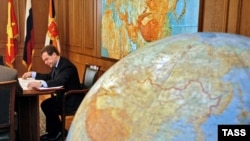
An unusual degree of secrecy has surrounded President Dmitry Medvedev's upcoming state-of-the-nation address this year. Moreover, the annual speech was originally scheduled for this week, but has reportedly been delayed at least until November 22.
Today we got some idea of why this might be the case. According to a report in the daily "Vedomosti," Medvedev is considering a plan that is nothing short of a wholesale redrawing Russia's political and administrative map -- and the plan could be announced in next week's speech.
Citing three unidentified Kremlin officials and a secret government draft document, "Vedomosti" reported that Medvedev plans to scrap the current system in which the country is divided into a dizzying array of 83 regions, territories, republics, and federal cities -- replacing them with 20 massive super-regions centered on major cities:
Under the plan, for example, most of Russia's northwest would be part of a giant province governed from St. Petersburg. (A map of the proposed reorganization is included with the "Vedomosti" article.)
There is historical precedent for such large administrative divisions. In 1708, Peter the Great divided Russia eight administrative "gubernia" to streamline governance. The number, however, increased over time as Russia acquired more territory and the size of its administrative units was diminished. The number of gubernia increased to 23 under Catherine the Great and by 1914 had grown to 81.
"Vedomosti" has a reputation for thorough and quality reporting and the story appears to be well sourced. I have few doubts that somebody is floating this idea -- perhaps to prepare the public for what would be a major change in governance, perhaps as a trial balloon, or perhaps as part of some hidden intrigue that we can only guess at.
But the thing is, the proposed changes make sense given recent political developments: Medvedev's removal of powerful regional leaders like Moscow's Yury Luzhkov, Tatarstan's Mintimer Shaimiyev, and Bashkortostan's Murtaza Rakhimov who may have tried to block such a plan.
The plan also fits with smaller developments like recent calls to abolish the title of "president" for leaders of Russia's ethnic republics.
So if this is the real deal, what is Medvedev up to?
The official line is that it will help spur the president's modernization drive by encouraging migration into large and medium-sized cities. "A critical mass of intellectual resources forms an infrastructure of knowledge, establishes a new model of urban governance and the concept of creative cities," "Vedomosti" quotes the document outlining the plan as saying.
Some analysts say it is also an attempt to burnish Medvedev's image as election season approaches. The daily quotes political analyst Yevgeny Minchenko as saying that the move has a "campaign character," adding that Medvedev needs "to start a great reform to demonstrate that the country is not stagnant and is moving to something bigger and better."
Speaking to RFE/RL's Russian Service, political analyst Mikhail Tulsky says, however, that the project also carries enormous political risks -- including potential separatism:
It is unclear what effect subsuming ethnic-based republics like Chechnya into larger administrative units would have in the restive North Caucasus.
The plan also has the potential to create administrative chaos and bureaucratic backlash. Russia currently has 83 regional leaders. Reducing the number to 20 would constitute a major and possibly destabilizing downsizing.
This could turn out to be nothing. But is also could turn out to be huge. Just something else to keep an eye on.
-- Brian Whitmore
Today we got some idea of why this might be the case. According to a report in the daily "Vedomosti," Medvedev is considering a plan that is nothing short of a wholesale redrawing Russia's political and administrative map -- and the plan could be announced in next week's speech.
Citing three unidentified Kremlin officials and a secret government draft document, "Vedomosti" reported that Medvedev plans to scrap the current system in which the country is divided into a dizzying array of 83 regions, territories, republics, and federal cities -- replacing them with 20 massive super-regions centered on major cities:
The current territorial organization is imperfect, the document says. Local branches of the federal authorities are not where needed, but where there are limits on the maximum number of employees and limits on networks of schools, clinics, hospitals, post offices, and banks. This lowers the quality of life in rural areas and in small towns.... It is necessary to restore order and to introduce the criteria of population for cities and towns and to establish uniform criteria for placement of regional federal agencies, the document says.
Under the plan, for example, most of Russia's northwest would be part of a giant province governed from St. Petersburg. (A map of the proposed reorganization is included with the "Vedomosti" article.)
There is historical precedent for such large administrative divisions. In 1708, Peter the Great divided Russia eight administrative "gubernia" to streamline governance. The number, however, increased over time as Russia acquired more territory and the size of its administrative units was diminished. The number of gubernia increased to 23 under Catherine the Great and by 1914 had grown to 81.
"Vedomosti" has a reputation for thorough and quality reporting and the story appears to be well sourced. I have few doubts that somebody is floating this idea -- perhaps to prepare the public for what would be a major change in governance, perhaps as a trial balloon, or perhaps as part of some hidden intrigue that we can only guess at.
But the thing is, the proposed changes make sense given recent political developments: Medvedev's removal of powerful regional leaders like Moscow's Yury Luzhkov, Tatarstan's Mintimer Shaimiyev, and Bashkortostan's Murtaza Rakhimov who may have tried to block such a plan.
The plan also fits with smaller developments like recent calls to abolish the title of "president" for leaders of Russia's ethnic republics.
So if this is the real deal, what is Medvedev up to?
The official line is that it will help spur the president's modernization drive by encouraging migration into large and medium-sized cities. "A critical mass of intellectual resources forms an infrastructure of knowledge, establishes a new model of urban governance and the concept of creative cities," "Vedomosti" quotes the document outlining the plan as saying.
Some analysts say it is also an attempt to burnish Medvedev's image as election season approaches. The daily quotes political analyst Yevgeny Minchenko as saying that the move has a "campaign character," adding that Medvedev needs "to start a great reform to demonstrate that the country is not stagnant and is moving to something bigger and better."
Speaking to RFE/RL's Russian Service, political analyst Mikhail Tulsky says, however, that the project also carries enormous political risks -- including potential separatism:
It's hard to talk about a campaign in a situation where election results are preordained in advance, when there is only an imitation of the campaign rather than real thing. In this situation, there can not be any pre-election moves in a serious sense of the word. The previous reduction in the number of regions from 89 to 83 looked reasonable. But now the situation is being brought to the point of absurdity. Creating 20 large regions could actually be the prototype of some future great state. The population begins to think of themselves as part of a vast region. And as soon as the country's problems will begin. Divided into 80 regions this is difficult. But at 20, it is quite real, unfortunately.
It is unclear what effect subsuming ethnic-based republics like Chechnya into larger administrative units would have in the restive North Caucasus.
The plan also has the potential to create administrative chaos and bureaucratic backlash. Russia currently has 83 regional leaders. Reducing the number to 20 would constitute a major and possibly destabilizing downsizing.
This could turn out to be nothing. But is also could turn out to be huge. Just something else to keep an eye on.
-- Brian Whitmore