




Dmitry Rogozin could barely contain his glee.
Shortly after NATO declined to grant Georgia and Ukraine their coveted Membership Action Plans (MAPs) at a foreign ministers' meeting this week, the firebrand nationalist who is Russia's envoy to the Atlantic alliance was gloating in front of the television cameras.
"Ukraine and Georgia did not get their plans. Those who took an ice-cold position toward Russia have been thwarted," Rogozin said in an interview on Russian television on December 2.
And at first glance, Rogozin appears to have reason to celebrate. It was the second time in eight months that the Western alliance balked at giving Georgia and Ukraine MAPs, detailed and tailor-made blueprints for military and political reforms that constitute a key step before formally joining the alliance.
Both times -- at the NATO summit in Bucharest in April and at this week's foreign ministers' meeting in Brussels -- the allies appeared to back down in the face of fierce Russian resistance to Tbilisi and Kyiv's bids.
And as Rogozin delighted in pointing out, in both instances the Western alliance was deeply divided with the United States, Great Britain, and a group of Eastern European members supporting expansion, and Germany, France, and Italy staunchly opposing it.
"The divisions in NATO are openly visible. And these will deepen every time NATO tries to expand," Rogozin said.
So is this the end of NATO expansion into the former Soviet space? Not so fast, say analysts familiar with the process.
"I think it is the end of the dream of fairly rapid NATO expansion to Ukraine and Georgia," says Edward Lucas, Central and Eastern European correspondent for the British weekly "The Economist" and author of the book "The New Cold War: How The Kremlin Menaces Russia And The West."
"I think we'll continue to see NATO working quite hard on Ukraine and Georgia, but on specific programs of military reform and modernization. But it won't have a label attached with the word membership."
Changing Geopolitical Landscape
It would be a mistake to assume that the current geopolitical landscape is permanent, analysts say. A new U.S. administration under President-elect Barack Obama will take office in January and will likely have more clout in Europe than that of deeply unpopular outgoing President George W. Bush. Falling oil prices, meanwhile, are battering Russia's economy and reducing Moscow's ability to throw its weight around abroad.
"I think that with President Obama, there will be more understanding between Europe and America. And I'm not sure [this means] that the Russians will have something to be happy about," says Eugeniusz Smolar, director of the Warsaw-based Center for International Relations.
In Bucharest, NATO made a formal pledge to Georgia and Ukraine that they would eventually become members, despite denying them MAP status. That pledge was reiterated again in Brussels this week. The alliance also said it would work closely with each country to help them complete necessary reforms via the NATO-Ukraine Commission and the NATO-Georgia Commission.
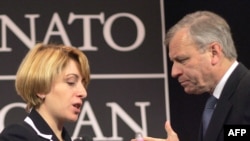
Speaking at a press conference in Brussels on December 3, Georgian Foreign Minister Eka Tkeshelashvili put an optimistic spin on what was clearly a disappointing decision.
"We do feel very firmly that we are much closer to the ultimate goal that we have, which is membership of this organization, in the way how the Bucharest decisions have been reaffirmed," Tkeshelashvili said.
Nitty-Gritty Reform
Georgia and Ukraine's best hope for eventually winning NATO membership, analysts say, is to push ahead with military reforms and hope the international environment turns more favorable to their aspirations.
"I think the hope in NATO and in the incoming Obama administration is that after a few years of nitty-gritty military reform, maybe after a few years both Georgia and Ukraine will look like more credible candidates and maybe the wider political climate will be more favorable," Lucas says.
In addition to reforming their militaries to meet NATO standards, both countries also have a lot of work to do on the political front.
Georgian President Mikheil Saakashvili damaged his country's democratic credentials and harmed its NATO bid in November 2007 when he broke up massive antigovernment demonstrations in Tbilisi and temporarily closed down independent media outlets. Georgia's five-day war with Russia in August and Saakashvili's often erratic conduct during that conflict have also given many in the Western alliance pause.
Ukraine, where a majority of the population oppose membership, is mired in a political crisis and constant bickering between President Viktor Yushchenko and Prime Minister Yulia Tymoshenko.
"If you imagine in three years' time, if we have a stable government in Ukraine, a different Georgian leadership, a Russia that is preoccupied with its own problems, and a more popular American administration, NATO expansion might not look so crazy," Lucas says. "I'm not saying that any of those is certain, but they are all possible, or even probable."
Shortly after NATO declined to grant Georgia and Ukraine their coveted Membership Action Plans (MAPs) at a foreign ministers' meeting this week, the firebrand nationalist who is Russia's envoy to the Atlantic alliance was gloating in front of the television cameras.
"Ukraine and Georgia did not get their plans. Those who took an ice-cold position toward Russia have been thwarted," Rogozin said in an interview on Russian television on December 2.
And at first glance, Rogozin appears to have reason to celebrate. It was the second time in eight months that the Western alliance balked at giving Georgia and Ukraine MAPs, detailed and tailor-made blueprints for military and political reforms that constitute a key step before formally joining the alliance.
Both times -- at the NATO summit in Bucharest in April and at this week's foreign ministers' meeting in Brussels -- the allies appeared to back down in the face of fierce Russian resistance to Tbilisi and Kyiv's bids.
And as Rogozin delighted in pointing out, in both instances the Western alliance was deeply divided with the United States, Great Britain, and a group of Eastern European members supporting expansion, and Germany, France, and Italy staunchly opposing it.
"The divisions in NATO are openly visible. And these will deepen every time NATO tries to expand," Rogozin said.
So is this the end of NATO expansion into the former Soviet space? Not so fast, say analysts familiar with the process.
"I think it is the end of the dream of fairly rapid NATO expansion to Ukraine and Georgia," says Edward Lucas, Central and Eastern European correspondent for the British weekly "The Economist" and author of the book "The New Cold War: How The Kremlin Menaces Russia And The West."
"I think we'll continue to see NATO working quite hard on Ukraine and Georgia, but on specific programs of military reform and modernization. But it won't have a label attached with the word membership."
Changing Geopolitical Landscape
It would be a mistake to assume that the current geopolitical landscape is permanent, analysts say. A new U.S. administration under President-elect Barack Obama will take office in January and will likely have more clout in Europe than that of deeply unpopular outgoing President George W. Bush. Falling oil prices, meanwhile, are battering Russia's economy and reducing Moscow's ability to throw its weight around abroad.
"I think that with President Obama, there will be more understanding between Europe and America. And I'm not sure [this means] that the Russians will have something to be happy about," says Eugeniusz Smolar, director of the Warsaw-based Center for International Relations.
In Bucharest, NATO made a formal pledge to Georgia and Ukraine that they would eventually become members, despite denying them MAP status. That pledge was reiterated again in Brussels this week. The alliance also said it would work closely with each country to help them complete necessary reforms via the NATO-Ukraine Commission and the NATO-Georgia Commission.
Speaking at a press conference in Brussels on December 3, Georgian Foreign Minister Eka Tkeshelashvili put an optimistic spin on what was clearly a disappointing decision.
"We do feel very firmly that we are much closer to the ultimate goal that we have, which is membership of this organization, in the way how the Bucharest decisions have been reaffirmed," Tkeshelashvili said.
Nitty-Gritty Reform
Georgia and Ukraine's best hope for eventually winning NATO membership, analysts say, is to push ahead with military reforms and hope the international environment turns more favorable to their aspirations.
"I think the hope in NATO and in the incoming Obama administration is that after a few years of nitty-gritty military reform, maybe after a few years both Georgia and Ukraine will look like more credible candidates and maybe the wider political climate will be more favorable," Lucas says.
In addition to reforming their militaries to meet NATO standards, both countries also have a lot of work to do on the political front.
Georgian President Mikheil Saakashvili damaged his country's democratic credentials and harmed its NATO bid in November 2007 when he broke up massive antigovernment demonstrations in Tbilisi and temporarily closed down independent media outlets. Georgia's five-day war with Russia in August and Saakashvili's often erratic conduct during that conflict have also given many in the Western alliance pause.
Ukraine, where a majority of the population oppose membership, is mired in a political crisis and constant bickering between President Viktor Yushchenko and Prime Minister Yulia Tymoshenko.
"If you imagine in three years' time, if we have a stable government in Ukraine, a different Georgian leadership, a Russia that is preoccupied with its own problems, and a more popular American administration, NATO expansion might not look so crazy," Lucas says. "I'm not saying that any of those is certain, but they are all possible, or even probable."