




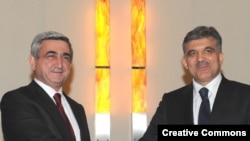
Over the past month, Armenian President Serzh Sarkisian has expressed frustration on three separate occasions that the Turkish government is apparently backpedaling with regard to its April commitment to seek ways to "normalize" bilateral relations without preconditions. Turkey's response to those statements has been cautiously muted.
Sarkisian first publicly called for unconditional rapprochement between Turkey and Armenia over a year before his election as president in February 2008. In September 2008, Turkish President Abdullah Gul visited Yerevan at Sarkisian's invitation to watch a soccer match between the two countries' national teams.
Then in April, following months of Swiss-mediated talks, it was announced that the two sides had agreed on a "road map" intended to lead to the establishment of formal bilateral relations and to the opening of their common border.
The first unconfirmed reports of that impending announcement surfaced in late March and triggered outrage in Azerbaijan, whose leadership had for years argued that any formal agreement by Turkey on closer relations with Armenia should be contingent on key concessions by the latter on the terms for a solution of the Nagorno-Karabakh conflict.
On June 16, Turkey's Ambassador to Azerbaijan Hulusi Kilic told Azerbaijan's APA news agency that no steps had been taken to implement measures outlined in the road map. "Nothing is being done. Nothing has changed," he was quoted as saying. Commenting on July 21 on the apparent stalemate, Richard Giragosian, who heads the Armenian Center for National and International Studies, made the point that "Turkey is surprised: it underestimated the reaction of Azerbaijan and overestimated its own leverage."
The lack of progress in implementing the road map, in conjunction with increasing opposition criticism of the most recent draft of the so-called Madrid Principles for resolving the Karabakh conflict, clearly irks Sarkisian. Speaking in Yerevan on July 6 following talks with visiting Cypriot President Demetris Christofias, Sarkisian said, "we want to eliminate closed borders remaining in Europe and to build normal relationships without preconditions. But in that endeavor, we do not intend to allow [anyone] to use the negotiating process for misleading the international community."
Three weeks later, on July 28, Sarkisian implied that he might refrain from traveling to Turkey in October as planned to watch the return soccer match unless Ankara takes "constructive steps" to "create a proper environment" for that visit. "I will leave for Turkey if we have an open border [by then] or stand on the brink of the lifting of the blockade of Armenia," Sarkisian said.
Then on July 30, at a meeting with young diaspora Armenians, Sarkisian explicitly rejected attempts to link the desired normalization of Armenian-Turkish relations to progress in resolving the Karabakh conflict. Sarkisian recalled that Armenia had "found the strength" to extend a hand in friendship to Turkey despite the legacy of the mass killings of Armenians in the Ottoman Empire. He said that "Armenia and Turkey have been conducting negotiations for a whole year, we have reached agreement on two documents, but now certain Turkish political forces are trying to put forward preconditions and link the establishment of diplomatic relations with Armenia to the Karabakh conflict and to Armenian-Azerbaijani relations."
Sarkisian acknowledged that Turkey is a large and influential country. But he warned at the same time that "we Armenians are an independent nation, and it is inadmissible to talk to us in the language of preconditions. Any tough step brings about a counterreaction." He did not elaborate.
Some Turkish commentators have suggested that such statements by Sarkisian could jeopardize the rapprochement process. But Turkish Foreign Minister Ahmet Davutoglu took a softer position, saying that the "cold war" in bilateral relations is over and that the two countries no longer regard each other as enemies. Davutoglu said he considers it unlikely that Sarkisian will cancel his plans to visit Turkey in October.
Sarkisian first publicly called for unconditional rapprochement between Turkey and Armenia over a year before his election as president in February 2008. In September 2008, Turkish President Abdullah Gul visited Yerevan at Sarkisian's invitation to watch a soccer match between the two countries' national teams.
Then in April, following months of Swiss-mediated talks, it was announced that the two sides had agreed on a "road map" intended to lead to the establishment of formal bilateral relations and to the opening of their common border.
The first unconfirmed reports of that impending announcement surfaced in late March and triggered outrage in Azerbaijan, whose leadership had for years argued that any formal agreement by Turkey on closer relations with Armenia should be contingent on key concessions by the latter on the terms for a solution of the Nagorno-Karabakh conflict.
On June 16, Turkey's Ambassador to Azerbaijan Hulusi Kilic told Azerbaijan's APA news agency that no steps had been taken to implement measures outlined in the road map. "Nothing is being done. Nothing has changed," he was quoted as saying. Commenting on July 21 on the apparent stalemate, Richard Giragosian, who heads the Armenian Center for National and International Studies, made the point that "Turkey is surprised: it underestimated the reaction of Azerbaijan and overestimated its own leverage."
The lack of progress in implementing the road map, in conjunction with increasing opposition criticism of the most recent draft of the so-called Madrid Principles for resolving the Karabakh conflict, clearly irks Sarkisian. Speaking in Yerevan on July 6 following talks with visiting Cypriot President Demetris Christofias, Sarkisian said, "we want to eliminate closed borders remaining in Europe and to build normal relationships without preconditions. But in that endeavor, we do not intend to allow [anyone] to use the negotiating process for misleading the international community."
Three weeks later, on July 28, Sarkisian implied that he might refrain from traveling to Turkey in October as planned to watch the return soccer match unless Ankara takes "constructive steps" to "create a proper environment" for that visit. "I will leave for Turkey if we have an open border [by then] or stand on the brink of the lifting of the blockade of Armenia," Sarkisian said.
Then on July 30, at a meeting with young diaspora Armenians, Sarkisian explicitly rejected attempts to link the desired normalization of Armenian-Turkish relations to progress in resolving the Karabakh conflict. Sarkisian recalled that Armenia had "found the strength" to extend a hand in friendship to Turkey despite the legacy of the mass killings of Armenians in the Ottoman Empire. He said that "Armenia and Turkey have been conducting negotiations for a whole year, we have reached agreement on two documents, but now certain Turkish political forces are trying to put forward preconditions and link the establishment of diplomatic relations with Armenia to the Karabakh conflict and to Armenian-Azerbaijani relations."
Sarkisian acknowledged that Turkey is a large and influential country. But he warned at the same time that "we Armenians are an independent nation, and it is inadmissible to talk to us in the language of preconditions. Any tough step brings about a counterreaction." He did not elaborate.
Some Turkish commentators have suggested that such statements by Sarkisian could jeopardize the rapprochement process. But Turkish Foreign Minister Ahmet Davutoglu took a softer position, saying that the "cold war" in bilateral relations is over and that the two countries no longer regard each other as enemies. Davutoglu said he considers it unlikely that Sarkisian will cancel his plans to visit Turkey in October.