




On a sunny spring day in 2000, then-U.S. President Bill Clinton arrived in Pakistan's capital, Islamabad. The threat of an Al-Qaeda-sponsored attack had led to unprecedented security measures, leading to the deployment of 10,000 soldiers and police officers to protect the few kilometers between the airport and the city.
During his five-hour stay, the American president spoke directly to the Pakistani people in a speech broadcast live on national television and radio.
"We have both suffered enough to know that no grievance, no cause, no system of beliefs can ever justify the deliberate killing of innocents," he told them. "Those who bomb bus stations, target embassies or kill those who uphold the law are not heroes."
What the U.S. president then said about the disputed Himalayan region of Kashmir surely didn't please many in the Pakistani military establishment who had assumed power under the leadership of General Pervez Musharraf in October 1999.
"There is no military solution to Kashmir," Bill Clinton asserted. "International sympathy, support, and intervention cannot be won by provoking a bigger, bloodier conflict."
'Mortal Threat'
Nine years later, addressing the U.S. House Foreign Affairs Committee in Washington on April 23, former first lady and current U.S. Secretary of State Hillary Clinton described Pakistan as "a mortal threat to the security and safety of our country and the world."
She warned of "continuing advances...by a loosely confederated group of terrorists and others who are seeking the overthrow of the Pakistani state, which is, as we all know, a nuclear-armed state."
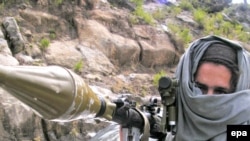
Secretary Clinton's comments followed news that Taliban militants had expanded their control from Pakistan's western border regions by taking the Buner district, placing them within 110 kilometers of Islamabad and positioning them to threaten Mardan, the second largest city in the Northwest Frontier Province.
After years of bloodshed and calls for nonviolent means to end Pakistan's internal conflicts, the country is clearly struggling for its survival, with Islamic militants now eying Pakistan's heartland: the rich plains of the eastern Punjab province.
In an effort to identify the roots of the dilemma, some Pakistan watchers point to theories suggesting that the Pakistani military and its intelligence services grew adept over the past three decades at exploiting Islamic militancy by using militants as proxies, first in neighboring Afghanistan and then in Kashmir.
That approach continues today, experts argue, with some in the Pakistani military establishment viewing Islamic militants as strategic assets while perceiving the United States as a global superpower whose engagements in the region will ultimately result in a docile Pakistan living in the shadow of archenemy India.
Military In Difficulty
Hawkish former Pakistani generals, including Hamid Gul and Mirza Aslam Baig, have publicly and forcefully expressed such views. They have alleged that the ultimate U.S. aim is to take control of Pakistan's nuclear arsenal. Both generals described Osama Bin Laden as a "great Muslim warrior." Pakistani President Asif Ali Zardari once described Gul as a "political ideologue of terror."
Some Pakistan observers stress the importance of acknowledging the nuances of the situation, rather than seeking easy answers in hastily applied labels.
"I don't personally see a grand strategy," says Marvin Weinbaum, a veteran regional expert who has followed Pakistan for the past four decades and is currently a specialist at the Middle East Institute. "[Pakistan] still needs the United States, and the idea that somehow it's going to allow the Pakistani Taliban to 'Talibanize' large parts of Pakistan as a way of somehow leveraging the United States is far-fetched to me and speaks of conspiracy theory."
Weinbaum concedes that "this is a [Pakistani] military which is, honestly, in difficulty." He warns that "it cannot really pursue the kind of policy against the Pakistani Taliban because it's not now even sure of its own ranks and the support of its own troops and junior officers."
Relations between Islamabad and Washington soured recently, after senior U.S. military officers publicly accused Pakistan's premier military intelligence agency, the Directorate of Inter-Services Intelligence (ISI), of maintaining close ties to the Taliban.
Although the issue only recently came into media focus, Washington has been urging reforms to the ISI since 2001. Experts suggest that, despite purges, some militant groups -- in particular, including the leaders of the Afghan Taliban -- receive direct support from the ISI.
'Nightmare Scenario'
In her remarks on April 22, Clinton expressed concern over recent concessions that the Pakistani government has made to the Taliban, including Zardari's recent signing of law allowing Shari'a law in the country's western Swat Valley.
"I think that the Pakistani government is basically abdicating to the Taliban and to the extremists," Clinton told the U.S. House Foreign Affairs Committee.
However, regional expert Weinbaum argues that the Pakistani military's perceived threats differ from those of the United States. That might explain suspicions that its intelligence agency continues to play both sides -- helping the United States while supporting some Taliban groups it considers vital to Islamabad's national-security interests.
"At this stage, at least, the ISI is pretty much...immune from any kind of serious change," Weinbaum says, adding that such a situation does not exclude the kind of ISI cooperation with the United States that has been happening since 2001.
"So what we have here is an ISI which has two faces to it," Weinbaum says. "One face has been cooperative, up to a point at least; and the other face has pursued what it considered to be the military's interest and also what it considered to be Pakistan's interest. And, ordinarily speaking, those have frequently not been coincidental with what American interests are."
In addition to Taliban successes in Buner, reports suggest the Taliban is strengthening its influence and stepping up attacks in Pakistan's most populous and politically important province, Punjab.
Weinbaum says that should represent the "nightmare scenario" for the Pakistani military, most of whose officers and soldiers hail from Punjab.
"If the law and order breaks down in the Punjab, the corps commanders [and] General [Ashfaq Pervez] Kayani know that they cannot order their troops into the streets in a fashion that would kill Punjabis," Weinbaum says. "This has always been a rule of thumb here: that the military cannot be used against the Punjabi, the people of the Punjab."
He calls such a scenario reminiscent of Mohammad Reza Shah Pahlavi's last days in Iran, when "the military was placed in the position where it could not act against the crowds that were gathering."
He warns that "we may see a replay of that. There are just too many parallels with the late 1970s in Iran."
If U.S. President Barack Obama meets with Afghan President Hamid Karzai and Pakistani President Zardari in early May, as some expect, preventing such a scenario might well be a key topic of conversation.
Out of concern for the safety of the author, an RFE/RL correspondent, this article contains no byline
During his five-hour stay, the American president spoke directly to the Pakistani people in a speech broadcast live on national television and radio.
"We have both suffered enough to know that no grievance, no cause, no system of beliefs can ever justify the deliberate killing of innocents," he told them. "Those who bomb bus stations, target embassies or kill those who uphold the law are not heroes."
What the U.S. president then said about the disputed Himalayan region of Kashmir surely didn't please many in the Pakistani military establishment who had assumed power under the leadership of General Pervez Musharraf in October 1999.
"There is no military solution to Kashmir," Bill Clinton asserted. "International sympathy, support, and intervention cannot be won by provoking a bigger, bloodier conflict."
'Mortal Threat'
Nine years later, addressing the U.S. House Foreign Affairs Committee in Washington on April 23, former first lady and current U.S. Secretary of State Hillary Clinton described Pakistan as "a mortal threat to the security and safety of our country and the world."
She warned of "continuing advances...by a loosely confederated group of terrorists and others who are seeking the overthrow of the Pakistani state, which is, as we all know, a nuclear-armed state."
Secretary Clinton's comments followed news that Taliban militants had expanded their control from Pakistan's western border regions by taking the Buner district, placing them within 110 kilometers of Islamabad and positioning them to threaten Mardan, the second largest city in the Northwest Frontier Province.
After years of bloodshed and calls for nonviolent means to end Pakistan's internal conflicts, the country is clearly struggling for its survival, with Islamic militants now eying Pakistan's heartland: the rich plains of the eastern Punjab province.
In an effort to identify the roots of the dilemma, some Pakistan watchers point to theories suggesting that the Pakistani military and its intelligence services grew adept over the past three decades at exploiting Islamic militancy by using militants as proxies, first in neighboring Afghanistan and then in Kashmir.
That approach continues today, experts argue, with some in the Pakistani military establishment viewing Islamic militants as strategic assets while perceiving the United States as a global superpower whose engagements in the region will ultimately result in a docile Pakistan living in the shadow of archenemy India.
Military In Difficulty
Hawkish former Pakistani generals, including Hamid Gul and Mirza Aslam Baig, have publicly and forcefully expressed such views. They have alleged that the ultimate U.S. aim is to take control of Pakistan's nuclear arsenal. Both generals described Osama Bin Laden as a "great Muslim warrior." Pakistani President Asif Ali Zardari once described Gul as a "political ideologue of terror."
Some Pakistan observers stress the importance of acknowledging the nuances of the situation, rather than seeking easy answers in hastily applied labels.
"I don't personally see a grand strategy," says Marvin Weinbaum, a veteran regional expert who has followed Pakistan for the past four decades and is currently a specialist at the Middle East Institute. "[Pakistan] still needs the United States, and the idea that somehow it's going to allow the Pakistani Taliban to 'Talibanize' large parts of Pakistan as a way of somehow leveraging the United States is far-fetched to me and speaks of conspiracy theory."
Weinbaum concedes that "this is a [Pakistani] military which is, honestly, in difficulty." He warns that "it cannot really pursue the kind of policy against the Pakistani Taliban because it's not now even sure of its own ranks and the support of its own troops and junior officers."
Relations between Islamabad and Washington soured recently, after senior U.S. military officers publicly accused Pakistan's premier military intelligence agency, the Directorate of Inter-Services Intelligence (ISI), of maintaining close ties to the Taliban.
Although the issue only recently came into media focus, Washington has been urging reforms to the ISI since 2001. Experts suggest that, despite purges, some militant groups -- in particular, including the leaders of the Afghan Taliban -- receive direct support from the ISI.
'Nightmare Scenario'
In her remarks on April 22, Clinton expressed concern over recent concessions that the Pakistani government has made to the Taliban, including Zardari's recent signing of law allowing Shari'a law in the country's western Swat Valley.
"I think that the Pakistani government is basically abdicating to the Taliban and to the extremists," Clinton told the U.S. House Foreign Affairs Committee.
However, regional expert Weinbaum argues that the Pakistani military's perceived threats differ from those of the United States. That might explain suspicions that its intelligence agency continues to play both sides -- helping the United States while supporting some Taliban groups it considers vital to Islamabad's national-security interests.
"At this stage, at least, the ISI is pretty much...immune from any kind of serious change," Weinbaum says, adding that such a situation does not exclude the kind of ISI cooperation with the United States that has been happening since 2001.
"So what we have here is an ISI which has two faces to it," Weinbaum says. "One face has been cooperative, up to a point at least; and the other face has pursued what it considered to be the military's interest and also what it considered to be Pakistan's interest. And, ordinarily speaking, those have frequently not been coincidental with what American interests are."
In addition to Taliban successes in Buner, reports suggest the Taliban is strengthening its influence and stepping up attacks in Pakistan's most populous and politically important province, Punjab.
Weinbaum says that should represent the "nightmare scenario" for the Pakistani military, most of whose officers and soldiers hail from Punjab.
"If the law and order breaks down in the Punjab, the corps commanders [and] General [Ashfaq Pervez] Kayani know that they cannot order their troops into the streets in a fashion that would kill Punjabis," Weinbaum says. "This has always been a rule of thumb here: that the military cannot be used against the Punjabi, the people of the Punjab."
He calls such a scenario reminiscent of Mohammad Reza Shah Pahlavi's last days in Iran, when "the military was placed in the position where it could not act against the crowds that were gathering."
He warns that "we may see a replay of that. There are just too many parallels with the late 1970s in Iran."
If U.S. President Barack Obama meets with Afghan President Hamid Karzai and Pakistani President Zardari in early May, as some expect, preventing such a scenario might well be a key topic of conversation.
Out of concern for the safety of the author, an RFE/RL correspondent, this article contains no byline