




Former Bosnian Serb leader Radovan Karadzic appeared today in the Yugoslav war crimes tribunal's courtroom in The Hague for the first time since his trial began last week.
Karadzic, who faces charges of genocide, crimes against humanity, and ethnic cleansing during the 1992-95 Bosnian War, is remembered for his role in two of the war's grimmest chapters -- the massacre of 8,000 Muslim boys and men at Srebrenica, and the devastating siege of the Bosnian capital, Sarajevo, which lasted nearly four years and left an estimated 10,000 people dead or missing.
Gordana Knezevic, the director of RFE/RL's Balkan Service, was working as the deputy editor of Sarajevo's "Oslobodjenje" daily during the first two years of the siege. She remembers life during the siege and her struggle to understand the motivations fueling Karadzic, "the butcher of Bosnia."
By Gordana Knezevic
The first bullets that were fired shattered the windows of my newsroom at the "Oslobodjenje" daily. It was Sarajevo, in April 1992. Neither Radovan Karadzic, the Bosnian Serb leader, nor his military commanders setting siege to the city, had given any warning.
News arrived from Zvornik, a town in eastern Bosnia, that Serb forces had killed our correspondent Kjasif Smajlovic in his office. It wasn't until after the war that his body was recovered from a mass grave.
Our editorial meeting that day served as a memorial service for Kjasif. Who would know about his tragic death if we weren't able to put out the paper? On that day, and every day that followed, our challenge became figuring out how to run a daily paper without newsprint, phone lines to the outside world, or regular power supplies.
The structure of our civil life was broken. The road to "Oslobodjenje" was under constant sniper fire, and the building itself was targeted by artillery from a nearby army barracks. The homes of staff members turned into offices, while the newsroom -- moved to an underground shelter -- became a temporary home for the desk editors.
Our building was disappearing under a pile of rubble, the result of shelling by Karadzic's forces. But the daily bombardments didn't crush our determination to report and publish the news, no matter how grim the circumstances.
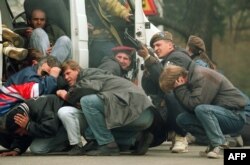 A Bosnian special forces soldier returns fire from Serb extremists who were shooting at a peace demonstration in downtown Sarajevo on April 6, 1992.That summer, however, my colleague Salko Hondo was killed, and I was drained of all confidence. I was the last person to talk to him before he walked to his death. We had discussed a story by a young journalist about a freshwater spring that had been discovered in the back yard of a Sarajevan home.
In our besieged city -- where depriving us of life's basic necessities was part of Karadzic's attempt to keep the city in a state of desperation and terror -- any source of water, no matter how tiny, was news.
All we needed was a photo. Salko volunteered, cheerful as always. On his way back, he passed by the central market at the moment of a massive artillery attack. Thousands of shells were unleashed by Karadzic, unprovoked and unexpected. Salko and seven others were killed that day, with many more wounded.
The only thing left was his camera, flung some distance away by the force of the blast. A photograph showing happy Sarajevans gathered around a garden spring, drops of water glistening on their faces, was published the following day as part of Salko's obituary. Faced with the loss of a friend, I felt defeated. All our efforts seemed meaningless. No story was worth dying for.
Simple Message
In the indiscriminate slaughter of civilians, there could be no logic other than a desire to bring us all to our knees. Karadzic and his supporters, secure in the hills surrounding the city, wanted to scare us to death, to allow his army to walk into the city and divvy it up. Serbs would be on one side, Muslims on the other. Croats, as far as he was concerned, could walk back to Croatia. He might even provide them buses, as an act of generosity.
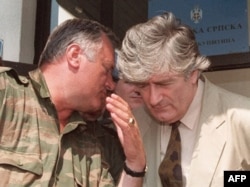 Radovan Karadzic (right) listens to Bosnian Serb wartime commander Ratko Mladic in Pale on August 5, 1993.His message was simple and had been repeated hundreds of times before the war: that people of different ethnic backgrounds cannot live together. Whatever the question put to him, his answer was the same, a constant, menacing mantra: "As long as Yugoslavia is breaking up, Bosnia cannot exist as a multiethnic country."
But my newspaper -- where people of different ethnicities continued to work together to put out the only daily in town -- was living proof that he was wrong. That's why we were targeted. "Oslobodjenje" was an uncomfortable and inconvenient reminder of Bosnian reality.
In this way, it was Karadzic, despite his best efforts, who gave me a reason to pull myself together. In spite of the military power he had acquired, and the terror that he had already sown, I decided that I would not be intimidated by Karadzic and his plans to build a Greater Serbia at Bosnia's expense. And so I went to talk to his former colleague from his former career as a psychiatrist -- Ismet Ceric, the chief of psychiatry at Sarajevo's Kosevo hospital.
"Don't worry," he reassured me. "If Radovan is commanding the army, they will lose the war. I keep seeing him on television looking at topographic maps, and I know he can't read those maps. He hasn't had a single day of military training."
An Average Man
I was surprised by how calm Ceric was, especially as a Muslim. He described Karadzic as an average doctor and an average man. It was not at all the account I was desperate for -- something that would help explain his evolution into a mass murderer.
"He didn't discriminate between patients based on nationality or religion. The way he performed his functions as a doctor was quite normal." That was all I could get from Ceric. It was only after I read German-Jewish philosopher Hannah Arendt's observations on Holocaust architect Adolph Eichmann that I was finally able to understand what Ceric was talking about:
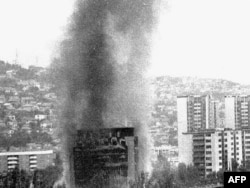 A building burns in Sarajevo following Serb shelling on August 5, 1992."The trouble with Eichmann was precisely that so many were like him and that many were neither perverted nor sadistic, that they were and still are terribly and terrifyingly normal," Arendt writes in her book, "Eichmann in Jerusalem," in which she coined the historic phrase, "the banality of evil." "From the viewpoint of our legal institutions and of our moral standards of judgment, this normality was much more terrifying than all the atrocities put together."
Arendt observed that the entire world wanted to see a monster, the person responsible for the deaths of millions of Jews, and that instead, the judges at his trial in Israel were facing a "new type of criminal" who, to the contrary, appeared at moments almost clownish.
Eichmann notoriously expressed a desire to reconcile with his enemies. In one of his letters from The Hague, Karadzic did the same, saying that he was "sorry for all the victims of the war." But, like Eichmann, Karadzic is utterly incapable of recognizing his personal responsibility for those victims. In his own sense of wartime reality, he was simply creating a "lebensraum" for Serbs.
It's hard to comprehend that the man who today will finally appear at his trial at The Hague tribunal is a plain and ordinary person doing his best to avoid justice. Karadzic's apparent "normality" is absolutely incongruous with the extent of his crimes.
The views expressed in this commentary are the author's own and do not necessarily reflect those of RFE/RL.
Karadzic, who faces charges of genocide, crimes against humanity, and ethnic cleansing during the 1992-95 Bosnian War, is remembered for his role in two of the war's grimmest chapters -- the massacre of 8,000 Muslim boys and men at Srebrenica, and the devastating siege of the Bosnian capital, Sarajevo, which lasted nearly four years and left an estimated 10,000 people dead or missing.
Gordana Knezevic, the director of RFE/RL's Balkan Service, was working as the deputy editor of Sarajevo's "Oslobodjenje" daily during the first two years of the siege. She remembers life during the siege and her struggle to understand the motivations fueling Karadzic, "the butcher of Bosnia."
By Gordana Knezevic
The first bullets that were fired shattered the windows of my newsroom at the "Oslobodjenje" daily. It was Sarajevo, in April 1992. Neither Radovan Karadzic, the Bosnian Serb leader, nor his military commanders setting siege to the city, had given any warning.
News arrived from Zvornik, a town in eastern Bosnia, that Serb forces had killed our correspondent Kjasif Smajlovic in his office. It wasn't until after the war that his body was recovered from a mass grave.
Our editorial meeting that day served as a memorial service for Kjasif. Who would know about his tragic death if we weren't able to put out the paper? On that day, and every day that followed, our challenge became figuring out how to run a daily paper without newsprint, phone lines to the outside world, or regular power supplies.
The structure of our civil life was broken. The road to "Oslobodjenje" was under constant sniper fire, and the building itself was targeted by artillery from a nearby army barracks. The homes of staff members turned into offices, while the newsroom -- moved to an underground shelter -- became a temporary home for the desk editors.
Our building was disappearing under a pile of rubble, the result of shelling by Karadzic's forces. But the daily bombardments didn't crush our determination to report and publish the news, no matter how grim the circumstances.

In our besieged city -- where depriving us of life's basic necessities was part of Karadzic's attempt to keep the city in a state of desperation and terror -- any source of water, no matter how tiny, was news.
All we needed was a photo. Salko volunteered, cheerful as always. On his way back, he passed by the central market at the moment of a massive artillery attack. Thousands of shells were unleashed by Karadzic, unprovoked and unexpected. Salko and seven others were killed that day, with many more wounded.
The only thing left was his camera, flung some distance away by the force of the blast. A photograph showing happy Sarajevans gathered around a garden spring, drops of water glistening on their faces, was published the following day as part of Salko's obituary. Faced with the loss of a friend, I felt defeated. All our efforts seemed meaningless. No story was worth dying for.
Simple Message
In the indiscriminate slaughter of civilians, there could be no logic other than a desire to bring us all to our knees. Karadzic and his supporters, secure in the hills surrounding the city, wanted to scare us to death, to allow his army to walk into the city and divvy it up. Serbs would be on one side, Muslims on the other. Croats, as far as he was concerned, could walk back to Croatia. He might even provide them buses, as an act of generosity.

But my newspaper -- where people of different ethnicities continued to work together to put out the only daily in town -- was living proof that he was wrong. That's why we were targeted. "Oslobodjenje" was an uncomfortable and inconvenient reminder of Bosnian reality.
In this way, it was Karadzic, despite his best efforts, who gave me a reason to pull myself together. In spite of the military power he had acquired, and the terror that he had already sown, I decided that I would not be intimidated by Karadzic and his plans to build a Greater Serbia at Bosnia's expense. And so I went to talk to his former colleague from his former career as a psychiatrist -- Ismet Ceric, the chief of psychiatry at Sarajevo's Kosevo hospital.
"Don't worry," he reassured me. "If Radovan is commanding the army, they will lose the war. I keep seeing him on television looking at topographic maps, and I know he can't read those maps. He hasn't had a single day of military training."
An Average Man
I was surprised by how calm Ceric was, especially as a Muslim. He described Karadzic as an average doctor and an average man. It was not at all the account I was desperate for -- something that would help explain his evolution into a mass murderer.
"He didn't discriminate between patients based on nationality or religion. The way he performed his functions as a doctor was quite normal." That was all I could get from Ceric. It was only after I read German-Jewish philosopher Hannah Arendt's observations on Holocaust architect Adolph Eichmann that I was finally able to understand what Ceric was talking about:
Arendt observed that the entire world wanted to see a monster, the person responsible for the deaths of millions of Jews, and that instead, the judges at his trial in Israel were facing a "new type of criminal" who, to the contrary, appeared at moments almost clownish.
Eichmann notoriously expressed a desire to reconcile with his enemies. In one of his letters from The Hague, Karadzic did the same, saying that he was "sorry for all the victims of the war." But, like Eichmann, Karadzic is utterly incapable of recognizing his personal responsibility for those victims. In his own sense of wartime reality, he was simply creating a "lebensraum" for Serbs.
It's hard to comprehend that the man who today will finally appear at his trial at The Hague tribunal is a plain and ordinary person doing his best to avoid justice. Karadzic's apparent "normality" is absolutely incongruous with the extent of his crimes.
The views expressed in this commentary are the author's own and do not necessarily reflect those of RFE/RL.