





Three weeks before Afghanistan’s presidential election, thousands of people were already shouting "Karzai is the winner!"
They were gathered at a campaign rally on August 1 in central Afghanistan's Kayan Valley, friendly territory for President Hamid Karzai. The strongman presiding over the region, Syed Mansoor Nadiri, claims he can deliver 1 million votes for the incumbent from the minority Ismaili community.
The Karzai supporters in the Kayan Valley are among some 36 percent of Afghan voters who favor the incumbent, according to a recent poll, placing him 16 points ahead of his closest rival, Abdullah Abdullah. Among decided voters, Karzai boasts a 20 percent lead, with 45 percent favoring him against his rival's 25 percent.
The key to an easy election win may be the 20 percent of Afghan voters who are still undecided, as Karzai will need their support to win the 50 percent-plus-one majority necessary to avoid a second round.
Karzai, who has dominated the country's politics since taking over under a UN-backed deal in 2001, appears confident of victory. In Kayan, he began his speech by claiming his opponents are free to campaign everywhere in Afghanistan. In doing so, he took on the persona of the founding father of a democratic Afghanistan where political rivals can focus on competing for ballots rather than plotting to capture Kabul by force.
In July, before a gathering of turbaned Kandahari Pashtun elders in his native Kandahar, Karzai outlined his plans for a second term. "If I am elected by the votes of the Afghan people -- if I win because of their free choice -- I will first try to bring peace to Afghanistan," he said, to a round of applause.
"Peace means that we have to bring our Taliban and other alienated brothers into a process of negotiations. Our second objective is to further improve and strengthen our relations with the world," Karzai said.
Karzai also promised improved governance and a renewed focus on reconstruction. His failures in those areas to date have made his administration unpopular while diminishing his personal appeal.
Chameleonic Leader
Born into an aristocratic Popalzai Pashtun family, the 52-year-old Karzai sometimes seems to be trying to be all things to all people across the Afghan political spectrum. He has welcomed Western-trained technocrats, warlords, mujahedin factional leaders, Afghan nationalists, and former communists to return to their homeland and work together.
 An election banner in Kabul
Elizabeth Rubin, an American freelance reporter who spent many days at Karzai's Arg presidential palace this past winter, tells RFE/RL that it is difficult to define Karzai.
"He is very hard to pin down and especially now that he has become president," Rubin says. She adds that part of him is "very theatrical" and "really gets turned on by performance and by hearing himself on stage."
After the demise of the Taliban regime in 2001, Karzai projected the image of a determined young Afghan leader, adopting a blue and green chapan cloak and a lambskin karakul hat as he took on the task of healing a deeply traumatized and fragmented Afghanistan.
But his eight-year journey -- starting when he was named Transitional Administration chairman in December 2001, including his time as interim president from June 2002, and through his presidential term that began in 2004 -- has received mixed reviews. His supporters credit him with providing democratic order under "the most progressive constitution in the Islamic world," as his official spokesman Humayun Hamidzada puts it.
Following the initial military success against the Taliban and the window of opportunity created by a new political order and aid dollars, the Afghan economy quickly began to bounce back. It still boasts a steady growth rate and a mushrooming private sector. Media outlets have flourished.
More than 5 million Afghan refugees have returned home since 2002, and a majority of its 33 million people have access to basic health care. Millions of Afghan children and youth now attend schools or universities.
The Taliban tried to turn the country into an Islamist caliphate, but Afghanistan now has a semblance of state institutions. The country remains high on the international agenda and has more international backing than at any point in its long and tumultuous history.
But other indicators paint a more pessimistic picture. Some 8 million Afghans still face food shortages, and insecurity is growing. Government corruption, joblessness, and impunity for the perpetrators of past crimes are among the most talked-about issues in Afghan homes and teahouses. This creates uncertainty and has led some pundits to predict doomsday scenarios.
Where To Turn?
Unlike many leaders in the region, Karzai enjoys a certain legitimacy as an elected leader. But he has always lacked the resources, real power, and authority to implement his policies.
Rubin suggests that many share the blame for the failures often attributed to Karzai alone.
"The blame goes in part to the way the [George W.] Bush administration worked with Karzai -- what they wanted from Afghanistan – [and] the way that they were distracted by Iraq," she says.
Rubin says she would blame Karzai for "not having a very clear vision and [not] pursuing specific goals." But she similarly blames NATO member states for failing to "get their act together to decide on one common goal for Afghanistan and have one common leadership."
"So you had countries going in and pushing him in different directions on the same issue whether it was drugs, Taliban, development [and] the police," she says.
Karzai claims Mohandas Gandhi and Pashtun pacifist Abdul Ghaffar Khan as his political models. But once in power he was surrounded with mujahedin commanders whose past atrocities lead Afghans to refer to them as warlords. Their return to power was subsequently bankrolled by the U.S.-led coalition, seemingly because of their value as military allies against the Taliban and Al-Qaeda.
Karzai sought to distance himself from the warlords after winning election in 2004. But he soon discovered that he had no real power base and that the warlords were even more troublesome out of office. By the end of 2007, he had brought many associates of former prime minister and current insurgent leader Gulbuddin Hekmatyar into his fold to consolidate a power base.
'Big Tent' Approach
While it appeared that his honeymoon with the international community was over early this year, one of his key election maneuvers was to build a formidable alliance of regional warlords. In early May, Karzai chose powerful ethnic-Tajik commander Mohammad Qasim Fahim Khan as his running mate.
Khan explained Karzai's mujahedin dilemma during a recent campaign speech in northeastern Badakhshan Province. "During Karzai's elected term -- especially after having completed the first two years of his five-year elected term -- he used to say forcefully that 'the reasons for my decline and weakness are that I expelled the mujahedin from my government,'" Khan told supporters.
For his reelection bid, Karzai has continued to build alliances with warlords. Karim Khalili, his current deputy vice president and leader of a Hazara political and military faction, would retain that position in a new Karzai administration.
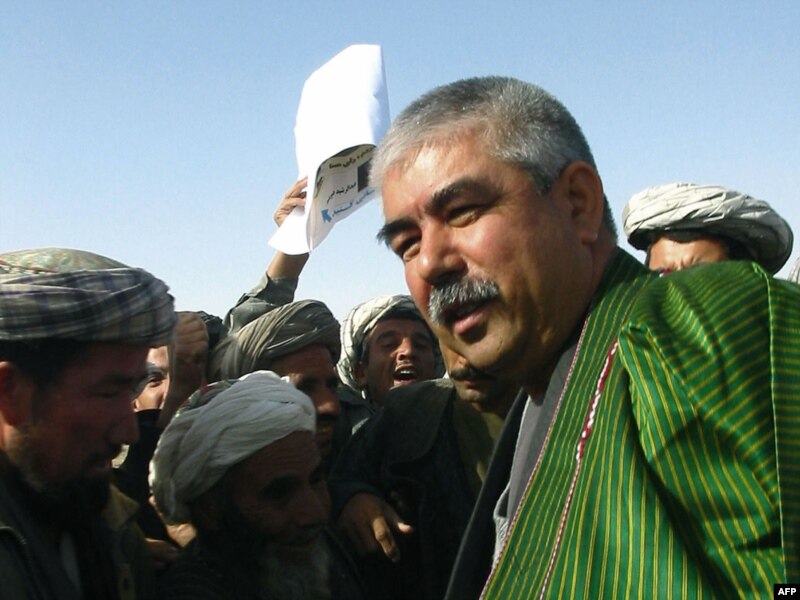
 Ethnic Uzbek warlord General Abdul Rashid Dostum is among Karzai's allies.
Among those campaigning for Karzai are Wahhabi leader Abdul Rab Rasul Sayyaf, powerful ethnic Uzbek warlord General Abdul Rashid Dostum, and Pashtun warlords Sher Muhammad Akhudzada and Gul Agha Sherzai.
Another warlord, Mohammad Mohaqiq, has declared public support for a new term for Karzai. Some minor political parties and tribal leaders also support him.
There are reports that Karzai secured the backing of many with promises of cabinet posts in a future administration.
Karzai calls his approach "Musharikat-e Milli," or national participation, and recently announced plans to hold a Loya Jirga, or Grand Council, to bring back Taliban and Hezb-i Islami to "find the ways for peace and security and put an end to foreign influence."
Rubin suggests this "big tent" approach might ultimately prove too inclusive to succeed.
"He has promised so much to so many different people and so many different factions that he is going to have a very hard time pursuing a vision," she says, "unless there is the inner Karzai that says, 'You know, I want to leave behind a legacy of change and peace and democracy and development.'"
His supporters, however, suggest that Karzai intimately understands his country, and that his approach is the best response to the complexities of governing Afghanistan.
In eastern Nangarhar Province, Pashtun tribal leader Malik Nyaz compared Karzai’s mission to building a sturdy Afghan house.
"Karzai took over power in Afghanistan at a time it was like a house whose four walls had fallen. Now how can Karzai fix those four walls in one or two years?" Nyaz asked. "What we have seen is that he has started rebuilding these walls and has built three with only one remaining [to be built]. If he is elected for another term, it's possible he will build that one remaining wall and bring Afghanistan together."
The question is whether Afghans are willing to stake their future on a leader who focuses on delivering peace, democracy, and development, and who worries less about keeping the country's notorious strongmen happy.

They were gathered at a campaign rally on August 1 in central Afghanistan's Kayan Valley, friendly territory for President Hamid Karzai. The strongman presiding over the region, Syed Mansoor Nadiri, claims he can deliver 1 million votes for the incumbent from the minority Ismaili community.
The Karzai supporters in the Kayan Valley are among some 36 percent of Afghan voters who favor the incumbent, according to a recent poll, placing him 16 points ahead of his closest rival, Abdullah Abdullah. Among decided voters, Karzai boasts a 20 percent lead, with 45 percent favoring him against his rival's 25 percent.
The key to an easy election win may be the 20 percent of Afghan voters who are still undecided, as Karzai will need their support to win the 50 percent-plus-one majority necessary to avoid a second round.
Karzai, who has dominated the country's politics since taking over under a UN-backed deal in 2001, appears confident of victory. In Kayan, he began his speech by claiming his opponents are free to campaign everywhere in Afghanistan. In doing so, he took on the persona of the founding father of a democratic Afghanistan where political rivals can focus on competing for ballots rather than plotting to capture Kabul by force.
In July, before a gathering of turbaned Kandahari Pashtun elders in his native Kandahar, Karzai outlined his plans for a second term. "If I am elected by the votes of the Afghan people -- if I win because of their free choice -- I will first try to bring peace to Afghanistan," he said, to a round of applause.
"Peace means that we have to bring our Taliban and other alienated brothers into a process of negotiations. Our second objective is to further improve and strengthen our relations with the world," Karzai said.
Karzai also promised improved governance and a renewed focus on reconstruction. His failures in those areas to date have made his administration unpopular while diminishing his personal appeal.
Chameleonic Leader
Born into an aristocratic Popalzai Pashtun family, the 52-year-old Karzai sometimes seems to be trying to be all things to all people across the Afghan political spectrum. He has welcomed Western-trained technocrats, warlords, mujahedin factional leaders, Afghan nationalists, and former communists to return to their homeland and work together.
An election banner in Kabul"He is very hard to pin down and especially now that he has become president," Rubin says. She adds that part of him is "very theatrical" and "really gets turned on by performance and by hearing himself on stage."
After the demise of the Taliban regime in 2001, Karzai projected the image of a determined young Afghan leader, adopting a blue and green chapan cloak and a lambskin karakul hat as he took on the task of healing a deeply traumatized and fragmented Afghanistan.
But his eight-year journey -- starting when he was named Transitional Administration chairman in December 2001, including his time as interim president from June 2002, and through his presidential term that began in 2004 -- has received mixed reviews. His supporters credit him with providing democratic order under "the most progressive constitution in the Islamic world," as his official spokesman Humayun Hamidzada puts it.
Following the initial military success against the Taliban and the window of opportunity created by a new political order and aid dollars, the Afghan economy quickly began to bounce back. It still boasts a steady growth rate and a mushrooming private sector. Media outlets have flourished.
More than 5 million Afghan refugees have returned home since 2002, and a majority of its 33 million people have access to basic health care. Millions of Afghan children and youth now attend schools or universities.
The Taliban tried to turn the country into an Islamist caliphate, but Afghanistan now has a semblance of state institutions. The country remains high on the international agenda and has more international backing than at any point in its long and tumultuous history.
But other indicators paint a more pessimistic picture. Some 8 million Afghans still face food shortages, and insecurity is growing. Government corruption, joblessness, and impunity for the perpetrators of past crimes are among the most talked-about issues in Afghan homes and teahouses. This creates uncertainty and has led some pundits to predict doomsday scenarios.
Where To Turn?
Unlike many leaders in the region, Karzai enjoys a certain legitimacy as an elected leader. But he has always lacked the resources, real power, and authority to implement his policies.
Rubin suggests that many share the blame for the failures often attributed to Karzai alone.
"The blame goes in part to the way the [George W.] Bush administration worked with Karzai -- what they wanted from Afghanistan – [and] the way that they were distracted by Iraq," she says.
Rubin says she would blame Karzai for "not having a very clear vision and [not] pursuing specific goals." But she similarly blames NATO member states for failing to "get their act together to decide on one common goal for Afghanistan and have one common leadership."
"So you had countries going in and pushing him in different directions on the same issue whether it was drugs, Taliban, development [and] the police," she says.
Karzai claims Mohandas Gandhi and Pashtun pacifist Abdul Ghaffar Khan as his political models. But once in power he was surrounded with mujahedin commanders whose past atrocities lead Afghans to refer to them as warlords. Their return to power was subsequently bankrolled by the U.S.-led coalition, seemingly because of their value as military allies against the Taliban and Al-Qaeda.
Karzai sought to distance himself from the warlords after winning election in 2004. But he soon discovered that he had no real power base and that the warlords were even more troublesome out of office. By the end of 2007, he had brought many associates of former prime minister and current insurgent leader Gulbuddin Hekmatyar into his fold to consolidate a power base.
'Big Tent' Approach
While it appeared that his honeymoon with the international community was over early this year, one of his key election maneuvers was to build a formidable alliance of regional warlords. In early May, Karzai chose powerful ethnic-Tajik commander Mohammad Qasim Fahim Khan as his running mate.
Khan explained Karzai's mujahedin dilemma during a recent campaign speech in northeastern Badakhshan Province. "During Karzai's elected term -- especially after having completed the first two years of his five-year elected term -- he used to say forcefully that 'the reasons for my decline and weakness are that I expelled the mujahedin from my government,'" Khan told supporters.
For his reelection bid, Karzai has continued to build alliances with warlords. Karim Khalili, his current deputy vice president and leader of a Hazara political and military faction, would retain that position in a new Karzai administration.
Another warlord, Mohammad Mohaqiq, has declared public support for a new term for Karzai. Some minor political parties and tribal leaders also support him.
There are reports that Karzai secured the backing of many with promises of cabinet posts in a future administration.
Karzai calls his approach "Musharikat-e Milli," or national participation, and recently announced plans to hold a Loya Jirga, or Grand Council, to bring back Taliban and Hezb-i Islami to "find the ways for peace and security and put an end to foreign influence."
Rubin suggests this "big tent" approach might ultimately prove too inclusive to succeed.
"He has promised so much to so many different people and so many different factions that he is going to have a very hard time pursuing a vision," she says, "unless there is the inner Karzai that says, 'You know, I want to leave behind a legacy of change and peace and democracy and development.'"
His supporters, however, suggest that Karzai intimately understands his country, and that his approach is the best response to the complexities of governing Afghanistan.
In eastern Nangarhar Province, Pashtun tribal leader Malik Nyaz compared Karzai’s mission to building a sturdy Afghan house.
"Karzai took over power in Afghanistan at a time it was like a house whose four walls had fallen. Now how can Karzai fix those four walls in one or two years?" Nyaz asked. "What we have seen is that he has started rebuilding these walls and has built three with only one remaining [to be built]. If he is elected for another term, it's possible he will build that one remaining wall and bring Afghanistan together."
The question is whether Afghans are willing to stake their future on a leader who focuses on delivering peace, democracy, and development, and who worries less about keeping the country's notorious strongmen happy.
Afghan Presidential Campaign
Video
On The Campaign Trail
Afghan President Hamid Karzai and presidential challenger Abdullah Abdullah campaigned in early August at separate rallies in Kabul. Play