

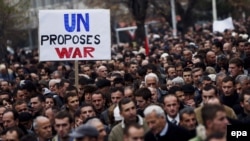
Thousands of angry Kosovars demonstrated in central Pristina on November 19. Carrying banners and chanting "No division -- we want to be sovereign," the crowd protested recent steps by the United Nations to weaken the mandate of the incoming European Union mission.
The 2,000-strong mission -- comprising police, judicial, and customs officials -- was envisioned to take over from UNMIK, the United Nations mission that has helped govern Kosovo as a Serbian province since 1999. It is still tentatively due to begin operating in December.
Kosovo, which emerged from years of Serbian control with an independence declaration in February, has eagerly awaited the deployment of the EU mission, known as EULEX, as a sign that its long journey toward statehood was in the final lap.
Last week, however, the United Nations -- which still maintains the UN Mission in Kosovo -- upended those expectations, putting forward a six-point plan amending the EULEX role.
The plan, presented by UN Secretary-General Ban Ki-moon, proposes two separate chains of command for ethnic-Albanian and ethnic-Serbian police officers in Kosovo. In Albanian-majority areas, police would serve under the EU umbrella. In northern Kosovo, which is mainly Serbian, law enforcement would fall under UN administration.
Such a plan would also require EULEX, like UNMIK before it, to act as a "status-neutral" mission -- that is, not formally aligned with Kosovo's self-designation as an independent state.
Kosovars reject the plan outright, saying it amounts to a de facto partition of their territory. Activist Albin Kurti, addressing the Pristina protesters, said the people of Kosovo will never accept the plan.
"They claim that EULEX will be neutral in regard to status," Kurti shouted to loud calls from the crowd. "This neutrality means being unbiased toward two sides. In terms of the Kosovo issue, this implies that there are two sides -- Kosovo and Serbia."
Bad Neighbors
The plan appears to be a sop to Belgrade, which continues to reject Kosovo statehood and defend the rights of its Serbian brethren in Kosovo.
The UN is under pressure to accommodate Security Council member Russia, a Belgrade ally. And Brussels, which appeared to tentatively back the UN plan, is eager to keep restive Serbia on a slow-but-steady path toward EU membership.
The terms of the six-point plan do not appear to be final. U.S. Assistant Secretary of State Daniel Fried this week said Washington supports the deployment of EULEX "as soon as possible" and in a way that would overcome the objections of Kosovo's leadership.
EU foreign-policy chief Javier Solana and UN chief Ban are due to meet on November 21 to discuss the EULEX deployment, and Kosovar leaders are in London with hopes of persuading British Prime Minister Gordon Brown to tip the negotiations in their favor.
Serbia, however, appears confident. Foreign Minister Vuk Jeremic says Belgrade has received guarantees the six-point plan will not be changed, and that a Security Council session on Kosovo may take place as early as November 24 or 25.
If true, it's a lone bright spot in what is proving a time of troubles for Serbia, whose ties with its Balkan neighbors are growing increasingly fractious.
Belgrade recently expelled the ambassadors from Macedonia and Montenegro after those countries opted to recognize Kosovo's statehood. And the UN's main judicial body, the International Court of Justice (ICJ), announced this week it would hear a genocide case filed by Croatia against Serbia stemming back to the Balkan wars of the early 1990s.
The announcement has reopened old wounds, with many Serbian officials and commentators expressing outrage at what they see as Croatian hypocrisy.
Speaking on Serbian state television, Jeremic lashed out at Croatia, saying Belgrade will file a countersuit with the ICJ to bring Zagreb to account for its own military actions targeting ethnic Serbs.
"I'm very sorry that Croatia didn't accept our offer to make peace -- an offer that Serbia has made more than once," Jeremic said. "They have refused to face the fact that 250,000 Serbs were themselves victims of ethnic cleansing, and now they will have to face it in front of the International Court of Justice."
Fractious Union
The rift appears to underscore Serbia's reputation as the scrappy black sheep of the Balkan neighborhood, and comes at a time when the international community is largely distracted by the global economic crisis and the pending political transition in the United States.
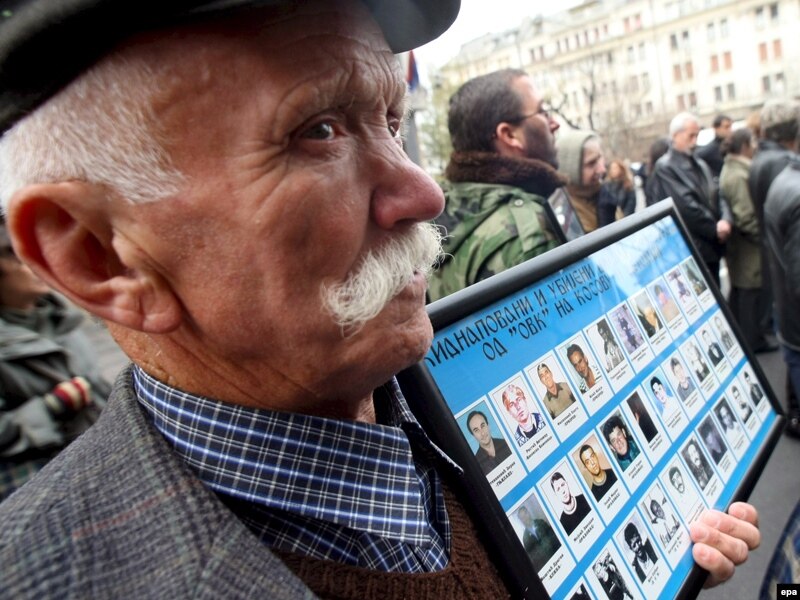
 Kosovo Serbs hold pictures of people who went missing or were killed in Kosovo.But Serbia's troubles with its neighbors, including the intractable standoff with Kosovo, are also in part the result of a fractured EU policy that has failed to settle on a unified stance in Brussels' dealing with the Balkans.
Although 22 of the 27 EU states have recognized Kosovo independence -- Cyprus, Spain, Romania, Greece, and Slovakia being the holdouts -- the lack of unanimity has made it difficult for the EU to stay firm on Balkan policy.
This includes the original EULEX mandate, which was based on the plan for Kosovo's internationally monitored independence drafted in 2007 by the UN's special envoy for Kosovo, Martti Ahtisaari, this year's Nobel Peace Prize laureate.
That plan envisioned a complete transfer of mission responsibilities from UNMIK to EULEX, and was based on Kosovo independence and territorial integrity.
This month, however, Pierre Mirel, the head of the European Commission's western Balkans division, said the EU had "accepted" that EULEX would not be related to the Ahtisaari plan, and would not proceed without Security Council approval.
Pieter Feith, the EU's current Kosovo representative, shot back that Mirel's comments "are not the EU's official position."
James Lyon, a Balkans expert with the Democratization Policy Council, says trying to get Brussels to come together on any Kosovo issue "is always very difficult."
"There's a great deal of confusion on this, because the EU representatives here in Serbia were coming out and saying that this plans is acceptable, whereas we had Pieter Feith saying it's not acceptable and it isn't the EU's position," Lyon says.
"So obviously the EU bureaucrats are not singing off the same sheet of music. As far as whether the plan is acceptable or not, there's the sense that the EU is floundering on this."
Such "floundering" can be felt in protracted administrative and legal chaos throughout Kosovo, with Albanian and Serbian institutions often working in parallel, or not at all. "The international community has wasted almost a year in terms of establishing an effective mission there," Lyon says.
Brussels may also face difficulties in factoring its tenuous relationship with Russia into the balance. The EU recently resumed partnership talks with Moscow after a chilly spell brought on by Russia's war with Georgia in August. Now, with ties growing warmer, some observers worry that Kosovo may prove a casualty of the EU's zeal to appease Moscow and its Serbian ally.
Richard Giragosian, an analyst specializing in security and military issues based in Yerevan, says the EU should not allow recent events in the South Caucasus to reshape its stance on Kosovo.
"We see an attempt by the European Union to try to perhaps move closer to the Serbian position," he says. "I would also say, from a U.S. military point of view in terms of on-the-ground security, that we're entering a dangerous phase now for guaranteeing the security and viability for the infant institutions of Kosovo."
"The real burden for the West and for the European Union," Giragosian adds, "is to support those infant institutions."
RFE/RL's South Slavic and Albanian Languages Service contributed to this report
The 2,000-strong mission -- comprising police, judicial, and customs officials -- was envisioned to take over from UNMIK, the United Nations mission that has helped govern Kosovo as a Serbian province since 1999. It is still tentatively due to begin operating in December.
Kosovo, which emerged from years of Serbian control with an independence declaration in February, has eagerly awaited the deployment of the EU mission, known as EULEX, as a sign that its long journey toward statehood was in the final lap.
Last week, however, the United Nations -- which still maintains the UN Mission in Kosovo -- upended those expectations, putting forward a six-point plan amending the EULEX role.
The plan, presented by UN Secretary-General Ban Ki-moon, proposes two separate chains of command for ethnic-Albanian and ethnic-Serbian police officers in Kosovo. In Albanian-majority areas, police would serve under the EU umbrella. In northern Kosovo, which is mainly Serbian, law enforcement would fall under UN administration.
Such a plan would also require EULEX, like UNMIK before it, to act as a "status-neutral" mission -- that is, not formally aligned with Kosovo's self-designation as an independent state.
Kosovars reject the plan outright, saying it amounts to a de facto partition of their territory. Activist Albin Kurti, addressing the Pristina protesters, said the people of Kosovo will never accept the plan.
"They claim that EULEX will be neutral in regard to status," Kurti shouted to loud calls from the crowd. "This neutrality means being unbiased toward two sides. In terms of the Kosovo issue, this implies that there are two sides -- Kosovo and Serbia."
Bad Neighbors
The plan appears to be a sop to Belgrade, which continues to reject Kosovo statehood and defend the rights of its Serbian brethren in Kosovo.
The UN is under pressure to accommodate Security Council member Russia, a Belgrade ally. And Brussels, which appeared to tentatively back the UN plan, is eager to keep restive Serbia on a slow-but-steady path toward EU membership.
The terms of the six-point plan do not appear to be final. U.S. Assistant Secretary of State Daniel Fried this week said Washington supports the deployment of EULEX "as soon as possible" and in a way that would overcome the objections of Kosovo's leadership.
EU foreign-policy chief Javier Solana and UN chief Ban are due to meet on November 21 to discuss the EULEX deployment, and Kosovar leaders are in London with hopes of persuading British Prime Minister Gordon Brown to tip the negotiations in their favor.
Serbia, however, appears confident. Foreign Minister Vuk Jeremic says Belgrade has received guarantees the six-point plan will not be changed, and that a Security Council session on Kosovo may take place as early as November 24 or 25.
If true, it's a lone bright spot in what is proving a time of troubles for Serbia, whose ties with its Balkan neighbors are growing increasingly fractious.
Belgrade recently expelled the ambassadors from Macedonia and Montenegro after those countries opted to recognize Kosovo's statehood. And the UN's main judicial body, the International Court of Justice (ICJ), announced this week it would hear a genocide case filed by Croatia against Serbia stemming back to the Balkan wars of the early 1990s.
The announcement has reopened old wounds, with many Serbian officials and commentators expressing outrage at what they see as Croatian hypocrisy.
Speaking on Serbian state television, Jeremic lashed out at Croatia, saying Belgrade will file a countersuit with the ICJ to bring Zagreb to account for its own military actions targeting ethnic Serbs.
"I'm very sorry that Croatia didn't accept our offer to make peace -- an offer that Serbia has made more than once," Jeremic said. "They have refused to face the fact that 250,000 Serbs were themselves victims of ethnic cleansing, and now they will have to face it in front of the International Court of Justice."
Fractious Union
The rift appears to underscore Serbia's reputation as the scrappy black sheep of the Balkan neighborhood, and comes at a time when the international community is largely distracted by the global economic crisis and the pending political transition in the United States.
Although 22 of the 27 EU states have recognized Kosovo independence -- Cyprus, Spain, Romania, Greece, and Slovakia being the holdouts -- the lack of unanimity has made it difficult for the EU to stay firm on Balkan policy.
This includes the original EULEX mandate, which was based on the plan for Kosovo's internationally monitored independence drafted in 2007 by the UN's special envoy for Kosovo, Martti Ahtisaari, this year's Nobel Peace Prize laureate.
That plan envisioned a complete transfer of mission responsibilities from UNMIK to EULEX, and was based on Kosovo independence and territorial integrity.
This month, however, Pierre Mirel, the head of the European Commission's western Balkans division, said the EU had "accepted" that EULEX would not be related to the Ahtisaari plan, and would not proceed without Security Council approval.
Pieter Feith, the EU's current Kosovo representative, shot back that Mirel's comments "are not the EU's official position."
James Lyon, a Balkans expert with the Democratization Policy Council, says trying to get Brussels to come together on any Kosovo issue "is always very difficult."
"There's a great deal of confusion on this, because the EU representatives here in Serbia were coming out and saying that this plans is acceptable, whereas we had Pieter Feith saying it's not acceptable and it isn't the EU's position," Lyon says.
"So obviously the EU bureaucrats are not singing off the same sheet of music. As far as whether the plan is acceptable or not, there's the sense that the EU is floundering on this."
Such "floundering" can be felt in protracted administrative and legal chaos throughout Kosovo, with Albanian and Serbian institutions often working in parallel, or not at all. "The international community has wasted almost a year in terms of establishing an effective mission there," Lyon says.
Brussels may also face difficulties in factoring its tenuous relationship with Russia into the balance. The EU recently resumed partnership talks with Moscow after a chilly spell brought on by Russia's war with Georgia in August. Now, with ties growing warmer, some observers worry that Kosovo may prove a casualty of the EU's zeal to appease Moscow and its Serbian ally.
Richard Giragosian, an analyst specializing in security and military issues based in Yerevan, says the EU should not allow recent events in the South Caucasus to reshape its stance on Kosovo.
"We see an attempt by the European Union to try to perhaps move closer to the Serbian position," he says. "I would also say, from a U.S. military point of view in terms of on-the-ground security, that we're entering a dangerous phase now for guaranteeing the security and viability for the infant institutions of Kosovo."
"The real burden for the West and for the European Union," Giragosian adds, "is to support those infant institutions."
RFE/RL's South Slavic and Albanian Languages Service contributed to this report