





The leaders of the four opposition parties that together hold 53 of the 101 seats in Moldova's new parliament were all smiles over the weekend when they announced their new coalition, Alliance for European Integration.
"We did the most important thing we had to do and the most important thing our voters were expecting from us: to agree and to come together,” Liberal Democratic Party leader Vlad Filat boasted to reporters on August 8.
 In addition to supporting improved relations with neighboring Romania and an association agreement with the European Union, the new coalition's program includes combating corruption, promoting media freedom, and pursuing economic reform and a "balanced" foreign policy.
The coalition agreement was viewed as a major step for the divided opposition. Some observers had been uncertain whether the stridently anti-Communist members of the group would be able to reach an accommodation with Democratic Party leader Marian Lupu, who is a former senior member of the Communist Party and a former parliament speaker who voted for the Communist candidate in the failed presidential elections in June.
"I cannot forget how he acted as parliament speaker,” Victor Cobasneanu, editor of the Soroca-based newspaper "Observatorul de Nord," told RFE/RL's Moldovan Service, “when he was turning off the microphones of the opposition. The Democratic Party cannot expect today to have power served to it on a silver platter. Marian Lupu has to feel that he has to pay for his past mistakes."
But despite this show of unity, the new coalition must still come to grips with the Communist Party, which -- with 48 seats -- controls the largest faction in the new legislature.
Worst Possible Outcome
The previous parliament was dissolved in June following two failed attempts to elect a president to succeed Communist Party head Vladimir Voronin. The Communists were unable to gain the 61 votes needed to elect their candidate, acting Prime Minister Zinaida Greceanii. As a result, Voronin was forced to dissolve the parliament and hold the July 29 snap elections.
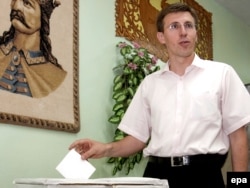 Chisinau Mayor Dorin ChirtoacaNow the opposition's position is boosted somewhat, but it still needs at least eight votes from the Communist faction to avoid a repeat deadlock and new elections.
Analysts agree that months of standoff would be the worst possible outcome for Moldova, whose economy is teetering on the brink of collapse and whose citizens are deeply divided between pro-Western and pro-Russian outlooks.
But the new alliance seems divided on whether to reach a compromise with the Communists -- possibly by offering them the post of speaker or prime minister -- or attempt to pick off some disaffected members of the Communist faction to support the opposition candidate in the secret ballot for president.
More radical members of the opposition alliance, such as Liberal Party leader and Chisinau Mayor Dorin Chirtoaca, believe there is enough dissatisfaction among the usually monolithic Communist bloc to elect a president without making a deal with Voronin.
"It is possible that today, and tomorrow, and the day after that, some Communists will come over to the Democratic Party,” Chirtoaca told journalists in Chisinau. “Probably not just one, but several people, because the Communists have no future in the Republic of Moldova. Or they might just give their votes in the presidential election."
Virtually Silent
While in the last parliament, the opposition was in the position of spoiler, a role that has now fallen to the Communists. And it remains unclear what they will do.
Party leader Voronin has left the country for a summer vacation in Turkey, and other senior leaders have been virtually silent in recent days. There is no sign of official negotiations between the new coalition and the Communists. Indeed, Liberal Democratic Party leader Filat has said the new alliance will not talk to the Communists until the new parliament convenes.
Some observers have suggested the Communists may be biding their time, waiting to see if tensions develop between the Alliance for European Integration partners.
Vladimir Turcanu, a Communist Party official and former deputy parliament speaker, told RFE/RL last week that his party would consider backing a non-Communist for president if that candidate were not a member of any parliamentary party.
"[The candidate] can be someone from the important people we have in our country, a person who is popular, a person who is not a member of any political party currently in the parliament. We have to look at who such a person could be,” Turcanu said.
However, he may have been referring to the Communists' long-preferred candidate, Greceanii, who is not officially a member of the Communist Party, although she is a staunch Voronin loyalist.
No Presidential Pronouncements
The opposition parties have not made any pronouncements on who they intend to propose as president. It is widely believed that Lupu harbors presidential ambitions and some analysts think a Lupu candidacy could attract a few disaffected Communists.
Another possible compromise candidate is Ion Sturza, who served as prime minister from February to November 1999. Sturza is an independent who reportedly has pragmatic relations with the Communists and business and political ties with Russia.
 Former Moldovan Prime Minister Ion SturzaSturza tells RFE/RL the new coalition would do well to negotiate with the Communists.
“That is the way people act in democratic countries,” he said. “Whether we like it or not, the Communist Party has almost 50 percent of the votes. We can't push them aside. It would be great if these four [opposition] leaders invited them into a dialogue and found a common language regarding the election of a new president. If this doesn't happen, things will be very difficult and complicated."
Another name that has been mentioned in the Moldovan press in recent days is that of former Democratic Party head Dumitru Diacov, the man who stepped aside to let Lupu lead the party in the election last month. Diacov was a Soviet-era Komsomol activist and many believe he worked for the KGB. At a press conference following the announcement of the election results last month, Voronin hinted mysteriously that Diacov was a man to watch in the future.
The new parliament must hold its first session by August 29. A new parliament speaker can be elected by a simple majority vote.
Key Questions
Under the constitution, deputies must hold two votes on the president, with 61 votes required to elect one. If a president is elected, he or she would then nominate a government, which would have to be endorsed by a simple majority in parliament.
If deputies again fail to elect a president after two ballots, the situation becomes complicated, and the Constitutional Court -- which was appointed by and is viewed as loyal to the Communists -- would likely have to decide several key questions.
First, it is unclear whether Voronin would remain acting president until the new elections could be held, or whether the newly elected speaker of parliament -- as the second-ranking politician in the country after the president -- would become acting president and be able to nominate a government.
Second, the constitution is unclear on when new elections may be held. It says parliament may only be dissolved once a year. Some analysts believe this means the current parliament must serve until one year after the last regular parliamentary elections - the ones that were held in April. Others hold that the current parliament can be dissolved at the end of the calendar year, which would mean new elections could be held after January 1.
"We did the most important thing we had to do and the most important thing our voters were expecting from us: to agree and to come together,” Liberal Democratic Party leader Vlad Filat boasted to reporters on August 8.

The coalition agreement was viewed as a major step for the divided opposition. Some observers had been uncertain whether the stridently anti-Communist members of the group would be able to reach an accommodation with Democratic Party leader Marian Lupu, who is a former senior member of the Communist Party and a former parliament speaker who voted for the Communist candidate in the failed presidential elections in June.
"I cannot forget how he acted as parliament speaker,” Victor Cobasneanu, editor of the Soroca-based newspaper "Observatorul de Nord," told RFE/RL's Moldovan Service, “when he was turning off the microphones of the opposition. The Democratic Party cannot expect today to have power served to it on a silver platter. Marian Lupu has to feel that he has to pay for his past mistakes."
But despite this show of unity, the new coalition must still come to grips with the Communist Party, which -- with 48 seats -- controls the largest faction in the new legislature.
Worst Possible Outcome
The previous parliament was dissolved in June following two failed attempts to elect a president to succeed Communist Party head Vladimir Voronin. The Communists were unable to gain the 61 votes needed to elect their candidate, acting Prime Minister Zinaida Greceanii. As a result, Voronin was forced to dissolve the parliament and hold the July 29 snap elections.

Analysts agree that months of standoff would be the worst possible outcome for Moldova, whose economy is teetering on the brink of collapse and whose citizens are deeply divided between pro-Western and pro-Russian outlooks.
But the new alliance seems divided on whether to reach a compromise with the Communists -- possibly by offering them the post of speaker or prime minister -- or attempt to pick off some disaffected members of the Communist faction to support the opposition candidate in the secret ballot for president.
More radical members of the opposition alliance, such as Liberal Party leader and Chisinau Mayor Dorin Chirtoaca, believe there is enough dissatisfaction among the usually monolithic Communist bloc to elect a president without making a deal with Voronin.
"It is possible that today, and tomorrow, and the day after that, some Communists will come over to the Democratic Party,” Chirtoaca told journalists in Chisinau. “Probably not just one, but several people, because the Communists have no future in the Republic of Moldova. Or they might just give their votes in the presidential election."
Virtually Silent
While in the last parliament, the opposition was in the position of spoiler, a role that has now fallen to the Communists. And it remains unclear what they will do.
Party leader Voronin has left the country for a summer vacation in Turkey, and other senior leaders have been virtually silent in recent days. There is no sign of official negotiations between the new coalition and the Communists. Indeed, Liberal Democratic Party leader Filat has said the new alliance will not talk to the Communists until the new parliament convenes.
Some observers have suggested the Communists may be biding their time, waiting to see if tensions develop between the Alliance for European Integration partners.
Vladimir Turcanu, a Communist Party official and former deputy parliament speaker, told RFE/RL last week that his party would consider backing a non-Communist for president if that candidate were not a member of any parliamentary party.
"[The candidate] can be someone from the important people we have in our country, a person who is popular, a person who is not a member of any political party currently in the parliament. We have to look at who such a person could be,” Turcanu said.
However, he may have been referring to the Communists' long-preferred candidate, Greceanii, who is not officially a member of the Communist Party, although she is a staunch Voronin loyalist.
No Presidential Pronouncements
The opposition parties have not made any pronouncements on who they intend to propose as president. It is widely believed that Lupu harbors presidential ambitions and some analysts think a Lupu candidacy could attract a few disaffected Communists.
Another possible compromise candidate is Ion Sturza, who served as prime minister from February to November 1999. Sturza is an independent who reportedly has pragmatic relations with the Communists and business and political ties with Russia.

“That is the way people act in democratic countries,” he said. “Whether we like it or not, the Communist Party has almost 50 percent of the votes. We can't push them aside. It would be great if these four [opposition] leaders invited them into a dialogue and found a common language regarding the election of a new president. If this doesn't happen, things will be very difficult and complicated."
Another name that has been mentioned in the Moldovan press in recent days is that of former Democratic Party head Dumitru Diacov, the man who stepped aside to let Lupu lead the party in the election last month. Diacov was a Soviet-era Komsomol activist and many believe he worked for the KGB. At a press conference following the announcement of the election results last month, Voronin hinted mysteriously that Diacov was a man to watch in the future.
The new parliament must hold its first session by August 29. A new parliament speaker can be elected by a simple majority vote.
Key Questions
Under the constitution, deputies must hold two votes on the president, with 61 votes required to elect one. If a president is elected, he or she would then nominate a government, which would have to be endorsed by a simple majority in parliament.
If deputies again fail to elect a president after two ballots, the situation becomes complicated, and the Constitutional Court -- which was appointed by and is viewed as loyal to the Communists -- would likely have to decide several key questions.
First, it is unclear whether Voronin would remain acting president until the new elections could be held, or whether the newly elected speaker of parliament -- as the second-ranking politician in the country after the president -- would become acting president and be able to nominate a government.
Second, the constitution is unclear on when new elections may be held. It says parliament may only be dissolved once a year. Some analysts believe this means the current parliament must serve until one year after the last regular parliamentary elections - the ones that were held in April. Others hold that the current parliament can be dissolved at the end of the calendar year, which would mean new elections could be held after January 1.