

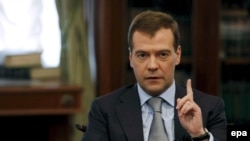
BRUSSELS -- On the eve of talks on a new bilateral agreement between Russia and the EU, President Dmitry Medvedev appears to be following the course set by Vladimir Putin.
Russian and EU leaders are beginning talks on July 4 in Brussels to discuss a new cooperation agreement.
The two main objectives of what might be called the "Putin doctrine" have been the moral rehabilitation of the Soviet Union, and asserting Russia's entitlement to determine what count as "European values" on an equal basis with the EU.
At a summit meeting with EU leaders in Khanty-Mansyisk on June 26-27, Moscow focused mainly on issues of prestige, from visa-free travel to recognition of the Soviet Union's contribution to the victory over Nazism.
Russia's interest in substantive issues appeared fleeting at best, with President Dmitry Medvedev arguing the two sides should negotiate a "short" strategic partnership agreement with the detail to be thrashed out later.
Medvedev repeated his call, first made in a speech delivered in Berlin on June 5, for a new global security structure, which would bring the United States, the EU, and other powers together in a "non-bloc" manner. The parties would in future jointly deliberate on issues such as NATO expansion, the U.S. missile-shield plans, and the future of the Conventional Forces in Europe Treaty.
At the June summit, Medvedev railed against what he described as attempts in the EU to "rethink" Europe's "shared" history and cast the Soviet Union as an enslaver rather than Europe's liberator from Nazism. The Russian president also attacked EU hearings on totalitarian crimes.
Medvedev was also keen to press Russia's case for visa-free travel for its citizens in the EU -- an issue of great psychological importance for the Russian leadership. The current EU visa restrictions bracket Russia with the rest of the former Soviet Union, and leave it behind the Balkan countries which are already negotiating visa-free travel with the EU.
Evasive EU Response
The EU's response to such issues has for the most part been evasive. The bloc would much rather focus on the nitty-gritty of practical cooperation between the two sides. When it comes to global cooperation, the EU would like to confine it to fields like environment and energy policy.
While EU leaders were in broad agreement with Medvedev's espousal of nonviolence and multilateralism as the grounding principles of international politics, they were careful to distance themselves from Russian calls for new global security structures.
Slovenian Prime Minister Janez Jansa, who represented the outgoing EU presidency at the summit, argued that the EU and Russia must first come to an agreement on common values. This highlighted a subtle, but crucial difference in the approaches of the two sides, as Medvedev had argued that the EU and Russia should build on common ground which already united them.
Russia's attacks on the Eastern European critics of the Soviet Union's historical record received a rebuff from the president of the European Commission, Jose Manuel Barroso, who told reporters after the summit that the EU rejects all forms of totalitarianism, Soviet totalitarianism
among them.
And Moscow's lobbying for visa freedom also received short shrift. Most EU member states are against it and Barroso cited Russia's draconian registration requirements for visiting foreign nationals, introduced last year, as another obstacle.
Energy Relationship
The two sides are closest to harmony on issues where raw self-interest is at stake. Both sides recognize their interdependence in energy cooperation. When Medvedev complained that the Russia-supported Nord Stream gas pipeline was being opposed by "political elements," Barroso reaffirmed the project retains EU support. He said the main difficulties, for the EU, were environmental constraints.
There is also a degree of agreement when it comes to the "frozen conflicts" in the Caucasus and Transdneister. Again, the EU recognizes that Russia's cooperation is crucial to their resolution. At the Khanty-Mansyisk summit, Russia singled out Georgia for criticism, arguing that Tbilisi is not interested in dialogue or a peaceful solution to the conflict with Abkhazia.
Russia once again warned the EU that Kosovo could become a precedent for separatists in Europe, as well as Russia itself. In a sign of difficulties yet to come in the strategic partnership negotiations, Medvedev has indicated that Moscow will not tolerate any preconditions.
Yet Lithuania only agreed to authorize the talks if they address specific issues such as Russia's conduct in "frozen conflicts" and oil deliveries to a Lithuanian refinery. Britain added an precondition demanding cooperation from Russia in the Alexander Litvinenko murder case.
Russian and EU leaders are beginning talks on July 4 in Brussels to discuss a new cooperation agreement.
The two main objectives of what might be called the "Putin doctrine" have been the moral rehabilitation of the Soviet Union, and asserting Russia's entitlement to determine what count as "European values" on an equal basis with the EU.
At a summit meeting with EU leaders in Khanty-Mansyisk on June 26-27, Moscow focused mainly on issues of prestige, from visa-free travel to recognition of the Soviet Union's contribution to the victory over Nazism.
Russia's interest in substantive issues appeared fleeting at best, with President Dmitry Medvedev arguing the two sides should negotiate a "short" strategic partnership agreement with the detail to be thrashed out later.
Medvedev repeated his call, first made in a speech delivered in Berlin on June 5, for a new global security structure, which would bring the United States, the EU, and other powers together in a "non-bloc" manner. The parties would in future jointly deliberate on issues such as NATO expansion, the U.S. missile-shield plans, and the future of the Conventional Forces in Europe Treaty.
The two sides are closest to harmony on issues where raw self-interest is at stake.
At the June summit, Medvedev railed against what he described as attempts in the EU to "rethink" Europe's "shared" history and cast the Soviet Union as an enslaver rather than Europe's liberator from Nazism. The Russian president also attacked EU hearings on totalitarian crimes.
Medvedev was also keen to press Russia's case for visa-free travel for its citizens in the EU -- an issue of great psychological importance for the Russian leadership. The current EU visa restrictions bracket Russia with the rest of the former Soviet Union, and leave it behind the Balkan countries which are already negotiating visa-free travel with the EU.
Evasive EU Response
The EU's response to such issues has for the most part been evasive. The bloc would much rather focus on the nitty-gritty of practical cooperation between the two sides. When it comes to global cooperation, the EU would like to confine it to fields like environment and energy policy.
While EU leaders were in broad agreement with Medvedev's espousal of nonviolence and multilateralism as the grounding principles of international politics, they were careful to distance themselves from Russian calls for new global security structures.
Slovenian Prime Minister Janez Jansa, who represented the outgoing EU presidency at the summit, argued that the EU and Russia must first come to an agreement on common values. This highlighted a subtle, but crucial difference in the approaches of the two sides, as Medvedev had argued that the EU and Russia should build on common ground which already united them.
Russia's attacks on the Eastern European critics of the Soviet Union's historical record received a rebuff from the president of the European Commission, Jose Manuel Barroso, who told reporters after the summit that the EU rejects all forms of totalitarianism, Soviet totalitarianism
among them.
And Moscow's lobbying for visa freedom also received short shrift. Most EU member states are against it and Barroso cited Russia's draconian registration requirements for visiting foreign nationals, introduced last year, as another obstacle.
Energy Relationship
The two sides are closest to harmony on issues where raw self-interest is at stake. Both sides recognize their interdependence in energy cooperation. When Medvedev complained that the Russia-supported Nord Stream gas pipeline was being opposed by "political elements," Barroso reaffirmed the project retains EU support. He said the main difficulties, for the EU, were environmental constraints.
There is also a degree of agreement when it comes to the "frozen conflicts" in the Caucasus and Transdneister. Again, the EU recognizes that Russia's cooperation is crucial to their resolution. At the Khanty-Mansyisk summit, Russia singled out Georgia for criticism, arguing that Tbilisi is not interested in dialogue or a peaceful solution to the conflict with Abkhazia.
Russia once again warned the EU that Kosovo could become a precedent for separatists in Europe, as well as Russia itself. In a sign of difficulties yet to come in the strategic partnership negotiations, Medvedev has indicated that Moscow will not tolerate any preconditions.
Yet Lithuania only agreed to authorize the talks if they address specific issues such as Russia's conduct in "frozen conflicts" and oil deliveries to a Lithuanian refinery. Britain added an precondition demanding cooperation from Russia in the Alexander Litvinenko murder case.