




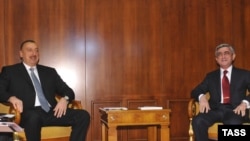
Just a month or two ago, it seemed to many observers that the Karabakh conflict was closer than it had been for years to a negotiated solution. But the much-trumpeted "breakthrough" never materialized.
This is not surprising. Once an active participant in the peace process, the central party in the dispute -- the Nagorno Karabakh republic (NKR), which in 2009 marks the 18th anniversary of its de facto independence, but whose international status has not been formalized -- is conspicuously absent from the talks today.
Since 1997, Azerbaijan has refused to negotiate directly with the NKR, preferring to discuss the resolution with Armenia. The NKR appreciates Armenia's role in the peace process, but it should be understood from the outset that Karabakh's elected officials must be represented in the talks every step of the way.
Indeed, politically the NKR is a separate state with its own democratic traditions, and, in the long run, any serious progress towards resolving the conflict cannot take place unless its representatives return to the negotiating table and agree to share the responsibility for implementing the hoped-for peace agreement.
Azerbaijan: Oil-Backed Warmongering Will Not Work
Many analysts believe that the high oil prices of the past few years gave rise to the nationalist illusion in Baku that, by channeling millions of petrodollars into upgrading its armed forces, Azerbaijan could launch a new offensive and thus bring the NKR under its control by force. Azerbaijani presidential administration official Elnur Aslanov issued an implicit warning last month that the "leadership of Armenia must understand that it is necessary to protect its citizens from a new war" and should therefore stop helping Nagorno-Karabakh defend its hard-won freedom.
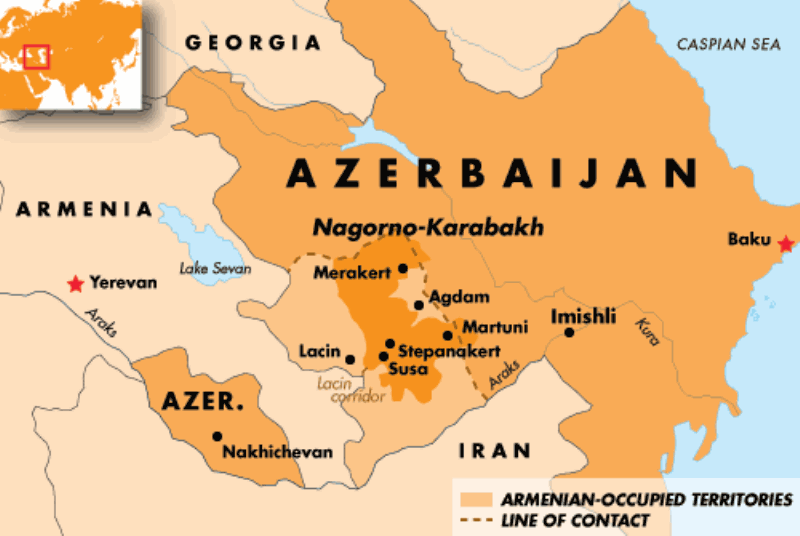
Despite the temporary euphoria created by the influx of petrodollars, and because of Azerbaijan's history of military-backed coups d'etat, the least desirable option for the country's ruling family is to start a war, during which the army could again snap out of control. But rising military expenditures and the threat to attack Nagorno-Karabakh again should still be taken seriously, because that rhetoric could inspire opportunistic skirmishes on the Line of Contact that currently separates the Azerbaijani armed forces from the troops of the Nagorno-Karabakh Defense Army. This could lead to larger, possibly uncontrolled, clashes.
Azerbaijan's zero-sum logic was visible from the very first days of the conflict in February 1988, when Azerbaijan responded to Nagorno-Karabakh's peaceful and constitutional appeal to the Soviet leadership to reconsider its status within the USSR with the unprecedented massacre of ethnic Armenians in the Caspian city of Sumgait, hundreds of miles away from Nagorno-Karabakh.
The events in Sumgait were the continuation of policies implemented by Heydar Aliyev during his tenure as the first secretary of the Communist Party of Azerbaijan in the 1970s and early 1980s. Aliyev bragged in 2000-03 that for two decades he executed a policy of economic and demographic discrimination against Nagorno-Karabakh in a deliberate effort to force its majority-Armenian population to emigrate. As a result of Aliyev's strategy, the growth of the Armenian population of Nagorno-Karabakh stopped, while the number of ethnic Azeris increased artificially.
 Click to enlargeFollowing the collapse of the USSR in late 1991, Azerbaijan advanced from pogroms to full-scale armed aggression. Reports compiled between 1991 and 1994 by the Commission for Security and Cooperation in Europe (CSCE, later renamed OSCE) document the openly declared genocidal intentions of that military campaign.
Azerbaijan ignored four consecutive UN Security Council resolutions calling for a Karabakh cease-fire, and is therefore responsible for the continuing consequences of the war it started. Azerbaijan must appreciate the lessons of the early 1990s: all previous such attempts by Baku to use force against Nagorno-Karabakh proved infinitely more costly than the perpetrators anticipated.
Self-Determination: International Law And History Do Matter
Azerbaijan's standard approach to arguing the legitimacy of its claims on Nagorno-Karabakh is to stress the principle of the territorial integrity of states while downplaying the right of peoples to self-determination.
Although the territorial-integrity principle does apply to Azerbaijan as a general theoretical notion -- as it does to NKR, Armenia, or any other state -- it does not apply to Baku's claims on Nagorno-Karabakh. The reason is straightforward: in contrast to, say, Spain (with its potentially secessionist Basque country) or the United Kingdom (with its potentially separatist Scotland), no independent Azerbaijani state ever controlled Nagorno-Karabakh -- neither in 1918-20, nor after 1991. It was the Soviet leadership that imposed on Nagorno-Karabakh the subordinate status of an autonomous region within the Azerbaijani Soviet Socialist Republic. When the USSR began to weaken in the late 1980s, this artificial "matryoshka doll" construct collapsed immediately, with Baku losing any measure of direct power over Stepanakert three years before declaring sovereignty in 1991.
Importantly, the NKR's right to self-determination also hinges on the fact that the region has for centuries been the centerpiece of Armenian statehood. Nagorno-Karabakh -- the historic Armenian province of Artsakh -- is the only territory where the self-rule and political institutions of a compactly residing Armenian majority were maintained continuously from the fifth century to the present day, with the exception of several decades in the 18th and 19th centuries.
Artsakh is the birthplace of the earliest known Armenian constitutional edict -- the fifth-century document called "The Canons of Aghven." It governed Nagorno-Karabakh's Armenian kingdoms and principalities hundreds of years before most European peoples became nations, and 15 centuries prior to the time when the people known today as "Azerbaijanis" were officially designated as such for the first time in the Soviet census of 1939.
Among the dozens of Armenian medieval churches and monasteries and hundreds of Armenian stone inscriptions (some dating from the fifth century) on the territory of the NKR is the Monastery of Amaras. It was founded by the foremost Armenian saint, St. Gregory the Enlightener, shortly after he proclaimed Christianity the official faith of the Kingdom of Armenia, which thus became in 301 A.D. the world's first Christian state. It was at Amaras one century later that the inventor of the Armenian alphabet, St. Mesrob Mashtots, founded the first-ever school where that script was taught.
The indigenous Armenian population of Nagorno-Karabakh is fiercely protective of that centuries-old Christian heritage, now under threat. The international community should continue investigating the barbarous demolition of dozens of medieval Armenian churches and cemeteries in the formerly Armenian-populated province of Naxcivan and the region south of the city of Ganja.
Conflict Resolution: The Realities And The Peace Process
Azerbaijan's and NKR's political evolution differ fundamentally. Defined by free and fair elections and a tradition of postelectoral consensual coexistence of the government and the opposition, Nagorno-Karabakh's political system is irreversibly incompatible with that of Azerbaijan. This is just one of the many reasons why any attempts to propose a political future for these two countries under the roof of one state are doomed to fail.
The negotiation process must be backed up by a commitment on the part of all three states to confidence-building measures. Bellicose rhetoric should be abandoned. And societies in all three states should start preparing for reconciliation as official talks continue. Only genuine reconciliation -- achieved through official contacts, confidence building measures and elements of second-track diplomacy -- can yield a stable peace.
The international community, for its part, should support this approach to achieve progress.
The Karabakh dispute is a difficult one to solve, but the people of Nagorno-Karabakh remain optimistic. We believe that reverting to the original format of the peace talks, with the full participation of the Nagorno-Karabakh republic, will restore the lacking balance and provide Azerbaijan with tangible incentives to act constructively. That would also credibly demonstrate Azerbaijan's readiness to co-exist peacefully with Nagorno-Karabakh, regardless of the outcome of the negotiations.
Robert Avetisyan is the permanent representative of the Nagorno-Karabakh republic to the United States. The views expressed in this commentary are his own, and do not necessarily reflect those of RFE/RL. Nor does RFE/RL make any judgment as to the current and future international political status of Nagorno-Karabakh.
This commentary is the latest of several on the Nagorno-Karabakh dispute by authors supporting different parties to the conflict. RFE/RL reserves the right to run further articles on this issue
This is not surprising. Once an active participant in the peace process, the central party in the dispute -- the Nagorno Karabakh republic (NKR), which in 2009 marks the 18th anniversary of its de facto independence, but whose international status has not been formalized -- is conspicuously absent from the talks today.
Since 1997, Azerbaijan has refused to negotiate directly with the NKR, preferring to discuss the resolution with Armenia. The NKR appreciates Armenia's role in the peace process, but it should be understood from the outset that Karabakh's elected officials must be represented in the talks every step of the way.
Counterpoint: Advice For Armenia On Resolving The Karabakh Dispute
Indeed, politically the NKR is a separate state with its own democratic traditions, and, in the long run, any serious progress towards resolving the conflict cannot take place unless its representatives return to the negotiating table and agree to share the responsibility for implementing the hoped-for peace agreement.
Azerbaijan: Oil-Backed Warmongering Will Not Work
Many analysts believe that the high oil prices of the past few years gave rise to the nationalist illusion in Baku that, by channeling millions of petrodollars into upgrading its armed forces, Azerbaijan could launch a new offensive and thus bring the NKR under its control by force. Azerbaijani presidential administration official Elnur Aslanov issued an implicit warning last month that the "leadership of Armenia must understand that it is necessary to protect its citizens from a new war" and should therefore stop helping Nagorno-Karabakh defend its hard-won freedom.
Despite the temporary euphoria created by the influx of petrodollars, and because of Azerbaijan's history of military-backed coups d'etat, the least desirable option for the country's ruling family is to start a war, during which the army could again snap out of control. But rising military expenditures and the threat to attack Nagorno-Karabakh again should still be taken seriously, because that rhetoric could inspire opportunistic skirmishes on the Line of Contact that currently separates the Azerbaijani armed forces from the troops of the Nagorno-Karabakh Defense Army. This could lead to larger, possibly uncontrolled, clashes.
Azerbaijan's zero-sum logic was visible from the very first days of the conflict in February 1988, when Azerbaijan responded to Nagorno-Karabakh's peaceful and constitutional appeal to the Soviet leadership to reconsider its status within the USSR with the unprecedented massacre of ethnic Armenians in the Caspian city of Sumgait, hundreds of miles away from Nagorno-Karabakh.
The events in Sumgait were the continuation of policies implemented by Heydar Aliyev during his tenure as the first secretary of the Communist Party of Azerbaijan in the 1970s and early 1980s. Aliyev bragged in 2000-03 that for two decades he executed a policy of economic and demographic discrimination against Nagorno-Karabakh in a deliberate effort to force its majority-Armenian population to emigrate. As a result of Aliyev's strategy, the growth of the Armenian population of Nagorno-Karabakh stopped, while the number of ethnic Azeris increased artificially.
Azerbaijan ignored four consecutive UN Security Council resolutions calling for a Karabakh cease-fire, and is therefore responsible for the continuing consequences of the war it started. Azerbaijan must appreciate the lessons of the early 1990s: all previous such attempts by Baku to use force against Nagorno-Karabakh proved infinitely more costly than the perpetrators anticipated.
Self-Determination: International Law And History Do Matter
Azerbaijan's standard approach to arguing the legitimacy of its claims on Nagorno-Karabakh is to stress the principle of the territorial integrity of states while downplaying the right of peoples to self-determination.
Although the territorial-integrity principle does apply to Azerbaijan as a general theoretical notion -- as it does to NKR, Armenia, or any other state -- it does not apply to Baku's claims on Nagorno-Karabakh. The reason is straightforward: in contrast to, say, Spain (with its potentially secessionist Basque country) or the United Kingdom (with its potentially separatist Scotland), no independent Azerbaijani state ever controlled Nagorno-Karabakh -- neither in 1918-20, nor after 1991. It was the Soviet leadership that imposed on Nagorno-Karabakh the subordinate status of an autonomous region within the Azerbaijani Soviet Socialist Republic. When the USSR began to weaken in the late 1980s, this artificial "matryoshka doll" construct collapsed immediately, with Baku losing any measure of direct power over Stepanakert three years before declaring sovereignty in 1991.
Importantly, the NKR's right to self-determination also hinges on the fact that the region has for centuries been the centerpiece of Armenian statehood. Nagorno-Karabakh -- the historic Armenian province of Artsakh -- is the only territory where the self-rule and political institutions of a compactly residing Armenian majority were maintained continuously from the fifth century to the present day, with the exception of several decades in the 18th and 19th centuries.
Artsakh is the birthplace of the earliest known Armenian constitutional edict -- the fifth-century document called "The Canons of Aghven." It governed Nagorno-Karabakh's Armenian kingdoms and principalities hundreds of years before most European peoples became nations, and 15 centuries prior to the time when the people known today as "Azerbaijanis" were officially designated as such for the first time in the Soviet census of 1939.
Among the dozens of Armenian medieval churches and monasteries and hundreds of Armenian stone inscriptions (some dating from the fifth century) on the territory of the NKR is the Monastery of Amaras. It was founded by the foremost Armenian saint, St. Gregory the Enlightener, shortly after he proclaimed Christianity the official faith of the Kingdom of Armenia, which thus became in 301 A.D. the world's first Christian state. It was at Amaras one century later that the inventor of the Armenian alphabet, St. Mesrob Mashtots, founded the first-ever school where that script was taught.
The indigenous Armenian population of Nagorno-Karabakh is fiercely protective of that centuries-old Christian heritage, now under threat. The international community should continue investigating the barbarous demolition of dozens of medieval Armenian churches and cemeteries in the formerly Armenian-populated province of Naxcivan and the region south of the city of Ganja.
Conflict Resolution: The Realities And The Peace Process
Azerbaijan's and NKR's political evolution differ fundamentally. Defined by free and fair elections and a tradition of postelectoral consensual coexistence of the government and the opposition, Nagorno-Karabakh's political system is irreversibly incompatible with that of Azerbaijan. This is just one of the many reasons why any attempts to propose a political future for these two countries under the roof of one state are doomed to fail.
The negotiation process must be backed up by a commitment on the part of all three states to confidence-building measures. Bellicose rhetoric should be abandoned. And societies in all three states should start preparing for reconciliation as official talks continue. Only genuine reconciliation -- achieved through official contacts, confidence building measures and elements of second-track diplomacy -- can yield a stable peace.
The international community, for its part, should support this approach to achieve progress.
The Karabakh dispute is a difficult one to solve, but the people of Nagorno-Karabakh remain optimistic. We believe that reverting to the original format of the peace talks, with the full participation of the Nagorno-Karabakh republic, will restore the lacking balance and provide Azerbaijan with tangible incentives to act constructively. That would also credibly demonstrate Azerbaijan's readiness to co-exist peacefully with Nagorno-Karabakh, regardless of the outcome of the negotiations.
Robert Avetisyan is the permanent representative of the Nagorno-Karabakh republic to the United States. The views expressed in this commentary are his own, and do not necessarily reflect those of RFE/RL. Nor does RFE/RL make any judgment as to the current and future international political status of Nagorno-Karabakh.
This commentary is the latest of several on the Nagorno-Karabakh dispute by authors supporting different parties to the conflict. RFE/RL reserves the right to run further articles on this issue