




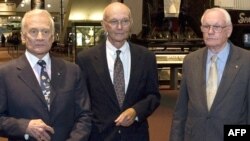
In a rare public appearance, Neil Armstrong, the commander of the Apollo 11 spacecraft and the first human to walk on the moon, credited Cold War tensions as enabling the rapid development of technologies that paved the way for space exploration.
"Scientists, particularly Russian and American, recognized that if it would be possible to use one of these new high-performance military rockets carrying scientific instruments to put a man-made object into orbit around the Earth, it would have a new perspective at perhaps solving or at least shedding new light on some of Earth's mysteries," the 78-year-old Armstrong said at an appearance July 19 at Washington's Smithsonian Institution.
By 1957, both the United States and Soviet Union were racing to send an object in orbit. It was a huge upset for the United States when the Soviets sent not one, but two, into space first: Sputnik I and Sputnik II.
"Sputnik shocked the American public. We believed we were the most technologically advanced community in the world and how could this have happened?! Somebody has to be doing something!" Armstrong said. "A rocket that had the power and the accuracy to orbit a satellite had the power and accuracy to send a nuclear warhead across the ocean to a specific target."
The launch of Sputnik, Armstrong said, convinced the U.S. Congress to establish a separate, federally funded space agency. NASA, the U.S. National Aeronautics and Space Administration, was established in 1958.
Playing Catch-Up
Despite the United States' frantic efforts to catch up with the Soviet Union in the early days of space exploration, Armstrong said he remembers feeling outmaneuvered.
"On the whole, the Soviets were out in front in most areas and Americans were embarrassed," he recalled.
It was only with the development of the Apollo program, he said, that he U.S. eventually began to catch up with Moscow.
Armstrong recalled a dramatic moment midflight on the Apollo mission when the astronauts were told that the Soviet's Luna 15 spaceship was already orbiting the moon.
"It had no human crew aboard," Armstrong said, "but its secret mission was to land on the lunar surface, collect some soil samples, rocket them back to Earth and claim a Soviet victory -- first chunks of the moon returned to the Earth by humans."
Luna 15 failed and eventually crashed on July 21, 1969 -- one day after U.S. astronauts took their first steps on the moon's surface.
It was the first time the United States and Soviet Union cooperated on space exploration. Moscow gave U.S. mission control in Houston Luna's flight path to ensure that the orbits of the spacecrafts did not cross.
That small gesture kicked off a new era of space relations between the two countries, who now saw their scientific objectives as shared aspirations. Armstrong said it was then that competition evolved into cooperation, and the result was "an exceptional national investment for both sides."
"Scientists, particularly Russian and American, recognized that if it would be possible to use one of these new high-performance military rockets carrying scientific instruments to put a man-made object into orbit around the Earth, it would have a new perspective at perhaps solving or at least shedding new light on some of Earth's mysteries," the 78-year-old Armstrong said at an appearance July 19 at Washington's Smithsonian Institution.
By 1957, both the United States and Soviet Union were racing to send an object in orbit. It was a huge upset for the United States when the Soviets sent not one, but two, into space first: Sputnik I and Sputnik II.
"Sputnik shocked the American public. We believed we were the most technologically advanced community in the world and how could this have happened?! Somebody has to be doing something!" Armstrong said. "A rocket that had the power and the accuracy to orbit a satellite had the power and accuracy to send a nuclear warhead across the ocean to a specific target."
The launch of Sputnik, Armstrong said, convinced the U.S. Congress to establish a separate, federally funded space agency. NASA, the U.S. National Aeronautics and Space Administration, was established in 1958.
Playing Catch-Up
Despite the United States' frantic efforts to catch up with the Soviet Union in the early days of space exploration, Armstrong said he remembers feeling outmaneuvered.
"On the whole, the Soviets were out in front in most areas and Americans were embarrassed," he recalled.
It was only with the development of the Apollo program, he said, that he U.S. eventually began to catch up with Moscow.
Armstrong recalled a dramatic moment midflight on the Apollo mission when the astronauts were told that the Soviet's Luna 15 spaceship was already orbiting the moon.
"It had no human crew aboard," Armstrong said, "but its secret mission was to land on the lunar surface, collect some soil samples, rocket them back to Earth and claim a Soviet victory -- first chunks of the moon returned to the Earth by humans."
Luna 15 failed and eventually crashed on July 21, 1969 -- one day after U.S. astronauts took their first steps on the moon's surface.
It was the first time the United States and Soviet Union cooperated on space exploration. Moscow gave U.S. mission control in Houston Luna's flight path to ensure that the orbits of the spacecrafts did not cross.
That small gesture kicked off a new era of space relations between the two countries, who now saw their scientific objectives as shared aspirations. Armstrong said it was then that competition evolved into cooperation, and the result was "an exceptional national investment for both sides."