


In sports, as in politics, "moving the goalposts" -- and thus changing the rules of the game midstream -- may make the spectacle more intriguing, but it doesn't do much for fairness, consistency, or the long-term viability of the enterprise. A momentary "win" may be achieved by this or that side, but the real victim can end up being the process and people's trust and future participation in it.
Momentum is building in Moldova for a constitutional amendment to lead the way out of the current deadlock over electing a president. For sure, Moldova's election laws and practices are impossibly tangled and contradictory. Since 2000, six out of eight presidential ballots in parliament have failed to yield a leader. Sometimes precisely opposite outcomes find equal support in law. The courts -- which should be the final arbiters -- remain politicized and subject to pressure. All of this mixed together with the venal post-Soviet legacy has allowed a creeping "Ukrainization" to enter Moldova's politics in 2009.
Thorough and thoughtful constitutional changes are needed to allow direct presidential elections and to fix other serious shortcoming in the system, particularly the lack of local representation in parliament, which keeps political elites Chisinau-bound and out of touch with the rest of the country.
Not having a fully empowered head of state is, of course, a serious problem. But resorting to rushed constitutional amendments as a way out of a political crisis also presents a danger to this deeply divided fledgling democracy. The Alliance for European Integration (AIE) risks continuing a troubling trend in which each newly ascendant group of politicians spikes, or is perceived to spike, the ground rules to suit its interests.
The alliance complained bitterly about this rule-tweaking by the previous Communist government. Vladimir Voronin's party was notorious for its disciplined use of administrative resources and, generally, for doing whatever it took to remain on top. The AIE's lamentations about these highly effective tactics played a prominent role in their campaign strategies and promises, particularly after the terrible events of April.
What Comes Around
Since gaining power in the July repeat elections, however, the alliance has flirted with moves uncannily similar to those it so decried as an opposition force. It has already changed the rules in a self-serving manner on a number of very important issues. First, it pushed through a simplified procedure for electing a president in parliament. Now a single candidate (theirs) can run unopposed.
Then, the AIE amended the Audiovisual Code to ensure that it could use its simple majority of 53 votes to elect the members of the Audiovisual Coordination Council and the Board of Observers of Teleradio Moldova. Such a move had formerly required a consensus of three-fifths of legislators, the same troublesome threshold that currently so complicates electing a president. Not surprisingly, Moldova 1, the state's national broadcaster is now giving a priority to information about the alliance, just as it formerly did in reporting the doings of the Communist Party after it had packed broadcaster's board.
The AIE thought it fit to leave nine alliance ministers as deputies in parliament for a period of six months, essentially violating the separation of powers, stretching what had been a "temporary" measure, and preserving those votes should the coalition fall apart. As a bone to the public, Prime Minister Vlad Filat announced -- without tongue in cheek it seems -- that these nine deputies would not, at least, be receiving two salaries. Even Chisinau Mayor Dorin Chirtoaca (who should know better) made only half-hearted efforts to relinquish his simultaneous mandates in the legislature and as the city's chief executive.
In parliament, certain AIE members have acted with an authoritarian air, shutting off the microphones when the Communists have the floor (just as the Communists did so often before to their opponents) and using earthy Voronin-esque language more expected in a locker room than a legislature. As well, the AIE has managed to postpone key parliamentary sessions on shaky pretexts, such as the presence of foreign guests in the country.
And now the prosecutions of Communist legislators are starting. It was recently announced that Communist deputies Iurie Muntean and Igor Dodon -- who also is the former minister of economy and trade -- are under investigation for an alleged scheme to monopolize the import of meat into Moldova.
Prosecuting opponents was a tactic used extensively and painfully by the Communists against certain members of the AIE. While corruption may be as widespread as ever in Moldova, great care needs to be taken with prosecutions having political overtones.
...Goes Around
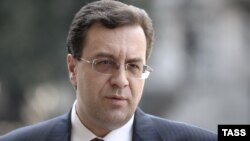
Following all this comes the suggestion of a national referendum on direct popular presidential election as the "only way" out of the political stalemate. Given the Communists' seeming intransigence on Marian Lupu's candidacy and the AIE's insistence on it, such a referendum may be the magic-bullet solution that acting President Mihai Ghimpu has been hinting at for some time.
It should surprise no one, however, that the burning need for this approach only appeared publicly when, for the first time, Lupu's popularity surpassed that of Voronin. An opinion poll from November 5 showed Lupu as 7 percentage points more trusted by the Moldovan people than the Communist leader.
Lupu carefully suggested a week later that any changes to the constitution only need modify the voting procedure -- to get him elected and "end" the crisis -- and not the other gnarled provisions that continue to create headaches for politicians and constitutional experts alike.
The problem is that once you start hastily modifying the constitution, unexpected things can happen. The Alliance would do well to remember that it only takes a one-third vote of parliament to put a question to national referendum, and any question is fair game. That means that the Communists, still with the largest bloc of any party at 48 seats, could easily counter with their own referendum proposals. What those might be is constrained only by the limits of political imagination.
Ironically, the Moldovan Constitution has already been changed by referendum once -- to create the very parliamentary republic we know today, in which the president is elected (or, as the case may be, not elected) by the legislature. With the AIE's newly proposed referendum question on direct popular elections, the wheel will have come full circle.
No More Quick Fixes
Despite its heavy-handedness, the new Moldovan government is beginning to put into action the long-standing rhetoric of European integration and reform. The AIE has many well-wishers who are stepping up to support it. Germany just offered 8.5 million euros ($12.7 million) for social investments and technical assistance. Poland, itself now a donor nation in the Eastern Partnership area, is providing $15 million to cover Moldova's deficit and buy the AIE some breathing room.
The European Bank for Reconstruction and Development will lend 15 millions euros for small and medium enterprises. The World Bank recently allotted $24 million for capital investments through commercial banks. And the International Monetary Fund is back in Moldova, signing memoranda with the provisional Filat government and revealing how clearly political was its refusal last year to deal with the equally provisional (but markedly less friendly) Voronin government.
Even the Russian Federation has telegraphed its preference for a stable Moldova under a Lupu presidency. Still, although Moscow finds in Lupu the most palatable option among the AIE leaders, it has yet to pony up any of the $500 million that Russian Prime Minister Vladimir Putin promised Voronin last spring.
Serious changes to the Moldovan Constitution are sorely needed, but they should be undertaken with great care and deliberation, not as a quick fix. Even Lupu, who stands the most to gain from direct elections, has indicated that real constitutional reform could take years to do properly.
What is needed now is one last round of serious, responsible, mature, good-faith negotiations between the AIE and the Communists to elect a president under the existing system. Then, in an atmosphere of (relative) calm, Moldova's politicians, scholars, and advisers can undertake a comprehensive review of the constitution to create a better system for Moldova's people and its future leaders.
Otherwise, the country's politicians will just be perceived as moving, once again, to advance their own interests, and in reality will only be slapping a bandage on a dysfunctional system.
Louis O'Neill was OSCE ambassador and head of mission to Moldova from 2006-08. The views expressed in this commentary are the author's own and do not necessarily reflect those of RFE/RL
Momentum is building in Moldova for a constitutional amendment to lead the way out of the current deadlock over electing a president. For sure, Moldova's election laws and practices are impossibly tangled and contradictory. Since 2000, six out of eight presidential ballots in parliament have failed to yield a leader. Sometimes precisely opposite outcomes find equal support in law. The courts -- which should be the final arbiters -- remain politicized and subject to pressure. All of this mixed together with the venal post-Soviet legacy has allowed a creeping "Ukrainization" to enter Moldova's politics in 2009.
Thorough and thoughtful constitutional changes are needed to allow direct presidential elections and to fix other serious shortcoming in the system, particularly the lack of local representation in parliament, which keeps political elites Chisinau-bound and out of touch with the rest of the country.
Not having a fully empowered head of state is, of course, a serious problem. But resorting to rushed constitutional amendments as a way out of a political crisis also presents a danger to this deeply divided fledgling democracy. The Alliance for European Integration (AIE) risks continuing a troubling trend in which each newly ascendant group of politicians spikes, or is perceived to spike, the ground rules to suit its interests.
The alliance complained bitterly about this rule-tweaking by the previous Communist government. Vladimir Voronin's party was notorious for its disciplined use of administrative resources and, generally, for doing whatever it took to remain on top. The AIE's lamentations about these highly effective tactics played a prominent role in their campaign strategies and promises, particularly after the terrible events of April.
What Comes Around
Since gaining power in the July repeat elections, however, the alliance has flirted with moves uncannily similar to those it so decried as an opposition force. It has already changed the rules in a self-serving manner on a number of very important issues. First, it pushed through a simplified procedure for electing a president in parliament. Now a single candidate (theirs) can run unopposed.
Then, the AIE amended the Audiovisual Code to ensure that it could use its simple majority of 53 votes to elect the members of the Audiovisual Coordination Council and the Board of Observers of Teleradio Moldova. Such a move had formerly required a consensus of three-fifths of legislators, the same troublesome threshold that currently so complicates electing a president. Not surprisingly, Moldova 1, the state's national broadcaster is now giving a priority to information about the alliance, just as it formerly did in reporting the doings of the Communist Party after it had packed broadcaster's board.
The AIE thought it fit to leave nine alliance ministers as deputies in parliament for a period of six months, essentially violating the separation of powers, stretching what had been a "temporary" measure, and preserving those votes should the coalition fall apart. As a bone to the public, Prime Minister Vlad Filat announced -- without tongue in cheek it seems -- that these nine deputies would not, at least, be receiving two salaries. Even Chisinau Mayor Dorin Chirtoaca (who should know better) made only half-hearted efforts to relinquish his simultaneous mandates in the legislature and as the city's chief executive.
In parliament, certain AIE members have acted with an authoritarian air, shutting off the microphones when the Communists have the floor (just as the Communists did so often before to their opponents) and using earthy Voronin-esque language more expected in a locker room than a legislature. As well, the AIE has managed to postpone key parliamentary sessions on shaky pretexts, such as the presence of foreign guests in the country.
And now the prosecutions of Communist legislators are starting. It was recently announced that Communist deputies Iurie Muntean and Igor Dodon -- who also is the former minister of economy and trade -- are under investigation for an alleged scheme to monopolize the import of meat into Moldova.
Prosecuting opponents was a tactic used extensively and painfully by the Communists against certain members of the AIE. While corruption may be as widespread as ever in Moldova, great care needs to be taken with prosecutions having political overtones.
...Goes Around
Following all this comes the suggestion of a national referendum on direct popular presidential election as the "only way" out of the political stalemate. Given the Communists' seeming intransigence on Marian Lupu's candidacy and the AIE's insistence on it, such a referendum may be the magic-bullet solution that acting President Mihai Ghimpu has been hinting at for some time.
It should surprise no one, however, that the burning need for this approach only appeared publicly when, for the first time, Lupu's popularity surpassed that of Voronin. An opinion poll from November 5 showed Lupu as 7 percentage points more trusted by the Moldovan people than the Communist leader.
Lupu carefully suggested a week later that any changes to the constitution only need modify the voting procedure -- to get him elected and "end" the crisis -- and not the other gnarled provisions that continue to create headaches for politicians and constitutional experts alike.
The problem is that once you start hastily modifying the constitution, unexpected things can happen. The Alliance would do well to remember that it only takes a one-third vote of parliament to put a question to national referendum, and any question is fair game. That means that the Communists, still with the largest bloc of any party at 48 seats, could easily counter with their own referendum proposals. What those might be is constrained only by the limits of political imagination.
Ironically, the Moldovan Constitution has already been changed by referendum once -- to create the very parliamentary republic we know today, in which the president is elected (or, as the case may be, not elected) by the legislature. With the AIE's newly proposed referendum question on direct popular elections, the wheel will have come full circle.
No More Quick Fixes
Despite its heavy-handedness, the new Moldovan government is beginning to put into action the long-standing rhetoric of European integration and reform. The AIE has many well-wishers who are stepping up to support it. Germany just offered 8.5 million euros ($12.7 million) for social investments and technical assistance. Poland, itself now a donor nation in the Eastern Partnership area, is providing $15 million to cover Moldova's deficit and buy the AIE some breathing room.
The European Bank for Reconstruction and Development will lend 15 millions euros for small and medium enterprises. The World Bank recently allotted $24 million for capital investments through commercial banks. And the International Monetary Fund is back in Moldova, signing memoranda with the provisional Filat government and revealing how clearly political was its refusal last year to deal with the equally provisional (but markedly less friendly) Voronin government.
Even the Russian Federation has telegraphed its preference for a stable Moldova under a Lupu presidency. Still, although Moscow finds in Lupu the most palatable option among the AIE leaders, it has yet to pony up any of the $500 million that Russian Prime Minister Vladimir Putin promised Voronin last spring.
Serious changes to the Moldovan Constitution are sorely needed, but they should be undertaken with great care and deliberation, not as a quick fix. Even Lupu, who stands the most to gain from direct elections, has indicated that real constitutional reform could take years to do properly.
What is needed now is one last round of serious, responsible, mature, good-faith negotiations between the AIE and the Communists to elect a president under the existing system. Then, in an atmosphere of (relative) calm, Moldova's politicians, scholars, and advisers can undertake a comprehensive review of the constitution to create a better system for Moldova's people and its future leaders.
Otherwise, the country's politicians will just be perceived as moving, once again, to advance their own interests, and in reality will only be slapping a bandage on a dysfunctional system.
Louis O'Neill was OSCE ambassador and head of mission to Moldova from 2006-08. The views expressed in this commentary are the author's own and do not necessarily reflect those of RFE/RL