


Benita Ferrero-Waldner served five years as the EU's external relations commissioner before making way on December 1 for the bloc's new high representative for foreign policy, Catherine Ashton. Ferrero-Waldner took over the trade portfolio from Ashton and will retain the EU neighborhood brief until a new European Commission is sworn in early next year. In an interview with RFE/RL, Ferrero-Waldner cautions the bloc's Eastern neighbors to accept the fact that the reforms needed to make them ready for the EU could take "generations." Ferrero-Waldner spoke with RFE/RL's Brussels correspondent, Ahto Lobjakas.
RFE/RL: Let's get the big picture out of the way first. Having done your job for five years now, what would you say being European means? And where does Europe end for you?
Benita Ferrero-Waldner: First of all, I think there is a certain European identity. We have a common history, we have a common culture, and we also have common values. That is absolutely clear. And I think that I see that and I have been seeing that in these five years whenever I've gone outside -- to the other continents, to other countries. Then you really feel there is something that brings us together. Therefore, I don't really think that the borders are geographic borders, but they are the borders of this certain European identity that is there.
RFE/RL: Every now and then one hears the words "European values," which represent something basic the EU stands for. Yet when I hear the neighborhood countries being told -- as you yourself told the foreign ministers of the six Eastern Partnership countries on December 9 -- that the reforms the EU proposes to them are subject to their consent, I wonder if you don't feel that there are certain European values that should be accepted unconditionally and not be at the mercy of what the partner governments might happen to think?
Ferrero-Waldner: I think [it] is our objective to have the same values for all the countries. But I also think we have to see the history of some of those countries. And so they have to recuperate some of the values that for us are already very evident. And I think that we have to help them to recuperate [those values], and that is one of the aims I have tried to [reach] in my time as commissioner for external relations and neighborhood policy.
RFE/RL: Obviously, these values span a wide spectrum; there are different types of values. But it would seem to me that respect for human rights constitutes a very basic element of what it means to be European. And in that sense, one sometimes wonders about what is going on when, for example, the EU receives the foreign minister of Azerbaijan without the slightest public sign of friction, at a time when there are journalists in jail in Azerbaijan for expressing their opinions. How do you personally reconcile yourself to this?
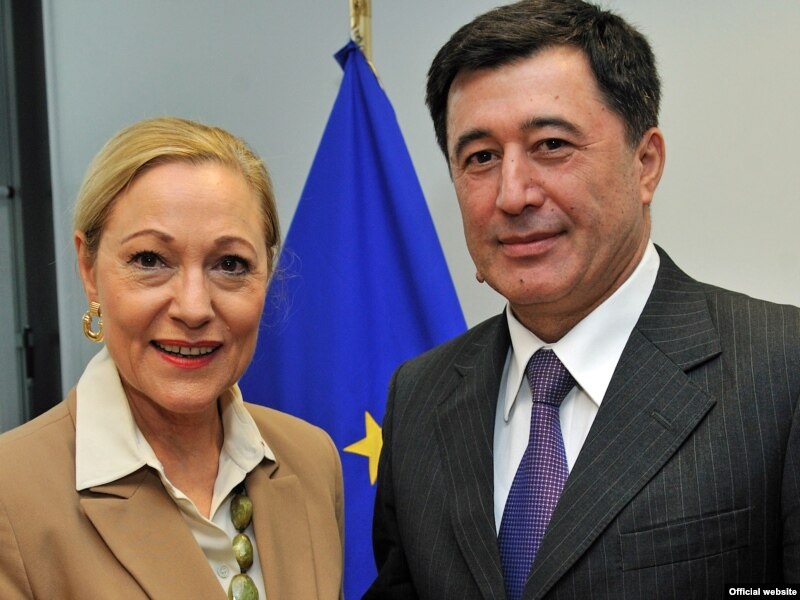
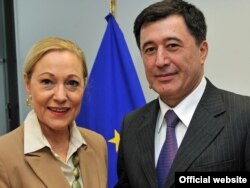 Ferrero-Waldner meets Uzbek Foreign Minister Vladimir Norov in Brussels in September.Ferrero-Waldner: What I've been doing all the time is I've always been quite firm with all these countries in private, in the meetings, but I have not always put them on the spot in public. Because I think it's very important to have trust, to have confidence, and that you can also speak even of the most difficult issues with those ministers. And I remember very well always having mentioned all those difficult cases that unfortunately -- and you are right -- are still there, not only in Azerbaijan, but in many others of these countries.
RFE/RL: This brings us to the dilemma of dialogue versus sanctions. You're known as a great proponent of dialogue. Do you feel that when the EU has applied sanctions -- for example, against Belarus -- it has done so in error?
Ferrero-Waldner: Well, I thought that sanctions, indeed, have not really brought us very far. You can have this policy or that, but we always have to go back and ask ourselves: "What is really more constructive? What will bring us further?" And I personally believe that engagement is much more constructive and brings us better [results] than isolation.
RFE/RL: The two countries keenest to have a dialogue with the EU in the Eastern Partnership have been Ukraine and Georgia. Neither has gotten very far in their development. Why do you think that is the case?
Ferrero-Waldner: I don't agree with that. I think [that Ukraine] in particular has gone very far. You know, the neighborhood policy, from the outset, has been designed as a policy to bring our neighbors -- east and south, but I will speak now about the east -- much closer to the European Union. And we have tried to give them all the possibilities to bring them close to us.
But there was one thing that at that moment was not mature, and is not yet mature. That is the question of whether these countries in the future can become members of the European Union or not. Therefore, I've always said from the outset, very clearly, "Please, take whatever we can offer you. Try to comply with what we ask of you, and use this momentum to come closer. But the future is, of course, open and at [this] very moment we cannot give you any other answer." And this is what we have said during [the past] five years.
Now Ukraine, at a certain moment, didn't want to accept that. But in the end, [the EU maintains] exactly this policy, because you need unanimity of all the member states. It's not a policy of the [European] Commission. The commission, so to speak, [pursues] the policy that has been commonly agreed upon. And I think we have given a lot of possibilities to Ukraine. Bilaterally, they are also the furthest in the negotiations of the [new Association] Agreement.
But all these things are painful negotiations. They are difficult because [Ukraine] needs to change not only their whole legislation -- all different items -- but they also have to change their implementation [of it], and their spirit, and this takes time. I always am also of the opinion -- because I think I'm a realist -- that this is a societal change that we want to help them bring about. Again, it's for them to change, and it's for us to help them to change.
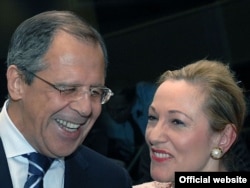 Ferrero-Waldner shares a laugh with Russian Foreign Minister Sergei Lavrov in 2007.RFE/RL: I remember in 2003 when the European Commission released the first draft of what became the European Neighborhood Policy, and I vividly remember a highlight in the text noting that enlargement has been the EU's most successful foreign policy tool. Now, without the promise of accession -- as you said, the member states are not agreed -- do you not feel that without that, the EU has been attempting to reform these countries with one arm tied behind its back?
Ferrero-Waldner: Well, there is this opinion that only enlargement can change everything. But I'm not of that opinion. And we as foreign ministers -- and I was foreign minister [of Austria] in 2003 -- and I remember we discussed this policy with Anna Lindh [then foreign minister of Sweden] and many others of our good colleagues then. And I think there is a very important policy to bring these countries closer. Because for the moment, none of these countries is mature [enough] to enter the European Union, [even] if we wanted it. No.
And there always have to be the two sides -- both have to be ripe, have to be mature. Remember, countries like Sweden, Austria, Finland, for instance, when they wanted to become members of the European Union, there was this European economic space, or area, which I must say as an Austrian we didn't like too much. But then we understood how important it was. And when the time was ripe, this helped us. So let us see.
But these countries, I think, have to do their reforms. And you know [in] Ukraine, for instance, a lot still is missing. But also in the other countries. And therefore, we tell them, "Please use this momentum. You get a lot of financial support. You get, in reality, a free-trade zone, a comprehensive free-trade zone. You get regulatory [convergence]." And apart from the bilateral [links] we also have now created this multilateral Eastern Partnership with all the platforms, where the different six countries can work together, can see the best practices -- "Who is farther [along]? What do I learn from here or there?" That is very important.
RFE/RL: There is the reality of cooperation and integration, and there is the reality on the ground, in the countries themselves. I listened to Swedish Foreign Minister Carl Bildt the other day observe in a speech that all of the EU's eastern neighbors are now more fragile than they were five years ago -- even if they may have progressed in their relations with the EU. Do you agree with this? And if so, why would that be?
Ferrero-Waldner: There is, of course, the politics around [the countries] that you cannot completely disregard. And, indeed, of course, Russia is there and sees these countries somehow [as its] near abroad. But we think these countries should use the momentum to come closer to us. So I think it is really to show both -- these countries, but also the Russians -- this is our common neighborhood, as we always have said.
To stabilize countries is not against Russia but, indeed, is a favor for all of us, and for the countries themselves. So, you know, you have to see it in this context, in this political context.
RFE/RL: Russia -- is it a European country in the sense of having a legitimate and necessary contribution to make to Europe's identity and its values? Or is it something located next to Europe on the map which has to be accommodated?
Ferrero-Waldner: I think Russia is a European country, but it's a huge European country. And therefore, I don't think that Russia would be a member in the European Union one day. I don't think so. And I think Russia, after having had its Soviet phase for a long time, and before that a feudal system, has to slowly, slowly get acquainted with all our values and also adopt them. All of them. But it will take time. This is my belief. I always say societal changes take generations.
RFE/RL: Let's get the big picture out of the way first. Having done your job for five years now, what would you say being European means? And where does Europe end for you?
Benita Ferrero-Waldner: First of all, I think there is a certain European identity. We have a common history, we have a common culture, and we also have common values. That is absolutely clear. And I think that I see that and I have been seeing that in these five years whenever I've gone outside -- to the other continents, to other countries. Then you really feel there is something that brings us together. Therefore, I don't really think that the borders are geographic borders, but they are the borders of this certain European identity that is there.
RFE/RL: Every now and then one hears the words "European values," which represent something basic the EU stands for. Yet when I hear the neighborhood countries being told -- as you yourself told the foreign ministers of the six Eastern Partnership countries on December 9 -- that the reforms the EU proposes to them are subject to their consent, I wonder if you don't feel that there are certain European values that should be accepted unconditionally and not be at the mercy of what the partner governments might happen to think?
Ferrero-Waldner: I think [it] is our objective to have the same values for all the countries. But I also think we have to see the history of some of those countries. And so they have to recuperate some of the values that for us are already very evident. And I think that we have to help them to recuperate [those values], and that is one of the aims I have tried to [reach] in my time as commissioner for external relations and neighborhood policy.
RFE/RL: Obviously, these values span a wide spectrum; there are different types of values. But it would seem to me that respect for human rights constitutes a very basic element of what it means to be European. And in that sense, one sometimes wonders about what is going on when, for example, the EU receives the foreign minister of Azerbaijan without the slightest public sign of friction, at a time when there are journalists in jail in Azerbaijan for expressing their opinions. How do you personally reconcile yourself to this?
RFE/RL: This brings us to the dilemma of dialogue versus sanctions. You're known as a great proponent of dialogue. Do you feel that when the EU has applied sanctions -- for example, against Belarus -- it has done so in error?
Ferrero-Waldner: Well, I thought that sanctions, indeed, have not really brought us very far. You can have this policy or that, but we always have to go back and ask ourselves: "What is really more constructive? What will bring us further?" And I personally believe that engagement is much more constructive and brings us better [results] than isolation.
RFE/RL: The two countries keenest to have a dialogue with the EU in the Eastern Partnership have been Ukraine and Georgia. Neither has gotten very far in their development. Why do you think that is the case?
Ferrero-Waldner: I don't agree with that. I think [that Ukraine] in particular has gone very far. You know, the neighborhood policy, from the outset, has been designed as a policy to bring our neighbors -- east and south, but I will speak now about the east -- much closer to the European Union. And we have tried to give them all the possibilities to bring them close to us.
But there was one thing that at that moment was not mature, and is not yet mature. That is the question of whether these countries in the future can become members of the European Union or not. Therefore, I've always said from the outset, very clearly, "Please, take whatever we can offer you. Try to comply with what we ask of you, and use this momentum to come closer. But the future is, of course, open and at [this] very moment we cannot give you any other answer." And this is what we have said during [the past] five years.
Now Ukraine, at a certain moment, didn't want to accept that. But in the end, [the EU maintains] exactly this policy, because you need unanimity of all the member states. It's not a policy of the [European] Commission. The commission, so to speak, [pursues] the policy that has been commonly agreed upon. And I think we have given a lot of possibilities to Ukraine. Bilaterally, they are also the furthest in the negotiations of the [new Association] Agreement.
But all these things are painful negotiations. They are difficult because [Ukraine] needs to change not only their whole legislation -- all different items -- but they also have to change their implementation [of it], and their spirit, and this takes time. I always am also of the opinion -- because I think I'm a realist -- that this is a societal change that we want to help them bring about. Again, it's for them to change, and it's for us to help them to change.

Ferrero-Waldner: Well, there is this opinion that only enlargement can change everything. But I'm not of that opinion. And we as foreign ministers -- and I was foreign minister [of Austria] in 2003 -- and I remember we discussed this policy with Anna Lindh [then foreign minister of Sweden] and many others of our good colleagues then. And I think there is a very important policy to bring these countries closer. Because for the moment, none of these countries is mature [enough] to enter the European Union, [even] if we wanted it. No.
And there always have to be the two sides -- both have to be ripe, have to be mature. Remember, countries like Sweden, Austria, Finland, for instance, when they wanted to become members of the European Union, there was this European economic space, or area, which I must say as an Austrian we didn't like too much. But then we understood how important it was. And when the time was ripe, this helped us. So let us see.
But these countries, I think, have to do their reforms. And you know [in] Ukraine, for instance, a lot still is missing. But also in the other countries. And therefore, we tell them, "Please use this momentum. You get a lot of financial support. You get, in reality, a free-trade zone, a comprehensive free-trade zone. You get regulatory [convergence]." And apart from the bilateral [links] we also have now created this multilateral Eastern Partnership with all the platforms, where the different six countries can work together, can see the best practices -- "Who is farther [along]? What do I learn from here or there?" That is very important.
RFE/RL: There is the reality of cooperation and integration, and there is the reality on the ground, in the countries themselves. I listened to Swedish Foreign Minister Carl Bildt the other day observe in a speech that all of the EU's eastern neighbors are now more fragile than they were five years ago -- even if they may have progressed in their relations with the EU. Do you agree with this? And if so, why would that be?
Ferrero-Waldner: There is, of course, the politics around [the countries] that you cannot completely disregard. And, indeed, of course, Russia is there and sees these countries somehow [as its] near abroad. But we think these countries should use the momentum to come closer to us. So I think it is really to show both -- these countries, but also the Russians -- this is our common neighborhood, as we always have said.
To stabilize countries is not against Russia but, indeed, is a favor for all of us, and for the countries themselves. So, you know, you have to see it in this context, in this political context.
RFE/RL: Russia -- is it a European country in the sense of having a legitimate and necessary contribution to make to Europe's identity and its values? Or is it something located next to Europe on the map which has to be accommodated?
Ferrero-Waldner: I think Russia is a European country, but it's a huge European country. And therefore, I don't think that Russia would be a member in the European Union one day. I don't think so. And I think Russia, after having had its Soviet phase for a long time, and before that a feudal system, has to slowly, slowly get acquainted with all our values and also adopt them. All of them. But it will take time. This is my belief. I always say societal changes take generations.