




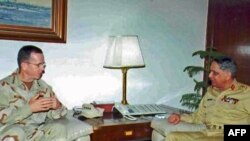
A report by a popular U.S. magazine that questions the security of Pakistan's nuclear arsenal amid rising insecurity has prompted angry reactions in Islamabad.
"Defending the Arsenal," published this week on the "The New Yorker" magazine's website and to be published in the November 16 edition of the print version, reports that, although U.S. President Barack Obama and his administration have publically expressed confidence that Islamabad's nukes are safe, current and former U.S. officials have said his administration has "been negotiating highly sensitive understandings with the Pakistani military" on the issue.
The article says the talks involve allowing "specially trained American units to provide added security for the Pakistani arsenal in case of a crisis," and also address the provision of funds to the Pakistani military to be used for equipment, training, and infrastructure development.
Pakistani officials were quick to belittle the article, written by well-known American journalist Seymour Hersh.
"Our security apparatus has the capacity and is fully geared to meet all conceivable challenges," General Tariq Majid, the chairman of the Pakistani military's Joint Chiefs of Staff, said in a statement on November 9.
He rejected the "The New Yorker" report as "absurd and plain mischievous." A statement by the Pakistani Foreign Ministry called the article "utterly misleading and totally baseless."
'No Danger' From Militants
Independent experts say that while extremism indeed poses a grave threat to the security and stability of the Muslim state, Islamabad's nuclear arsenal is safe.
Abdul Hameed Nayyar, a prominent Pakistani physicist and peace activist, described Hersh's article to RFE/RL as "sensational."
He notes that he and other civil society leaders have regularly raised concerns similar to Hersh's with the Pakistani nuclear establishment, and have consistently been assured that Pakistan's nuclear arsenal is safe and cannot be infiltrated or overrun by extremists.
Such worries came to a head this spring, when the Taliban strengthened control over the northwestern Swat Valley, which lies a few hours' drive northwest of the capital, Islamabad.
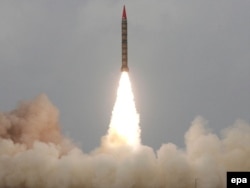 A Hatf-VI ballistic missile is test-fired at an undisclosed location in Pakistan last year."At that time we were very worried and we didn't know how many of [the] nuclear-storage systems lied in the region where these militants had taken over the control. And we were not very sure and therefore, we questioned [the] Pakistani nuclear establishment, the nuclear command authority, if they were safe," Nayyar says.
"And they assured [us] that there was no danger to those things from those people."
Growing Insecurity
Insecurity in Pakistan is on the rise again in the wake of a large-scale military operation against the Taliban in the western South Waziristan tribal region.
On November 10, a car bomb killed 34 people in a crowded market in Charsadda, a city 170 kilometers northwest of Islamabad. More than 300 civilians and soldiers have died in coordinated attacks against security installations and public places over the past few weeks.
Nayyar suggests that aside from a hypothetical and "highly improbable" scenario under which the Taliban were to take over the Pakistani state, the country's nuclear weapons would be safe.
"The point is that as long as Islamic militancy and this kind of militancy -- which is very highly motivated and which is also bent upon taking over the state and bent upon sacrificing their lives -- exists, all of us should be worried," Nayyar says.
"All of us should be worried, but only to the extent that we only want assurances that these things are in safe hands."
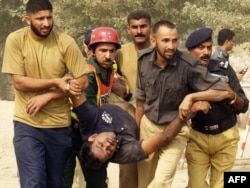 Policemen remove an injured colleague from a police training center after an attack in Lahore last month.Pervez Hoodbhoy, a Pakistani nuclear physicist, public intellectual, and nuclear-disarmament advocate, says that Hersh's article didn't present new facts regarding existing concerns over Islamabad's nuclear program.
"It is an open question as to how secure Pakistan's nuclear weapons are, and certainly until something happens one cannot say anything with any degree of certainty, especially since the whole nuclear program, the custodial authority and the entire protection mechanism that surrounds these weapons, is so hidden from public view," Hoodbhoy says.
"So nothing definitive can be said. On the other hand, there are obviously things that are worrying."
In his article, Hersh states that "the Taliban overrunning Islamabad is not the only, or even the greatest, concern. The principal fear is mutiny -- that extremists inside the Pakistani military might stage a coup, take control of some nuclear assets, or even divert a warhead."
Hoodbhoy, describing himself as "a very worried Pakistani," says the most immediate concern is the prospect of extremists infiltrating the military's ranks. He cites the various militant attacks on senior military officers, the army headquarters, intelligence and special forces offices, which have all been attacked during the past year.
Pakistani experts note that past military coups in Pakistan were orchestrated exclusively by senior generals, and that the rebellions by junior officers, known as "colonel coups," invariably failed. They also note that the military's current leadership is broadly secular and works closely with the civilian government in fighting the Taliban.
Experts also point to Pakistan's diversity and the popular revulsion against the Taliban's tactics as further undermining the group's ability to control the entire county in the near future.
"Defending the Arsenal," published this week on the "The New Yorker" magazine's website and to be published in the November 16 edition of the print version, reports that, although U.S. President Barack Obama and his administration have publically expressed confidence that Islamabad's nukes are safe, current and former U.S. officials have said his administration has "been negotiating highly sensitive understandings with the Pakistani military" on the issue.
The article says the talks involve allowing "specially trained American units to provide added security for the Pakistani arsenal in case of a crisis," and also address the provision of funds to the Pakistani military to be used for equipment, training, and infrastructure development.
Pakistani officials were quick to belittle the article, written by well-known American journalist Seymour Hersh.
"Our security apparatus has the capacity and is fully geared to meet all conceivable challenges," General Tariq Majid, the chairman of the Pakistani military's Joint Chiefs of Staff, said in a statement on November 9.
He rejected the "The New Yorker" report as "absurd and plain mischievous." A statement by the Pakistani Foreign Ministry called the article "utterly misleading and totally baseless."
'No Danger' From Militants
Independent experts say that while extremism indeed poses a grave threat to the security and stability of the Muslim state, Islamabad's nuclear arsenal is safe.
Abdul Hameed Nayyar, a prominent Pakistani physicist and peace activist, described Hersh's article to RFE/RL as "sensational."
He notes that he and other civil society leaders have regularly raised concerns similar to Hersh's with the Pakistani nuclear establishment, and have consistently been assured that Pakistan's nuclear arsenal is safe and cannot be infiltrated or overrun by extremists.
Such worries came to a head this spring, when the Taliban strengthened control over the northwestern Swat Valley, which lies a few hours' drive northwest of the capital, Islamabad.

"And they assured [us] that there was no danger to those things from those people."
Growing Insecurity
Insecurity in Pakistan is on the rise again in the wake of a large-scale military operation against the Taliban in the western South Waziristan tribal region.
On November 10, a car bomb killed 34 people in a crowded market in Charsadda, a city 170 kilometers northwest of Islamabad. More than 300 civilians and soldiers have died in coordinated attacks against security installations and public places over the past few weeks.
Nayyar suggests that aside from a hypothetical and "highly improbable" scenario under which the Taliban were to take over the Pakistani state, the country's nuclear weapons would be safe.
"The point is that as long as Islamic militancy and this kind of militancy -- which is very highly motivated and which is also bent upon taking over the state and bent upon sacrificing their lives -- exists, all of us should be worried," Nayyar says.
"All of us should be worried, but only to the extent that we only want assurances that these things are in safe hands."

"It is an open question as to how secure Pakistan's nuclear weapons are, and certainly until something happens one cannot say anything with any degree of certainty, especially since the whole nuclear program, the custodial authority and the entire protection mechanism that surrounds these weapons, is so hidden from public view," Hoodbhoy says.
"So nothing definitive can be said. On the other hand, there are obviously things that are worrying."
In his article, Hersh states that "the Taliban overrunning Islamabad is not the only, or even the greatest, concern. The principal fear is mutiny -- that extremists inside the Pakistani military might stage a coup, take control of some nuclear assets, or even divert a warhead."
Hoodbhoy, describing himself as "a very worried Pakistani," says the most immediate concern is the prospect of extremists infiltrating the military's ranks. He cites the various militant attacks on senior military officers, the army headquarters, intelligence and special forces offices, which have all been attacked during the past year.
Pakistani experts note that past military coups in Pakistan were orchestrated exclusively by senior generals, and that the rebellions by junior officers, known as "colonel coups," invariably failed. They also note that the military's current leadership is broadly secular and works closely with the civilian government in fighting the Taliban.
Experts also point to Pakistan's diversity and the popular revulsion against the Taliban's tactics as further undermining the group's ability to control the entire county in the near future.