



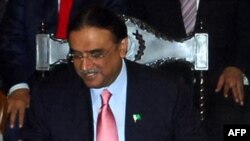
In a ceremony in the Pakistani capital, President Asif Ali Zardari transferred some of his key powers to Prime Minister Yousaf Raza Gilani after signing into law the 18th amendment to Pakistan's 1973 Constitution.
"For me to have signed into law this bill that seeks to undo the undemocratic clauses introduced into the constitution by undemocratic forces, it is a historic day, a historical moment," Zardari said. "It marks an important milestone in the struggle of our people on the road to democracy."
The 18th amendment does away with most of the constitutional changes introduced during the authoritarian rule of Generals Zia-ul-Haq and Pervez Musharraf, who led Pakistan for nearly 20 years during the past three decades.
Pakistani politicians suggest that the changes restore the spirit of the 1973 constitution, which established Pakistan as a federal parliamentary democracy. But amendments during the military dictatorships turned the government into a presidential system with successive presidents repeatedly sacking elected parliaments.
Now the prime minister and the parliament will have the key executive powers, such as appointing powerful military leaders and judges, while being responsible for running the administration. The amendment also formally changes the name of the Northwest Frontier Province to Khyber Pakhtunkhwa.
'Landmark' Changes
Senator Afrasiab Khattak was one of the members of the parliamentary constitutional commission that worked on the reforms in endless meetings during the past nine months. He calls the reform package a "landmark in Pakistan's constitutional history."
Khattak says the constitutional changes could make Pakistan one of the best federal states in Asia. The Council of Common Interests, formerly a temporary body, will now turn into a permanent institution managing equitable resource distribution among the country's four provinces. Khattak's secular Awami National Party is also jubilant over the renaming of the Pashtun-majority Northwest Frontier Province as Khyber Pakhtunkhwa.
 The reforms have abolished the "concurrent list," giving the provinces more powers to raise taxes and control more sectors of the economy while their legislatures will have power to make laws about subjects formerly controlled from Islamabad. The enhanced government structures in the provinces are expected to create new jobs and business opportunities in remote regions facing insecurity, crippling power cuts, and rising unemployment.
Khattak says the changes mark a victory for political parties in Pakistan that have been undermined by the constant manipulation of the country's security establishment.
"The whole thing has been done through consensus," Khattak says. "The entire political spectrum owns these amendments and supports these amendments, barring the clause of an article which is renaming the Northwest Frontier Province as Khyber Pakhtunkhwa."
Bringing Border Regions Into Mainstream
That last issue has been controversial, with a small minority of non-Pashto speakers in the region violently opposing the name change.
The constitutional reforms, however, have completely ignored the volatile western tribal regions on the Afghan border. Despite promising reforms and mainstreaming of these regions for years, politicians cheering the constitutional reforms are silent over the fate of the Federally Administered Tribal Areas (FATA), where thousands have died and hundreds of thousands have been displaced by fighting between Islamic extremists and national security forces.
Khattak says the country's "ruling establishment," a common euphemism for the powerful military, is of the view that security needs to improve before political freedoms and economic development can be introduced into the FATA.
But politicians, he says, have a different view. "We believe that part of this insecurity and instability is [due to] the lack of reforms," Khattak says. "If FATA is opened up for reforms we believe it will lead to the empowerment of the people of FATA, who will stand up against terrorists."
"For me to have signed into law this bill that seeks to undo the undemocratic clauses introduced into the constitution by undemocratic forces, it is a historic day, a historical moment," Zardari said. "It marks an important milestone in the struggle of our people on the road to democracy."
The 18th amendment does away with most of the constitutional changes introduced during the authoritarian rule of Generals Zia-ul-Haq and Pervez Musharraf, who led Pakistan for nearly 20 years during the past three decades.
Pakistani politicians suggest that the changes restore the spirit of the 1973 constitution, which established Pakistan as a federal parliamentary democracy. But amendments during the military dictatorships turned the government into a presidential system with successive presidents repeatedly sacking elected parliaments.
Now the prime minister and the parliament will have the key executive powers, such as appointing powerful military leaders and judges, while being responsible for running the administration. The amendment also formally changes the name of the Northwest Frontier Province to Khyber Pakhtunkhwa.
'Landmark' Changes
Senator Afrasiab Khattak was one of the members of the parliamentary constitutional commission that worked on the reforms in endless meetings during the past nine months. He calls the reform package a "landmark in Pakistan's constitutional history."
Khattak says the constitutional changes could make Pakistan one of the best federal states in Asia. The Council of Common Interests, formerly a temporary body, will now turn into a permanent institution managing equitable resource distribution among the country's four provinces. Khattak's secular Awami National Party is also jubilant over the renaming of the Pashtun-majority Northwest Frontier Province as Khyber Pakhtunkhwa.
Khattak says the changes mark a victory for political parties in Pakistan that have been undermined by the constant manipulation of the country's security establishment.
"The whole thing has been done through consensus," Khattak says. "The entire political spectrum owns these amendments and supports these amendments, barring the clause of an article which is renaming the Northwest Frontier Province as Khyber Pakhtunkhwa."
Bringing Border Regions Into Mainstream
That last issue has been controversial, with a small minority of non-Pashto speakers in the region violently opposing the name change.
The constitutional reforms, however, have completely ignored the volatile western tribal regions on the Afghan border. Despite promising reforms and mainstreaming of these regions for years, politicians cheering the constitutional reforms are silent over the fate of the Federally Administered Tribal Areas (FATA), where thousands have died and hundreds of thousands have been displaced by fighting between Islamic extremists and national security forces.
Khattak says the country's "ruling establishment," a common euphemism for the powerful military, is of the view that security needs to improve before political freedoms and economic development can be introduced into the FATA.
But politicians, he says, have a different view. "We believe that part of this insecurity and instability is [due to] the lack of reforms," Khattak says. "If FATA is opened up for reforms we believe it will lead to the empowerment of the people of FATA, who will stand up against terrorists."