

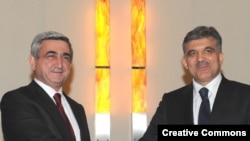
A joint statement issued late on August 31 by Turkey and Armenia, together with mediators from Switzerland, says Ankara and Yerevan will conduct six weeks of diplomatic consultations before signing two protocols that establish formal diplomatic ties and help develop bilateral relations.
The two neighboring countries have no diplomatic ties, closed borders, and a history of animosity that stems from the mass killing of Armenians in 1915.
But Yerevan is eager to see the reopening of its border with Turkey, which was closed in 1993 after Armenian forces took control of the territory of Nagorno-Karabakh, located within Azerbaijan. Turkey and Azerbaijan share cultural ties and are traditional allies.
Turkey wants to bolster its image as a regional statesman, a stable energy distribution hub, and a key ally of world powers. Turkey's steps toward rapprochement with Armenia also coincide with efforts to resolve a long-running feud with Turkey's Kurdish minority, an issue vital to Ankara's efforts to earn membership in the European Union.
But to be sure, the talks still face potential pitfalls. The parliaments of both countries must ratify a deal on diplomatic normalization by ratifying the protocols. And many Turkish lawmakers distrust Yerevan over its position on the frozen conflict in Nagorno-Karabakh.
'Difficult To Foresee'
Barcin Yinanc, the managing editor of the English-language newspaper "Hurriyet Daily News" in Turkey, tells RFE/RL that the Turkish parliament may insist on seeing progress on resolving the Nagorno-Karabakh conflict before talks can proceed any farther.
"Right now, it is a bit difficult to foresee the parliament approving the protocols unless they see substantial progress in the solution of Nagorno-Karabakh," she says.
"Turkey had linked the opening of the borders between Armenia and Turkey to a solution in Nagorno-Karabakh. However, with the protocols, once they enter into force the borders will be open within two months. The parliamentarians would like to see if there has been any progress on Nagorno-Karabakh before giving their consent to the protocols," she says.
Richard Giragosian, director of the Yerevan-based Armenian Center for National and International Studies, says the next two months will be crucial for moving toward an agreement that can be ratified by both the Turkish and Armenian parliaments.
He says it is significant that Ankara has not insisted on a specific reference in the protocols to Nagorno-Karabakh.
"Surprisingly, despite several months of diplomatic rhetoric by Turkish officials designed to reassure Azerbaijan, there was no specific mention of Nagorno-Karabakh," Giragosian says. "Nor [was there] any specific mention of the Armenians holding areas of Azerbaijan beyond the borders of Karabakh. In fact, the omission of the Karabakh issue in many ways can be seen as a diplomatic compromise."
'Positive Sign'
Giragosian says he thinks the Turkish leadership has been rethinking its policy of linking Nagorno-Karabakh to relations with Armenia.
"Turkey was looking to modify a failed policy of blockade and refusing to establish diplomatic relations," he says. "What this means now is the whole agreement and the whole Turkish diplomatic effort was all about restoring flexibility and giving more options to Turkey, which was not quite happy in becoming overly dependent or hostage to Azerbaijan on this issue. Therefore, the omission of the Nagorno-Karabakh conflict from this diplomatic protocol is a positive sign."
Nevertheless, Turkish Foreign Minister Ahmet Davutoglu said in a nationwide television broadcast on August 31 that Ankara will "guard" Azerbaijan's interest during its reconciliation talks with Armenia. Davutoglu says Ankara's aim is to "establish stability in the Caucasus."
The language of the protocols has sparked an angry reaction in Azerbaijan.
Foreign Ministry spokesman Elkhan Polukhov told RFE/RL's Azerbaijani Service that Turkish officials like Prime Minister Recep Tayyip Erdogan assured Baku in the past that no deal with Armenia would be offered without a satisfactory resolution of Nagorno-Karabakh's status.
"When Erdogan was in Baku during his speech to the Milli Mejlis [parliament] in May, he stated that as long as Nagorno-Karabakh is occupied, the borders between Armenia and Turkey will remain closed," Polukhov said. "Opening the borders without a resolution would be against Azerbaijan's national interest."
Mass Killings In 1915
Resource-rich Azerbaijan is a critical link in Turkey's ambition to become a regional energy hub, and Ankara is likely to weigh Baku's concerns seriously. Polukhov noted the Turkey-Armenia deal has yet to be signed, suggesting Baku is confident its concerns will be addressed in any future talks.
Another delicate issue in the reconciliation talks would be the mass killing of Armenians by Ottoman Turks in 1915. Yerevan has long insisted that the killing of hundreds of thousands of ethnic Armenians constitutes a deliberate plan of ethnic cleansing and should be branded genocide. Ankara rejects the demand, saying Turks were also killed in what it characterizes as a partisan conflict.
For his part, Armenian President Serzh Sarkisian has indicated that the ongoing dispute over the massacre would not stop the diplomatic process. Sarkisian says it is important for historical justice to be restored. But he says Yerevan is not demanding that Ankara recognize the mass killings as genocide as a preliminary condition for establishing diplomatic relations.
Hrant Margarian, acting chief for the governing body of the opposition Armenian Revolutionary Federation, told RFE/RL's Armenian Service that the protocols should make a specific reference to Yerevan's demand for Turkey to recognize the killings as genocide.
"The published points are unacceptable," Margarian said. "The documents contain veiled preconditions from the Turkish side. It is a pity that our president is opting for signing a document, which he has no right to do. No government has the right to make the Armenian genocide a bargaining chip. No government has the right to make announcements at the expense of the future generations."
'Hostage' To Nagorno-Karabakh
Another prominent Armenian opposition figure, former Foreign Minister Alexandr Arzumanian, told RFE/RL that the ratification process is an unnecessary step that will make the protocols, in his words, "hostage" to the Nargorno-Karabakh issue.
"Armenia has established diplomatic relations with about 140 countries," Arzumanian said. "Similar protocols have been signed with each of them separately and none of those protocols has been ratified [by parliaments]. The ratification format is unclear and it is just a way to delay the moment, when the protocols come into action. This means that Armenian-Turkish relations are again kept in suspense held hostage to Nagorno-Karabakh conflict settlement."
Giragosian says initial media reports about the agreement were wrong to say that the 1915 massacre would not be part of the diplomatic talks during the next six weeks.
"According to the diplomatic protocol, we see the creation of an intergovernment bilateral commission," he says. "One of the subcommittees of this new diplomatic body will deal with a dialogue on the 'historical dimension' -- according to the diplomatic language used -- and in an effort to restore mutual confidence. So we do see a new attempt, at least softly and vaguely defined, to examine the legacy of the Armenian genocide."
By the same token, the issue of Nagorno-Karabakh also could be raised within the subcommittee on "historical dimension." That makes the subcommittee of critical importance in the effort to reestablish diplomatic ties between Armenia and Turkey.
RFE/RL's Azerbaijani and Armenian services contributed to this report.
The two neighboring countries have no diplomatic ties, closed borders, and a history of animosity that stems from the mass killing of Armenians in 1915.
But Yerevan is eager to see the reopening of its border with Turkey, which was closed in 1993 after Armenian forces took control of the territory of Nagorno-Karabakh, located within Azerbaijan. Turkey and Azerbaijan share cultural ties and are traditional allies.
Turkey wants to bolster its image as a regional statesman, a stable energy distribution hub, and a key ally of world powers. Turkey's steps toward rapprochement with Armenia also coincide with efforts to resolve a long-running feud with Turkey's Kurdish minority, an issue vital to Ankara's efforts to earn membership in the European Union.
But to be sure, the talks still face potential pitfalls. The parliaments of both countries must ratify a deal on diplomatic normalization by ratifying the protocols. And many Turkish lawmakers distrust Yerevan over its position on the frozen conflict in Nagorno-Karabakh.
'Difficult To Foresee'
Barcin Yinanc, the managing editor of the English-language newspaper "Hurriyet Daily News" in Turkey, tells RFE/RL that the Turkish parliament may insist on seeing progress on resolving the Nagorno-Karabakh conflict before talks can proceed any farther.
"Right now, it is a bit difficult to foresee the parliament approving the protocols unless they see substantial progress in the solution of Nagorno-Karabakh," she says.
"Turkey had linked the opening of the borders between Armenia and Turkey to a solution in Nagorno-Karabakh. However, with the protocols, once they enter into force the borders will be open within two months. The parliamentarians would like to see if there has been any progress on Nagorno-Karabakh before giving their consent to the protocols," she says.
Richard Giragosian, director of the Yerevan-based Armenian Center for National and International Studies, says the next two months will be crucial for moving toward an agreement that can be ratified by both the Turkish and Armenian parliaments.
He says it is significant that Ankara has not insisted on a specific reference in the protocols to Nagorno-Karabakh.
"Surprisingly, despite several months of diplomatic rhetoric by Turkish officials designed to reassure Azerbaijan, there was no specific mention of Nagorno-Karabakh," Giragosian says. "Nor [was there] any specific mention of the Armenians holding areas of Azerbaijan beyond the borders of Karabakh. In fact, the omission of the Karabakh issue in many ways can be seen as a diplomatic compromise."
'Positive Sign'
Giragosian says he thinks the Turkish leadership has been rethinking its policy of linking Nagorno-Karabakh to relations with Armenia.
"Turkey was looking to modify a failed policy of blockade and refusing to establish diplomatic relations," he says. "What this means now is the whole agreement and the whole Turkish diplomatic effort was all about restoring flexibility and giving more options to Turkey, which was not quite happy in becoming overly dependent or hostage to Azerbaijan on this issue. Therefore, the omission of the Nagorno-Karabakh conflict from this diplomatic protocol is a positive sign."
Nevertheless, Turkish Foreign Minister Ahmet Davutoglu said in a nationwide television broadcast on August 31 that Ankara will "guard" Azerbaijan's interest during its reconciliation talks with Armenia. Davutoglu says Ankara's aim is to "establish stability in the Caucasus."
The language of the protocols has sparked an angry reaction in Azerbaijan.
Foreign Ministry spokesman Elkhan Polukhov told RFE/RL's Azerbaijani Service that Turkish officials like Prime Minister Recep Tayyip Erdogan assured Baku in the past that no deal with Armenia would be offered without a satisfactory resolution of Nagorno-Karabakh's status.
"When Erdogan was in Baku during his speech to the Milli Mejlis [parliament] in May, he stated that as long as Nagorno-Karabakh is occupied, the borders between Armenia and Turkey will remain closed," Polukhov said. "Opening the borders without a resolution would be against Azerbaijan's national interest."
Mass Killings In 1915
Resource-rich Azerbaijan is a critical link in Turkey's ambition to become a regional energy hub, and Ankara is likely to weigh Baku's concerns seriously. Polukhov noted the Turkey-Armenia deal has yet to be signed, suggesting Baku is confident its concerns will be addressed in any future talks.
Another delicate issue in the reconciliation talks would be the mass killing of Armenians by Ottoman Turks in 1915. Yerevan has long insisted that the killing of hundreds of thousands of ethnic Armenians constitutes a deliberate plan of ethnic cleansing and should be branded genocide. Ankara rejects the demand, saying Turks were also killed in what it characterizes as a partisan conflict.
For his part, Armenian President Serzh Sarkisian has indicated that the ongoing dispute over the massacre would not stop the diplomatic process. Sarkisian says it is important for historical justice to be restored. But he says Yerevan is not demanding that Ankara recognize the mass killings as genocide as a preliminary condition for establishing diplomatic relations.
Hrant Margarian, acting chief for the governing body of the opposition Armenian Revolutionary Federation, told RFE/RL's Armenian Service that the protocols should make a specific reference to Yerevan's demand for Turkey to recognize the killings as genocide.
"The published points are unacceptable," Margarian said. "The documents contain veiled preconditions from the Turkish side. It is a pity that our president is opting for signing a document, which he has no right to do. No government has the right to make the Armenian genocide a bargaining chip. No government has the right to make announcements at the expense of the future generations."
'Hostage' To Nagorno-Karabakh
Another prominent Armenian opposition figure, former Foreign Minister Alexandr Arzumanian, told RFE/RL that the ratification process is an unnecessary step that will make the protocols, in his words, "hostage" to the Nargorno-Karabakh issue.
"Armenia has established diplomatic relations with about 140 countries," Arzumanian said. "Similar protocols have been signed with each of them separately and none of those protocols has been ratified [by parliaments]. The ratification format is unclear and it is just a way to delay the moment, when the protocols come into action. This means that Armenian-Turkish relations are again kept in suspense held hostage to Nagorno-Karabakh conflict settlement."
Giragosian says initial media reports about the agreement were wrong to say that the 1915 massacre would not be part of the diplomatic talks during the next six weeks.
"According to the diplomatic protocol, we see the creation of an intergovernment bilateral commission," he says. "One of the subcommittees of this new diplomatic body will deal with a dialogue on the 'historical dimension' -- according to the diplomatic language used -- and in an effort to restore mutual confidence. So we do see a new attempt, at least softly and vaguely defined, to examine the legacy of the Armenian genocide."
By the same token, the issue of Nagorno-Karabakh also could be raised within the subcommittee on "historical dimension." That makes the subcommittee of critical importance in the effort to reestablish diplomatic ties between Armenia and Turkey.
RFE/RL's Azerbaijani and Armenian services contributed to this report.

