



Saturday, May 26, 2012


Features

Public Opinion On Nazi Collaborators Gets Revision In Balkans

Chetnik leader Draza Mihajlovic was executed by Tito's Partisans in 1946*.

Multimedia

TEXT SIZE - +
By Ron Synovitz
In communist-era Yugoslavia, antifascism was very much embedded in the local ideology.

History lessons for schoolchildren warned about the evils of the so-called "fascist-monarchist alliance." Families would speak with pride about a relative who fought as a Partisan against the Nazis, but hide family ties to Croatia's pro-Nazi Ustashe regime or the Serbian nationalist Chetnik paramilitary group.

Nowadays, as Serbia and Croatia move further from their communist past, such tendencies appear to be undergoing a transformation. As the Balkan countries join Europe in marking 65 years since the defeat of Nazi Germany in World War II, many people there now appear to be rejecting ex-Yugoslavia's history of antifascism.

In modern-day Belgrade, it is acceptable -- even socially advantageous -- for people to speak openly about a Chetnik grandfather. Conversely, there is growing reluctance to discuss elderly relatives who were Partisan fighters.

Impact Of Ultranationalists


Historians and sociologists say the trend began with the Balkan wars of the 1990s, when ultranationalist leaders fanned the flames of nationalism in order to bolster their own hold on political power. Although the region has remained largely peaceful for the past decade, nationalist sentiment remains a powerful social force, and is seen by many as feeding a new generation of neo-Nazi and xenophobic movements in the region.

Some observers say Balkan history is being rewritten not only by selective family memory, but on a larger social scale as well.

Indeed, Serbia has been undergoing a constant internal dispute in recent years over the issue of whether a rising generation of fascist organizations and gatherings should be banned. The parliament in Belgrade has, so far, failed to pass legislation aimed at banning fascist organizations.

Serbian Interior Minister Ivica Dacic says that there also are symbols of Serbia's fascist World War II regime remaining in government buildings.

"I personally think the government of Serbia is unable to successfully fight fascism as long as, in our government buildings, we have a photograph of Milan Nedic, who was prime minister during Hitler's time -- not an elected prime minister, but one who was appointed by Hitler," Dacic says.

"It would be more honest to put a picture of the government that was in exile during World War II. Police have to go after fascists in the streets. But politicians don't differentiate between fascists and antifascists."

Meanwhile, Serbia's nationalist-dominated parliament recently passed a law giving Chetnik veterans of World War II the same pension rights and social benefits as Partisans who fought against the Nazis.

In 2005, when Moscow marked the 60th anniversary of the Victory in Europe against fascism, Serbia did not send a representative to the event. Belgrade also declined to send a representative to ceremonies marking the 60th anniversary of the liberation of the Auschwitz Nazi death camp in Poland.

Last year, when delegates from 46 countries signed an international declaration at the Terezin Nazi concentration camp in the Czech Republic -- pledging to return property that was seized from Jewish families during World War II -- Belgrade opted not to sign the document.

At that time, the bigger priority for Serbia was to find the grave of Chetnik leader Draza Mihajlovic -- who was sentenced to death and executed by Tito's Partisans in 1945 for collaborating with the Nazi regime. Still, the anniversary of the liberation of Belgrade by the Soviet Red Army is an event that continues to be celebrated in Serbia.
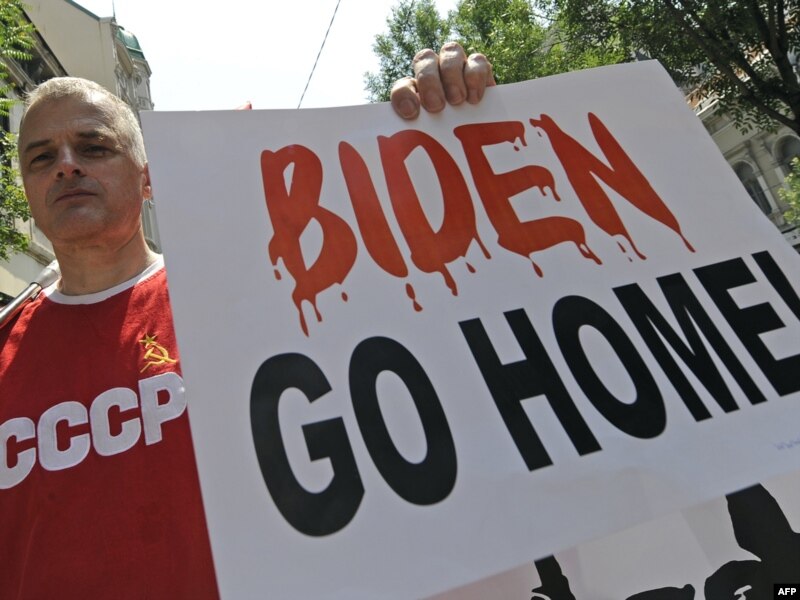
Nationalists are still a powerful force in the Balkans


Jovan Byford, a lecturer on social psychology at the Open University in the United Kingdom who has done extensive research into "social remembering" and historical revisionism in Serbia, says that "when it comes to World War II, what we have today [in Serbia] are just bits and pieces out of context. We have broken pictures without critical analysis and we have different narrations without logic."

Rehabilitating History

Byford has studied the historical rehabilitation in Serbia of figures who were decried as fascists by Tito's regime. One case study by Byford focuses on how Serbs' views have changed during the past two decades about Bishop Nikolaj Velimirovic -- a controversial Serbian Orthodox Christian theologian who died in 1956 and had been vilified by communist Yugoslav authorities as a fascist and anti-Semite who supported the Holocaust.

Since 1990, Velimirovic has come to be regarded within postcommunist Serbian Orthodox culture as the most important religious figure since medieval times.

Byford documented this transition by exploring the changing representations of Velimirovic in Serbian media and in commemorative speeches. Byford also has analyzed interviews with public figures in Serbia who have actively campaigned for the rehabilitation of the bishop's image during the past two decades.

Mladen Lazic, a professor at Belgrade University, says he thinks the majority of Serbs today are antifascists. But he says their voices are being drowned out by more aggressive revisionists.

"Of these two factions, the faction that supports fascism by rehabilitating its collaborators has been on the offensive for some years now. Meanwhile, [antifascists] are not a minority, but rather a majority of Serbian society," Lazic says. "Yet they are on the defensive. They are not trying to win public opinion. That is why this majority is being marginalized."

In Croatia, too, views about history are changing, with many people viewing the wars of the 1990s as an extension of World War II and its disputes in the Balkans.

Zorica Stipetic, a leader of Croatia's Social Democratic Party, says the legacy of World War II is still keenly felt in her country. "The fall of communism, the civil war, and the aggression that all came together in Croatia -- caused a brutal historical revision of World War II. It happened in all spheres of our society, though mostly at the level of ideology," Stipetic says.

Even 65 years after the end of the war, strong divisions remain between supporters of the Partisans and the Ustashe regime, in spite of calls by former Croatian President Franjo Tudjman, the country's first post-independence leader, for all Croats to come together and bridge their differences.

Ustashe symbols are far less prevalent in Croatian cities today than they were in the early 1990s, when Croatia was fighting its war for independence and the Ustashe were equated more with Croatian nationalism than fascism.

Still, critics say Croatia's government is not doing all it can to completely remove the historical symbols of the Ustashe era.

* Due to an error during editing, the caption accompanying the photograph of Draza Mihajlovic mistakenly put his execution in 1945. In fact, it was July 1946.

written by Ron Synovitz in Prague with contributions from RFE/RL Balkan Service correspondents in Belgrade and Zagreb

This forum has been closed.
Comment Sorting
Comments page of 2
    Next 
by: Anonymous
May 09, 2010 21:27
What a lack of knowledge. First to compare Ustasa with Cetnik! If you want to compare fascist movements you have to compare the croation Ustasa with the serbian ZBOR movement during WWII which formed the serbian puppet state under Nedic and which current neo facists i Serbia consider as their root.

Second Serbia was not invited to the anniversary and not - as stated in this "article" - somehow didn't want to send their soldiers to the parade!

Very poorly written article with no clue and knowledge about WWII and the real fascist problems on the balkans and very biased anti serbian POV between the lines.
In Response

by: Political Dissident
May 10, 2010 10:51
Note how "fascist" is used in a way that doesn't distinguish Draza Mihailovic and his supporters from those who allied themselves with the Nazis.

This contrasts from RFE/RL commentary that has made mention of the Ukrainian nationalist UPA/OUN opposition to the Nazis. One RFE/RL piece stated that the OUN/UPA opposed the Nazis and Soviets without noting how said movement (for a period) cooperated with the Nazis.

Has RFE/RL ran commentary noting support in Croatia for the Nazi allied Ustasha regime, which was involved with running the concentration camp at Jasenovac?

Meantime, Draza Mihailovic's forces are appropriately credited with opposing the Nazis and protecting about 500 Anglo-American airmen shot down over Yugoslavia during World War II. In addition, Nazi documents on Yugoslavia and Nazi wanted posters of Mihailovic are among several factors of evidence which run counter to the slant of the above article.

In the above linked article, the uncritical citation of the Tito regime's faulty accusation against Mihailovic is in line with this recent RFE/RL article:

http://www.rferl.org/content/Thirty_Years_After_Titos_Death_Yugoslav_Nostalgia_Abounds_/2031874.html

Note how the first linked article propagandistically states: "In 2005, when Moscow marked the 60th anniversary of the Victory in Europe against fascism, Serbia did not send a representative to the event." I haven't checked back on this claim. Given the slant of the article, it wouldn't be a surprise to find the claim to be inaccurate.

At this year's V-Day holiday, the Serbian president was present in Moscow, unlike many other world leaders. Serbia and Republika Srpska are the only former Yugoslav lands which formally observe the May 9 holiday.

by: Miroslav from: USA
May 10, 2010 00:11
Hmmmm, RFE!!!!
1) Chetnik leader Draza Mihajlovic was executed by Tito's Partisans in 1945??? Mr. author check the dates, there is a relevance in the date. (it is 1946)
2) "the Serbian nationalist Chetnik paramilitary group" ... "PARAMILITARY GROUP" ??????????? well, president Truman as well as General and president Dwight D. Eisenhowerhere did not think of general Mihailovic same way. Here is little something regarding "PARAMILITARY" for Mr. author to read (source Wikipedia):
Due to the efforts of Major Richard L. Felman and his friends, President Harry S. Truman, on the recommendation of General Dwight D. Eisenhower, posthumously awarded Mihailović the Legion of Merit for the rescue of American airmen by the Chetniks. For the first time in history, this high award and the story of the rescue was classified secret by the State Department so as not to offend the Yugoslav government.
"General Dragoljub Mihailovich distinguished himself in an outstanding manner as Commander-in-Chief of the Yugoslavian Army Forces and later as Minister of War by organizing and leading important resistance forces against the enemy which occupied Yugoslavia, from December 1941 to December 1944. Through the undaunted efforts of his troops, many United States airmen were rescued and returned safely to friendly control. General Mihailovich and his forces, although lacking adequate supplies, and fighting under extreme hardships, contributed materially to the Allied cause, and were instrumental in obtaining a final Allied victory." (March 29, 1948, Harry S. Truman)
Almost sixty years after his death, on May 9, 2005, Draža Mihailović's daughter, Gordana, was presented with a decoration bestowed posthumously on her father by United States President Harry S. Truman in 1948, for the assistance provided to the crews of US bombers that were gunned down on the territory under Chetnik control in World War II., July 2009.
In Response

by: Andy
May 11, 2010 07:34
Thank you for your comment, particularly your bringing to our attention the erroneous date in our caption to the photograph of Draza Mihajlovic. We have corrected the caption appropriately. I should mention that the mistake was inserted during the editing process, not by the author of the article.
In Response

by: Political Dissident
May 11, 2010 10:45
What of the other "mistakes," particularly omissions/inaccurate slanrs?
In Response

by: Political Dissident
May 11, 2010 13:05
I didn't intially catch the claim in the article made about how modern Croatia views the Ustasha. If an insert was involved on that, then it should be noted. Otherwise, pardon my oversight.

That said, comparatively speaking, the article is sugar-coating the situation in Croatia in a misrepresentative way.

Not so long ago, a prominent pro-Ustasha Croat musician played before a packed stadium in Croatia which included supporters wearing Ustasha garb. The audience included a career Croat diplomat known for issuing pious comments about Serbs and Serbia.

As has been noted in this discussion, the suggestion that Mihailovic and his supporters are on par with Pavelic and his Ustasha is a crock. Once again, for accuracy sake, distinction should be made on the differences which developed between Mihailovic and Nedic. The latter comes across as a Petain like figure. In actuality, the former doesn't.

by: Mark from: Australia
May 10, 2010 01:02
Thank you for this very interesting article. I however dispute the strength of the pro-Partisan faction in Serbia (as opposed to the pro-Chetnik faction) merely because the majority of Serbian partisans were Chetniks who joined near the end of the war as part of an amnesty. I would also like to give other examples of revisionism in Serbia; during WWII, in order to save ‘orthodox Serbs’ from German reprisals the then collaborationist Serb regime would round up Serbian Jews as the object of reprisals. However in modern times, those same Jewish victims are suddenly worthy of being Serbs and heralded as Serbian victims of fascism. In this way, the competing nationalist narratives in the region try to misappropriate the suffering of the Jewish people in order to enhance their own sense of victimhood but also legitimise their nationalist agendas.

There also is a tendency to impute the declaration of Belgrade as Juden-frei during WWII on the occupying German forces, conveniently glossing over the integral role played by the Milan Nedic regime and the Chetnik factions allied with him.

W.r.t Croatia, I suspect there is loss of credibility in the pro-partisan position because of the destruction wrought on Croatian cities in the 1990s by the JNA (Jugoslav National Army) who were the successors and inheritors of the partisan tradition. There are also mass grave sites recently discovered of victims of a massacre by the partisans of Ustahsa, home guard and many civilians at the end of WWII (also known as the Bleiberg Massacres). The pro-partisan political parties and president have obstructed the investigation of these sites and exhumation of the remains and thereby not providing closure for any living relatives. But they also undermine the credibility of the pro-partisan parties which seek to preach about the rule of law, yet in the same breath seek to justify the Bleiberg massacres as necessary for post WWII reconciliation. The consequences of ex-communists parroting democratic principles without actually understanding them.

What each country in the region needs is a truth and reconciliation commission focused solely on their nation-state’s territory and with significant input by Euro-Atlantic institutions to ensure the commissions do not get hijacked by nationalists and use the current standards of a liberal democracy as the criteria to judge past events.
In Response

by: Political Dissident
May 10, 2010 11:00
Nedic wasn't so popular among Serbs.

Note that the Nazis recognized the sate of Croatia in a way that contrasted with how Serbia was treated. For good measure, this explain's Nedic's limited popularity among Serbs.

The Serbs never had anything at the level of the WW II era Ustasha .

RFE/RL seems to have its own version of a clash of civilizations, as shown by the general slant of its posted articles dealing with issues like the Chetniks and OUN/UPA. Groups seen as not being so pro-Russian are covered more sympathetically as well as inaccurately.

FYI, the Partizans weren't free of committing atrocities on a noticeable scale.
In Response

by: Mark from: Australia
May 11, 2010 11:14
Political Dissident, thank you for your comment.

I would however dispute your assertion that the Ustasha and Chetniks were not the same. Chetnik leader Stevan Moljevic plan for creating an ethnically homogenous Greater Serbia is evidence of this and mirrors anything the Nazi's were doing in Europe. Various Chetnik factions tried to implement Moljevic's policy in Eastern Bosnia with British intelligence estimating the massacre of over 50,000 Bosnian Muslims in Eastern Bosnia. Similar patterns were repeated in the Lika region and Eastern Herzegovina. It is documented that the Ustashi recruited survivors of these massacres for their Black Legion units, and so the cycle of violence continued. Indeed the Chetnik attrocities preceded the German invasion of Yugoslavia.

I can see no redeeming feature of the Chetniks and am puzzled why an Orthodox Christian royalist militia that was notoriously undiciplined and by its very nature was decentralised would be rehabilitated in Serbia. In the US such militias (e.g. Hutaree) are viewed with suspicion at best, ridiculed at worst as impish deluded rogues.

I think the major difference between Croatia & Serbia is that Croatia has gone done the path of transparency (note President Mesic releasing all tape recordings of Tudjman etc) whereas Serbia has a cultire of secrecy and denial - it argued national security interest in the ICTY to evade accountability in the ICJ. There is the pattern of digging up and reburying massacre victims as a systemic process of covering up attrocities (cf the Srebrenica Genocide and the Racak massacre). Looking at the two societies, I say Croatia is better for the reforms.
In Response

by: Miroslav from: Canada
May 11, 2010 15:39
Stevan Moljevic was a minor figure. He had little influence on the Chetniks and furthermore on Serbia. If he was the neo-fascists who praise Ljotic would praise him, but they do not. Furthermore, his importance to the Chetnik movement is clear when one considers that unlike Draza and many others he was not executed -- the opposite for someone Chetnik critics constantly site as some big important Chetnik.

You cannot assert that any Chetnik assert that he was the inspiration for Kalabic and other Chetniks who carried out crimes in Eastern Bosnia. Especially since (according to Bosnian sources) one of the most active Chetnik groups in Eastern Bosnia were led by Muslim commanders - most famously Mustafa Mulalic. I doubt Mustafa would be friends with Draza and kill his own people.

Furthermore regarding Chetniks and the Muslims. Draza actively sought to obtain Muslim support. Not only that but Draza officially made an order calling for tolerance towards Muslims. Massacres committed against Muslims had nothing to do with Draza, but with his subordinates. (It`s strange how the acts of Draza`s subordinates on him, but when PArtisans killed civilians with regard to ethniticity this isn`t a stain on Tito).

Oh please. Don`t spread these lies about Lika and Eastern Hercegovina. Not even the most sentisized Communist history makes such a ludicrous claim. Look at the massacre sites in these regions, strangely you`ll find them the ones filled with the most bones of Serbs killed by UStasha (except Jasenovac).

The Black Legion was the elite formation of the Ustashe. They wouldn`t go after someone who just witnessed a massacre. They`d go after someone with years of top-class military training.

The claim that Chetnik massacres preceeded the invasion of Germany is absurd. Prior to WWII, `Chetniks`` were present in the sourthern areas of Yugoslavia. There were no Chetnik paramilitaries present outside these areas or after 1922. So your claim is a lie (especially since when the Germans evaded, the Croats had just obtained homerule in 1939).

LOL. If you are comparing the Chetniks to the Hutaree, then you must compare the Hutaree to the militias that thought against the British in the War of Independence. That is a more adept comparison. They wanted to liberate their lands and some of them committed atrocities -- read what happened to Tories (those who were pro-british) in the Americas then.

It;s absurd to call them a Christian force, since they had Muslim and Catholic (mainly Slovenian) members.
In Response

by: Marinko from: Australia
May 12, 2010 06:49
@ Miroslav, a couple observations:

(i) Stevan Moljevic was a key advisor to Miahailovic and member of the executive council of the Chetnik National Committee. His Homogenous Serbia plan was adopted by many Chetnik factions (particularly in Eastern Bosnia & Sandzak).

(ii) The comparison of Chetniks to the Hutaree is valid as both are ill-discipline and have extremist views. With the America militia in the War if independence, they were responding to taxes being levied without the same services supplied. With the chetniks, it was a case of extending territory of the purported Greater Serbia state to areas where no substantial Serb communities existed.

(iii) The Chetniks may have had some Muslims (who considered themselves Serbs) just as there were Ustashi who considered themselves Croat. To suggest the inclusion of some minorities somehow transformed the Chetniks as evidence of non-racism or a multiethnic ethic is flawed logic, especially when considering they had the goal of a Greater Serbia. Such absurdity is equivalent to the Ustashi pointing to Jews in their ranks as evidence of filo-semiticism.

(iii) Black legion recruited mainly from survivors of the Chetnik attrocities in East Bosnia, precisely because their motivation would be high, either as thirst for revenge or to protect surviving relatives. Assumptions of absence of military experience is presumptuous. Many home gaurd, Ottoman gendarmes were not allowed to join the security services of Yugoslavia.

(iv) The reason the non-Serbs of Lika & Herzegovina turned to the Ustasha for protection was precisely because of the behaviour of the Chetniks, who were disbanded Royal Army Officers post German invasion. I think you'll find just as many Croat/Muslim bones in those pitts.

(v) 1937, Senj, Chetniks organised a pogrom of Croats that devolved into a massacre. Unfortunately many children/youth were attending a concert in the town also became victims.
In Response

by: Miroslav from: Canada
May 22, 2010 18:58
@ Mairnko

(i) Actually Moljevic wasn't an advisor to Draza. There is no evidence that the two ever communicated or met. Not even Communists made this allegation. And three, even if Chetniks outside Draza's control adopted his ideas it is not associatible for Draza.

(ii) Actually the Chetniks were not fighting fore Greater Serbia, but for the monarchy. The movment of Draza was openly pro-monarchy and pro-Yugoslav. So your claim is invalid. The Yugoslav state and monarchy, which Draza's movement espoused, are not extremist views.

(iii) Except Draza's Chetniks (the only ones with any minority and Muslim presence) were pro-Yugoslav and not for Greater Serbia. So my point is entirely valid.

iv) The Chetniks of Lika & Herzegovina have nothing to do with Draza. Furthermore, the massacres by Ustasha are recorded far sooner then any appearance of Chetniks in the region.

Furthermore, not even the most biased communist hsitory will make your absurd claim that the number of Serbs killed in Lika and Herzegovina is the same as the number of non-Serbs.

(v) Yeah, Draza's Chetniks are responsible for some event preceding the war that they are allegedly responsible. Absurd logic.

Never mind that it was the Yugoslav Gendarme. Furthermore, how about you mention the fact that in the preceding days near Senj (in the Gospic area) Ustashe-linked Croats killed Serbs.

The Gendarme attack was in response to it. The yugoslav gendarmie is somehow worthy to be accused of being Chetnik (never mind it wasn't), but there is no need to mention the pre-WWII Ustashe organization then based in Italy.

Oh please, that incident has nothing to do with Chetniks.
In Response

by: Political Dissident
May 11, 2010 04:27
BTW Mark, many of the Partizans weren't Communists.

In areas where the choices were either Nazi or Partizan, Serbs would quite understandably opt for the latter. This wasn't out of support for Communism.

As communicated in a previously submitted set of comments, Tito and some of his Partizans were involved in a good number of bloody actions.

In Response

by: Political Dissident
May 11, 2010 14:35
Mark

You can inaccurately dispute all you want. Pavelic and the Ustasha were clear cut Nazi allies unlike Mihailovic and his Chetnik supporters.

Some years back, my local Pacifica Foundation radio affiliate had a show that was hosted by someone who is by no means pro-Serb. According to him, the Ustasha treated shot down Allied airmen over Yugoslavia as POWs unlike Mihailovic's Chetniks. The host went on to say that shot down Black airmen were especially singled out for mistreatment. If I'm not mistaken, the Ustasha sent a contingent to the USSR on the side of the Nazis. There's also the matter of the Ustasha run concentration camp at Jasenovac. There's German commentary which expressed revulsion at the brutality exhibited by the Ustasha.

It's true that elements within Mihailovic's Chetnik movement had instances of carrying on in an unruly manner - which shouldn't be excused. Accentuating the wrongs of Mihailovic's Chetniks in a misrepresentative way is lousy history. The analogy with the Hutaree is off the wall.

I'd like to see some well founded citation of what you claim. Offhand, it comes across as anti-Serb/Croat nationalist propaganda. For all of the anti-Serb propaganda out there (include the above article), there's also a general understanding among a good number of non-partisan observers that the pre-WW II conditions in Yugoslavia didn't have circumstances which could be reasonably equated and/or rationalized as support for the manner of the Ustasha. I note how some pro-OUN/UPA supporters rationalize the murdering antics of that org. by bringing up the discrimination of non-Poles in inter-war era Poland. My understanding is that Moljević proposed a future federal Yugoslav state composed of three units: Serbia, Croatia and Slovenia. In any event, he's one person expressing a view and not an individual with the popularity of Mihailovic

David Martin's book on Draza Mihailovic is a well documented work.

Your "culture" point on present day circumstances has an inaccurate and suggestively bigoted aspect to it. Mesic doesn't reflect all Croats (nor is he far from ideal). It's not difficult to find pro-Ustasha sympathy among a good number of present day Croats. Apologizing for actions taken against Muslims but not Serbs is faulty. One example pertains to how Mostar has been covered in some instances.
In Response

by: Political Dissident
May 12, 2010 07:44
Marinko

If anything, the comparison to the Hutaree is more appropriately applied to the Ustasha. Within their ranks was the idea of killing a certain % of Serbs and having the rest of them forcefully converted to Roman Catholicism.

FYI, the American Revolution also concerned the desire of some colonists to expand westward against the British policy of wanting to maintain existing agreements with the Indians.

The repeatedly mentioned (by anti-Serb advocates) Moljevic omits that modern day Serbs aren't generally looking up to him. Moreover, the evidence suggests that his mentioned views weren't adopted by the Mihailovic led Chetniks at large.

That the Chetniks were mostly comprised of Serbs doesn't make them bigots.

Thee claims about actions against Croats before WW II should consider the accuracy of the claims and the flip side of some pre-WW II Croat nationalist terrorism.
In Response

by: Miroslav from: Canada
May 11, 2010 15:11
To the lies of this Mark character.

One, historical records indicate most of the Partisans (up until the latter parts of 1944, before others - Muslims and Croats - joined) were Serbs.
Second, the claim that most Serb partisans were Chetniks is absurd.

Two, the Chetniks who joined the PArtisans joined because that was the kings urging after the Tito-Subasic agreement. Not only that but Tito agreed to have Chetniks join Partisans (an order many of his subordinates wouldn't allow and would kill Chetniks trying to join the PArtisans). By allowing Chetniks to join the PArtisans after the kings order, Tito bassically admits that Chetniks (particularly Draza's group) were essentially a resistance force to the same degree his Partisans were.

As with regard to the Jews. When talking of Nedic, Serbia, the Serbs and the Holocaust Serbophobes miss several critical facts.
* The vast majority of them died in Staro Sajmiste concentration camp, this camp was in what is now Novi Beograd. This is geographically located in Srem, which was part of NDH.
* The vast majority of Jews in Serbia lived in Vojvodina. None of Vojvodina was under Serb control- Banat (where some 40% of the population was German) was directly ruled by the army, Backa was under Hungarians, Srem under Croats. Thus outside Serb control.
* The vast majority of Jews outside Vojvodina were in Beograd and even then that's the greater Belgrade area with 90% of them being in Zemun, which is part of Srem and near where Staro Sajmiste was located. (You don't believe me, you should no a popular neo-ustashe saying is that they will rule Zemun once again).
* If Belgrade was juden-frei its out of the simple fact that most Jews had already fled and 90% of Jews in Belgrade lived in Zemun (ruled by NDH)

by: TruthSquad
May 10, 2010 02:22
Interesting that you have 'forum rules', but what are the rules (if any) for commentators such as Ron Synovitz? Somehow he omitted telling us about Jasenovac death camp and who did the massacring there and beyond in WWII. That was the catalyst for the mayhem of the 1990s. What was your real purpose with hiding so much vital information?
In Response

by: Political Dissident
May 10, 2010 11:03
The above article is a prime example of overly inaccurate hack journalism.
In Response

by: Nan J from: Florida
May 10, 2010 11:09
Perhaps the writer , if I may be so bold as to suggest, should obtain an education on how to research a subject instead of writing pulp fiction and attempting to pass if off as "truth".
He writes for the biggest YELLOW journalism site in the world.
RFE/RL.
Radio LIBERTY to commit sins of emission and half truth. SHAME , SHAME!

by: mike pat from: belgrade
May 10, 2010 09:00
Chetniks were not a paramilitary group. There were the foremost resistance movement, supported by the Allies until 1943, when they shifted in favour of the partisans. Even after that though, chetniks were indirectly supported by the Allies. General Mihajlovic received the Legion of Honour from both Truman and Charles de Gaule. Chetniks and partisans today have equal treatmant according to the law on political rehabilitation. Any proposed connections between Chetniks and the Ustashe movement in Croatia shows nothing but deep ignorance of the author. One should check Yad Yashem, Simon Wisenthaal, Washington genocide memorial sources to gain insight into genocidal horror Jews, Serbs and Roma have gone through in wartime Croatia.

by: Nan Jaracz from: Florida USA
May 10, 2010 11:01
What sloppy research and obvious BIAS against the Serbians IN GENERAL.
WHY no mention of one of the LARGEST concentration camps, Jasenovac in Europe organized and run by the CROATIAN FASCISTS?? A killing machine for over 700,000 Serbs, 20,000 JEWS and 15,000Roma.
WHY no mention of the Serbs & Jews murdered together in Novi Sad by the German occupiers of Yugoslavia??


by: Nick Smith from: Toronto
May 10, 2010 13:24
This is a rather bizarre article. Serbian Chetniks started the first large scale restsistence against Nazi Germany and its puppet state supporters in all of Europe, in May 1941. When all of Europe was underr the Nazi boot and England stood alone, Russia was still not attacked and America was neutral, the Serbs rebelled. Yes, the Communist victors rewrote the history books and branded their enemy Mihailovich a "collaborator". But the historic facts are very different. Mihailovich made a material contribution to the final Allied victory in Europe and was awarded the Legion of Merit Medal by Harry Truman. It's fantastic that the Serbs, in a new democracy, are questioning their past and discovering the truth. And that truth is that the Serbian Chetniks were noble and honorable fighters who stood up against evil when not one else could or would. They are, and remain, true heroes for all freedom loving people and all anti fascists in the world.

by: Brazilian Man from: São Paulo - Brazil
May 10, 2010 15:25
The 7 instructions of Draza Mihailovic:

1. The struggle for the freedom of all of our people under the scepter of His Majesty, the King Peter II;

2. The creation of Greater Yugoslavia, and within it Greater Serbia, ethnically clean within the borders of Serbia, Montenegro, Bosnia and Herzegovina, Srem, Banat, and Bačka;

3. The struggle for the incorporation into our social structure of those non-liberated Slovenian territories under Italy and Germany (Trieste, Gorizia, Istria, and Kaernten), as well as Bulgaria and Northern Albania with Skadar;

4. The cleansing of all national minorities and anti-state elements from state territory;

5. The creation of direct common borders between Serbia and Montenegro, as well as Serbia and Slovenia by cleansing the Muslim population from Sandžak, and the Muslim and Croat populations from Bosnia and Herzegovina;

6. The punishment of all Ustashas and Muslims who have mercilessly destroyed our people in these tragic days;

7. The settlement of the areas cleansed of national minorities and anti-state elements by Montenegrins (to be considered are poor, nationally patriotic, and honest families).

I think Slobodan Milosevic, Arkan, Ratko Mladic and Radovan Karadzic would sign bellow.
In Response

by: Political Dissident
May 11, 2010 10:54
Cite a specific and credible source, instead of dishing out your usual dosage of hypocritically applied anti-Serb and anti-Russian propaganda.

At another recent RFE/RL link, you falsely stated that the Russians criticize Stalin for external (non-Russian) consumption. That comment is inaccurate and bigoted. Many Russians suffered under Stalin. Moreover, Russia at large doesn't always follow some influential thinking found in the West. Hence, the Russian criticism of Stalin is sincere.

You reflect the bias of RFE/RL. Making Mihailovic the suggested face of "fascism" in Europe is disingenuous, given some of the mood evident in Croatia, Hungary, the Baltics, Romania and western Ukraine in the present as well as the not so distant past.

As for the more recent historical views of recent peole in former Yugoslavia, one can reference some of Tudjman's and Izetbegovic's crackpot writings.
In Response

by: Miroslav from: Canada
May 11, 2010 15:46
The only reference to such a document ever being existing was the show trial of Mihailovich.

Its interesting to note that Tito rejected the fact that Americans and British telling him that that was an outright lie.

No copy or transcript of such a document exists (even the alledged original the partisans claimed to posses at his trial has never been shown to the public -- strangely this is a document the PArtisans would not hide if it even existed). While plenty of documentation exists that Draza was not a collaborator.

by: marina
May 10, 2010 16:00
Ronny boy - hey Mr Synovitz- you check need to your facts, baby, you really are out of your depth here!

1. Charles de Gaulle refused to ever shake Tito's hand bcs he killed Gen. Mihailovic

2. Gen Mihailovic received the legion of merit from the USA (posthumously) for his fight against the Nazis


who is this author "ron synovitz" anyways?
In Response

by: Political Dissident
May 11, 2010 10:58
Whoever he is, he's reflecting overly propagandistic journalism.

Put mildly, it makes any RFE/RL criticism of RT and Russian media at large appear ironic.

by: John Harduny from: Reston, VA, USA
May 10, 2010 17:48
Ron Synovitz is unfair to the Chetniks, who were one of the most fierce anti-Nazi force in the entire history of WWII. What a spectacular lack of fundamental knowledge! RFERL continues drifting toward rather idiotic historical revisionism.
In Response

by: Political Dissident
May 11, 2010 18:33
RFE/RL is decent enough to post legitimate criticisms in the comments section.

IMO, it's nevertheless bogus for RFE/RL to continue to run such overtly one-sided anti-Serb propaganda pieces.

People making a living do that are taking the place of a more responsible kind of journalism, which (comparatively speaking) should be getting the column space.

The issue of which options are used over others is a matter concerning other media venues besides RFE/RL.
In Response

by: david
May 12, 2010 15:58
Your self-importance is remarkable, Mr. Averko. Perhaps they simply don't care about the all-too-predictably shrill outcry from the blinkered diaspora types? This forum is a prime example of such. Anything about Armenia is the same.
In Response

by: Political Dissident
May 12, 2010 22:32
"david" (Mr. Hoare or Mr. Muir type with proxy monikers like Abdulmajid) chimes in with the usual dosage of BS.

"Diaspora" types apply to some of the anti-Russian and anti-Serb propaganda dished out. Note how "david" doesn't address that aspect.

This thread has shed light on an overly mis-informative article.

Excuse any repeat of this note. It wasn't made clear to me if a prior submission went through.

Comments page of 2
    Next 

Most Popular


Being Discussed Now

No Saturday Night Fever, As Armenia Mulls Eurovision Blackout

Latest Comment (23 total)

greg: Rafi. you go through round after round accusing me of raping and killing ... More

Loophole Offers Legal Out For Doctor Convicted In Bin Laden Case

Latest Comment (3 total)

khan: i think everyone in the paki gov should be hanged the traiters suking ... More

Putin Wants To Party Like It's 2007

Latest Comment (3 total)

nirvichara: It is so boring to hear all this crap about Putin's "old KGB ... More