



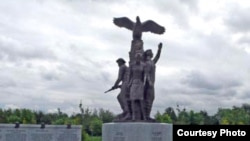
The first official memorial for the half-million Poles who fought under British command in World War II is being unveiled in England on September 19.
One of the leading supporters of the campaign to officially celebrate the Polish war effort is retired General Charles Guthrie, who commanded the British armed forces between 1994-97.
RFE/RL correspondent Ahto Lobjakas speaks to Guthrie about his support for the Polish cause.
RFE/RL: Why are you backing the campaign to mark Poland's effort in World War II?
Charles Guthrie: Well, I think there are many people in the United Kingdom who have forgotten the part Poland played in World War II. They were our oldest allies at one time. They were our only allies, and it's absolutely fitting that we are now, 70 years afterward, putting up a memorial in our National Memorial Arboretum.
They do need to be remembered. They were very gallant. Many, many came to enlist in the British Army and in the Royal Air Force and in the Royal Navy -- but mostly, the great numbers were in the army. Some of them actually came from the Soviet Union because they had been taken by Stalin and put in the gulags. And when they were released, they actually walked and got here, enlisted, and then helped us.
Their record in the war was astonishing when you think they had a squadron in the [1940] Battle of Britain which actually had more successes than any of the other squadrons. They were fighter pilots of extreme skill and bravery. The Polish Army was the army which really, finally, succeeded in capturing Monte Cassino [in a crucial series of World War II battles in Italy]. And we shouldn't forget that. They also were involved in the home front -- code-breaking, they did much to frustrate the Germans about the V-1 and V-2 bombing attacks on places like London and other towns.
So, our debt to them is enormous, and we really should not forget that. And, I'm afraid, Poland was treated very badly -- the ones who came to England, we rather abandoned them, and they became part of the Soviet [bloc], and they were oppressed by Stalin, brutally. [Stalin] had, of course, killed many Poles [an estimated 22,000 soldiers and civilians] in the Katyn forest.
So, it's absolutely fitting what we are doing this weekend. And there will be many people who, at the end of the war -- many people who will be there on Saturday, who at the end of the war felt they could not go back to Poland or a communist country. I think 120,000, something like that, stayed in the United Kingdom and fitted into the British society and made a huge contribution to life here.
I'm delighted to have been involved. I was actually involved with the memorial to General [Wladyslaw] Sikorski, which is in Portland Place in London -- the great Polish leader who lived in London for much of the war. We owe him much. So, I hope that people will recall just what Poland did.
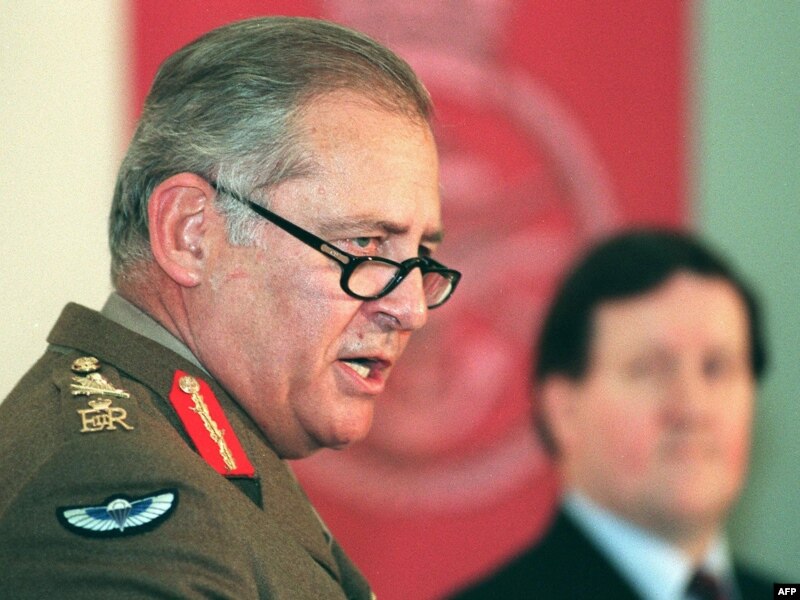
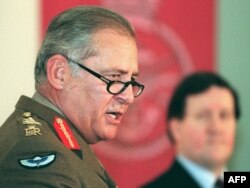 General Charles Guthrie with former British Defense Secretary George Robertson in 1998.RFE/RL: Do you think the fact that it's taken the British government 70 years to officially sponsor a memorial for these Poles is an admission of guilt, of sorts?
Guthrie: Well, I don't know whether I would call it guilt. But I'm a bit ashamed myself that our country has not acknowledged Poland's war effort, [their] fighting for us, dying for the allied cause, fighting the Nazis. I think they were pretty shabbily treated.
And one shouldn't forget that there was a great victory parade at the end of the war which the Poles were not allowed to take part in. Other nations who had fought alongside us took part, but Poland didn't. And I think that was because in those days we did not want to offend Stalin, and I think that's rather a shameful episode.
RFE/RL: Do you think that was a mistake on the part of the British government?
Guthrie: Well, looking at it now, it was. But, you know, the pressures on the government of the time to get on with Russia and Stalin were very great. It's easy for me to say the wrong decision was made, but Winston Churchill and others had to look forward and had to get on with Russia. I think it was a rather cowardly decision, but it happened.
RFE/RL: Certain events of the time are now being seen in a different light -- for example, Prime Minister Gordon Brown has just apologized for the British government's persecution in the 1950s of codebreaker Alan Turing for his homosexuality. Do you think there is also an apology owed to Eastern European nations left in the lurch before and after World War II?
Guthrie: I think you want to be very careful about apologizing for things which happened many, many years ago -- nearly 70 years ago, in the case of the victory parade. The pressures on the leaders of the United Kingdom and the United States were great, and Russia had been our ally, and I don't think we really realized just how bad life would be under the Soviet oppressor. So, I can understand why it happened. I still think it was rather cowardly. I wish it hadn't [happened]. But just going around apologizing for [what happened] all those years ago -- I really don't see any point in that.
RFE/RL: Do you think the Soviet Union's contribution to the war effort outweighs its crimes against Eastern European countries?
Guthrie: Well, I don't think you can compare that sort of thing. I do think that the Russian war effort was astonishing. There's no question that it hasn't always been recognized by people in the United Kingdom -- the sacrifices the Soviet Union made fighting the Germans were huge. And we should never forget that. But that doesn't justify oppressing countries once you had won the war.
RFE/RL: When countries like Estonia remove Soviet World Wr II memorials from public places, are they right in doing that?
Guthrie: I've always thought that the Russians should be allowed to keep their war memorials, and I think it should be duty of the host nation to look after them. It is history -- it happened, the war -- and you can't forget it.
RFE/RL: Do you think countries like Poland should have fought Soviet Russia the way they fought Germany?
Guthrie: Well, it happened in such a way that that was impossible. The Germans plotted and [created] a reason to attack Poland, and that's what happened. And when the Soviet empire attacked, Poland was already being pulled in one direction, and I don't think they could have possibly held out on two fronts because of the Soviet-Nazi pact [of 1939].
RFE/RL: But morally, would Poland and the Baltic countries have been justified in fighting the Soviet Union?
Guthrie: There's no point in fighting a war which is an absolutely hopeless cause. And I think there was a just cause there, but I think it would have been idiotic to go on and on fighting. What would have happened was that Poland would have been in an even worse way than it was in the end.
RFE/RL: Moving 70 years ahead in time, do you think as a military professional that these events could be repeated?
Guthrie: Well, I think the likelihood of having another cold war or world war breaking out in Europe is very, very unlikely.
RFE/RL: But that of a large country taking over a smaller country?
Guthrie: Well, it's not inconceivable under certain circumstances [that] that could happen, but it doesn't seem very likely.
One of the leading supporters of the campaign to officially celebrate the Polish war effort is retired General Charles Guthrie, who commanded the British armed forces between 1994-97.
RFE/RL correspondent Ahto Lobjakas speaks to Guthrie about his support for the Polish cause.
RFE/RL: Why are you backing the campaign to mark Poland's effort in World War II?
Charles Guthrie: Well, I think there are many people in the United Kingdom who have forgotten the part Poland played in World War II. They were our oldest allies at one time. They were our only allies, and it's absolutely fitting that we are now, 70 years afterward, putting up a memorial in our National Memorial Arboretum.
They do need to be remembered. They were very gallant. Many, many came to enlist in the British Army and in the Royal Air Force and in the Royal Navy -- but mostly, the great numbers were in the army. Some of them actually came from the Soviet Union because they had been taken by Stalin and put in the gulags. And when they were released, they actually walked and got here, enlisted, and then helped us.
Their record in the war was astonishing when you think they had a squadron in the [1940] Battle of Britain which actually had more successes than any of the other squadrons. They were fighter pilots of extreme skill and bravery. The Polish Army was the army which really, finally, succeeded in capturing Monte Cassino [in a crucial series of World War II battles in Italy]. And we shouldn't forget that. They also were involved in the home front -- code-breaking, they did much to frustrate the Germans about the V-1 and V-2 bombing attacks on places like London and other towns.
So, our debt to them is enormous, and we really should not forget that. And, I'm afraid, Poland was treated very badly -- the ones who came to England, we rather abandoned them, and they became part of the Soviet [bloc], and they were oppressed by Stalin, brutally. [Stalin] had, of course, killed many Poles [an estimated 22,000 soldiers and civilians] in the Katyn forest.
So, it's absolutely fitting what we are doing this weekend. And there will be many people who, at the end of the war -- many people who will be there on Saturday, who at the end of the war felt they could not go back to Poland or a communist country. I think 120,000, something like that, stayed in the United Kingdom and fitted into the British society and made a huge contribution to life here.
I'm delighted to have been involved. I was actually involved with the memorial to General [Wladyslaw] Sikorski, which is in Portland Place in London -- the great Polish leader who lived in London for much of the war. We owe him much. So, I hope that people will recall just what Poland did.
Guthrie: Well, I don't know whether I would call it guilt. But I'm a bit ashamed myself that our country has not acknowledged Poland's war effort, [their] fighting for us, dying for the allied cause, fighting the Nazis. I think they were pretty shabbily treated.
And one shouldn't forget that there was a great victory parade at the end of the war which the Poles were not allowed to take part in. Other nations who had fought alongside us took part, but Poland didn't. And I think that was because in those days we did not want to offend Stalin, and I think that's rather a shameful episode.
RFE/RL: Do you think that was a mistake on the part of the British government?
Guthrie: Well, looking at it now, it was. But, you know, the pressures on the government of the time to get on with Russia and Stalin were very great. It's easy for me to say the wrong decision was made, but Winston Churchill and others had to look forward and had to get on with Russia. I think it was a rather cowardly decision, but it happened.
RFE/RL: Certain events of the time are now being seen in a different light -- for example, Prime Minister Gordon Brown has just apologized for the British government's persecution in the 1950s of codebreaker Alan Turing for his homosexuality. Do you think there is also an apology owed to Eastern European nations left in the lurch before and after World War II?
Guthrie: I think you want to be very careful about apologizing for things which happened many, many years ago -- nearly 70 years ago, in the case of the victory parade. The pressures on the leaders of the United Kingdom and the United States were great, and Russia had been our ally, and I don't think we really realized just how bad life would be under the Soviet oppressor. So, I can understand why it happened. I still think it was rather cowardly. I wish it hadn't [happened]. But just going around apologizing for [what happened] all those years ago -- I really don't see any point in that.
RFE/RL: Do you think the Soviet Union's contribution to the war effort outweighs its crimes against Eastern European countries?
Guthrie: Well, I don't think you can compare that sort of thing. I do think that the Russian war effort was astonishing. There's no question that it hasn't always been recognized by people in the United Kingdom -- the sacrifices the Soviet Union made fighting the Germans were huge. And we should never forget that. But that doesn't justify oppressing countries once you had won the war.
RFE/RL: When countries like Estonia remove Soviet World Wr II memorials from public places, are they right in doing that?
Guthrie: I've always thought that the Russians should be allowed to keep their war memorials, and I think it should be duty of the host nation to look after them. It is history -- it happened, the war -- and you can't forget it.
RFE/RL: Do you think countries like Poland should have fought Soviet Russia the way they fought Germany?
Guthrie: Well, it happened in such a way that that was impossible. The Germans plotted and [created] a reason to attack Poland, and that's what happened. And when the Soviet empire attacked, Poland was already being pulled in one direction, and I don't think they could have possibly held out on two fronts because of the Soviet-Nazi pact [of 1939].
RFE/RL: But morally, would Poland and the Baltic countries have been justified in fighting the Soviet Union?
Guthrie: There's no point in fighting a war which is an absolutely hopeless cause. And I think there was a just cause there, but I think it would have been idiotic to go on and on fighting. What would have happened was that Poland would have been in an even worse way than it was in the end.
RFE/RL: Moving 70 years ahead in time, do you think as a military professional that these events could be repeated?
Guthrie: Well, I think the likelihood of having another cold war or world war breaking out in Europe is very, very unlikely.
RFE/RL: But that of a large country taking over a smaller country?
Guthrie: Well, it's not inconceivable under certain circumstances [that] that could happen, but it doesn't seem very likely.