



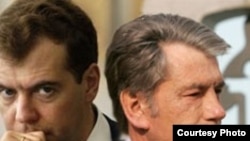
Ukrainian President Viktor Yushchenko's chief of staff has denounced the "aggressive tone" of an open letter from his Russian counterpart that sent shock waves through Ukraine's political elite.
Vera Ulyanchenko accused the Russian leadership of being "hostage to old imperialist complexes" and capable of speaking to its neighbors only "in the language of insults and threats."
 Russian Deputy Foreign Minister Grigory Karasin countered by saying the missive reflects Moscow's "concern" about deteriorating relations, accusing Ulyanchenko of "willfully misinterpreting" Medvedev's message.
In the letter, Medvedev accuses Kyiv of adopting policies intended to undermine a 1997 bilateral agreement on friendship and partnership, and says he hopes "the new political leadership of Ukraine" that emerges after the presidential election in January takes steps to improve relations.
Medvedev offers a litany of specific complaints against Yushchenko, including the claim that Kyiv provided arms to Georgia in the run-up to the war in the Caucasus last August and that Ukraine is "distorting" Soviet history by insisting the Great Famine of the 1930s was an act of "genocide" against Ukrainians. He also complains that Yushchenko's government is suppressing the Russian language and "obstructing" the activities of Russia's Black Sea Fleet, which is based in the Ukrainian city of Sevastopol.
"I am certain that new times will come. But in the current situation, I have decided not to send our ambassador to Ukraine," Medvedev says in a video blog post filmed at Medvedev's Black Sea residence in Sochi. "He will begin work later. Exactly when will be determined by the real dynamics of our relations."
Medvedev goes on to say he's "certain that the multifaceted connections between Russia and Ukraine will return, and on a qualitatively new level -- on the level of strategic partnership."
"Such times are not far off," Medvedev adds, "I hope that the new Ukrainian leadership will be ready for this."
Medvedev's blunt message comes shortly after a controversial 10-day visit to Ukraine by Russian Orthodox Patriarch Kirill, a trip that was marred by protests by Ukrainian nationalists and complaints that the visit was part of an attempt to exert Russian authority in Ukraine.
It also comes as politicians in Ukraine prepare for the country's January 17 presidential election. Opinion polls show Yushchenko with just 4 percent support, trailing Prime Minister Yulia Tymoshenko by 10 percent and Party of Regions leader Viktor Yanukovych by 20 percent.
Just The Start?
Many observers see Medvedev's initiative as an attempt to influence the campaign and the election.
"This is an attempt to make a direct and forceful intervention in Ukraine's domestic politics, and this is an open attempt to give Russia's aggressive politics a decisive influence on the outcome of the upcoming elections in Ukraine," says Andro Barnov, the head of the Institute for Strategy and Development in Tbilisi. "Russia has much more resources and leverage in Ukraine than in Georgia, and so the possibility that this Russian policy will be successful there can not be excluded."
Marek Siwiec, a Polish member of the European Parliament, echoes that sentiment.
"[This is] the beginning of the Russian involvement in the election process in Ukraine," Siwiec says. "I think the language of imperial policies is very well recognized in Europe. The Russians want to be active in the presidential election process and they demonstrate it. That's it."
But former Ukrainian President Leonid Kravchuk dismisses such concerns, saying it's the voters -- not the Kremlin -- who will decide who the next president of Ukraine will be.
"God forbid that our relations should come to a conflict, to a confrontation, or bring about a situation where people are suffering because there is no heat in their homes, where rather than working on overcoming our economic crisis we are worrying about how to please Russia and Russia is thinking how to change the ruling powers in Ukraine," Kravchuk tells RFE/RL's Ukrainian Service. "The Ukrainian people will vote for that president, which it wants to elect. This is our right and Russia must accept this, just as we must accept what is happening at the highest level of Russian politics. This is not our business, just as it's not Russia's business to dictate to Ukraine."
Getting Their Attention
Still, most observers are taking Medvedev's signal seriously. Russia's "Nezavisimaya gazeta" wrote on August 12 that Medvedev is sending "an unambiguous message to pro-Russian forces in the neighboring country: Moscow would like to see the Ukrainian government re-formed." The moderate daily added that the capitals of all the other former Soviet states are watching these developments closely and warned that such actions could "lead to our close and not-so-close partners distancing themselves further from Russia."
Writing last week in "The Moscow Times," former Duma Deputy Vladimir Ryzhkov argued that "Russia's leaders have managed to alienate even its strongest allies." He discusses Moscow's "policy failures" vis-a-vis Belarus, Armenia, Turkmenistan, and Azerbaijan. In Ukraine, Ryzhkov wrote, "Moscow's actions have helped consolidate Ukrainian society around an anti-Russian platform."
Russian political analyst Dmitry Oreshkin, however, says Medvedev's letter is primarily aimed at a domestic audience. He says the Kremlin feels the situation at home -- he mentions the violence in the North Caucasus and growing discontent at the economic crisis worsens and unemployment rises -- is "getting out of control."
As a result, Oreshkin says, Russia's leaders are resorting to the old tactic of building domestic support by convincing Russians their country is surrounded by enemies.
"Over the last few years, we are constantly being encouraged to hate some enemy -- [whether] it is Estonia, or Georgia, or Belarus, or, now, Ukraine," Oreshkin says.
Oreshkin adds that, most likely, Medvedev's open letter to Yushchenko is only the beginning of a new period of heightened tensions.
"I think that since Russia's leaders have decided to ratchet things up like this, this is only the first step and most likely there will be some further steps to come," Oreshkin says.
RFE/RL's Ukrainian, Russian, and Georgian services contributed to this report
Vera Ulyanchenko accused the Russian leadership of being "hostage to old imperialist complexes" and capable of speaking to its neighbors only "in the language of insults and threats."

In the letter, Medvedev accuses Kyiv of adopting policies intended to undermine a 1997 bilateral agreement on friendship and partnership, and says he hopes "the new political leadership of Ukraine" that emerges after the presidential election in January takes steps to improve relations.
Medvedev offers a litany of specific complaints against Yushchenko, including the claim that Kyiv provided arms to Georgia in the run-up to the war in the Caucasus last August and that Ukraine is "distorting" Soviet history by insisting the Great Famine of the 1930s was an act of "genocide" against Ukrainians. He also complains that Yushchenko's government is suppressing the Russian language and "obstructing" the activities of Russia's Black Sea Fleet, which is based in the Ukrainian city of Sevastopol.
"I am certain that new times will come. But in the current situation, I have decided not to send our ambassador to Ukraine," Medvedev says in a video blog post filmed at Medvedev's Black Sea residence in Sochi. "He will begin work later. Exactly when will be determined by the real dynamics of our relations."
Medvedev goes on to say he's "certain that the multifaceted connections between Russia and Ukraine will return, and on a qualitatively new level -- on the level of strategic partnership."
"Such times are not far off," Medvedev adds, "I hope that the new Ukrainian leadership will be ready for this."
Medvedev's blunt message comes shortly after a controversial 10-day visit to Ukraine by Russian Orthodox Patriarch Kirill, a trip that was marred by protests by Ukrainian nationalists and complaints that the visit was part of an attempt to exert Russian authority in Ukraine.
It also comes as politicians in Ukraine prepare for the country's January 17 presidential election. Opinion polls show Yushchenko with just 4 percent support, trailing Prime Minister Yulia Tymoshenko by 10 percent and Party of Regions leader Viktor Yanukovych by 20 percent.
Just The Start?
Many observers see Medvedev's initiative as an attempt to influence the campaign and the election.
"This is an attempt to make a direct and forceful intervention in Ukraine's domestic politics, and this is an open attempt to give Russia's aggressive politics a decisive influence on the outcome of the upcoming elections in Ukraine," says Andro Barnov, the head of the Institute for Strategy and Development in Tbilisi. "Russia has much more resources and leverage in Ukraine than in Georgia, and so the possibility that this Russian policy will be successful there can not be excluded."
Marek Siwiec, a Polish member of the European Parliament, echoes that sentiment.
"[This is] the beginning of the Russian involvement in the election process in Ukraine," Siwiec says. "I think the language of imperial policies is very well recognized in Europe. The Russians want to be active in the presidential election process and they demonstrate it. That's it."
But former Ukrainian President Leonid Kravchuk dismisses such concerns, saying it's the voters -- not the Kremlin -- who will decide who the next president of Ukraine will be.
"God forbid that our relations should come to a conflict, to a confrontation, or bring about a situation where people are suffering because there is no heat in their homes, where rather than working on overcoming our economic crisis we are worrying about how to please Russia and Russia is thinking how to change the ruling powers in Ukraine," Kravchuk tells RFE/RL's Ukrainian Service. "The Ukrainian people will vote for that president, which it wants to elect. This is our right and Russia must accept this, just as we must accept what is happening at the highest level of Russian politics. This is not our business, just as it's not Russia's business to dictate to Ukraine."
Getting Their Attention
Still, most observers are taking Medvedev's signal seriously. Russia's "Nezavisimaya gazeta" wrote on August 12 that Medvedev is sending "an unambiguous message to pro-Russian forces in the neighboring country: Moscow would like to see the Ukrainian government re-formed." The moderate daily added that the capitals of all the other former Soviet states are watching these developments closely and warned that such actions could "lead to our close and not-so-close partners distancing themselves further from Russia."
Writing last week in "The Moscow Times," former Duma Deputy Vladimir Ryzhkov argued that "Russia's leaders have managed to alienate even its strongest allies." He discusses Moscow's "policy failures" vis-a-vis Belarus, Armenia, Turkmenistan, and Azerbaijan. In Ukraine, Ryzhkov wrote, "Moscow's actions have helped consolidate Ukrainian society around an anti-Russian platform."
Russian political analyst Dmitry Oreshkin, however, says Medvedev's letter is primarily aimed at a domestic audience. He says the Kremlin feels the situation at home -- he mentions the violence in the North Caucasus and growing discontent at the economic crisis worsens and unemployment rises -- is "getting out of control."
As a result, Oreshkin says, Russia's leaders are resorting to the old tactic of building domestic support by convincing Russians their country is surrounded by enemies.
"Over the last few years, we are constantly being encouraged to hate some enemy -- [whether] it is Estonia, or Georgia, or Belarus, or, now, Ukraine," Oreshkin says.
Oreshkin adds that, most likely, Medvedev's open letter to Yushchenko is only the beginning of a new period of heightened tensions.
"I think that since Russia's leaders have decided to ratchet things up like this, this is only the first step and most likely there will be some further steps to come," Oreshkin says.
RFE/RL's Ukrainian, Russian, and Georgian services contributed to this report