




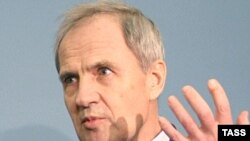
It appears that Valery Zorkin got the memo.
In a speech in St. Petersburg on April 7, the chairman of Russia's Constitutional Court argued that due to the economic crisis, Russia could descend into anarchy and then turn to totalitarianism. To prevent this, he said, the Kremlin has the right to employ authoritarian methods to save the country from disaster.
Zorkin invoked the fate of Weimar Germany, which he described as "one of the most democratic republics in world history" until the Nazis came to power, to argue that Russia needed to find what he described as a "golden mean" between freedom and order.
He also took more than a bit of liberty with the facts, claiming that U.S. President Franklin Roosevelt was "not afraid of accusations of applying authoritarian measures."
Zorkin's comments are the latest in a series by Russian officials that appear to be making the same argument: If you think we're bad, look out! The regime that follows us will be even worse.
Deputy Kremlin chief of staff Vladislav Surkov, the regime's informal ideologist, has been arguing that the authoritarian system of "sovereign democracy" he devised is working fine and does not need to be loosened up.
Pro-Kremlin political strategist Gleb Pavlovsky claims that a cabal exists in the Russian elite that is seeking to exploit the economic crisis and topple the current regime.
And Dmitry Orlov, director of the Agency for Political and Economic Communications, recently wrote that whenever Russia's social contract collapses, it has historically resulted in chaos and disaster.
As I have noted here, this parade of comments comes in response to mounting calls for a liberalization from leading public intellectuals, who argue that the crisis has exposed the bankruptcy of the current arrangement.
Among those appealing for change are Igor Yurgens, director of the Institute of Contemporary Development and an aide to Russian President Dmitry Medvedev, Arkady Dvorkovich, the head of the Kremlin's experts directorate, and Yevgeny Gontmakher, director of the Center for Social Policy at the Institute of Economics of the Russian Academy of Sciences.
The calls for preserving the current system also come amid a wave of demonstrations calling on President Dmitry Medvedev to fire Prime Minister Vladimir Putin.
Russia's elite is clearly splitting into factions that have drawn radically different lessons from the economic crisis. Many in the pro-reform camp are placing their hopes in Medvedev and the Russian media has seen its fair share of stories claiming that the president is waiting for the opportune time to make his move.
Much has been made of Medvedev's "Golden 1,000," the group of new leaders the president has recruited to form Russia's new nomenklatura.
If this is indeed Medvedev's intention -- and that is a very big if -- it seems far fetched that he could really mount a serious challenge to the 'siloviki' clan of security service veterans that dominates Putin's inner circle. The likes of Deputy Prime Minister Igor Sechin, for example, are not going to go quietly into the night.
And Zorkin's comments this week are a warning to any liberalizers out there that the forces invested in preserving the current system are ready for a fight.
-- Brian Whitmore
In a speech in St. Petersburg on April 7, the chairman of Russia's Constitutional Court argued that due to the economic crisis, Russia could descend into anarchy and then turn to totalitarianism. To prevent this, he said, the Kremlin has the right to employ authoritarian methods to save the country from disaster.
Zorkin invoked the fate of Weimar Germany, which he described as "one of the most democratic republics in world history" until the Nazis came to power, to argue that Russia needed to find what he described as a "golden mean" between freedom and order.
He also took more than a bit of liberty with the facts, claiming that U.S. President Franklin Roosevelt was "not afraid of accusations of applying authoritarian measures."
Zorkin's comments are the latest in a series by Russian officials that appear to be making the same argument: If you think we're bad, look out! The regime that follows us will be even worse.
Deputy Kremlin chief of staff Vladislav Surkov, the regime's informal ideologist, has been arguing that the authoritarian system of "sovereign democracy" he devised is working fine and does not need to be loosened up.
Pro-Kremlin political strategist Gleb Pavlovsky claims that a cabal exists in the Russian elite that is seeking to exploit the economic crisis and topple the current regime.
And Dmitry Orlov, director of the Agency for Political and Economic Communications, recently wrote that whenever Russia's social contract collapses, it has historically resulted in chaos and disaster.
As I have noted here, this parade of comments comes in response to mounting calls for a liberalization from leading public intellectuals, who argue that the crisis has exposed the bankruptcy of the current arrangement.
Among those appealing for change are Igor Yurgens, director of the Institute of Contemporary Development and an aide to Russian President Dmitry Medvedev, Arkady Dvorkovich, the head of the Kremlin's experts directorate, and Yevgeny Gontmakher, director of the Center for Social Policy at the Institute of Economics of the Russian Academy of Sciences.
The calls for preserving the current system also come amid a wave of demonstrations calling on President Dmitry Medvedev to fire Prime Minister Vladimir Putin.
Russia's elite is clearly splitting into factions that have drawn radically different lessons from the economic crisis. Many in the pro-reform camp are placing their hopes in Medvedev and the Russian media has seen its fair share of stories claiming that the president is waiting for the opportune time to make his move.
Much has been made of Medvedev's "Golden 1,000," the group of new leaders the president has recruited to form Russia's new nomenklatura.
If this is indeed Medvedev's intention -- and that is a very big if -- it seems far fetched that he could really mount a serious challenge to the 'siloviki' clan of security service veterans that dominates Putin's inner circle. The likes of Deputy Prime Minister Igor Sechin, for example, are not going to go quietly into the night.
And Zorkin's comments this week are a warning to any liberalizers out there that the forces invested in preserving the current system are ready for a fight.
-- Brian Whitmore