


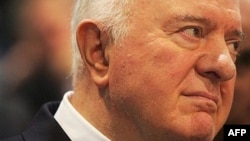
Former Soviet Foreign Minister Eduard Shevardnadze was a major force behind the reforms that led to the collapse of the Soviet Union. Later, Mikhail Gorbachev's onetime ally became leader of his native Georgia when civil war threatened to tear the former Soviet republic apart. Shevardnadze spoke to RFE/RL's Georgian Service correspondent Marina Vashakmadze ahead of the 20th anniversary of the fall of the Berlin Wall.
RFE/RL: When your name is mentioned in connection with the fall of the Berlin Wall, you say it was the German people who brought it down. But the London "Times" recently reported that the Politburo was desperately trying to maintain control of the political situation in East Germany as late as six days before the wall fell. You were Soviet foreign minister at the time and, according to the report, said "We'd better take down the wall ourselves." Were those really your words?
Eduard Shevardnadze: The decision about German reunification was reached in Ottawa [at a meeting of NATO and Warsaw Pact representatives in February 1990]. We were discussing another matter and when the discussion was over, [U.S. Secretary of State James] Baker sat down next to me and said, "Eduard, what do you think, perhaps the time has come for Germany's unification?" I told him he should ask [West German Foreign Minister Hans-Dietrich] Genscher. Baker replied that Genscher had already agreed, but added that problems could arise with certain neighbors. Later it became known that [British Prime Minister Margaret] Thatcher was actively working against German unification. Being a prudent politician, Thatcher didn't want to see the formation of a giant, unified Germany in the center of Europe.
RFE/RL: In your memoirs, you write that the issue of German reunification emerged as early as July 1985, during the first meeting between Gorbachev and Genscher. How did the process develop? In what ways, for instance, was Gorbachev's stance affected by a 1986 controversy during which [German Chancellor] Helmut Kohl compared Gorbachev to [Nazi propaganda chief Josef] Goebbels?
Shevardnadze: Gorbachev's stance was unclear. When asked whether he thought Germany's reunification possible, he said neither yes nor no. He avoided the matter, and would only talk around it. When the issue arose in Ottawa, Baker asked about Gorbachev's position. It seems strange, but Gorbachev and I had never actually talked about German unification in private. So I told [Baker] that I would call Gorbachev in Moscow and ask.
I made the call and told [Gorbachev] that the [NATO and Warsaw Pact] foreign ministers conference was under way, and that the issue of German unification had emerged. I also told him about the [negotiation] mechanism that had been proposed, '2 +4,' which stood for the two German states, plus the Soviet Union, the United States, Great Britain, and France. Gorbachev was silent for minute or two. And then he said, "You know what, Eduard? Sooner or later this matter has to be resolved. It would be better if we don't let it drag on, if we don't create a problem.

I went back and delivered the message to Baker. And since we had obtained Gorbachev's consent, the process began. Obviously, German unification could not have taken place in one day. There were difficulties. Germany had its own issues, so did Genscher. He wanted [a unified Germany] to remain in NATO, which the Soviet Union opposed. Personally, I didn't object; and later, after a long time bargaining, we agreed Germany would remain within NATO. The second, very difficult problem was military weapons. When it came to that issue, we pressured Genscher much more forcefully and agreed that if Germany were to remain in NATO, it would have to reduce its arms stockpiles. Work commenced; the process was under way. We seemed to agree on everything. And then Kohl appeared. I don't remember whether he spoke in the Bundestag, or elsewhere....
RFE/RL: He gave an interview.
Shevardnadze: Yes, I think it was in an interview that he compared Gorbachev to Goebbels. It set off a big controversy, and the case we'd been building was on the verge of collapse. So Genscher and I made an agreement. My brother had died in the battle for Brest during World War II, so I suggested he come to Brest to visit my brother's grave to soften Kohl's statement. And indeed, when word got out that Genscher and I were going to Brest, the reaction to Kohl's statement grew milder. Soon Kohl himself appeared in the Bundestag and clarified that [when comparing Gorbachev to Goebbels] he hadn't meant there was an ideological resemblance, but that the two shared a similar work ethic.
RFE/RL: The process continued for more than a year. The wall began to come down in October 1989, but reunification only took place in October-November 1990. What was happening on the ground? How did people cross the wall?
Shevardnadze: People were crossing [the wall] in both directions. Had Germany not been united without bloodshed, the onset of another world war was possible.
RFE/RL: So the threat of military confrontation was real?
Shevardnadze: Yes, of course. But we'd already been working together with the Americans on arms reduction and had reached an agreement. Persuading Soviet military people was the hardest task, especially Chief of Staff [Sergei] Akhromeyev. The defense minister rarely intervened in anything. I was aware that if any issue needed to be resolved, I had to call or meet Akhromeyev. But he was a stubborn man. So I [often] had no choice but to call Gorbachev. He used to say, "Of course Akhromeyev is right. But this time, we need to support Shevardnadze." By the way, Akhromeyev took those developments very hard -- [German] reunification and the Soviet military withdrawal. He ended up committing suicide.
RFE/RL: Let's talk about the withdrawal of the Soviet Army from East Germany. The 2+4 agreement came into effect in March 1991. But Russian forces actually left only in 1994. How did the process take place?
Shevardnadze: The final decision about the army's withdrawal was made at a convention in Aarhus, Denmark, attended by Kohl, Gorbachev, Akhromeyev, Shevardnadze, and Genscher. It was there the declaration was signed. There was a disagreement about the amount Germany would pay us for withdrawing our military.
RFE/RL: As compensation?
Shevardnadze: Yes. Pulling an army out costs money. We asked for $20 billion. The Germans agreed to pay $16 billion. But on top of that, they gave us a $6 billion loan. So we were supposed to receive $22 billion to resettle our soldiers, build housing, and so on. Nevertheless, the actual withdrawal started after three to four years.
RFE/RL: You write that when Gorbachev received the Nobel Peace Prize, you were standing in front of the Soviet parliament, defending yourself for the same decisions for which Gorbachev was being awarded the prize. Your statement implies a certain discontent with Gorbachev.

Shevardnadze: Yes, indeed. Had Gorbachev done something, said just a couple words, Shevardnadze would have received the Nobel Prize, too. I was in good working shape at the time -- the world had gotten to know me and trust me and Gorbachev wasn't pleased about it. I think it was in India that two people received the Nobel Prize. The same thing could have happened in the Soviet Union, but they decided against it.
RFE/RL: Georgian President Mikheil Saakashvili cited the example of the Berlin Wall in his address to the UN General Assembly on September 24. He spoke about "new artificial dividing lines" in Europe. He said the importance of patience is clear, but that the story of the Berlin Wall taught us that patience shouldn't be passive, that the fall of the wall was made possible because of people's actions on both sides. What lesson does the story of the Berlin Wall teach us today?
Shevardnadze: The Russians did make mistakes. We, of course, were wrong too, when our [the Georgian] army entered Sukhumi [the capital of Georgia's pro-Moscow breakaway region Abkhazia in August 1992]. Had we not done so, war wouldn't have broken out. There were other mistakes, too. Russia's was to recognize the independence of Abkhazia and [Georgia's second pro-Moscow separatist province] South Ossetia [in August 2008]. If those regions deserve independence, what about the people of Chechnya, whose population is three or four times bigger?
The West supported us [last year], and most countries remain sympathetic to Georgia. The question is whether, and where, interests coincide -- say, of Russia and the United States.
Washington wants to help Georgia; Russia wants to become a member of NATO. If NATO membership is indeed in Russia's interests, then there's something to bargain over. Russia should recognize Georgia’s territorial integrity, as [Russian Prime Minister Vladimir] Putin did [before the war], despite the presence of [Russian] armed forces here. And Russia should become a member of NATO. Negotiations could also take place over other issues. But without anything to bargain over, this matter isn't going to be resolved quickly.