

!["The forces of integration in [the Balkan] region are beginning to be stronger than the forces of disintegration," said Swedish Foreign Minister Carl Bildt.](https://gdb.rferl.org/13A62E79-864C-44C7-9263-ECC4A310245F_w250_r1_s.jpg)
BRUSSELS -- Swedish Foreign Minister Carl Bildt has introduced his country's foreign policy priorities as EU president for the next half-year.
Speaking at the European Parliament in Brussels, Bildt said the ongoing global downturn is hitting fragile economies and states in much of the EU's own neighborhood. How well the EU does in helping provide stability for these countries, he said, will also determine the bloc's global role and credibility.
"The role of the European Union is also to try to bring stability to fragile nations and fragile economies in our immediate vicinity," he said. "If we fail in that, we'll fail in other tasks as well."
The Swedish foreign minister had very little to say on the EU's evolving relationship with U.S. President Barack Obama, noting only that there now exists a "more promising" relationship. This reflects the current view in Brussels that on many of the issues affecting Europe and its environs, Obama's priorities are a work in progress.
Bildt identified the Western Balkans' process of EU integration as one of Sweden's top concerns. Traditionally enlargement-friendly, Sweden will try to speed up the accession processes of candidate countries Croatia and Macedonia, and facilitate the progress of others.
Bildt said the EU can take credit for helping to keep the Western Balkans on the path of integration -- most recently with a move to lift visa restrictions for Serbia, Macedonia, and Montenegro. But he warned the bloc must not let slip what has been gained.
"I would say that, for the first time in a very long time, the forces of integration in [the Balkan] region are beginning to be stronger than the forces of disintegration," he said. "But this is critically important upon us maintaining momentum in our policies of integration in that particular region."
'Most EU-Friendly Government'
Sweden's top diplomat, who has a long history of involvement in the region as a mediator, praised Serbia as the "perhaps most reformist and EU-friendly government in history." He noted Kosovo is now independent, though he conceded some "issues" remain within the EU itself -- a reference to the fact that five EU member states have yet to recognize the country.
Croatia's progress on the road to the EU has been snagged by a highly public row over borders with neighboring Slovenia. An EU member state, Slovenia is blocking Croatia's accession talks and Bildt will have his work cut out for him if he is to put Zagreb back on track to join the EU in 2011. Without revealing too much of his strategy, Bildt said governments in both countries must tone down their rhetoric.
Bildt returned repeatedly to the issue of Bosnia-Herzegovina, whose leaders he said had squandered the chance to join Serbia, Montenegro, and Macedonia in the lifting of the visa regime. Leaders of the Bosnia's three ethnic communities dragged their feet over EU demands to introduce biometric passports and implement other measures.
Bildt said Bosnia's bickering politicians were failing the country's youth, who he said "want a European future."
Bildt also argued that Bosnia needs a so-called "Brussels process" to replace the Dayton process that brought peace to the country in the mid-1990s. He said Bosnia's current bid to move closer to the EU presents much more complex challenges than the Dayton framework is equipped to handle.
'It Is A Big Issue'
Briefly addressing Turkey, the EU's largest candidate nation, Bildt admitted controversy within the EU, where Germany and France want Ankara to accept a "privileged partnership" instead of full membership.
"The issue of Turkey is sometimes controversial. I think that is fairly natural. It is a big issue," Bildt said. "But the task of a presidency is, of course, to execute -- in an impartial and objective way -- the policies that have been decided by the union and supported by the vast majority of this particular parliament. We need to bring also that accession process forward in the months ahead."
In immediate terms, however, Cyprus remains the main obstacle in Turkey's accession talks. Mindful of this, Bildt said reconciling the island's Greek and Turkish communities is "perhaps the most important" challenge facing the EU. The two communities' leaders are currently holding talks, but Bildt ruefully conceded the bloc's own impotence in the matter, as it can have no role in the peace process, which is overseen by the United Nations.
Bildt predicted "maneuverings in the east" will occupy much of his time over the next six months. This will involve delicate efforts to add substance to the EU's Eastern Partnership with Ukraine, Belarus, Moldova, and the three South Caucasus countries without alienating Russia, which is loath to cede any influence over former Soviet territory to the EU.
"We need to develop the Eastern Partnership into something that is felt to be real and relevant for all of the countries, that deploys the transformational forces and powers that we have demonstrated in the past that we have, and that brings them hope for the future," he said.
"At the same time, [we need] to continue to engage with Russia, a country with which our relationship has deteriorated over the past year due to the conflict in Georgia and by the inability to fully implement the agreements that were done the wake of that particular war," he added.
'Hope For The Future'
Bildt painted a fairly bleak picture of the situation in the 12 countries "between the EU and China," where democracy has largely "stalled" and authoritarianism is on the rise. He said the EU must expand the transformational power that brought about its last rounds of enlargement and give those countries "hope for the future."
He argued for giving greater travel freedom to Ukraine and the South Caucasus countries, but admitted deep domestic concerns in many EU member states means such quick changes are unlikely.
Bildt could afford to be comparatively bullish on one enlargement prospect, however. With Iceland having declared interest, Bildt said he hopes the EU can in future gain a stake in the strategically important Arctic issues. There, again, it is likely to find itself opening up another front of confrontation with Russia.
The Swedish foreign minister had relatively little to say about the EU's southern, Mediterranean neighbors, for whom future membership has been ruled out. He noted that within a few decades, the region will gain "two Egypts" -- or 160 million people -- in terms of population increases. This is a process the EU is vitally interested in managing, given the increasing migratory pressures at its own southern borders.
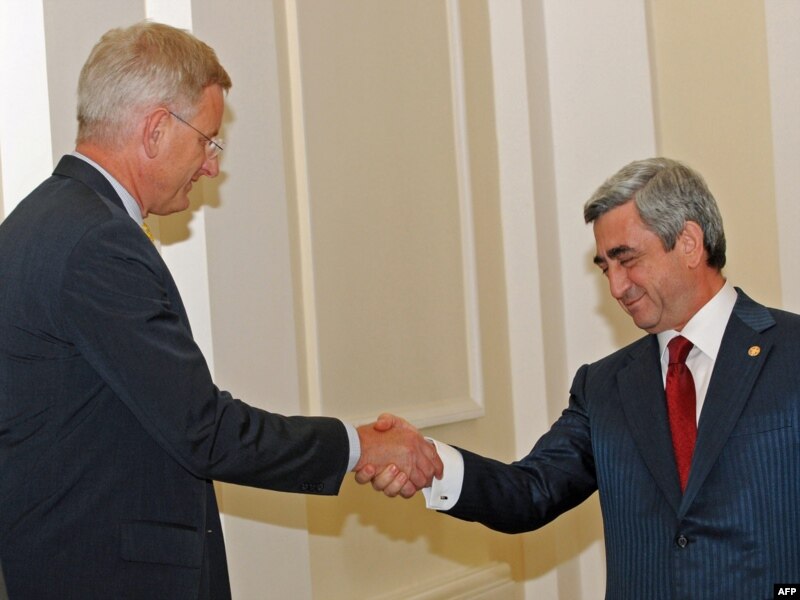
 Bildt (left) met with Armenian President Serzh Sarkisian in Yerevan on July 20.Bildt said the EU's relationship with the Muslim word is "a huge issue," adding he believes a more positive relationship has now been made possible as a result of U.S. policy changes.
The Swedish foreign minister also paid homage to the "highly significant nation" of Iran, saying the EU wants to reach out to the country's people. But Bildt also defended the EU's determination not to cut links with the Iranian government -- although he acknowledged the regime in Tehran faces "legitimacy" issues in the wake of the violently contested elections last month.
"We need to deal with all of the issues connected with Iran, deal with what has been seen happening on the streets, deal with the consular and other related issues that we've done in the last few weeks and days and will continue to do in a couple of highly important cases," he said. "But [we need] also to see if there is any way in which we can reach an accommodation on important issues, notably but not isolated to the important nuclear dossier."
Bildt largely skirted over his four-day trip to Georgia, Azerbaijan, and Armenia, which ended July 20. This was largely due to a lack of interest on the part of his audience of EU parliamentarians. The Swedish minister was also not asked to address the forthcoming elections in Moldova, a country whose internal turmoil has kept EU diplomats exercised behind closed doors for the better part of four months.
Speaking at the European Parliament in Brussels, Bildt said the ongoing global downturn is hitting fragile economies and states in much of the EU's own neighborhood. How well the EU does in helping provide stability for these countries, he said, will also determine the bloc's global role and credibility.
"The role of the European Union is also to try to bring stability to fragile nations and fragile economies in our immediate vicinity," he said. "If we fail in that, we'll fail in other tasks as well."
The Swedish foreign minister had very little to say on the EU's evolving relationship with U.S. President Barack Obama, noting only that there now exists a "more promising" relationship. This reflects the current view in Brussels that on many of the issues affecting Europe and its environs, Obama's priorities are a work in progress.
Bildt identified the Western Balkans' process of EU integration as one of Sweden's top concerns. Traditionally enlargement-friendly, Sweden will try to speed up the accession processes of candidate countries Croatia and Macedonia, and facilitate the progress of others.
Bildt said the EU can take credit for helping to keep the Western Balkans on the path of integration -- most recently with a move to lift visa restrictions for Serbia, Macedonia, and Montenegro. But he warned the bloc must not let slip what has been gained.
"I would say that, for the first time in a very long time, the forces of integration in [the Balkan] region are beginning to be stronger than the forces of disintegration," he said. "But this is critically important upon us maintaining momentum in our policies of integration in that particular region."
'Most EU-Friendly Government'
Sweden's top diplomat, who has a long history of involvement in the region as a mediator, praised Serbia as the "perhaps most reformist and EU-friendly government in history." He noted Kosovo is now independent, though he conceded some "issues" remain within the EU itself -- a reference to the fact that five EU member states have yet to recognize the country.
Croatia's progress on the road to the EU has been snagged by a highly public row over borders with neighboring Slovenia. An EU member state, Slovenia is blocking Croatia's accession talks and Bildt will have his work cut out for him if he is to put Zagreb back on track to join the EU in 2011. Without revealing too much of his strategy, Bildt said governments in both countries must tone down their rhetoric.
The issue of Turkey is sometimes controversial. I think that is fairly natural. It is a big issue.

Bildt said Bosnia's bickering politicians were failing the country's youth, who he said "want a European future."
Bildt also argued that Bosnia needs a so-called "Brussels process" to replace the Dayton process that brought peace to the country in the mid-1990s. He said Bosnia's current bid to move closer to the EU presents much more complex challenges than the Dayton framework is equipped to handle.
'It Is A Big Issue'
Briefly addressing Turkey, the EU's largest candidate nation, Bildt admitted controversy within the EU, where Germany and France want Ankara to accept a "privileged partnership" instead of full membership.
"The issue of Turkey is sometimes controversial. I think that is fairly natural. It is a big issue," Bildt said. "But the task of a presidency is, of course, to execute -- in an impartial and objective way -- the policies that have been decided by the union and supported by the vast majority of this particular parliament. We need to bring also that accession process forward in the months ahead."
In immediate terms, however, Cyprus remains the main obstacle in Turkey's accession talks. Mindful of this, Bildt said reconciling the island's Greek and Turkish communities is "perhaps the most important" challenge facing the EU. The two communities' leaders are currently holding talks, but Bildt ruefully conceded the bloc's own impotence in the matter, as it can have no role in the peace process, which is overseen by the United Nations.
Bildt predicted "maneuverings in the east" will occupy much of his time over the next six months. This will involve delicate efforts to add substance to the EU's Eastern Partnership with Ukraine, Belarus, Moldova, and the three South Caucasus countries without alienating Russia, which is loath to cede any influence over former Soviet territory to the EU.
"We need to develop the Eastern Partnership into something that is felt to be real and relevant for all of the countries, that deploys the transformational forces and powers that we have demonstrated in the past that we have, and that brings them hope for the future," he said.
"At the same time, [we need] to continue to engage with Russia, a country with which our relationship has deteriorated over the past year due to the conflict in Georgia and by the inability to fully implement the agreements that were done the wake of that particular war," he added.
'Hope For The Future'
Bildt painted a fairly bleak picture of the situation in the 12 countries "between the EU and China," where democracy has largely "stalled" and authoritarianism is on the rise. He said the EU must expand the transformational power that brought about its last rounds of enlargement and give those countries "hope for the future."
He argued for giving greater travel freedom to Ukraine and the South Caucasus countries, but admitted deep domestic concerns in many EU member states means such quick changes are unlikely.
Bildt could afford to be comparatively bullish on one enlargement prospect, however. With Iceland having declared interest, Bildt said he hopes the EU can in future gain a stake in the strategically important Arctic issues. There, again, it is likely to find itself opening up another front of confrontation with Russia.
The Swedish foreign minister had relatively little to say about the EU's southern, Mediterranean neighbors, for whom future membership has been ruled out. He noted that within a few decades, the region will gain "two Egypts" -- or 160 million people -- in terms of population increases. This is a process the EU is vitally interested in managing, given the increasing migratory pressures at its own southern borders.
The Swedish foreign minister also paid homage to the "highly significant nation" of Iran, saying the EU wants to reach out to the country's people. But Bildt also defended the EU's determination not to cut links with the Iranian government -- although he acknowledged the regime in Tehran faces "legitimacy" issues in the wake of the violently contested elections last month.
"We need to deal with all of the issues connected with Iran, deal with what has been seen happening on the streets, deal with the consular and other related issues that we've done in the last few weeks and days and will continue to do in a couple of highly important cases," he said. "But [we need] also to see if there is any way in which we can reach an accommodation on important issues, notably but not isolated to the important nuclear dossier."
Bildt largely skirted over his four-day trip to Georgia, Azerbaijan, and Armenia, which ended July 20. This was largely due to a lack of interest on the part of his audience of EU parliamentarians. The Swedish minister was also not asked to address the forthcoming elections in Moldova, a country whose internal turmoil has kept EU diplomats exercised behind closed doors for the better part of four months.