




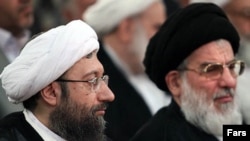
Ayatollah Sadeq Larijani has been appointed by Iran's supreme leader as head of the judiciary to replace Ayatollah Mahmud Hashemi-Shahrudi, whose term ended on August 16.
Shahrudi took over as the head of the judiciary in 1999, when he called it a "ruined place." But what has he left to his successor?
Who Is Sadeq Larijani?
The 48-year-old Larijani was born in Najaf, Iraq, and has served two terms in the Assembly of Experts, a body of clerics with the constitutional authority to appoint, supervise, and even dismiss Iran's supreme leader. He was then a member of the Guardians Council, the 12-member supervisory body tasked with overseeing legislation and supervising elections.
His brother Ali Larijani is the speaker of parliament and another brother, Mohammad Javad Larijani, is an adviser to Supreme Leader Ayatollah Ali Khamenei and the leader of the Islamic consultative assembly.
Sadeq Larijani is considered an ultraconservative and is close to the supreme leader.
He will face serious challenges in the ongoing crisis following the disputed presidential election, with the recent mass trials including a number of foreign citizens drawing attention to the efficiency of Iran's legal system.
"No judicial system can consider as valid a confession obtained as a result of harsh interrogations or under torture," Manfred Nowak, the UN's special rapporteur on torture, has said about the postelection trials in Iran.
The politicization of Iran's judicial system has been a key concern since the 1979 Islamic Revolution. A constant shifting among key positions in the three different branches of power is the biggest threat to the independency of judiciary.
Gholam Hussein Mohseni Ejei, a former intelligence minister, has been nominated as Larijani's deputy, and official reports say Abbas Ali Kadkhodai, the spokesman of the Guardians Council, will be the new spokesman for the judiciary.
It seems as long as the judiciary system is under the constant influence of the other branches of power, it will remain a "ruined place."
-- Mazyar Mokfi
Shahrudi took over as the head of the judiciary in 1999, when he called it a "ruined place." But what has he left to his successor?
Who Is Sadeq Larijani?
The 48-year-old Larijani was born in Najaf, Iraq, and has served two terms in the Assembly of Experts, a body of clerics with the constitutional authority to appoint, supervise, and even dismiss Iran's supreme leader. He was then a member of the Guardians Council, the 12-member supervisory body tasked with overseeing legislation and supervising elections.
His brother Ali Larijani is the speaker of parliament and another brother, Mohammad Javad Larijani, is an adviser to Supreme Leader Ayatollah Ali Khamenei and the leader of the Islamic consultative assembly.
Sadeq Larijani is considered an ultraconservative and is close to the supreme leader.
He will face serious challenges in the ongoing crisis following the disputed presidential election, with the recent mass trials including a number of foreign citizens drawing attention to the efficiency of Iran's legal system.
"No judicial system can consider as valid a confession obtained as a result of harsh interrogations or under torture," Manfred Nowak, the UN's special rapporteur on torture, has said about the postelection trials in Iran.
The politicization of Iran's judicial system has been a key concern since the 1979 Islamic Revolution. A constant shifting among key positions in the three different branches of power is the biggest threat to the independency of judiciary.
Gholam Hussein Mohseni Ejei, a former intelligence minister, has been nominated as Larijani's deputy, and official reports say Abbas Ali Kadkhodai, the spokesman of the Guardians Council, will be the new spokesman for the judiciary.
It seems as long as the judiciary system is under the constant influence of the other branches of power, it will remain a "ruined place."
-- Mazyar Mokfi