




Before the 1990s, there was one site in Sarajevo that every visitor to the city had to see. It wasn't a monument, a plaque, or a museum. It was a set of footprints in the pavement that marked the spot where Gavrilo Princip stood on June 28, 1914, when he pulled the trigger and assassinated Austrian Archduke Franz Ferdinand. That shot set off the chain of events that plunged Europe into World War I.
Sandwiched between two great empires -- Austria-Hungary and Ottoman Turkey -- the Balkans have for centuries been little more than the battleground where the waxing and waning fortunes of Vienna and Istanbul were played out. That legacy as much as anything else left the region divided, and among the issues that can probably never be settled in the Balkans is the historical legacy of Gavrilo Princip: for some he is a freedom fighter; for others, a terrorist.
World War I ended exactly 90 years ago. Hundreds of thousands of lives in the region were lost, but the result was not Princip's illusory vision of a united Yugoslav nation. The result of the war was not a uniting of the region, but its division into hostile ethnic groups.
And the debate over the man who started it continues. Princip's house in Sarajevo, which was destroyed during the war, was rebuilt afterward and turned into a museum of the Kingdom of Yugoslavia.
Then World War II broke out and another 1.7 million Balkan lives were swept away. Most of them, incidentally, died as a result of ethnic fighting among themselves; far fewer were killed by Hitler's armies.
During that war, Princip's house was destroyed a second time. After communist resistance leader Tito established a communist government in Yugoslavia in 1944 and the war ended in 1945, the house was rebuilt again. In addition, a museum dedicated to Princip was opened in Sarajevo. Those who interpreted Princip as a freedom fighter proudly took visitors to see the footprints, while those who saw him as a terrorist continued muttering under their breath.
Tito's ideology was based on the "brotherhood and unity" of the peoples of Yugoslavia. He attempted to bring the region's many peoples together under the umbrella of his strong, one-party state. Princip, as a hero of Yugoslav unification, was written into the history books as a patriotic hero.
But just a decade after Tito died, the illusion of Yugoslav unity was shattered again by war. The wars of the 1990s raged furiously and Princip's house was destroyed yet a third time. This time, it was razed by the government of Bosnia-Herzegovina and, to date, no attempts to restore it have been announced. The old Princip museum was refashioned as one devoted to Archduke Ferdinand and the Habsburg monarchy.
This, of course, did not settle the question. Many in the region (mostly non-Serbs) emphasize that Serbian military officers stood behind the assassination and that the political objective of the conspirators was to wrest the South Slav provinces from Austria in order to unite them into a Greater Serbia. How heroic, they ask, is it to kill a tyrant in the name of another tyranny?
Knee-Deep In Undigested History
Princip, of course, is a symptom rather than a cause of the divisions in the Balkans. In fact, looking at the patchwork of ethnic, religious, and cultural fault lines in the region, it is hard to imagine that Princip and others ever believed a united Yugoslavia could be possible. There are simply too many differences in a relatively tiny space -- too many conflicting interests and agendas. Sometimes it seems that war is a not a choice for the Balkans, but its fate. The peoples of the region are hot-headed and have a sadly underdeveloped ability to compromise. They fight when they should talk. When they love, they love too much, and when they hate....
Princip's legacy is controversial around the world. In the Czech Republic, at Ferdinand's hunting lodge of Konopiste (from which the archduke set off on his fateful journey to Sarajevo), a sign declares that he was killed by a "Serbian terrorist." But at the Czech prison in Terezin where Princip died, a sign in his cell describes him as "a freedom fighter." The prison museum was opened under the communists; the Konopiste museum was opened by the postcommunist government. Two ideologies -- two points of view. But no fighting.
But in the Balkans, there are no "minor" issues in history. The region is knee-deep in undigested history -- if the Princip question were miraculously settled to everyone's satisfaction, 1,000 other issues spanning the centuries would remain unresolved. And this is as true of recent decades as it is of medieval period -- tensions surrounding the actions of various ethnic groups during the wars of the 1990s have the potential to keep the region at a slow boil for decades.
Literally speaking, Princip's footprints no longer exist in Sarajevo. They were removed after the 1992-95 war by the new national government in Bosnia, which views him as a Serbian nationalist. As might be expected, in Bosnia's ethnic-Serbian entity, Republika Srpska, he is revered as a hero.
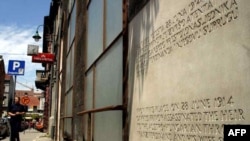
Now, on the spot where the footsteps once were, there is a simple wooden memorial with an inscription in Bosnian, Serbian, and English: "May Peace Prevail on Earth." Amen to that.
Nenad Pejic is associate director of broadcasting at RFE/RL. The views expressed in this commentary are the author's own and do not necessarily reflect those of RFE/RL
Sandwiched between two great empires -- Austria-Hungary and Ottoman Turkey -- the Balkans have for centuries been little more than the battleground where the waxing and waning fortunes of Vienna and Istanbul were played out. That legacy as much as anything else left the region divided, and among the issues that can probably never be settled in the Balkans is the historical legacy of Gavrilo Princip: for some he is a freedom fighter; for others, a terrorist.
World War I ended exactly 90 years ago. Hundreds of thousands of lives in the region were lost, but the result was not Princip's illusory vision of a united Yugoslav nation. The result of the war was not a uniting of the region, but its division into hostile ethnic groups.
And the debate over the man who started it continues. Princip's house in Sarajevo, which was destroyed during the war, was rebuilt afterward and turned into a museum of the Kingdom of Yugoslavia.
Then World War II broke out and another 1.7 million Balkan lives were swept away. Most of them, incidentally, died as a result of ethnic fighting among themselves; far fewer were killed by Hitler's armies.
During that war, Princip's house was destroyed a second time. After communist resistance leader Tito established a communist government in Yugoslavia in 1944 and the war ended in 1945, the house was rebuilt again. In addition, a museum dedicated to Princip was opened in Sarajevo. Those who interpreted Princip as a freedom fighter proudly took visitors to see the footprints, while those who saw him as a terrorist continued muttering under their breath.
Tito's ideology was based on the "brotherhood and unity" of the peoples of Yugoslavia. He attempted to bring the region's many peoples together under the umbrella of his strong, one-party state. Princip, as a hero of Yugoslav unification, was written into the history books as a patriotic hero.
But just a decade after Tito died, the illusion of Yugoslav unity was shattered again by war. The wars of the 1990s raged furiously and Princip's house was destroyed yet a third time. This time, it was razed by the government of Bosnia-Herzegovina and, to date, no attempts to restore it have been announced. The old Princip museum was refashioned as one devoted to Archduke Ferdinand and the Habsburg monarchy.
This, of course, did not settle the question. Many in the region (mostly non-Serbs) emphasize that Serbian military officers stood behind the assassination and that the political objective of the conspirators was to wrest the South Slav provinces from Austria in order to unite them into a Greater Serbia. How heroic, they ask, is it to kill a tyrant in the name of another tyranny?
Knee-Deep In Undigested History
Princip, of course, is a symptom rather than a cause of the divisions in the Balkans. In fact, looking at the patchwork of ethnic, religious, and cultural fault lines in the region, it is hard to imagine that Princip and others ever believed a united Yugoslavia could be possible. There are simply too many differences in a relatively tiny space -- too many conflicting interests and agendas. Sometimes it seems that war is a not a choice for the Balkans, but its fate. The peoples of the region are hot-headed and have a sadly underdeveloped ability to compromise. They fight when they should talk. When they love, they love too much, and when they hate....
Princip's legacy is controversial around the world. In the Czech Republic, at Ferdinand's hunting lodge of Konopiste (from which the archduke set off on his fateful journey to Sarajevo), a sign declares that he was killed by a "Serbian terrorist." But at the Czech prison in Terezin where Princip died, a sign in his cell describes him as "a freedom fighter." The prison museum was opened under the communists; the Konopiste museum was opened by the postcommunist government. Two ideologies -- two points of view. But no fighting.
But in the Balkans, there are no "minor" issues in history. The region is knee-deep in undigested history -- if the Princip question were miraculously settled to everyone's satisfaction, 1,000 other issues spanning the centuries would remain unresolved. And this is as true of recent decades as it is of medieval period -- tensions surrounding the actions of various ethnic groups during the wars of the 1990s have the potential to keep the region at a slow boil for decades.
Literally speaking, Princip's footprints no longer exist in Sarajevo. They were removed after the 1992-95 war by the new national government in Bosnia, which views him as a Serbian nationalist. As might be expected, in Bosnia's ethnic-Serbian entity, Republika Srpska, he is revered as a hero.
Now, on the spot where the footsteps once were, there is a simple wooden memorial with an inscription in Bosnian, Serbian, and English: "May Peace Prevail on Earth." Amen to that.
Nenad Pejic is associate director of broadcasting at RFE/RL. The views expressed in this commentary are the author's own and do not necessarily reflect those of RFE/RL