





The ghosts of 1986 are haunting the Kremlin.
That was the year when a precipitous drop in oil prices, from around $30 per barrel in late 1985 to just over $10 by mid-1986, crippled the Soviet economy and helped expedite the breakup of the USSR just five years later.
With crude prices again falling by two-thirds -- from just under $150 per barrel in July to slightly more than $50 today -- the Russian political elite is getting visibly jittery.
So could 2008 turn out to be the new 1986?
"As long as the oil and gas money is flowing, that gives the Russian government the wherewithal to keep living standards rising," says Steven Pifer, a former State Department official who is currently a senior fellow at the Brookings Institution. "So when the oil and gas revenues decline, that does raise questions about what the government can do."
Since Vladimir Putin ascended to power in 2000, petrodollars have been the key lubricant for Russia's authoritarian regime of "managed democracy." Easy money from energy exports has enabled the ruling elite to purchase the political loyalty of the country's sprawling bureaucracy, to win at least the passive consent of a critical mass of the population, and to buy friends and intimidate enemies abroad.
It is far too soon, according to most analysts, to say that Russia is on the brink of serious political instability, or even close to it. And nobody is suggesting that Russia is on the verge of disintegration.
But with the regime's essential lubricant slipping away, the system Putin built is beginning to show signs of strain. Newly emboldened regional leaders are clashing publicly with authorities in Moscow, marquee infrastructure projects -- and the patronage that goes with them -- are being scrapped, and the Kremlin is scrambling to amend the constitution to keep the current elite in power indefinitely.
"The potential damage that this fall in commodity prices could inflict is very great," says David Satter, a senior fellow at the Hudson Institute and author of the book "Darkness at Dawn: The Rise of the Russian Criminal State."
"Even though the leadership may be more capable of managing in a capitalist environment than the Communist leadership was, nonetheless, it is composed of people, because of the system that was created here, who have no hardcore loyalty to the system or the country, but are only pursuing their own individual personal well being."
Politics Trumps Economics
Signs that the Russian economy is in deep trouble are everywhere: From the dramatic 70-percent drop in the stock market in recent months to news of layoffs among major manufacturers like the KamAZ truck manufacturer and GAZ automaker.
Russia still has a major cushion in its $450 billion in foreign-currency reserves. But those are down by 25 percent from August when they stood at approximately $600 billion. There are also two stabilization funds - a Reserve Fund and a National Wealth Fund -- totaling nearly $200 billion, that the Kremlin created when oil prices were high to get the country through rough times.
"Russia seems to have the rainy day fund and the currency reserves to be able to keep going. It's not going to crash immediately, they've got some time there," says Pifer.
Nevertheless, the economic downturn is beginning to cause rumblings of rebellion in the regions, where local elites showing signs of challenging the central authorities in Moscow for the first time in years.
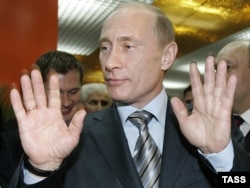 Could Vladimir Putin stage a return to the presidency before the full force of the economic downturn hits?A group of private oil companies in Tatarstan -- which account for 20 percent of all oil produced in the region -- is asking the government to temporarily exempt them from paying export duties and production taxes until crude prices recover. They are threatening to cease production as of December 1 if their request is denied.
Moscow Mayor Yury Luzhkov angered the Kremlin by calling on November 19 for the direct election of regional heads, which would give them more independence. Luzhkov received a stern rebuke from President Dmitry Medvedev and quickly backed off his comments.
Such insubordination, analysts say, could become increasingly frequent as the economic downturn dilutes the Kremlin's authority.
"The oil regions are going to say, 'We need to keep the income here. Why do we need to support these other regions that are parasites?'" says Marshall Goldman, professor emeritus in Russian Economics at Wellesley College and author of the book "Petrostate: Putin, Power, and the New Russia."
It is therefore not surprising that with the economy in crisis, Russia's rulers are spending a great deal of time worrying about politics, rushing to amend the country's post-Soviet constitution for the first time since it was enacted in 1993.
Both houses of parliament, the State Duma and the Federation Council, have passed legislation extending the presidential term from four years to six. The changes, proposed by Medvedev in his November 5 state-of-the-nation address, now must pass two-thirds of Russia's regional legislatures, which are dominated by the pro-Kremlin Unified Russia party, to become law.
Many Kremlin-watchers say the amendment is designed to create a pretext for new presidential elections to allow Putin -- currently the prime minister but widely seen as Russia's true ruler -- to return to the presidency safely before the full force of the economic downturn hits.
 Siberian oil has kept things smooth in the Kremlin."[Putin] might believe that he is the only person with sufficient credibility to take the country through the rough patch," political analyst Vladimir Frolov wrote in the magazine "Russia Profile" on November 25.
"The problem is that he would be wrong," Frolov argued. "His return to the Kremlin in such an artificial way would be destabilizing, and would make the economic crisis worse for Russia. It would reinforce an already strong sense among Russian and international investors that Putin and his people are more interested in holding on to power than anything else."
Cracks In The Facade
Since coming to power, Putin and his team have attempted to create a centralized, authoritarian, vertically integrated, and unitary executive that can manage a thorough and comprehensive modernization of Russia. In order to do this, however, the Kremlin built a vast network of patronage -- similar to the Soviet nomenklatura system -- in which key state posts, privileges, and favors were doled out to the loyal and obedient across Russia's vast regions and republics.
But in an economic downturn, when there is less patronage to pass around, some analysts warn that Putin and his inner circle will have a harder time placating and co-opting Russia's sprawling bureaucracy.
"The big question is are bribes elastic in a downward direction," Satter says. "If there is less money to pay for corruption, are those people who are benefiting from the corruption going to be reasonable and accept smaller payments, or are they going to start fighting among themselves. All experience suggests it's the latter and that could create enormous tension in the ruling elite...There was clan warfare even when the situation was favorable."
There are already signs that leaner times could be on the way for Russia's gilded bureaucratic class.
Boris Gryzlov, head of the ruling Unified Russia party's Supreme Council, announced on November 21 that it was cutting one-quarter of its staff positions. Gryzlov, who is also speaker of the State Duma, also said 10 percent of those working as aides for Unified Russia lawmakers in the lower house of parliament -- where the party has a two-thirds majority of seats -- will receive pink slips.
Gryzlov also announced that Unified Russia would create a new Anticrisis Commission to monitor how state funds are being spent in Russia's regions. "We must place the regional authorities under strict controls so they behave properly," the daily "Gazeta" quoted him as saying.
Such a move, analysts say, is not surprising. When the Kremlin has fewer carrots to pass around, it is more likely to rely on sticks.
"I think if things get really bad, the regime will get more authoritarian, more fascistic, more brutal, and more anti-Western. And that will be the way in which they stave off internal turbulence," Satter says, adding that he expects to see "an intensified search for foreign enemies" to explain the economic downturn to an increasingly restless public.
Rising Insecurity
That search for foreign culprits already appears to be under way with Russia's state-controlled media presenting the crisis as a byproduct of financial woes in the United States, particularly the meltdown in the sub-prime mortgage market. At the same time, the media has largely soft-pedaled -- or completely ignored -- any hint of Kremlin responsibility for the country's economic woes.
Meanwhile, unemployment hit a seven-month high of 4.6 million people, or 6.1 percent of the workforce, in October and wage arrears rose to a one-year high of 4 billion rubles ($146 million).
Aleksei Vovchenko, deputy head of the Federal Labor and Employment Service, announced on November 26 that Russian companies will cut as many as 200,000 jobs in the next two months.
"To a certain extent the Russian people are aware of their loss of liberties under Putin and Medvedev. To a degree, they have reconciled themselves to this because of the rising living standards," Satter says. "Well, the living standards are very likely not going to keep rising under these circumstances. So there are enormous sources of potential tension in Russian society."
But with a weak opposition and a public that has been politically passive for a decade, it remains unclear whether the hard economic times on the horizon will translate into demands for political change.
"If the government fails to keep its economic side of the bargain, I don't think we know yet how the Russian public reacts. They haven't shown themselves in the last 10-12 years to be an especially revolutionary group," Pifer of the Brookings Institution says.
That was the year when a precipitous drop in oil prices, from around $30 per barrel in late 1985 to just over $10 by mid-1986, crippled the Soviet economy and helped expedite the breakup of the USSR just five years later.
With crude prices again falling by two-thirds -- from just under $150 per barrel in July to slightly more than $50 today -- the Russian political elite is getting visibly jittery.
So could 2008 turn out to be the new 1986?
"As long as the oil and gas money is flowing, that gives the Russian government the wherewithal to keep living standards rising," says Steven Pifer, a former State Department official who is currently a senior fellow at the Brookings Institution. "So when the oil and gas revenues decline, that does raise questions about what the government can do."
Since Vladimir Putin ascended to power in 2000, petrodollars have been the key lubricant for Russia's authoritarian regime of "managed democracy." Easy money from energy exports has enabled the ruling elite to purchase the political loyalty of the country's sprawling bureaucracy, to win at least the passive consent of a critical mass of the population, and to buy friends and intimidate enemies abroad.
It is far too soon, according to most analysts, to say that Russia is on the brink of serious political instability, or even close to it. And nobody is suggesting that Russia is on the verge of disintegration.
But with the regime's essential lubricant slipping away, the system Putin built is beginning to show signs of strain. Newly emboldened regional leaders are clashing publicly with authorities in Moscow, marquee infrastructure projects -- and the patronage that goes with them -- are being scrapped, and the Kremlin is scrambling to amend the constitution to keep the current elite in power indefinitely.
"The potential damage that this fall in commodity prices could inflict is very great," says David Satter, a senior fellow at the Hudson Institute and author of the book "Darkness at Dawn: The Rise of the Russian Criminal State."
"Even though the leadership may be more capable of managing in a capitalist environment than the Communist leadership was, nonetheless, it is composed of people, because of the system that was created here, who have no hardcore loyalty to the system or the country, but are only pursuing their own individual personal well being."
Politics Trumps Economics
Signs that the Russian economy is in deep trouble are everywhere: From the dramatic 70-percent drop in the stock market in recent months to news of layoffs among major manufacturers like the KamAZ truck manufacturer and GAZ automaker.
Russia still has a major cushion in its $450 billion in foreign-currency reserves. But those are down by 25 percent from August when they stood at approximately $600 billion. There are also two stabilization funds - a Reserve Fund and a National Wealth Fund -- totaling nearly $200 billion, that the Kremlin created when oil prices were high to get the country through rough times.
"Russia seems to have the rainy day fund and the currency reserves to be able to keep going. It's not going to crash immediately, they've got some time there," says Pifer.
Nevertheless, the economic downturn is beginning to cause rumblings of rebellion in the regions, where local elites showing signs of challenging the central authorities in Moscow for the first time in years.

Moscow Mayor Yury Luzhkov angered the Kremlin by calling on November 19 for the direct election of regional heads, which would give them more independence. Luzhkov received a stern rebuke from President Dmitry Medvedev and quickly backed off his comments.
Such insubordination, analysts say, could become increasingly frequent as the economic downturn dilutes the Kremlin's authority.
"The oil regions are going to say, 'We need to keep the income here. Why do we need to support these other regions that are parasites?'" says Marshall Goldman, professor emeritus in Russian Economics at Wellesley College and author of the book "Petrostate: Putin, Power, and the New Russia."
It is therefore not surprising that with the economy in crisis, Russia's rulers are spending a great deal of time worrying about politics, rushing to amend the country's post-Soviet constitution for the first time since it was enacted in 1993.
Both houses of parliament, the State Duma and the Federation Council, have passed legislation extending the presidential term from four years to six. The changes, proposed by Medvedev in his November 5 state-of-the-nation address, now must pass two-thirds of Russia's regional legislatures, which are dominated by the pro-Kremlin Unified Russia party, to become law.
Many Kremlin-watchers say the amendment is designed to create a pretext for new presidential elections to allow Putin -- currently the prime minister but widely seen as Russia's true ruler -- to return to the presidency safely before the full force of the economic downturn hits.

"The problem is that he would be wrong," Frolov argued. "His return to the Kremlin in such an artificial way would be destabilizing, and would make the economic crisis worse for Russia. It would reinforce an already strong sense among Russian and international investors that Putin and his people are more interested in holding on to power than anything else."
Cracks In The Facade
Since coming to power, Putin and his team have attempted to create a centralized, authoritarian, vertically integrated, and unitary executive that can manage a thorough and comprehensive modernization of Russia. In order to do this, however, the Kremlin built a vast network of patronage -- similar to the Soviet nomenklatura system -- in which key state posts, privileges, and favors were doled out to the loyal and obedient across Russia's vast regions and republics.
But in an economic downturn, when there is less patronage to pass around, some analysts warn that Putin and his inner circle will have a harder time placating and co-opting Russia's sprawling bureaucracy.
"The big question is are bribes elastic in a downward direction," Satter says. "If there is less money to pay for corruption, are those people who are benefiting from the corruption going to be reasonable and accept smaller payments, or are they going to start fighting among themselves. All experience suggests it's the latter and that could create enormous tension in the ruling elite...There was clan warfare even when the situation was favorable."
There are already signs that leaner times could be on the way for Russia's gilded bureaucratic class.
Boris Gryzlov, head of the ruling Unified Russia party's Supreme Council, announced on November 21 that it was cutting one-quarter of its staff positions. Gryzlov, who is also speaker of the State Duma, also said 10 percent of those working as aides for Unified Russia lawmakers in the lower house of parliament -- where the party has a two-thirds majority of seats -- will receive pink slips.
Gryzlov also announced that Unified Russia would create a new Anticrisis Commission to monitor how state funds are being spent in Russia's regions. "We must place the regional authorities under strict controls so they behave properly," the daily "Gazeta" quoted him as saying.
Such a move, analysts say, is not surprising. When the Kremlin has fewer carrots to pass around, it is more likely to rely on sticks.
"I think if things get really bad, the regime will get more authoritarian, more fascistic, more brutal, and more anti-Western. And that will be the way in which they stave off internal turbulence," Satter says, adding that he expects to see "an intensified search for foreign enemies" to explain the economic downturn to an increasingly restless public.
Rising Insecurity
That search for foreign culprits already appears to be under way with Russia's state-controlled media presenting the crisis as a byproduct of financial woes in the United States, particularly the meltdown in the sub-prime mortgage market. At the same time, the media has largely soft-pedaled -- or completely ignored -- any hint of Kremlin responsibility for the country's economic woes.
Meanwhile, unemployment hit a seven-month high of 4.6 million people, or 6.1 percent of the workforce, in October and wage arrears rose to a one-year high of 4 billion rubles ($146 million).
Aleksei Vovchenko, deputy head of the Federal Labor and Employment Service, announced on November 26 that Russian companies will cut as many as 200,000 jobs in the next two months.
"To a certain extent the Russian people are aware of their loss of liberties under Putin and Medvedev. To a degree, they have reconciled themselves to this because of the rising living standards," Satter says. "Well, the living standards are very likely not going to keep rising under these circumstances. So there are enormous sources of potential tension in Russian society."
But with a weak opposition and a public that has been politically passive for a decade, it remains unclear whether the hard economic times on the horizon will translate into demands for political change.
"If the government fails to keep its economic side of the bargain, I don't think we know yet how the Russian public reacts. They haven't shown themselves in the last 10-12 years to be an especially revolutionary group," Pifer of the Brookings Institution says.