




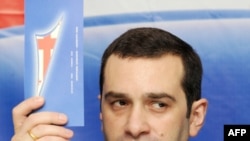
TBILISI -- It's hard to imagine Irakli Alasania eating his tie.
And that's just one way he contrasts with Georgian President Mikheil Saakashvili, who absentmindedly began chewing his red silk necktie on television in an apparent fit of nerves during last summer's war with Russia.
 Where Saakashvili is mercurial and impulsive, Alasania is calm and reassuring. While Saakashvili thrives on confrontation, Alasania instinctively seeks consensus. And whereas the gregarious Saakashvili revels in drama and the limelight, Alasania prefers to go about his business quietly and modestly.
But there is one area where Saakashvili and Alasania are absolutely in sync. Both are committed to bringing Georgian fully into Western institutions including NATO and the European Union.
Alasania resigned as Georgia's ambassador to the United Nations in December to enter politics back home. On July 16, he announced the formation of a new political party called Our Georgia--Free Democrats, which he hopes to use as a vehicle to broker a peace between the country's warring political factions.
In a recent interview with RFE/RL in his Tbilisi office, Alasania was a model of cool composure, dressed neatly in a dark blazer and white shirt -- but no tie.
He explained that the time had come for Georgia's long and bitter standoff between Saakashvili and the opposition to come to an end.
"These months of demonstrations have led to no tangible results, but they demonstrated something," Alasania said.
"The government alone cannot cope with this crisis, and we in the opposition understand that just street actions and demanding the president's resignation will not lead to the goals we want to achieve," he said. "So the only thing left is to cooperate, to sit down at the negotiating table, and work things out."
Many Georgians, weary of the exhausting high-wire act that has been Saakashvili's presidency, are increasingly looking to Alasania as someone who could break the country's political impasse and finally fulfill the dashed hopes of the 2004 democratic Rose Revolution -- possibly as Saakashvili's successor as president.
Nino Danielia, who teaches media management at the Caucasus School of Journalism in Tbilisi, explains the long and bitter standoff between Saakashvili and his opponents has left many Georgians looking for a fresh alternative.
"I don't know how things will develop, but I think Irakli Alasania is the guy that can fill this niche," Danielia says. "I like his arguments, personally. I think it is clear what he doesn't like in the existing situation and how this can be solved. This is especially true when he is talking about conflict resolution. I think that he knows what he is talking about."
Two-Way Mistrust
After leaving his UN post, Alasania initially supported opposition figures like former parliamentary speaker Nino Burjanadze and Levan Gachechiladze in their calls for Saakashvili's resignation.
But he soon began subtly distancing himself from them and indicated a willingness to negotiate with the authorities.
Saakashvili's resignation, he said, is less important than ending the political impasse and securing long-term reforms in the electoral system, courts, and state-run media. Most importantly, he says public trust needs to be restored.
"There is two-way mistrust in society now," Alasania said. "By taking away the freedom of the media, [the authorities show that] they don't trust journalists to report objectively. But they will report objectively. By taking away the independence of the court system, they [show that] they don't trust judges to make proper decisions. All of this has created mistrust and cynicism that everything that we stood for four years ago is dying."
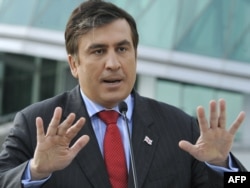 President Saakashvili after a meeting with opposition leaders in MayHe added "that regardless of the differences we have now, within society, within the opposition, between the opposition and the government, we now have a chance to pass this test and come to a national agreement."
A native of the Georgian port city of Batumi, the 35-year-old Alasania served in various posts in the foreign and defense ministries, including stints in Georgia's embassies in the United States, Canada, and Mexico.
A Rising Diplomatic Star
In February 2005, Saakashvili tapped him to be his special representative in talks with breakaway Abkhazia. It was a post that had personal significance for the young diplomat.
When Alasania was 19 years old, his father, KGB General Mamia Alasania, was killed together with other Georgian politicians when the Abkhaz capital, Sukhumi, fell to separatist forces in September 1993.
Despite this tragic history -- or perhaps because of it -- Alasania was able to win the trust of Abkhaz separatist officials and establish a good working relationship with them. He was instrumental in resuming the Georgian-Abkhaz Coordination Council, a tool for direct talks between the two sides, in March 2006.
Alasania argued that the best way to bring Abkhazia and South Ossetia back into Georgia since their independence declarations last year is to make Georgia a more attractive place for them.
"The only way to deal with this is to demonstrate to the Abkhaz and the Ossetians that we are building a truly democratic state and democratic institutions. This will take away the fear they have," Alasania said.
"If we can show them this, I believe that in years to come, when we are solidly on the path of European integration, then they will really rethink whether they want to be part of Europe together with Georgians, or whether they want to be part of [Russia's] Krasnodarsky Krai."
In June 2006, Saakashvili named Alasania as Georgia's UN envoy. During the Russia-Georgia war in August 2008, Alasania earned widespread praise as Tbilisi's main international representative, coming across as a calm and reassuring voice during and after the five-day conflict.
Moscow's Worst Nightmare?
Alasania stresses that Georgian relations with Russia did not need to deteriorate to the extent that they did, and gently suggests that Saakashvili's bombastic style played a role in intensifying the confrontation
"The best thing you can do [as Georgia's president] is not to solicit any aggressive behavior from the Russian side with your rhetoric," Alasania said.
"You can keep going with your business of building democratic institutions, integrating more deeply into European structures, but not being so vocal about using this against Russia or [acting like] you are doing this to harm Russian interests. Rhetoric contributed to straining this relationship."
He added that Georgia needs "to have a truly normalized situation with Russia and to try to find some common ground because we are neighbors, we cannot escape this." At the same time, Alasania said he would not waver in Tbilisi's longstanding goal of joining NATO.
"The political forces that I represent are going to be very strong in securing Georgian interests," Alasania said. "We will never let Russia legalize what they gained by using aggressive force in Georgia. They [Russia] will see us as very committed to Georgia's future in the European security architecture."
Lincoln Mitchell, a professor of international politics at Columbia University and author of the book "Uncertain Democracy: U.S. Foreign Policy and Georgia's Rose Revolution," says the combination of Alasania's smooth diplomatic touch and pro-Western policies would make him a strong representative of Georgia's interests in its dealings with Moscow.
"What he can do for Georgia is bring Saakashvili's ideals without Saakashvili's baggage, and that is what Georgia desperately needs," Mitchell says.
"And that is [also] what Russia needs to see. A President Alasania would be cautious, thoughtful, mature, and he would still want to join NATO. He has a strong position on Abkhazia, but unlike Misha [Saakashvili] he can actually talk to the Abkhaz. And he still wants to be pro-Western. This is the worst fear, if you are sitting in Moscow."
'But Is He A Vote Getter?'
Mitchell and others note that it would be difficult -- if not impossible -- for Moscow to vilify and caricature Alasania the way it has Saakashvili.
Not that they haven't tried. A strong signal that the Kremlin fears Georgia's rising political star came in September when nationalist State Duma deputy Vladimir Zhirinovsky, during a meeting with Prime Minister Vladimir Putin, launched into a tirade against Alasania, calling him "anti-Russian" and a "CIA agent."
But before he starts dealing with the Russians, Alasania needs to win public office. Presidential elections are not scheduled until January 2013, although the opposition has been pressing for an early vote -- which Saakashvili staunchly opposes.
Most analysts expect early local or parliamentary elections after reforms to the electoral system are negotiated. Alasania might be expected to play a key role in any of these scenarios.
While Alasania has been winning plaudits, particularly among the Tbilisi intelligentsia, doubts remain whether he has the political skills to win the votes of Georgians, who tend to favor charismatic, larger-than-life figures like Saakashvili.
Mitchell says Alasania's greatest strength -- his calm and measured style -- could equally turn out to be his greatest weakness.
"He's not a natural on-the-stump politician. He needs to work those skills more, he needs to improve those skills," Mitchell says.
"Alasania is clearly, among the opposition figures, one of the few who could conceivably govern," Mitchell says. "But is he a vote-getter? He hasn't proven that yet and he certainly has work to do there."
And that's just one way he contrasts with Georgian President Mikheil Saakashvili, who absentmindedly began chewing his red silk necktie on television in an apparent fit of nerves during last summer's war with Russia.

But there is one area where Saakashvili and Alasania are absolutely in sync. Both are committed to bringing Georgian fully into Western institutions including NATO and the European Union.
Alasania resigned as Georgia's ambassador to the United Nations in December to enter politics back home. On July 16, he announced the formation of a new political party called Our Georgia--Free Democrats, which he hopes to use as a vehicle to broker a peace between the country's warring political factions.
In a recent interview with RFE/RL in his Tbilisi office, Alasania was a model of cool composure, dressed neatly in a dark blazer and white shirt -- but no tie.
He explained that the time had come for Georgia's long and bitter standoff between Saakashvili and the opposition to come to an end.
"These months of demonstrations have led to no tangible results, but they demonstrated something," Alasania said.
"The government alone cannot cope with this crisis, and we in the opposition understand that just street actions and demanding the president's resignation will not lead to the goals we want to achieve," he said. "So the only thing left is to cooperate, to sit down at the negotiating table, and work things out."
Many Georgians, weary of the exhausting high-wire act that has been Saakashvili's presidency, are increasingly looking to Alasania as someone who could break the country's political impasse and finally fulfill the dashed hopes of the 2004 democratic Rose Revolution -- possibly as Saakashvili's successor as president.
Nino Danielia, who teaches media management at the Caucasus School of Journalism in Tbilisi, explains the long and bitter standoff between Saakashvili and his opponents has left many Georgians looking for a fresh alternative.
"I don't know how things will develop, but I think Irakli Alasania is the guy that can fill this niche," Danielia says. "I like his arguments, personally. I think it is clear what he doesn't like in the existing situation and how this can be solved. This is especially true when he is talking about conflict resolution. I think that he knows what he is talking about."
Two-Way Mistrust
After leaving his UN post, Alasania initially supported opposition figures like former parliamentary speaker Nino Burjanadze and Levan Gachechiladze in their calls for Saakashvili's resignation.
But he soon began subtly distancing himself from them and indicated a willingness to negotiate with the authorities.
Saakashvili's resignation, he said, is less important than ending the political impasse and securing long-term reforms in the electoral system, courts, and state-run media. Most importantly, he says public trust needs to be restored.
"There is two-way mistrust in society now," Alasania said. "By taking away the freedom of the media, [the authorities show that] they don't trust journalists to report objectively. But they will report objectively. By taking away the independence of the court system, they [show that] they don't trust judges to make proper decisions. All of this has created mistrust and cynicism that everything that we stood for four years ago is dying."
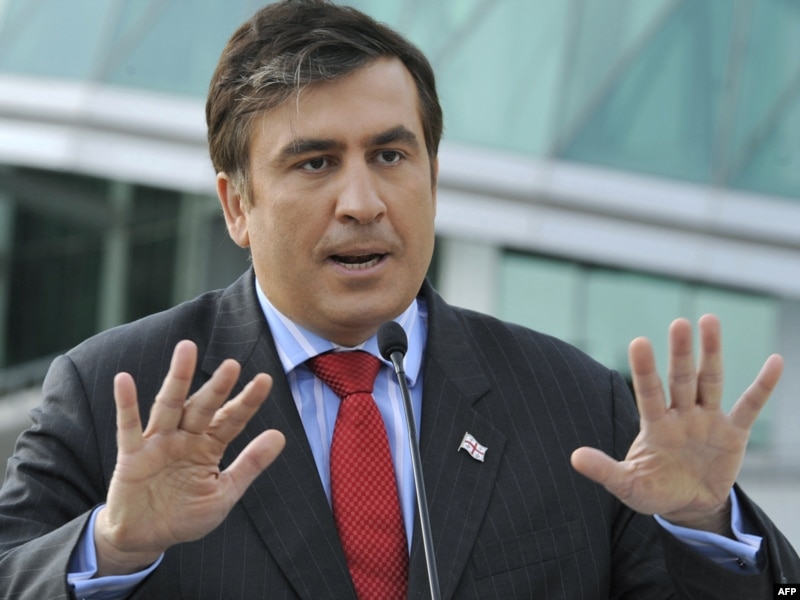
A native of the Georgian port city of Batumi, the 35-year-old Alasania served in various posts in the foreign and defense ministries, including stints in Georgia's embassies in the United States, Canada, and Mexico.
A Rising Diplomatic Star
In February 2005, Saakashvili tapped him to be his special representative in talks with breakaway Abkhazia. It was a post that had personal significance for the young diplomat.
When Alasania was 19 years old, his father, KGB General Mamia Alasania, was killed together with other Georgian politicians when the Abkhaz capital, Sukhumi, fell to separatist forces in September 1993.
Despite this tragic history -- or perhaps because of it -- Alasania was able to win the trust of Abkhaz separatist officials and establish a good working relationship with them. He was instrumental in resuming the Georgian-Abkhaz Coordination Council, a tool for direct talks between the two sides, in March 2006.
Alasania argued that the best way to bring Abkhazia and South Ossetia back into Georgia since their independence declarations last year is to make Georgia a more attractive place for them.
"The only way to deal with this is to demonstrate to the Abkhaz and the Ossetians that we are building a truly democratic state and democratic institutions. This will take away the fear they have," Alasania said.
"If we can show them this, I believe that in years to come, when we are solidly on the path of European integration, then they will really rethink whether they want to be part of Europe together with Georgians, or whether they want to be part of [Russia's] Krasnodarsky Krai."
In June 2006, Saakashvili named Alasania as Georgia's UN envoy. During the Russia-Georgia war in August 2008, Alasania earned widespread praise as Tbilisi's main international representative, coming across as a calm and reassuring voice during and after the five-day conflict.
Moscow's Worst Nightmare?
Alasania stresses that Georgian relations with Russia did not need to deteriorate to the extent that they did, and gently suggests that Saakashvili's bombastic style played a role in intensifying the confrontation
"The best thing you can do [as Georgia's president] is not to solicit any aggressive behavior from the Russian side with your rhetoric," Alasania said.
"You can keep going with your business of building democratic institutions, integrating more deeply into European structures, but not being so vocal about using this against Russia or [acting like] you are doing this to harm Russian interests. Rhetoric contributed to straining this relationship."
He added that Georgia needs "to have a truly normalized situation with Russia and to try to find some common ground because we are neighbors, we cannot escape this." At the same time, Alasania said he would not waver in Tbilisi's longstanding goal of joining NATO.
"The political forces that I represent are going to be very strong in securing Georgian interests," Alasania said. "We will never let Russia legalize what they gained by using aggressive force in Georgia. They [Russia] will see us as very committed to Georgia's future in the European security architecture."
Lincoln Mitchell, a professor of international politics at Columbia University and author of the book "Uncertain Democracy: U.S. Foreign Policy and Georgia's Rose Revolution," says the combination of Alasania's smooth diplomatic touch and pro-Western policies would make him a strong representative of Georgia's interests in its dealings with Moscow.
"What he can do for Georgia is bring Saakashvili's ideals without Saakashvili's baggage, and that is what Georgia desperately needs," Mitchell says.
"And that is [also] what Russia needs to see. A President Alasania would be cautious, thoughtful, mature, and he would still want to join NATO. He has a strong position on Abkhazia, but unlike Misha [Saakashvili] he can actually talk to the Abkhaz. And he still wants to be pro-Western. This is the worst fear, if you are sitting in Moscow."
'But Is He A Vote Getter?'
Mitchell and others note that it would be difficult -- if not impossible -- for Moscow to vilify and caricature Alasania the way it has Saakashvili.
Not that they haven't tried. A strong signal that the Kremlin fears Georgia's rising political star came in September when nationalist State Duma deputy Vladimir Zhirinovsky, during a meeting with Prime Minister Vladimir Putin, launched into a tirade against Alasania, calling him "anti-Russian" and a "CIA agent."
But before he starts dealing with the Russians, Alasania needs to win public office. Presidential elections are not scheduled until January 2013, although the opposition has been pressing for an early vote -- which Saakashvili staunchly opposes.
Most analysts expect early local or parliamentary elections after reforms to the electoral system are negotiated. Alasania might be expected to play a key role in any of these scenarios.
While Alasania has been winning plaudits, particularly among the Tbilisi intelligentsia, doubts remain whether he has the political skills to win the votes of Georgians, who tend to favor charismatic, larger-than-life figures like Saakashvili.
Mitchell says Alasania's greatest strength -- his calm and measured style -- could equally turn out to be his greatest weakness.
"He's not a natural on-the-stump politician. He needs to work those skills more, he needs to improve those skills," Mitchell says.
"Alasania is clearly, among the opposition figures, one of the few who could conceivably govern," Mitchell says. "But is he a vote-getter? He hasn't proven that yet and he certainly has work to do there."