Saturday, May 26, 2012


Commentary

The Wider Implications Of The Russian-Armenian Defense Deal

Russian President Dmitry Medvedev (right) looks on as his counterparts Serzh Sarkisian (center) and Ilham Aliyev shake hands at talks over Nagorno-Karabakh in 2008. Can Russia bring an end to such conflicts in the former Soviet space?
TEXT SIZE - +
By Andrei Trenin, Dmitri Trenin
Russian President Dmitry Medvedev and Armenian President Serzh Sarkisian signed a protocol last week prolonging the two countries' 1995 bilateral defense treaty. While the protocol is deemed a mere prolongation of the existing treaty, there are important new features.

First, Russia undertakes to guarantee Armenia's territorial integrity in its entirety, and not just its borders with Turkey and Iran, as before. This pledge is already contained in the current Russian military doctrine, which calls an attack on any member of the Moscow-led Collective Security Treaty Organization (CSTO) an attack on all. Azerbaijan, which talks about using all means necessary to restore control over Nagorno-Karabakh, is being put on notice: war against Armenia is not an option.

Second, Russia is signaling it is not about to leave anytime soon. The treaty with Armenia has been extended through 2044. This is becoming a trend: earlier this year, Ukraine agreed to host the Russian Black Sea Fleet through 2042. Russian strategists are beginning again to think in the long term. Some analysts believe this trend will continue in Moldova. From Moscow's perspective, however, it is crucial to consolidate a military presence in Kyrgyzstan and Tajikistan, Central Asia's two fragile states sharing the potentially explosive Ferghana Valley and situated too close for comfort to Afghanistan.

Thus, Russia is busy creating a security system around its perimeter. All his differences with Moscow notwithstanding, Belarusian President Alyaksandr Lukashenka has recently dropped his objections to chairing the CSTO. Two years after the war with Georgia, Russia has become entrenched militarily in Abkhazia and South Ossetia. It has also intensified contacts with Ukraine and Moldova, neither of which belongs to the CSTO. And next month, Medvedev is due in Baku.

A Geopolitical Vacuum

The Russian leadership is obviously capitalizing on the pause in the NATO enlargement process. Both Ukraine and Georgia, mostly through their own actions, are much farther away from acceding to the Atlantic alliance than they were in 2008. The Obama administration, unlike its Republican predecessor, has little interest in combating Russian influence in the former Soviet republics. For the United States, the reset in U.S.-Russian relations holds out the promise of strategic cooperation on the issues of utmost importance to Washington, such as Afghanistan and Iran. Moscow's own drive toward technological modernization prioritizes relations with North America and the European Union.
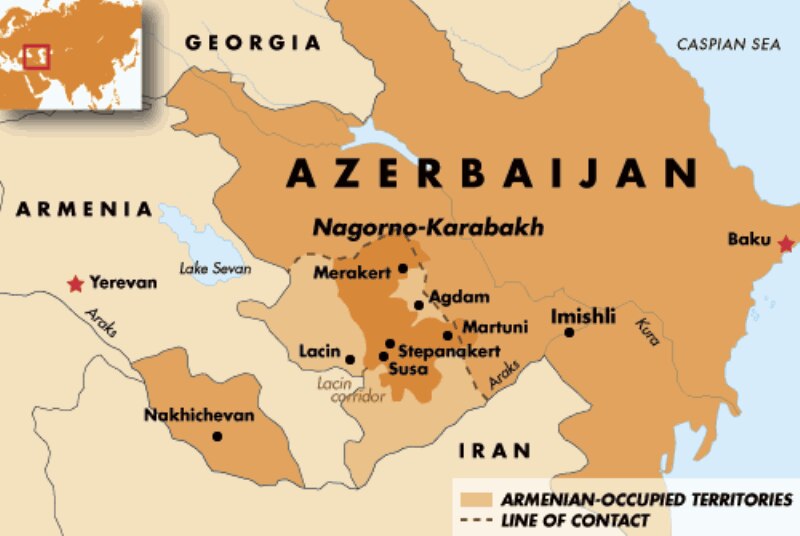
Nagorno-Karabakh is perhaps the thorniest of post-Soviet frozen conflicts.
True to the new trend, the leading powers of the West have expressed little concern over the strengthening of Moscow's strategic position in its immediate neighborhood. Partly this was due to the voluntary nature of the new agreements. The cash-strapped Ukrainians have agreed to the extension of the Sevastopol lease in exchange for a substantial subsidy; the Armenians have just won an unambiguous Russian security guarantee for their strategically isolated state.

Partly the reason for acquiescence has been the convergence of interest: the United States shares Russia's concern over the stability of Kyrgyzstan and its neighbors. Where Washington disagrees with Moscow, as on Georgia, the disagreement has been securely fenced off.

It is also important that the long lull in NATO's eastern enlargement has resulted from the changes in the candidate countries themselves -- and not from any deal with Moscow. Ukraine has seen a change of government and, consequently, a strategic reassessment; and Georgia resorted to force against its breakaway province, provoking a war with Russia. What is no less important is the sense of strategic overstretch that was discernible even before the global crisis both in the United States and in the European Union. Neither NATO nor the EU will begin moving east again for a long time.

A New, Grown-Up CSTO


Which means that, in the foreseeable future, Russia may have fewer impediments than ever to play a role it has always coveted, that of a principal security provider and peace guarantor in the space once covered by the Soviet Union. If the Russians are serious about exercising that role, they will have to adapt their policies and mend their ways. Above all, they will need to refocus their strategy from an essentially negative one -- resisting NATO's drive and U.S. deployments -- to a positive one: conflict prevention and conflict resolution.

Conflict prevention would necessitate a thorough reform of the CSTO away from a club of Russia's friends into an effective security tool, first of all in Central Asia. The region looks increasingly fragile, both from within and in view of the developments next door, particularly in Afghanistan. A NATO-like political structure, plus a modern integrated security toolbox and a much better analytical capacity, would help turn the toy copy of the Warsaw Pact into a functioning regional mechanism adequate to the new challenges. The reformed CSTO would not need to bother looking beyond Central Asia: bilateral treaties, like the Russo-Armenian one, would suffice.

Conflict resolution would require determined efforts to bring the post-Soviet conflicts to a close, two decades after the beak-up of the USSR. The Transdniestrian one appears easiest to resolve, but it still demands some heavy lifting in Tiraspol and Chisinau, as well as close coordination with Kyiv and good-faith cooperation with the European Union and the United States. To ease the Abkhaz and Ossetian situations, Russia would need, already now, to start opening up to the Georgian people and, eventually, to the government in Tbilisi -- probably after President Mikheil Saakashvili bows out at the end of his second term.

It is the Karabakh issue that looks the most difficult and dangerous one by far.

By expanding its guarantees to Armenia and extending the treaty's term, Moscow has given a warning to Baku to drop war as an instrument of policy. Now it needs to make another step, by producing incentives for both Armenia and Azerbaijan to reach a peace deal. A decade ago, at Key West, Florida, the deal was almost done, but it fell through because, unlike their leaders, the two countries' elites were not yet ready to embrace it.

Now, with the support of the Minsk group and its U.S. and French co-chairs, as well as the regional power Turkey, Russia needs to take the lead in bringing the sides to a final settlement. Over time, that will be the ultimate proof of its security-building capacity.

Dmitri Trenin is director of the Carnegie Moscow Center. His son, Andrei, is an independent security and energy analyst. The views expressed in this commentary are the authors' own and do not necessarily reflect those of RFE/RL
This forum has been closed.
Comment Sorting
Comments page of 2
    Next 
by: Ardon from: Madrid
August 25, 2010 06:48
Funny that after 19 years, things have changed so little in geopolotical terms.

It is sad to say, but it is even a relief to envisage to have a Russian grip on places like turbulent Kyrgyzstan...things have become too complicated

by: Ray F. from: Lawrence, KS
August 25, 2010 16:54
Good report and nice metaphor for growing realization that regional security trumps the ‘democratic’ aspirations of aggrieved peoples. Which is better? Having Russian police/military stand on the corner and provide order, or having the local clan leaders fighting and bickering over territory? The experience in Afghanistan, Iraq, Chechnya, Yugoslavia etc... has shown that a lousy peace is better than the most brilliant war.

by: Doug from: Washington DC
August 25, 2010 17:55
"Armenians have just won an unambiguous Russian security guarantee for their strategically isolated state," is a nonsensical formulation. There is nothing inherent in Armenia's strategic isolation. It's remarkable inability to make reliable allies of its neighbors is makes it isolated. This treaty with Armenia is as much about isolating Georgia, whom the Russians will never forgive for being a successful democratic former Soviet state, as it is about securing Russia's perimeter. i can't understand the theory that the Russians have, or even believe they have, any threat on their perimeter. It is a rationalization for imperial behavior. They are surrounded by weak, and most certainly to be weak for a long time, states on their perimeter. The actions imputed to the Russian obsession with the security of their perimeter, is more logically explained by a reference to the Great Russian imperial habit of mind.
In Response

by: Stephen from: Wyoming, USA
August 25, 2010 22:16
Doug, "remarkable inability to make reliable allies of its neighbors..."? With that statement you are automatically throwing aside hundreds of years of hostility among and with those neighbors, two closed borders, economic blockade, a Christian country surrounded mostly by Muslims, constant threats of annihilation, and a sporadically active war-zone. Armenia is strategically isolated, but it is inherent in its existence, surrounded by enemies. Your comment obviously shows either gross ignorance or heavy bias. I am not sure which is worse.
In Response

by: Henrik from: New York
August 26, 2010 03:55
Isn't that the point? Russia is surrounded by weak states -- most of which can come under the sway of the West, house NATO troops, and inject themselves into otherwise Russian markets. This is not a legitimate security concern?

And Armenia's strategic isolation has every bit to do with its neighbors. How is it suppose to defend itself against a Turkey which argues Azerbaijan is a part of the Turkish "nation" and thus Turkey must come to its aid. The Turkish blockade is as every bit illegal as is Mexico blockading the American border for the American invasion of Canada.
In Response

by: Doug E from: Washington, DC
August 28, 2010 13:18
You may be right, I'm full of hot air. I just don't see how you can write an article about this without mentioning the Russia-Georgia angle. Certainly the Georgians took this development negatively. They canceled the Armenian MinDef's visit to Georgia, and are thinking of canceling overflight rights.

And I simply don't get the reality (as opposed to fetid imaginings) of Russian encirclement by weak states. So if Russia had not signed this treaty with Armenia, NATO would have established a bulwark there of NATO forces and invaded Russia (economically you say?) from there? Ludicrous. I know the Russians are at that level of paranoia, but we shouldn't aid and abet that sickness.
In Response

by: Taxpayer from: USA
August 28, 2010 04:04
"Georgia, whom the Russians will never forgive for being a successful democratic former Soviet state"

I'm sure many people on this site still remember how this "democratic" state of Georgia just two years ago started a war against now independent South Ossetia and lost it big time after a few days of fast running back home. I doubt Russians are concerned at all about Georgia after that.

On the other hand, nobody can even begin to suggest that Azerbaijan is "democratic" or could become democratic in the next 100 years. Why support Azeri claims to Armenian populated democratic Republic of Artsakh (Nagorno Karabakh) that Lenin's Bolsheviks placed within the borders of Soviet Socialist Republic of Azerbaijan almost 100 years ago?
In Response

by: Andrew from: Auckland
August 29, 2010 11:19
Shouldn't your moniker be "Taxpayer from Russia"

As for starting a war, man it was a frozen conflict that was not really all that frozen anyway.

Do you not remember the fact that the separatists were shelling Georgian controlled villages and deliberately targeting Georgian civilians?

What happened last time somebody did that to the USA?

Why should the Georgians be forced to siit there and watch their civilians get killed by a bunch of racist little Russian backed Mafiya thugs?

As for the "fast running back home" well, not really. The Russians could not get in to Tshkinvali until the Georgians withdrew in line with the Sarkozy-Medvedev agreement, and the Georgians were pretty severely outnumbered.

In west Georgia the Russians and Abkhazians launched an unprovoked attack against virtually non existent forces, and succeeded in overrunning the west of the country, because simply put the Georgians could not be everywhere at once, while the Russians could.

But the Georgians certainly can fight, just look at the number of Russian aircraft they waxed, while the Russians did not get a single Georgian aircraft.

The Russians won the war the same way they always do, through brute force, overwhelming numbers, and human waves. Not to mention raping, looting, and ethnic cleansing.
In Response

by: Taxpayer from: USA
September 07, 2010 22:36

"But the Georgians certainly can fight, just look at the number of Russian aircraft they waxed, while the Russians did not get a single Georgian aircraft"

I admire Georgian men talents as great dancers and also impressed with the long elaborate toasts they make but they should probably give credit to the brave Ukrainian mercenaries who came with the equipment and knew how to operate it. And were the Georgian planes ever in the air these days or were they all destroyed on the ground?

by: Tahir Ceferli from: Baku - Basqal
August 26, 2010 05:58
Russian-Armenian treaty: Who benefits? - The question is rhetorical. To properly answer this question, must proceed from the geopolitical situation, which forced Russia to go to this step, which will cost the Russians billions of dollars. After saving to a foreign military base expensive and leader of the country must take into account all the pros and cons of this decision. The fact that the Russian leadership is hampered entering the U.S. in the strategic Caucasus region, which, since 90 years, there is a clash of interests of great powers.
U.S. after the collapse of the Soviet Union, became the sole superpower, began to dictate terms of the new world order. Naturally, the Caucasus region, in the first place, Azerbaijan, with its oil resources and strategic location have attracted the country in the Caucasus. By agreement of the United States signed the "Contract of the Century" and the agreement "by the Baku-Ceyhan pipeline, which prevented Azerbaijan is economically independent from Russia. For a short period in contrast to other Caucasian republics of Azerbaijan is rapidly developing and evolving at this moment at such a rate that soon the whole world to talk about "Caucasian Dubai.
It is well known that the Russian use Armenia as a "canon de neck" to stay in the Caucasus, the Caucasian war started.
Despite the fact that Armenia Russian arms occupied 20% of Azerbaijani lands, she felt his incapacity to solve its own foreign policy issues related to the seizure of foreign territory.
Certainly, the leadership of Armenia, the backbone of which is predominantly Karabakh Albanians appealed for help to their brethren abroad, which have attracted foreign policy structure of the U.S. to address this issue. This resulted in the fact that the U.S. put to the negotiating table to Turkey and Armenia, which have signed the so-called "Protocols", allowing the opening of Turkish-Armenian border. Here Russian understood that opening the border is no good promise in geopolitical terms, and it can be a launching pad for the start of the withdrawal from the Caucasus all the Russian troops.
Russian realized that they could stay in Armenia only if Azerbaijan starts a war in Karabakh.
Azerbaijani President Ilham Aliyev felt that Armenia is sufficient weakening in economic terms can not be weighed down with Azerbaijan, spoke about ways to force the liberation of Armenian-occupied lands.
In this situation, the war in the Caucasus was in the interests of Iran and China who are interested to keep the U.S. out of the Caucasus. For all the geopolitical parameters of Azerbaijan is in an advantageous position.
Arrival Naryshkina in Azerbaijan was not a random event. This Russian "grandee" had a great influence on the leaders of Armenia, to think.
After leaving Naryshkina President Ilham Aliyev spoke again about the military way of liberation of the occupied lands, forcing Armenia firmly grasped by the legs and the Russian president to sign the contract.
That's what scenario developed by the situation that led to the signing of a military contract. This Armenia lost the actual support from the West, which promised her economic development and improve the welfare of the country.
We think that after the signing of the treaty of Armenia will not find an ally in the U.S. in solving the Karabakh problem. We are confident that the President of Azerbaijan will benefit from this.
The contract is beneficial Karabakh clan, which extended its power in Armenia.
Thanks to the anti-Armenian policy of "Karabakh clan" in the near future in Armenia Armenians certainly not remain, because all the levers of both economic and political are in their hands, and Karabakh will do everything to stay in power.
Now it is to answer the question of who benefits? "- Of course Karabakh’s to continue to rule in Armenia.
In Response

by: Taxpayer from: USA
September 07, 2010 22:12
Have others noticed that all Mr. Ceferli's posts are of almost identical length of about 600 words or 3000 characters? I think that's his daily quota no matter what nonsense he picks to copy-paste...

by: Tahir Ceferli from: Baku -Basqal
August 29, 2010 12:18
Russia will take care of Armenia begins an interview with Seyran Ohanyan . I want to start with the title of the article. A poor orphan, Armenia was left without care. On all sides the pressure on her, taking the last piece of bread. Surrounding her enemies: such as Azerbaijan. Iran, Turkey and Georgia, all want to Armenia was a independent republic. Therefore the "Karabakh" Serge Sargsyan and Seyran Ohanyan found a guardian to care for them. And it is no coincidence that "Karabakh" went on it to rely on the Russian and stay in power. About these people has Eastern proverb: Become a servant of the king , then we'll see!

Signing the agreement on the presence of Russian troops in Armenia is not affiliated with any threat against Armenia, as evidenced by the Western press. The new treaty arrangement with the addition of an old term that still does not fit into the logic. After all, the old agreement allowing Russia to remain indefinitely in Armenia, and the new de facto reduces the duration of stay.

Despite this, the surface floats new details that have become concerned about those who have signed an agreement with the Armenian side.

By signing this agreement, Armenia is actually put stones under the wheels of American politics, aimed at strengthening the position of the U.S.A in the Caucasus region, as well as the West who are interested in peaceful solution of the Karabakh conflict.
Now Armenia has turned their eyes to the country, invading the territory, and while it remained 0 source of threat to peace. For Azerbaijan, which was subjected to aggression for over 19 years, has not yet entered into any military agreement with any country: neither with Turkey nor Iran, nor with the U.S.A or Russia, etc.

And he could. Just don’t want to become in the hands of great powers in the "canon de neck", cannon fodder. It is known that in the big wars, small states have always played in such contracts a sexually role.

President Ilham Aliyev, in contrast to the Armenians, unable to hold the balance of power in the region have signed such a treaty. In this he showed the world that Azerbaijan - peace-loving country. This talk about his far-sighted policies aimed at strengthening the friendly relations with the world.

In this interview is interesting nuance related to the Karabakh . S. Ohanyan says: "At the same time, I must say that, if unleashed against Karabakh threat will grow into a direct threat to the Republic of Armenia, I do not doubt that Russia will fulfill its alliances and treaty obligations." That's where the shoe pinches!

It turns out that the Azerbaijani nation, if they started to liberate the occupied Azerbaijani lands originally and it does not pass the border of Armenia, the Russian troops would not act. On the other hand Armenia has actually become a hostage to the contract, under which the contract Armenia must report all its actions before the "Big Brother", which limits its action on the foreign policy arena.

" People of Karabakh " , which hold the power in Armenia, Russian arms actually turned this country into a hostage of the geopolitical ambitions of Russia. And can not believe Russia would take care of Armenia, as an orphan, left unattended. Russia will not build anything in Armenia or open new plants and factories, as in Soviet times. Most events will develop in the following scenario. Economically backward Armenia will leave the Armenians. Over the past two decades, the population of this country has decreased three times, as indicated by statistics. Stop the process after the signing of this agreement will be impossible.

That such things makes Seyran Ohanyan fuss before the media.


In Response

by: Konstantin from: Los Angeles
September 08, 2010 18:15
Tahir Ceferly simce got it right here, all World wants Armenia be free.
But there are two of them - Urartu Chaldeo-Persians and Armenia
That was a part of Ibero-Caucasian race - now they are fleeing.
Behind it there is Russian race war, using Urartu diaspora.

Urartu was last two times betrayed, by Russian Griboedov
And WW1 Russian government, producing many refugees
That Russia use in their plans to conquer their neighbours.
They needed help and they accepted, but the vaulcher see!

Vaulcher neither left it alone during Griboedov - nor Esenin,
Accompanied by Lenin and Serafimovich drunken "mordas",
That demanded to robb all the Urartu refugees for Rashkis,
Soon after vaulcher forced old and new Urartu into "Borges".

They also humans and have right to live, somewhere, - still,
Russia use them as hostages, prohibbit them make peace
Use them to force-out Ibero-Caucasian Armenians by a will,
While replacing them in Turkey by Kurd's communist breed.

Peacefull solution is always there, but Russia say: "No way!"
If not for that, some temporary peace-keeping force was OK,
Why not UN - EU peace-keeping - Urartu might change mind,
Actually go for the real peace with Turks and Caucsus - right?

Konstantin.


by: Avetis from: USA
August 29, 2010 16:39
Thank God Russia has long-term interests in Armenia and due to these interests it is protecting Armenia from Turkish and Azeri aggression. Armenians need to get smart and start using this opportunity to strengthen the country.

I emphasize Russia as a positive factor for Armenia simply because a majority of Armenians in the diaspora and a growing number in the republic are falling victim to anti-Russian mental conditioning. Anti-Russian propaganda in the West began before the Bolshevik revolution and it continues today long after the Soviet collapse. Most Armenians today, even if they don't realize it, are conditioned by the ubiquitous anti-Russian propaganda they are exposed to in the West. If the West got it way with our self-destructive peasantry (and had it not been for Kocharyan and Sargsyan they would have), we would have had to say good-bye to Armenia.

As long as a Turkic, Islamic, Iranian and/or a Western threat remains in the Caucasus, Armenia will be Russia's most valuable partner in the region. Like I said, instead of complaining let's use this opportunity to strengthen Armenia.


Russia has some of the same Turkic/Muslim problems we have. We need to exploit that factor in the Kremlin instead of acting like whining children about their growing influence in Armenia. The bottom line is this: without Russian support, Armenia would not last in the Caucasus for than a year, at most.
In Response

by: Leo from: Azerbaijan
September 03, 2010 08:32
I am not surprised by a paranoiac hateful discourse against Turks, but are not Armenia and Iranian mullah regime best friends in the region? You seemingly try to parasitize on a pseudo-racist "anti-Turkic" and "anti-Islamic" arguments to promote your petty cause. People are not blind.


by: RD from: Russia
September 01, 2010 12:25
This is a good piece of analysis, but the authors seem to exaggerate the implications of the extended Russia-Armenia military agreement. There is nothing fundamentally new in the extended agreement, and Russia has not taken any new commitments in addition to ones which it already had vis-a-vis Armenia.

by: Konstantin from: Los Angeles
September 02, 2010 18:09
To installed in Madrid Russian good-whisher, Ardon.
So, you are relieved - invision Russians grab a "grip
On places like (whole) turbulent" Euro-Asia. Pardon,
KGB, GRU and Spetcnaz create the turbulennce bip!

Konstantin.
In Response

by: J from: US
September 04, 2010 02:17
Nothing like a good old turbulennce bip, my man. Right on.

by: Konstantin from: Los Angeles
September 06, 2010 07:55
What a Fe Ray! Is it from Kansas, one of capitals of mail-froads?
Is it better have Russian military and police - breed in you land,
As occupying genocidal macaques that with Brits and Germs
Conspired since 1954-56, as the imperial resurectors gang,
Genocide and blocades - from Afghanistan through all CIS?

Bickering are you, for Russo-Austrio-Germo-Brito cousins,
Which might not even be aware what evil treasonous men
Promiss them be Emperor of the planet Earth, once again,
Race war against Caucasian race and Human Civilization.
Karabah, for 180 years, is Anychar of Russian armies van.

Konstantin.


by: Konstantin from: Los Angeles
September 06, 2010 08:12
Not quite Dug! British Empire was a symbol of reason and greed,
They started Opium War to defend its trade interest among a few
That had more trade with China, than greed prevail to go for a kill.
By the same tokan - they let India go - to keep bying British goods.

Russia lying about any reason -it has none! Only patalogical hate
To Human Civilization by Varangians - braking through the gates!
Some hate that their Norman British relatives might still possess,
But milder - they like more calling them Saib Hindus than Afghans.

Konstantin.
Comments page of 2
    Next 

Latest Commentary

No records found for this widget:963

More Commentary

Most Popular


Being Discussed Now

Afghan Parliament OKs Security Pact

Latest Comment (1 total)

donky kong: No surprise. Both candidates support this too. Choosing between Obama or Romney is ... More

No Saturday Night Fever, As Armenia Mulls Eurovision Blackout

Latest Comment (24 total)

Rafi: There's no need to bring in a straw man, and make me say ... More

Brzezinski Calls Putin Rule 'Anachronism'

Latest Comment (4 total)

Batanage:
Look who is Talking now, Brezenski the hypocrite.

The guy who spread fundemetelists around ... More