




At a marketplace in the city of Split, a group of elderly Croats talks about whether a statue should be erected to honor late President Franjo Tudjman -- the leader of Croatia during its war for independence from the former Yugoslavia.
There is not much debate. Old enough to remember life in Yugoslavia under communist leader Josip Broz Tito, they quickly agree. Instead of Tudjman, they would prefer a statue of Tito -- a man they still lovingly refer to by the nickname Jozo.
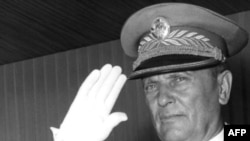
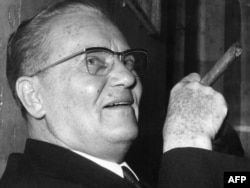 SLIDE SHOW: Tito's Life In PicturesTito's rise from Communist Party chairman to Yugoslav prime minister and president effectively amounted to an unchallenged reign of more than four decades. Today, 30 years after his death and nearly 20 years after the disintegration of the Yugoslavia he helped create, Tito still commands affection and respect, a unifying figure in a now deeply divided region.
He is considered by many in the Balkans a World War II liberator because of his leadership of the Yugoslav Partisans guerrilla movement against the Nazi occupation. After the war, Tito played a crucial role in building a multiethnic federation that included what is now Serbia, Montenegro, Croatia, Bosnia-Herzegovina, Slovenia, Macedonia, and Kosovo.
The idea of "brotherhood and unity" of all those nationalities, ethnicities, and religious backgrounds was an anthem that Tito repeated in many of his speeches -- declaring that "a sea of blood" had been spilt for Yugoslavia's unity and that nobody would be allowed to "undermine it or ruin it from inside."
In the West, Tito was respected for refusing to accept Moscow as the supreme communist authority and standing up to Soviet leader Josef Stalin by insisting that Yugoslavia follow its own national interests on the road toward socialism.
'A Soft Dictator'
Even some people who were targeted by Tito's political purges in the former Yugoslavia now have a positive assessment of his impact on world history.
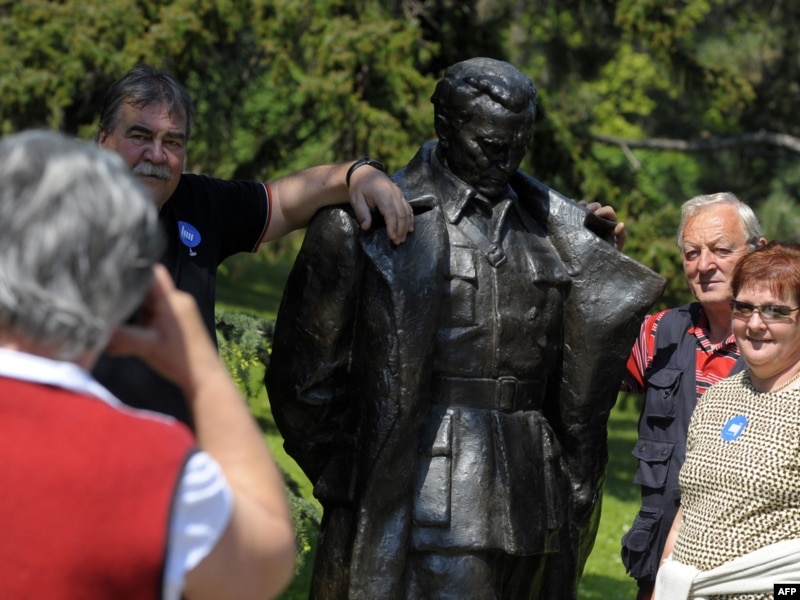
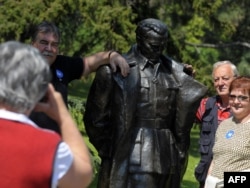 A group of Slovenian tourists take photos beside a bust of Tito in Belgrade.Tito removed Latinka Perovic from her position as a young communist functionary in 1972 after she had campaigned for the democratization of the Yugoslav Communist Party.
Perovic, today a leading expert on modern Serbian history, says that Tito will be remembered for being a key figure in the battle against fascism and a "crucial agent" in the eventual disintegration of the Soviet Union and the Eastern bloc.
"I believe that Tito belongs among such personalities sought out by history, in a certain sense, and above all during those fateful years before and during World War II, and in 1948," Perovic tells RFE/RL.
"His famous break with Stalin in 1948 was a bold and momentous step," Perovic says. "It shattered the ideological and the military-political monolith of the Eastern bloc, just as the world had been divided into two spheres of influence, and it was a crucial moment for Yugoslavia, which led to the deprovincialization of the country, opening it toward the whole world, and in a certain sense humanizing it."
Perovic says Tito will be remembered as a "soft dictator" who brought stability to a turbulent region with a long history of ethnic conflict.
She says he also will be remembered as a modernizer who used centralized power to transform Yugoslavia from an "economically backward, largely agrarian society into a developed industrial nation."
(WATCH: Hundreds of people came to pay their respects on May 4 at Tito's Belgrade memorial, the "House of Flowers.")
Indeed, many of those who remember Tito's rule speak about the relative tolerance in Yugoslavia at the time.
In the southern Bosnian town of Pocitelj, an imam named Dzemal Gadara says that the religious freedom he had in Tito's Yugoslavia was unlike his experience in any other country.
"Yugoslavia was the best country," Gadara insists. "I say this openly. And Tito was the greatest statesman. I have traveled around the world. But such freedom could not be found anywhere. I think that such freedom -- and only God knows this -- will never be again."
At a recent ceremony commemorating a strategic ruse that Tito pulled off against a Nazi-led force in the 1943 Battle of the Neretva, Omer Catic, a resident of the central Bosnian town of Bugojno, said: "They should celebrate him for 1,000 years -- not just 30. He left marks upon the world that will never be erased. You only need to imagine 120 statesmen coming to his funeral."
Golden Era Remembered
To be sure, the forces of nationalism that Tito kept under control during his life would be unleashed after his death -- culminating in the disintegration of Yugoslavia.
Those same forces of nationalism can make nostalgia for the former Yugoslavia controversial in countries that fought wars of independence.
Nevertheless, many now think of Tito's rule as a golden era compared to the war years before he came to power and a decade after his death.
Tvrtko Jakovina, a historian from Croatia, says it was the breadth of Tito's vision, the success of his Yugoslav diplomacy, and the number of encounters Tito had with world leaders that made him a leading statesman of his time.
"As a historian of the Cold War era, it seems to me that he is just about the only historical personality that I can study and still remain in step with the rest of the world," Jakovina says. "That is probably the only period when my people played some sort of pivotal role in world events. In the light of everything that has happened since then, it seems like science fiction."
'We Were Happier Then'
Each year -- honoring Tito on the anniversary of his death on May 4, 1980 -- thousands of sympathizers from across the former Yugoslavia visit his birthplace at Kumrovec in Croatia.
In Croatia and Bosnia, dozens of organizations have been established to keep Tito's memory alive. In Slovenia, Tito has become a kind of pop icon for youngsters, who wear T-shirts and badges bearing his image. And in Belgrade -- the city that arguably has felt most keenly the loss of the Yugoslav Republic -- thousands of people in recent weeks have visited Tito's tomb at the Yugoslav Museum of History and museum exhibitions that feature exhibitions of Tito memorabilia.
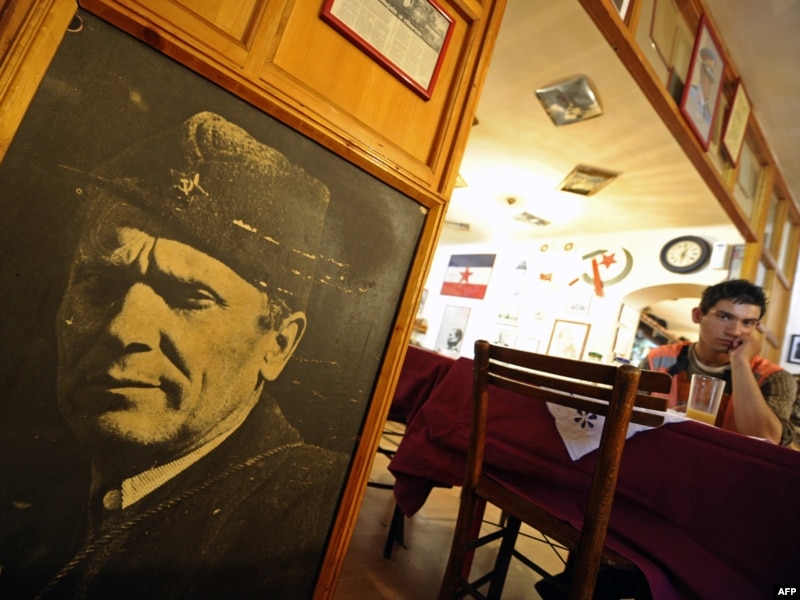
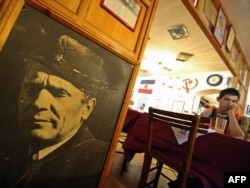 A Tito portrait at Belgrade's Korcagin restaurant, which is filled with communist- and Yugoslav-era nostalgiaFor 61-year-old Belgrade resident Ljubica Gulic, such exhibitions conjure memories of a time when life was simpler and Belgrade's citizens lived a more comfortable and prosperous life than people in other communist countries.
"I remember President Tito because it was one of the most carefree periods of my life. Compared to the present, I was happy and satisfied back then. I was not afraid of anything. Now I can't go to sleep because I am afraid that something will happen," Gulic says.
"Regardless of people who think that [Tito's era] was a period of fear, in my opinion it was more peaceful. People were happier. [Tito] had charisma."
Thirty-year-old Belgrade resident Nermanja Petrovic is too young to remember life under Tito. Born on May 4, 1980 -- the day Tito died -- he is the first generation to know of Tito only from stories told by those older than himself.
"I know all the historical facts. It was a time when people lived comfortably," Petrovic says. "But there is another argument -- that it was because of that nice life [in those times] that we are now paying the price."
Petrovic says he thinks there was enough time after Tito's death to avoid the dissolution of Yugoslavia and the wars of the 1990s if the right steps had been taken by political leaders. He concludes that blaming Tito for Serbia's current problems "does not make sense and cannot bring anything good."
RFE/RL's Balkan Service correspondents contributed to this report from Serbia, Bosnia-Herzegovina, and Croatia
There is not much debate. Old enough to remember life in Yugoslavia under communist leader Josip Broz Tito, they quickly agree. Instead of Tudjman, they would prefer a statue of Tito -- a man they still lovingly refer to by the nickname Jozo.
SLIDE SHOW: Tito's Life In PicturesHe is considered by many in the Balkans a World War II liberator because of his leadership of the Yugoslav Partisans guerrilla movement against the Nazi occupation. After the war, Tito played a crucial role in building a multiethnic federation that included what is now Serbia, Montenegro, Croatia, Bosnia-Herzegovina, Slovenia, Macedonia, and Kosovo.
The idea of "brotherhood and unity" of all those nationalities, ethnicities, and religious backgrounds was an anthem that Tito repeated in many of his speeches -- declaring that "a sea of blood" had been spilt for Yugoslavia's unity and that nobody would be allowed to "undermine it or ruin it from inside."
In the West, Tito was respected for refusing to accept Moscow as the supreme communist authority and standing up to Soviet leader Josef Stalin by insisting that Yugoslavia follow its own national interests on the road toward socialism.
'A Soft Dictator'
Even some people who were targeted by Tito's political purges in the former Yugoslavia now have a positive assessment of his impact on world history.
Perovic, today a leading expert on modern Serbian history, says that Tito will be remembered for being a key figure in the battle against fascism and a "crucial agent" in the eventual disintegration of the Soviet Union and the Eastern bloc.
"I believe that Tito belongs among such personalities sought out by history, in a certain sense, and above all during those fateful years before and during World War II, and in 1948," Perovic tells RFE/RL.
"His famous break with Stalin in 1948 was a bold and momentous step," Perovic says. "It shattered the ideological and the military-political monolith of the Eastern bloc, just as the world had been divided into two spheres of influence, and it was a crucial moment for Yugoslavia, which led to the deprovincialization of the country, opening it toward the whole world, and in a certain sense humanizing it."
Perovic says Tito will be remembered as a "soft dictator" who brought stability to a turbulent region with a long history of ethnic conflict.
She says he also will be remembered as a modernizer who used centralized power to transform Yugoslavia from an "economically backward, largely agrarian society into a developed industrial nation."


(WATCH: Hundreds of people came to pay their respects on May 4 at Tito's Belgrade memorial, the "House of Flowers.")
Indeed, many of those who remember Tito's rule speak about the relative tolerance in Yugoslavia at the time.
In the southern Bosnian town of Pocitelj, an imam named Dzemal Gadara says that the religious freedom he had in Tito's Yugoslavia was unlike his experience in any other country.
"Yugoslavia was the best country," Gadara insists. "I say this openly. And Tito was the greatest statesman. I have traveled around the world. But such freedom could not be found anywhere. I think that such freedom -- and only God knows this -- will never be again."
At a recent ceremony commemorating a strategic ruse that Tito pulled off against a Nazi-led force in the 1943 Battle of the Neretva, Omer Catic, a resident of the central Bosnian town of Bugojno, said: "They should celebrate him for 1,000 years -- not just 30. He left marks upon the world that will never be erased. You only need to imagine 120 statesmen coming to his funeral."
Golden Era Remembered
To be sure, the forces of nationalism that Tito kept under control during his life would be unleashed after his death -- culminating in the disintegration of Yugoslavia.
Those same forces of nationalism can make nostalgia for the former Yugoslavia controversial in countries that fought wars of independence.
Nevertheless, many now think of Tito's rule as a golden era compared to the war years before he came to power and a decade after his death.
Tvrtko Jakovina, a historian from Croatia, says it was the breadth of Tito's vision, the success of his Yugoslav diplomacy, and the number of encounters Tito had with world leaders that made him a leading statesman of his time.
"As a historian of the Cold War era, it seems to me that he is just about the only historical personality that I can study and still remain in step with the rest of the world," Jakovina says. "That is probably the only period when my people played some sort of pivotal role in world events. In the light of everything that has happened since then, it seems like science fiction."
'We Were Happier Then'
Each year -- honoring Tito on the anniversary of his death on May 4, 1980 -- thousands of sympathizers from across the former Yugoslavia visit his birthplace at Kumrovec in Croatia.
In Croatia and Bosnia, dozens of organizations have been established to keep Tito's memory alive. In Slovenia, Tito has become a kind of pop icon for youngsters, who wear T-shirts and badges bearing his image. And in Belgrade -- the city that arguably has felt most keenly the loss of the Yugoslav Republic -- thousands of people in recent weeks have visited Tito's tomb at the Yugoslav Museum of History and museum exhibitions that feature exhibitions of Tito memorabilia.
"I remember President Tito because it was one of the most carefree periods of my life. Compared to the present, I was happy and satisfied back then. I was not afraid of anything. Now I can't go to sleep because I am afraid that something will happen," Gulic says.
"Regardless of people who think that [Tito's era] was a period of fear, in my opinion it was more peaceful. People were happier. [Tito] had charisma."
Thirty-year-old Belgrade resident Nermanja Petrovic is too young to remember life under Tito. Born on May 4, 1980 -- the day Tito died -- he is the first generation to know of Tito only from stories told by those older than himself.
"I know all the historical facts. It was a time when people lived comfortably," Petrovic says. "But there is another argument -- that it was because of that nice life [in those times] that we are now paying the price."
Petrovic says he thinks there was enough time after Tito's death to avoid the dissolution of Yugoslavia and the wars of the 1990s if the right steps had been taken by political leaders. He concludes that blaming Tito for Serbia's current problems "does not make sense and cannot bring anything good."
RFE/RL's Balkan Service correspondents contributed to this report from Serbia, Bosnia-Herzegovina, and Croatia

