


Like millions of Russians, Tatyana had been bracing for the annual hike in utility tariffs that comes with the new year.
But her bill for January exceeded her worst nightmares. It had jumped 25 percent from the previous month, eating up as much as two-thirds of her salary.
"I have great difficulties in paying for my flat," she says. "Salaries here are low and tariffs for utilities are very high. I grew up in Soviet times, and we didn't have such problems. I'm really scared for my children."
Tatyana, a 50-year-old preschool teacher in the central Russian city of Penza, must now spend 5,000 rubles ($168) per month on water, gas, and electricity. This leaves her with just 2,300 rubles ($77) to feed her two teenage children and her husband, an invalid whose health problems prevent him from working.
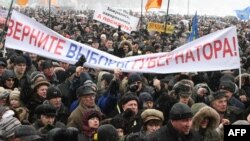
Panicked, Tatyana decided to take to the street. She joined a rally in Penza organized by the opposition this past weekend to protest worsening living conditions and call for the ouster of local leaders.
"I'm in a hopeless situation," says Tatyana, who was afraid to give her last name. "I can't bear it anymore. I need to do something about it and that's why I went to the protest. I saw that people had already been driven to despair."
Nervous authorities in Penza did their best to deter residents from attending the rally, offering free entrance to the local zoo, free city excursions, and public lectures on how to cut utility costs.
But to no avail. An estimated 2,000 protesters massed on March 7 in Penza's city center. The demonstration was peaceful but pointed: local residents are fed up with their sinking living standards, and ready to speak out about it.
Nationwide Rallies
The Penza rally was the latest in a string of street demonstrations that have rocked Russia in recent weeks. In places as varied as Samara, Irkutsk, and Archangelsk, disgruntled residents have been joining forces to protest low pay, mounting unemployment, police abuse, and what increasing numbers of Russians see as a corrupt government on both the local and federal level.
The largest demonstration, held last month in the Baltic city of Kaliningrad, drew as many as 10,000 people.
The demonstration will be repeated on a nationwide scale when Kaliningrad becomes one of at least 15 cities to stage coordinated protests on March 20.
And the protest is not limited to banners and slogans shouted on cold city squares; some prominent Russians, too, are voicing their resentment at the regime built by Vladimir Putin over the past decade.
"The rich are becoming even richer, the poor even poorer. Corruption is total, everyone is stealing," veteran rock star Yury Shevchuk told his fans at a March 7 concert in Moscow. "The system has built a brutal, cruel, and inhumane government in our country. People are suffering, not only in prisons and camps, but in orphanages and hospitals as well."
The recent protests are a notable shift from the public passivity of the early and mid-2000s, when the country was enjoying an unprecedented wave of stability and economic prosperity.
Political analyst Dmitry Oreshkin says much of the roiling discontent now is due to the economic crisis, which has hit Russia particularly hard after almost a decade of oil-fueled growth.
"Unemployment is on the rise, prices are soaring, livings standards are worsening," he says. "Television tells us tales that we are rising from our knees, but this no longer reassures people."
Nervous Kremlin?
Curiously, authorities are allowing the opposition rallies and police so far have largely refrained from arresting or beating protesters.
Oreshkin says Russia's political leaders understand that using force to stem such a wave of discontent could turn against them.
"Authorities are rational enough not to follow the Chinese path," he says. "They would happily break the arms of protesters, but when these protesters number 1,500 or even 10,000, it's better to find a compromise with them. This signals an evolution of society's political culture, a very slow evolution that is taking place with the change in generation."
The Kremlin's reaction to the season of protests has been muted, but betrays concern.
President Dmitry Medvedev sent his envoy to Kaliningrad following the February rally, and a Kremlin advisor for the region, Oleg Matveychev, resigned under pressure following the protests.
Medvedev also fired the chief of police in Tomsk following a public outcry over the murder of a local journalist by police.
The demonstrations are also notable for uniting the country's usually fractious political opposition.
Communists and other marginal political parties have been responsible for organizing many of the rallies, and the sight of Russia's opposition forces standing side by side after years of infighting likely adds to the Kremlin's uneasiness.
'Authorities Need Not Worry'
But analysts say the protests bear no real threat to the political system.
"It has been able to quench the protests," says sociologist Aleksei Grazhdankin, the deputy head of Russia's independent Levada polling center. "Besides, there is currently no political force that could lead these rallies and transform them from separate local outbursts into a massive protest. So authorities need not worry."
In fact, despite growing coverage of the rallies in the Russian and international press, studies by the Levada center show that the number of political protests have not increased significantly since the mid-2000s.
Grazhdankin says Medvedev and his mentor, Prime Minister Vladimir Putin, remain hugely popular despite a slump in polls following the economic crisis. The current wave of protests, he says, is nothing more than a seasonal phenomenon.
"People always display their discontent more actively in spring," he says. "But if we compare the current situation with data from previous years, there is no real increase."
There is no doubt that anger is mounting in Russia over enduring hardship and corruption. Many are desperate for change. But even among the thousands of Russians who took to the streets in recent months, far from all believe the protests will lead to genuine improvements.
"Keep the local government or change it? I think someone else will arrive and nothing will change," says Tatyana in Penza. "I've long given up hope that things will get better."
RFE/RL's Russian Service contributed to this report
But her bill for January exceeded her worst nightmares. It had jumped 25 percent from the previous month, eating up as much as two-thirds of her salary.
"I have great difficulties in paying for my flat," she says. "Salaries here are low and tariffs for utilities are very high. I grew up in Soviet times, and we didn't have such problems. I'm really scared for my children."
Tatyana, a 50-year-old preschool teacher in the central Russian city of Penza, must now spend 5,000 rubles ($168) per month on water, gas, and electricity. This leaves her with just 2,300 rubles ($77) to feed her two teenage children and her husband, an invalid whose health problems prevent him from working.
Panicked, Tatyana decided to take to the street. She joined a rally in Penza organized by the opposition this past weekend to protest worsening living conditions and call for the ouster of local leaders.
"I'm in a hopeless situation," says Tatyana, who was afraid to give her last name. "I can't bear it anymore. I need to do something about it and that's why I went to the protest. I saw that people had already been driven to despair."
Nervous authorities in Penza did their best to deter residents from attending the rally, offering free entrance to the local zoo, free city excursions, and public lectures on how to cut utility costs.
But to no avail. An estimated 2,000 protesters massed on March 7 in Penza's city center. The demonstration was peaceful but pointed: local residents are fed up with their sinking living standards, and ready to speak out about it.
Nationwide Rallies
The Penza rally was the latest in a string of street demonstrations that have rocked Russia in recent weeks. In places as varied as Samara, Irkutsk, and Archangelsk, disgruntled residents have been joining forces to protest low pay, mounting unemployment, police abuse, and what increasing numbers of Russians see as a corrupt government on both the local and federal level.
The rich are becoming even richer, the poor even poorer. Corruption is total, everyone is stealing.

The demonstration will be repeated on a nationwide scale when Kaliningrad becomes one of at least 15 cities to stage coordinated protests on March 20.
And the protest is not limited to banners and slogans shouted on cold city squares; some prominent Russians, too, are voicing their resentment at the regime built by Vladimir Putin over the past decade.
"The rich are becoming even richer, the poor even poorer. Corruption is total, everyone is stealing," veteran rock star Yury Shevchuk told his fans at a March 7 concert in Moscow. "The system has built a brutal, cruel, and inhumane government in our country. People are suffering, not only in prisons and camps, but in orphanages and hospitals as well."
The recent protests are a notable shift from the public passivity of the early and mid-2000s, when the country was enjoying an unprecedented wave of stability and economic prosperity.
Political analyst Dmitry Oreshkin says much of the roiling discontent now is due to the economic crisis, which has hit Russia particularly hard after almost a decade of oil-fueled growth.
"Unemployment is on the rise, prices are soaring, livings standards are worsening," he says. "Television tells us tales that we are rising from our knees, but this no longer reassures people."
Nervous Kremlin?
Curiously, authorities are allowing the opposition rallies and police so far have largely refrained from arresting or beating protesters.
Oreshkin says Russia's political leaders understand that using force to stem such a wave of discontent could turn against them.
"Authorities are rational enough not to follow the Chinese path," he says. "They would happily break the arms of protesters, but when these protesters number 1,500 or even 10,000, it's better to find a compromise with them. This signals an evolution of society's political culture, a very slow evolution that is taking place with the change in generation."
The Kremlin's reaction to the season of protests has been muted, but betrays concern.
President Dmitry Medvedev sent his envoy to Kaliningrad following the February rally, and a Kremlin advisor for the region, Oleg Matveychev, resigned under pressure following the protests.
Medvedev also fired the chief of police in Tomsk following a public outcry over the murder of a local journalist by police.
The demonstrations are also notable for uniting the country's usually fractious political opposition.
Communists and other marginal political parties have been responsible for organizing many of the rallies, and the sight of Russia's opposition forces standing side by side after years of infighting likely adds to the Kremlin's uneasiness.
'Authorities Need Not Worry'
But analysts say the protests bear no real threat to the political system.
"It has been able to quench the protests," says sociologist Aleksei Grazhdankin, the deputy head of Russia's independent Levada polling center. "Besides, there is currently no political force that could lead these rallies and transform them from separate local outbursts into a massive protest. So authorities need not worry."
In fact, despite growing coverage of the rallies in the Russian and international press, studies by the Levada center show that the number of political protests have not increased significantly since the mid-2000s.
Grazhdankin says Medvedev and his mentor, Prime Minister Vladimir Putin, remain hugely popular despite a slump in polls following the economic crisis. The current wave of protests, he says, is nothing more than a seasonal phenomenon.
"People always display their discontent more actively in spring," he says. "But if we compare the current situation with data from previous years, there is no real increase."
There is no doubt that anger is mounting in Russia over enduring hardship and corruption. Many are desperate for change. But even among the thousands of Russians who took to the streets in recent months, far from all believe the protests will lead to genuine improvements.
"Keep the local government or change it? I think someone else will arrive and nothing will change," says Tatyana in Penza. "I've long given up hope that things will get better."
RFE/RL's Russian Service contributed to this report