


The European Union has reaffirmed its commitment to integrating countries from the western Balkan states, dismissing fears of enlargement fatigue or doubts about the region's stability. In exchange, it requested a commitment from the Balkans to carry out agreed reforms for joining the EU.
The commitments were made during a one-day conference in Sarajevo, which brought together Balkan and EU officials.
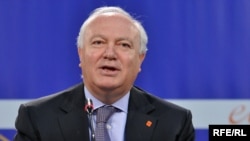
Speaking at a press conference after the talks, Spanish Foreign Minister Miguel Angel Moratinos said the EU and the western Balkans had agreed on "a new deal -- a deal of the future, a future of hope, a future of peace, a future of full integration in the EU."
Moratinos, whose country holds the EU's rotating presidency, described the results of the conference with two words: "engagement" and "responsibility.”
"The last five to six months in the western Balkans have been -- let's be frank -- the most peaceful, productive, hopeful of the last recent history," Moratinos said. "Because I think everybody acknowledges and is aware that we have to move forward in a constructive and positive manner."
Moratinos said the EU would continue to work to advance accession processes with the countries of the region, while the international community committed to accompany the "full inclusive process of reconciliation" in the region.
The Spanish foreign minister said western Balkan countries, in turn, had pledged to enforce political and economic reforms and strengthen regional cooperation in order to meet conditions for joining the EU.
"The international community, the European Union, have committed and have delivered their part," he said. "Now it's our friends from Bosnia, from the western Balkans, that have to do also their part."
'Top Priority'
The EU's conditions for membership include strengthening of the rule of law, fighting against corruption and organized crime, and guaranteeing media freedom.
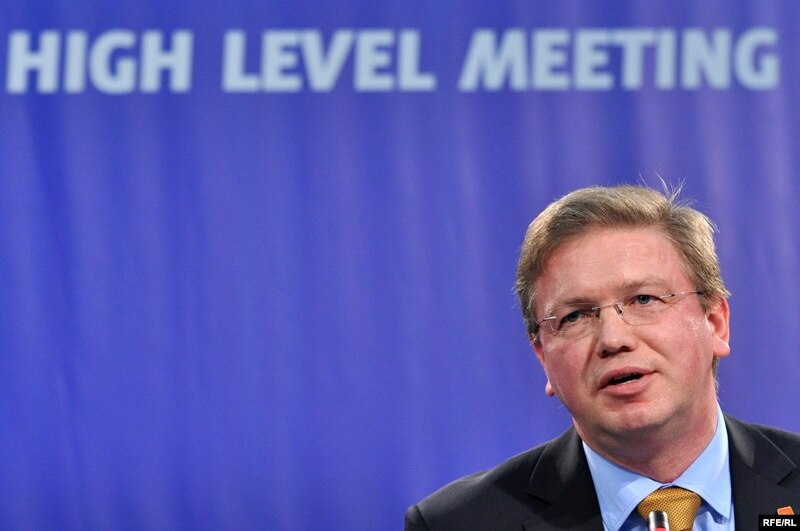
 EU enlargement commissioner Stefan FueleThe EU's enlargement commissioner, Stefan Fuele, called the western Balkans a "top priority" for the external policy of the 27-member bloc and said the Sarajevo conference was about "new momentum and enlargement."
"I think this conference today was meant to show clearly that there's not that much ground for enlargement fatigue among the member states," Fuele said.
Of the former Yugoslav republics, only Slovenia has joined the EU, while its southern neighbors are at various stages in the accession process.
Governments of the region have pushed for a clear commitment and agenda for accession from Brussels, amid growing concerns that the ongoing debt crisis will slow down enlargement and resistance to the accession of new members.
Ahead of the June 2 conference, Serbian Foreign Minister Vuk Jeremic told RFE/RL's Balkan Service that his country expected the EU to send a "clear signal" that the European integration "must not be stopped."
"We now have six months behind us in which we have made great progress regarding political relations in the region and the process of reconciliation," Jeremic said. "We think that the situation in the Balkans is stable and that things are going in the right direction. It would be a big mistake if this were not met not only by a continuation of the process of European integration but also by its acceleration. That will be Serbia’s message in Sarajevo."
Several Milestones
Brussels has supported the European ambitions of the former Yugoslav republics in order to ensure stability in the region, which is still recovering from the bloody breakup of Yugoslavia in the wars of the 1990s. And the EU has pushed for reconciliation, insisting that all potential members must have good relations with their neighbors.
Several milestones on that front have taken place in recent months. They include the Serbian parliament's apology for the 1995 Srebrenica massacre in which Bosnian Serb forces killed thousands of Muslim men and boys, and Croatian President Ivo Josipovic's expression of regret for his county's role in the Bosnian war.
Last weekend, the presidents of four ex-Yugoslav republics met in Sarajevo and pledged to make a fresh start in their relations and work closely on the path to the EU.
The EU last year extended to citizens of Serbia, Montenegro, and Macedonia the right to travel without visas to the Schengen area. Last week, Brussels proposed widening that benefit to include Bosnia and Albania this year.
But the bloc says the region continues to face "major challenges."
Threatens To Secede
Bosnia cannot apply for EU candidate status as long as it remains under the international guardianship established by the 1995 Dayton peace accords. But that guardianship -- in the form of the Office of the High Representative, currently held by Austrian diplomat Valentin Inzko -- is unlikely to be dropped amid mounting tensions between Bosnia's Serbian entity and its Muslim and Croatian communities.
 Republika Srpska Prime Minister Milorad DodikUnder Dayton, which ended the three-year Bosnian war, Bosnia was split into two rival regions -- the Muslim-Croat Federation and Republika Srpska -- linked by a weak central government.
Milorad Dodik, the prime minister of Republika Srpska, has repeatedly threatened to secede from Bosnia. His critics accuse him of seeking to undermine the workings of the central government in Sarajevo.
Morton Abramowitz, a former U.S. ambassador who has focused extensively on the Balkans in recent years, says that it is the responsibility of the West to fight Dodik's secessionist tendencies -- and to look ahead to Bosnia's autumn elections, when Dodik may face unexpected challenges in his reelection bid.
"Mr. Dodik clearly would like to establish some sort of independent state or perhaps union with Serbia. It's very hard for him to do that because of Dayton," Abramowitz says. "So what we will have to do is for the international community to find some way to secure more cooperation from Mr. Dodik -- or perhaps his successors. I don't think he's necessarily invincible politically."
Cooperation With The Hague
Other Balkan countries face their own challenges.
Macedonia was given candidate status back in 2005 but is being blocked from opening accession talks by its neighbor, EU member Greece, which argues that the country must change its name to something distinct from its own northern province, also called Macedonia.
Brussels has made it clear that Serbia, which has recently applied for candidate membership, can only move forward if it fully cooperates with The Hague UN war crimes court and helps arrest remaining fugitives from the Bosnian war. Topping the list is former Bosnian Serb commander Ratko Mladic, whom Abramowitz says Belgrade is reluctant to apprehend.
"I think The [Hague] tribunal has done some very good things, but it's [also] been ineffective and slow. And there's been a serious problem of Serb cooperation," he says. "I believe the arrest of General Mladic is an exceedingly important thing. I still believe Serbia could arrest him if they so choose."
Another challenge is a continued dispute between Serbia and Kosovo. The former Serbian province's unilateral declaration of independence in 2008 still has not been recognized by Belgrade and five EU member states. Serbia is awaiting a judgment, expected this summer, from the International Court of Justice on the legality of Kosovo's independence declaration.
Serbian officials refused to participate with Kosovar counterparts on an equal level at today's Sarajevo gathering, forcing the occasion to be downgraded from a summit to a ministerial-level conference.
 Kosovo Prime Minister Hashim Thaci'Quickest Integration Possible'
Ahead of the meeting, Kosovar Prime Minister Hashim Thaci stressed the importance of Kosovo taking part in the conference as an equal.
"This meeting amounts to an unambiguously clear international acknowledgment and recognition of Kosova and of the possibilities for progress and development that we have as a state," Thaci said. "This also means our own work for our Euro-Atlantic perspective, for the quickest integration possible into NATO and the EU."
Serbia, which maintains strong links to the ethnic Serbian community in northern Kosovo, has strongly alluded to its desire to partition Kosovo in order to bring its ethnic kin back into Belgrade's fold. The plan, not surprisingly, has met with howls of protest in Pristina.
Abramowitz, who traveled to Kosovo last week, said a partition would have serious ramifications overall for the Balkans, where many countries have their own minority populations.
"I think partition of Kosovo would be an absolute disaster for the [Balkan] region. And I fully expect the United States and most European countries to resist any such effort," Abramowitz says. "I think that's always been a great fear -- that it will open a whole Pandora's box. What happens to Republika Srpska? What happens to Macedonia? So I believe that any effort at partition should be ruled out immediately."
Because of the revised format of today's event, the conference did not issue a formal declaration and participants were represented only by their name, without any official reference to their country.
The meeting -- which also included representatives from the United States, Russia, and Turkey, as well as NATO, the OSCE, and the Council of Europe -- marks the 10th anniversary of a gathering in the Croatian capital, Zagreb, where the EU first promised Balkan nations a future in the bloc.
RFE/RL's Pristina bureau chief Arbana Vidishiqi contributed to this report
The commitments were made during a one-day conference in Sarajevo, which brought together Balkan and EU officials.
Speaking at a press conference after the talks, Spanish Foreign Minister Miguel Angel Moratinos said the EU and the western Balkans had agreed on "a new deal -- a deal of the future, a future of hope, a future of peace, a future of full integration in the EU."
Moratinos, whose country holds the EU's rotating presidency, described the results of the conference with two words: "engagement" and "responsibility.”
"The last five to six months in the western Balkans have been -- let's be frank -- the most peaceful, productive, hopeful of the last recent history," Moratinos said. "Because I think everybody acknowledges and is aware that we have to move forward in a constructive and positive manner."
Moratinos said the EU would continue to work to advance accession processes with the countries of the region, while the international community committed to accompany the "full inclusive process of reconciliation" in the region.
The Spanish foreign minister said western Balkan countries, in turn, had pledged to enforce political and economic reforms and strengthen regional cooperation in order to meet conditions for joining the EU.
"The international community, the European Union, have committed and have delivered their part," he said. "Now it's our friends from Bosnia, from the western Balkans, that have to do also their part."
'Top Priority'
The EU's conditions for membership include strengthening of the rule of law, fighting against corruption and organized crime, and guaranteeing media freedom.
"I think this conference today was meant to show clearly that there's not that much ground for enlargement fatigue among the member states," Fuele said.
Of the former Yugoslav republics, only Slovenia has joined the EU, while its southern neighbors are at various stages in the accession process.
Governments of the region have pushed for a clear commitment and agenda for accession from Brussels, amid growing concerns that the ongoing debt crisis will slow down enlargement and resistance to the accession of new members.
Ahead of the June 2 conference, Serbian Foreign Minister Vuk Jeremic told RFE/RL's Balkan Service that his country expected the EU to send a "clear signal" that the European integration "must not be stopped."
"We now have six months behind us in which we have made great progress regarding political relations in the region and the process of reconciliation," Jeremic said. "We think that the situation in the Balkans is stable and that things are going in the right direction. It would be a big mistake if this were not met not only by a continuation of the process of European integration but also by its acceleration. That will be Serbia’s message in Sarajevo."
Several Milestones
Brussels has supported the European ambitions of the former Yugoslav republics in order to ensure stability in the region, which is still recovering from the bloody breakup of Yugoslavia in the wars of the 1990s. And the EU has pushed for reconciliation, insisting that all potential members must have good relations with their neighbors.
Several milestones on that front have taken place in recent months. They include the Serbian parliament's apology for the 1995 Srebrenica massacre in which Bosnian Serb forces killed thousands of Muslim men and boys, and Croatian President Ivo Josipovic's expression of regret for his county's role in the Bosnian war.
Last weekend, the presidents of four ex-Yugoslav republics met in Sarajevo and pledged to make a fresh start in their relations and work closely on the path to the EU.
The EU last year extended to citizens of Serbia, Montenegro, and Macedonia the right to travel without visas to the Schengen area. Last week, Brussels proposed widening that benefit to include Bosnia and Albania this year.
But the bloc says the region continues to face "major challenges."
Threatens To Secede
Bosnia cannot apply for EU candidate status as long as it remains under the international guardianship established by the 1995 Dayton peace accords. But that guardianship -- in the form of the Office of the High Representative, currently held by Austrian diplomat Valentin Inzko -- is unlikely to be dropped amid mounting tensions between Bosnia's Serbian entity and its Muslim and Croatian communities.

Milorad Dodik, the prime minister of Republika Srpska, has repeatedly threatened to secede from Bosnia. His critics accuse him of seeking to undermine the workings of the central government in Sarajevo.
Morton Abramowitz, a former U.S. ambassador who has focused extensively on the Balkans in recent years, says that it is the responsibility of the West to fight Dodik's secessionist tendencies -- and to look ahead to Bosnia's autumn elections, when Dodik may face unexpected challenges in his reelection bid.
"Mr. Dodik clearly would like to establish some sort of independent state or perhaps union with Serbia. It's very hard for him to do that because of Dayton," Abramowitz says. "So what we will have to do is for the international community to find some way to secure more cooperation from Mr. Dodik -- or perhaps his successors. I don't think he's necessarily invincible politically."
Cooperation With The Hague
Other Balkan countries face their own challenges.
Macedonia was given candidate status back in 2005 but is being blocked from opening accession talks by its neighbor, EU member Greece, which argues that the country must change its name to something distinct from its own northern province, also called Macedonia.
Brussels has made it clear that Serbia, which has recently applied for candidate membership, can only move forward if it fully cooperates with The Hague UN war crimes court and helps arrest remaining fugitives from the Bosnian war. Topping the list is former Bosnian Serb commander Ratko Mladic, whom Abramowitz says Belgrade is reluctant to apprehend.
"I think The [Hague] tribunal has done some very good things, but it's [also] been ineffective and slow. And there's been a serious problem of Serb cooperation," he says. "I believe the arrest of General Mladic is an exceedingly important thing. I still believe Serbia could arrest him if they so choose."
Another challenge is a continued dispute between Serbia and Kosovo. The former Serbian province's unilateral declaration of independence in 2008 still has not been recognized by Belgrade and five EU member states. Serbia is awaiting a judgment, expected this summer, from the International Court of Justice on the legality of Kosovo's independence declaration.
Serbian officials refused to participate with Kosovar counterparts on an equal level at today's Sarajevo gathering, forcing the occasion to be downgraded from a summit to a ministerial-level conference.
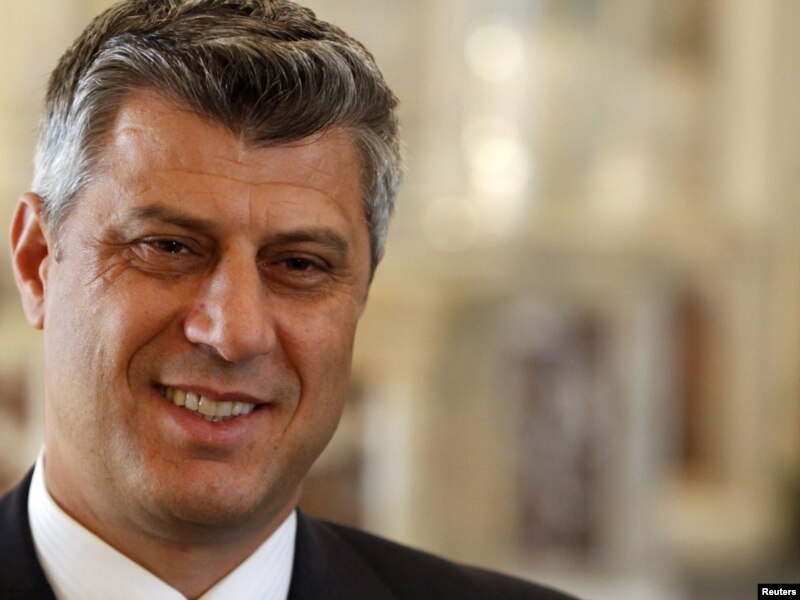
Ahead of the meeting, Kosovar Prime Minister Hashim Thaci stressed the importance of Kosovo taking part in the conference as an equal.
"This meeting amounts to an unambiguously clear international acknowledgment and recognition of Kosova and of the possibilities for progress and development that we have as a state," Thaci said. "This also means our own work for our Euro-Atlantic perspective, for the quickest integration possible into NATO and the EU."
Serbia, which maintains strong links to the ethnic Serbian community in northern Kosovo, has strongly alluded to its desire to partition Kosovo in order to bring its ethnic kin back into Belgrade's fold. The plan, not surprisingly, has met with howls of protest in Pristina.
Abramowitz, who traveled to Kosovo last week, said a partition would have serious ramifications overall for the Balkans, where many countries have their own minority populations.
"I think partition of Kosovo would be an absolute disaster for the [Balkan] region. And I fully expect the United States and most European countries to resist any such effort," Abramowitz says. "I think that's always been a great fear -- that it will open a whole Pandora's box. What happens to Republika Srpska? What happens to Macedonia? So I believe that any effort at partition should be ruled out immediately."
Because of the revised format of today's event, the conference did not issue a formal declaration and participants were represented only by their name, without any official reference to their country.
The meeting -- which also included representatives from the United States, Russia, and Turkey, as well as NATO, the OSCE, and the Council of Europe -- marks the 10th anniversary of a gathering in the Croatian capital, Zagreb, where the EU first promised Balkan nations a future in the bloc.
RFE/RL's Pristina bureau chief Arbana Vidishiqi contributed to this report