




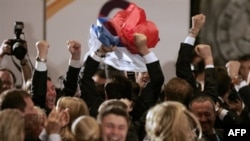
When Vladimir Putin traveled to Guatemala three years ago to personally promote Russia's bid for the 2014 Winter Olympics, he pledged the Games in Sochi would be "safe, enjoyable, and memorable."
Putin, now prime minister, may be wishing he never made that promise.
Reports that Islamic rebels are plotting to disrupt the event, U.S. calls to use the Olympics as a lever on Moscow, and a Georgia-led boycott campaign -- added to a shortage of funds and protests from environmentalists -- have all combined to make the Sochi Games some of the most divisive in Olympic history.
"I'm afraid that Putin, by proposing and taking charge of the 2014 Olympics, made a very serious mistake," says Russian political analyst Nikolai Petrov.
Security Fears
Although many Russians still see the 2014 Olympics as a matter of national pride, the initial euphoria sparked by Sochi's selection as host city is being eclipsed by concerns over security, ecological damage, and spiraling costs.
 Vladimir Putin at the Krasnaya Polyana ski center that will host many of the Sochi eventsAnd as the Games approach, more and more people seem intent on co-opting the event for political purposes.
The Russian Olympic Committee suffered another setback this week when Russia's FSB security service announced that rebel groups were planning attacks in Sochi with the intention of forcing the cancellation of the Games. The threat, said FSB head Aleksandr Bortnikov, will have a "serious influence on political decision-making."
The picturesque Black Sea resort of Sochi lies close the restive North Caucasus region, where Moscow has been battling a Islamist insurgency for more than 15 years.
Russians are still reeling from March bombing attacks on the Moscow metro that killed 40 people and fueled fears of another campaign of attacks by North Caucasus rebels in Russia's heartland.
The Kremlin, with just under four years left before the Sochi Games, has been scrambling to bring the North Caucasus under control.
The result is a raft of hasty measures that analysts say risk fanning tensions in the region and redoubling attacks.
"This is already beginning seriously to influence the federal government's policies in the Caucasus, which now consist in rejecting all efforts toward political modernization and institutionalizing local political regimes instead," says Petrov. "The government is returning to an archaic model with the sole aim of creating an appearance of calm over the next two or three years."
Everybody Needs Good Neighbors
The upcoming Games in Sochi are also drawing renewed attention to another regional conflict -- the one pitting Moscow against Tbilisi over Georgia's pro-Russian separatist regions of Abkhazia and South Ossetia.
 Construction at Nizhneimeretinskaya Bay for the Sochi OlympicsThe dispute came to a dramatic head when the two countries fought a brief war in August 2008, just one year after Sochi was awarded the Games. Later that month, Moscow officially recognized the two rebel regions as sovereign states, followed by allies Nicaragua, Venezuela, and the tiny island nation of Nauru.
Georgia has since led calls for a boycott of the Olympics in Sochi, which lies just 20 kilometers from Abkhazia.
Russia's decision to import building material from Abkhazia and accommodate thousands of Olympic construction workers in the rebel province, where the rent is cheaper, has further riled Georgians.
Western leaders, too, are likely to feel uneasy about such arrangements.
"The Russians will be using the Olympic Games to promote Abkhazia," says Tom de Waal, a Caucasus expert with the U.S. Carnegie Center. "Russian tourists will be staying there too and clearly Western countries will feel uncomfortable about that."
Few Western politicians would support a full-blown boycott, but some already see the Sochi Games as a unique opportunity to pressure Moscow into loosening its grip on Abkhazia and South Ossetia.
One of them is Kurt Volker, a former U.S. ambassador to NATO who is now a senior adviser at the Atlantic Council of the United States.
In a comment published by "The Washington Post" on May 25, Volker calls on Europe and the United States to use the 2014 Olympics as a "lever on Russia" to consign to history what he described as "Russia's zero-sum, divide-and-rule approach to the Caucasus."
Among other measures, Volker suggests slapping an economic and travel blockade on Georgia's rebel regions.
This type of proposal has drawn much criticism, including among those opposed to Moscow's policies in Abkhazia and South Ossetia.
"There is an obvious risk that some people, instead of proposing real solutions to the conflicts, will use the situation to score political points or gains in other spheres," says Petrov. "This type of pressure is counterproductive and not in the interests of the region, of Georgia, and of these practically unrecognized provinces."
Long List Of Critics
Olympic boycotts and pressure campaigns have had limited success in the past.
The U.S.-led partial boycott of the 1980 Moscow Olympics to protest the Soviet Union's invasion of Afghanistan is one such example. In the case of Abkhazia and South Ossetia, the odds of persuading Russia to back off seem even slimmer.
 A tribute to the 2014 Games at the closing ceremony of the Vancouver Winter Olympics in 2010"We saw a similar situation before the Beijing Olympics -- there were obvious attempts to exert pressure that failed to achieve anything," says Russian political analyst Fyodor Lukyanov. "I think this will fail in Sochi too. Georgia, Abkhazia, and South Ossetia are clearly not the main issue for Western countries and for their relations with Russia."
The International Olympic Committee has largely stayed out of the fray, and did not respond to repeated requests for an interview.
Opponents of the Sochi Games, meanwhile, are not giving up the fight.
Environmentalist groups are battling to save Sochi's national park and huge nature reserve -- designated as a UNESCO World Heritage Site -- from what they say is aggressive Olympic construction.
They say irreversible damage has already been done to the environment, including the pollution of rivers and the felling of rare species of trees.
The Circassians, a Muslim Caucasian people now scattered around the globe, have been actively lobbying for the Winter Olympics to be moved to another site. The year 2014 coincides with the 150th anniversary of a Russian military campaign that wiped out 300,000 Circassians in and around Sochi. Although the massacre was recorded by historians, no state has recognized the deaths as genocide.
To add to Russia's Olympic woes, reports of vast financial management and construction delays are making the rounds in the Russian press.
So the Sochi Olympics Games are shaping up to be memorable, although perhaps not for the reasons Putin had hoped.
Putin, now prime minister, may be wishing he never made that promise.
Reports that Islamic rebels are plotting to disrupt the event, U.S. calls to use the Olympics as a lever on Moscow, and a Georgia-led boycott campaign -- added to a shortage of funds and protests from environmentalists -- have all combined to make the Sochi Games some of the most divisive in Olympic history.
"I'm afraid that Putin, by proposing and taking charge of the 2014 Olympics, made a very serious mistake," says Russian political analyst Nikolai Petrov.
Security Fears
Although many Russians still see the 2014 Olympics as a matter of national pride, the initial euphoria sparked by Sochi's selection as host city is being eclipsed by concerns over security, ecological damage, and spiraling costs.

The Russian Olympic Committee suffered another setback this week when Russia's FSB security service announced that rebel groups were planning attacks in Sochi with the intention of forcing the cancellation of the Games. The threat, said FSB head Aleksandr Bortnikov, will have a "serious influence on political decision-making."
The picturesque Black Sea resort of Sochi lies close the restive North Caucasus region, where Moscow has been battling a Islamist insurgency for more than 15 years.
Russians are still reeling from March bombing attacks on the Moscow metro that killed 40 people and fueled fears of another campaign of attacks by North Caucasus rebels in Russia's heartland.
The Kremlin, with just under four years left before the Sochi Games, has been scrambling to bring the North Caucasus under control.
The result is a raft of hasty measures that analysts say risk fanning tensions in the region and redoubling attacks.
"This is already beginning seriously to influence the federal government's policies in the Caucasus, which now consist in rejecting all efforts toward political modernization and institutionalizing local political regimes instead," says Petrov. "The government is returning to an archaic model with the sole aim of creating an appearance of calm over the next two or three years."
Everybody Needs Good Neighbors
The upcoming Games in Sochi are also drawing renewed attention to another regional conflict -- the one pitting Moscow against Tbilisi over Georgia's pro-Russian separatist regions of Abkhazia and South Ossetia.

Georgia has since led calls for a boycott of the Olympics in Sochi, which lies just 20 kilometers from Abkhazia.
Russia's decision to import building material from Abkhazia and accommodate thousands of Olympic construction workers in the rebel province, where the rent is cheaper, has further riled Georgians.
Western leaders, too, are likely to feel uneasy about such arrangements.
"The Russians will be using the Olympic Games to promote Abkhazia," says Tom de Waal, a Caucasus expert with the U.S. Carnegie Center. "Russian tourists will be staying there too and clearly Western countries will feel uncomfortable about that."
Few Western politicians would support a full-blown boycott, but some already see the Sochi Games as a unique opportunity to pressure Moscow into loosening its grip on Abkhazia and South Ossetia.
One of them is Kurt Volker, a former U.S. ambassador to NATO who is now a senior adviser at the Atlantic Council of the United States.
In a comment published by "The Washington Post" on May 25, Volker calls on Europe and the United States to use the 2014 Olympics as a "lever on Russia" to consign to history what he described as "Russia's zero-sum, divide-and-rule approach to the Caucasus."
Among other measures, Volker suggests slapping an economic and travel blockade on Georgia's rebel regions.
This type of proposal has drawn much criticism, including among those opposed to Moscow's policies in Abkhazia and South Ossetia.
"There is an obvious risk that some people, instead of proposing real solutions to the conflicts, will use the situation to score political points or gains in other spheres," says Petrov. "This type of pressure is counterproductive and not in the interests of the region, of Georgia, and of these practically unrecognized provinces."
Long List Of Critics
Olympic boycotts and pressure campaigns have had limited success in the past.
The U.S.-led partial boycott of the 1980 Moscow Olympics to protest the Soviet Union's invasion of Afghanistan is one such example. In the case of Abkhazia and South Ossetia, the odds of persuading Russia to back off seem even slimmer.

The International Olympic Committee has largely stayed out of the fray, and did not respond to repeated requests for an interview.
Opponents of the Sochi Games, meanwhile, are not giving up the fight.
Environmentalist groups are battling to save Sochi's national park and huge nature reserve -- designated as a UNESCO World Heritage Site -- from what they say is aggressive Olympic construction.
They say irreversible damage has already been done to the environment, including the pollution of rivers and the felling of rare species of trees.
The Circassians, a Muslim Caucasian people now scattered around the globe, have been actively lobbying for the Winter Olympics to be moved to another site. The year 2014 coincides with the 150th anniversary of a Russian military campaign that wiped out 300,000 Circassians in and around Sochi. Although the massacre was recorded by historians, no state has recognized the deaths as genocide.
To add to Russia's Olympic woes, reports of vast financial management and construction delays are making the rounds in the Russian press.
So the Sochi Olympics Games are shaping up to be memorable, although perhaps not for the reasons Putin had hoped.

