





WASHINGTON -- Farah Pandith is a Muslim-American who was born in Kashmir, India, and immigrated to the United States with her parents when she was an infant.
Her appointment by U.S. Secretary of State Hillary Clinton to be the State Department’s envoy to Muslim communities around the world is a first --- the position is newly created and reflects President Barack Obama’s desire to improve not just the image of the United States within the Muslim world, but to actively listen and respond to Muslims in Europe, Africa, and Asia.
Obama’s speech in Cairo last month set the tone for what he hopes will be a new era of U.S. relations with Muslims. His words were welcomed by many Muslims who say their main problem with the United States was a foreign policy under former President George W. Bush that seemed aimed against them in every way -- from the invasion of Iraq, to the indefinite detentions at Guantanamo Bay, to the humiliation of prisoners at Abu Ghraib.
Somewhat strangely, given Obama’s very public diplomatic overture in Cairo, there was no public announcement that a new office of a Special Representative to Muslim Communities had been created. News of its debut was buried in an internal State Department memo last week, and it was only after spokesman Ian Kelley was questioned by reporters that an appearance by Pandith on July 1 in the daily briefing room was scheduled.
'I Think It's Nuance'
Pandith describes her background as a mix of private and public sector experience, which she says will allow her to think creatively about how to find out what Muslims “on a grassroots level” are doing and how best to engage them.
"I think it’s nuance, I think it’s respect, I think it’s listening, I think it’s being creative," she said. "And I think it’s creating many different types of initiatives to be able to do that."
When pressed, Pandith wouldn’t offer concrete examples of what initiatives she has in mind, but said the State Department has a variety of established avenues for two-way dialogue between the U.S. and overseas communities, from cultural exchanges to town hall meetings and community projects.
Most of all, Pandith said she plans “to listen to what is needed and be the arm that helps facilitate” a response. Her approach, she said, will be nuanced, to reflect the wide variety of people and population centers that constitute the almost indefinable “Muslim world.”
“There is no one bullet that’s going to fix everything," Pandith said. "There is not one program that’s going to be the magic program to engage with Muslims. It’s really listening. It’s really understanding what’s taking place on the ground. It’s finding opportunities to work with our embassies, to get to know what others are saying, and thinking, and dreaming, and believing.”
Whether it’s third-generation ethnic Turks living in Germany, or native Indonesians in Jakarta, Pandith said she understands that there are as many kind of Muslims as there are people. Her experience as a Muslim in America has given her a deep understanding of the differences among Muslims worldwide, she says, because the United States’ own Muslim population represents 80 different countries.
Outreach To Younger Muslims
This is not a new role for Pandith, who was hired in early 2007 to be former President George W. Bush’s senior advisor for Muslim engagement in the European and Eurasian region. She has also worked for the National Security Council, and with the U.S. Agency for International Development (USAID) in Kabul.
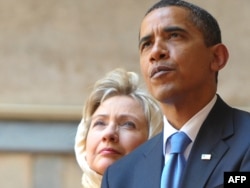 U.S. President Barack Obama and Secretary of State Hillary Clinton at the Sultan Hassan Mosque in Cairo on June 4.Her work will take her around the world but her first stop in every country she visits will be the U.S. Embassy, which will serve as the local facilitator for her ideas. Outreach efforts will cross generations and include rural and urban centers, but Pandith seems especially eager to hear from younger Muslims.
“What I’m doing is working with embassies to find ways that we can approach a younger generation as well, in terms of listening to how they want to engage," Pandith said. "When you talk about nuance, why I’m hitting it as hard as I am, is because it’s very important to understand, that it isn’t just one thing from Washington that’s going to be shoved into everybody’s faces."
Akbar Ahmed, the chair of Islamic Studies at American University in Washington, D.C., says he's taking a wait-and-see attitude toward Pandith's plans.
“Listening to them is only half the story. The second half is to in fact to do something about it,” Ahmed said.
What’s needed now, he says, is action.
“Obama does not have all that very much time. He is hitting the ground running, he is in the saddle, the crises are mounting in Afghanistan and Pakistan; these are Muslim countries," says Ahmed, who has advised U.S. General David Petraeus and Ambassador Richard Holbrooke, among others, on Islam and foreign policy.
"The Palestinian situation is on the boil again, and there really is no time for listening. There is time now to understand the problems -- which Farah obviously understands, coming from that background -- and begin to come up with proposals that somehow bring down the temperature, somehow give people hope, somehow engage people in the Muslim world,” he said.
Obama's 'Huge Advantages'
Ahmed met Pandith at the White House in 2007 during a Ramadan dinner hosted by former President Bush. He says she impressed him as a “competent diplomat” and has the right background for her new post.
And despite working for a president whose relations with the Muslim world were not exactly good, Ahmed says he thinks Pandith can embrace Obama’s approach. Besides, he says, Obama’s “huge advantages” with the Muslim world has already set the stage for her to succeed.
“He has a sensitivity to Muslims, his father was a Muslim, which means he understands instinctively Muslim culture, Muslim society, Muslim history. And his speech in Cairo has sort of set the stage," Ahmed said. "So Farah Pandith is in an ideal position to continue translating that vision of Obama’s and even in a sense what Bush wanted, but could not do, which is to reach out to the Muslim world."
Bush used Karen Hughes, his undersecretary of state for public diplomacy and public affairs, to reach out to Muslims, and in that role, Hughes also embarked on what she called a “listening tour” of Muslim communities abroad. But the effort has largely been judged a failure because nothing changed as a result. Hopes were raised, and then dashed.
If Pandith can take what she hears in Muslim communities and translate it into concrete responses, she’ll be supplying the crucial part of the equation that was missing in the Bush administration’s failed outreach efforts, Ahmad says.
He says there have to be concrete changes on the ground in the Muslim world if the United States hopes to win the hearts and minds of people who for many years have regarded America with suspicion at best, and hostility at worst.
“It’s all very well to talk about listening and understanding and dignity and rebuilding bridges, but when you come down to brass tacks, when the Palestinians say after a couple of months, or the Kashmiris in South Asia say, or the Chechens say, or the Pakistanis say that nothing very much has changed, then there will be frustration and mounting despair and anger,” Ahmad says.
Pandith says she will take her first overseas trip later this summer, but where exactly she’ll go hasn’t been decided yet.
Her appointment by U.S. Secretary of State Hillary Clinton to be the State Department’s envoy to Muslim communities around the world is a first --- the position is newly created and reflects President Barack Obama’s desire to improve not just the image of the United States within the Muslim world, but to actively listen and respond to Muslims in Europe, Africa, and Asia.
Obama’s speech in Cairo last month set the tone for what he hopes will be a new era of U.S. relations with Muslims. His words were welcomed by many Muslims who say their main problem with the United States was a foreign policy under former President George W. Bush that seemed aimed against them in every way -- from the invasion of Iraq, to the indefinite detentions at Guantanamo Bay, to the humiliation of prisoners at Abu Ghraib.
Somewhat strangely, given Obama’s very public diplomatic overture in Cairo, there was no public announcement that a new office of a Special Representative to Muslim Communities had been created. News of its debut was buried in an internal State Department memo last week, and it was only after spokesman Ian Kelley was questioned by reporters that an appearance by Pandith on July 1 in the daily briefing room was scheduled.
'I Think It's Nuance'
Pandith describes her background as a mix of private and public sector experience, which she says will allow her to think creatively about how to find out what Muslims “on a grassroots level” are doing and how best to engage them.
"I think it’s nuance, I think it’s respect, I think it’s listening, I think it’s being creative," she said. "And I think it’s creating many different types of initiatives to be able to do that."
There is not one program that’s going to be the magic program to engage with Muslims. It’s really listening.

Most of all, Pandith said she plans “to listen to what is needed and be the arm that helps facilitate” a response. Her approach, she said, will be nuanced, to reflect the wide variety of people and population centers that constitute the almost indefinable “Muslim world.”
“There is no one bullet that’s going to fix everything," Pandith said. "There is not one program that’s going to be the magic program to engage with Muslims. It’s really listening. It’s really understanding what’s taking place on the ground. It’s finding opportunities to work with our embassies, to get to know what others are saying, and thinking, and dreaming, and believing.”
Whether it’s third-generation ethnic Turks living in Germany, or native Indonesians in Jakarta, Pandith said she understands that there are as many kind of Muslims as there are people. Her experience as a Muslim in America has given her a deep understanding of the differences among Muslims worldwide, she says, because the United States’ own Muslim population represents 80 different countries.
Outreach To Younger Muslims
This is not a new role for Pandith, who was hired in early 2007 to be former President George W. Bush’s senior advisor for Muslim engagement in the European and Eurasian region. She has also worked for the National Security Council, and with the U.S. Agency for International Development (USAID) in Kabul.

“What I’m doing is working with embassies to find ways that we can approach a younger generation as well, in terms of listening to how they want to engage," Pandith said. "When you talk about nuance, why I’m hitting it as hard as I am, is because it’s very important to understand, that it isn’t just one thing from Washington that’s going to be shoved into everybody’s faces."
Akbar Ahmed, the chair of Islamic Studies at American University in Washington, D.C., says he's taking a wait-and-see attitude toward Pandith's plans.
“Listening to them is only half the story. The second half is to in fact to do something about it,” Ahmed said.
What’s needed now, he says, is action.
“Obama does not have all that very much time. He is hitting the ground running, he is in the saddle, the crises are mounting in Afghanistan and Pakistan; these are Muslim countries," says Ahmed, who has advised U.S. General David Petraeus and Ambassador Richard Holbrooke, among others, on Islam and foreign policy.
"The Palestinian situation is on the boil again, and there really is no time for listening. There is time now to understand the problems -- which Farah obviously understands, coming from that background -- and begin to come up with proposals that somehow bring down the temperature, somehow give people hope, somehow engage people in the Muslim world,” he said.
Obama's 'Huge Advantages'
Ahmed met Pandith at the White House in 2007 during a Ramadan dinner hosted by former President Bush. He says she impressed him as a “competent diplomat” and has the right background for her new post.
And despite working for a president whose relations with the Muslim world were not exactly good, Ahmed says he thinks Pandith can embrace Obama’s approach. Besides, he says, Obama’s “huge advantages” with the Muslim world has already set the stage for her to succeed.
“He has a sensitivity to Muslims, his father was a Muslim, which means he understands instinctively Muslim culture, Muslim society, Muslim history. And his speech in Cairo has sort of set the stage," Ahmed said. "So Farah Pandith is in an ideal position to continue translating that vision of Obama’s and even in a sense what Bush wanted, but could not do, which is to reach out to the Muslim world."
Bush used Karen Hughes, his undersecretary of state for public diplomacy and public affairs, to reach out to Muslims, and in that role, Hughes also embarked on what she called a “listening tour” of Muslim communities abroad. But the effort has largely been judged a failure because nothing changed as a result. Hopes were raised, and then dashed.
If Pandith can take what she hears in Muslim communities and translate it into concrete responses, she’ll be supplying the crucial part of the equation that was missing in the Bush administration’s failed outreach efforts, Ahmad says.
He says there have to be concrete changes on the ground in the Muslim world if the United States hopes to win the hearts and minds of people who for many years have regarded America with suspicion at best, and hostility at worst.
“It’s all very well to talk about listening and understanding and dignity and rebuilding bridges, but when you come down to brass tacks, when the Palestinians say after a couple of months, or the Kashmiris in South Asia say, or the Chechens say, or the Pakistanis say that nothing very much has changed, then there will be frustration and mounting despair and anger,” Ahmad says.
Pandith says she will take her first overseas trip later this summer, but where exactly she’ll go hasn’t been decided yet.