




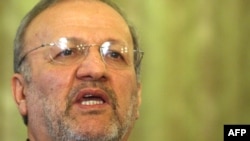
WASHINGTON -- Iranian Foreign Minister Manuchehr Mottaki has said that Tehran won't export its partially enriched uranium for further enrichment, as proposed by the United Nations.
Instead, Mottaki told the Iranian news agency ISNA that Iran would accept an exchange of Iran's lightly enriched nuclear material for more highly processed fuel -- a proposal that would stymie Western efforts to slow down the country's nuclear program.
Britain, China, France, Germany, Russia, and the United States have been pushing for a program proposed by the UN's International Atomic Energy Agency (IAEA) under which lightly enriched Iranian uranium would be sent to Russia for further enrichment, then sent to France to be turned into fuel rods, before being returned to Iran.
Western analysts estimate that such a program could delay Iran's suspected nuclear program by at least a year. The West believes that program is aimed at producing nuclear weapons. Iran says it merely wants to generate electricity.
U.S. Secretary of State Hillary Clinton has said Washington will accept no alternatives to the UN proposal, which means the United States is now facing a tough decision.
Henry Sokolski is the executive director of the Nonproliferation Policy Education Center in Washington, which studies nonproliferation issues. He tells RFE/RL that Iran's decision leaves the United States with two entirely different options.
"Either we begin to try to sanction them, however ineffectively -- initially -- by ourselves and with a few friends, and hope that we can turn others to our way of seeing things and sanction them even more effectively in time," Sokolski says. "Or we start talking about how we'll have to let them enrich under slightly more intrusive inspections, which will be totally inadequate to the task of detecting a possible diversion to make bombs."
Another option, Sokolski says, is military action, which he opposes.
Worth The Effort
The problem is that imposing sanctions through the UN may be impossible. In meetings this week in China, U.S. President Barack Obama heard that he can't rely on Beijing to support sanctions.
As a permanent member of the UN Security Council, China has the right to veto any of the body's resolutions.
As a result, Sokolski says, putting pressure on Iran may take time as the United States tries to persuade other countries to isolate the regime. He argues that such an appraoch would probably be worth the effort, however.
"You've got to show that what [the Iranians have] done is not a model for others to follow. You have to put a price on it," Sokolski says. "And so I would say, start with even ineffectual sanctions and improve them.
"Also, I think you need to be clear. You're not wild about this regime and you would prefer it to go out of business. Does anybody really think you'll be able to crack the nut of the security threat that Iran presents with this program, with the current people running that place? It just doesn't sound right. They like what they're doing. They want to do more of it."
There's always the possibility of accepting Mottaki's offer of a fuel swap, but Ivan Oelrich of the Strategic Security Project at the Federation of American Scientists calls that a bad idea.
Oelrich says the United Nations, the United States, and the other countries negotiating with Iran would lose control of the situation if they let Iran continue to ignore international rules on nuclear research.
"Everyone's gone on record. We've drawn all these lines in the sand. So it's really a question of, no matter what happens now, one side or the other is going to lose face politically, and that's where we are," Oelrich says.
"And I think that there have been so many cases, both with Iran and North Korea, where the West in general, the United States in particular, has said, 'You can't do this,' and then they go ahead and do it -- called our bluff on that. And Obama's starting to get some heat from that. I don't think that they can afford to back off."
'Just Isn't A Plausible Story'
Iran's stand is implausible, Oelrich says, because it implies that Iran can't trust either Russia or France to handle its uranium. And yet, he points out, Iran has long and favorable commercial ties with both countries.
"There is nothing wrong with the previous offer. The Iranians and the Russians have long-term business relationships. The Iranians cannot plausibly say to the Russians, 'No, we don't trust you on that,' because they trust them with billions of dollars worth of business," Oelrich says.
"Now, the Russian-enriched fuel has to go to France to have the fuel rods constructed. The French aren't going to be reneging on the Iranians. It just isn't a plausible story that the Iranians can't trust France and Russia."
Oelrich says the United States should easily be able to show the world that Iran isn't merely defending its right to nuclear power but is engaged in a charade. As a result, he says, the only sensible choice for the United States is to say no to Iran.
Oelrich also believes it's time to revise the Nuclear Nonproliferation Treaty, which says all nations have a right to peaceful nuclear energy. He says that right shouldn't include a country processing its own nuclear fuel.
Instead, Oelrich proposes that the processing of nuclear fuel be internationalized under an agency like the IAEA so that no single country controls any of it. That way, he says, all countries have access to its energy without facing the risk that one or more may secretly develop nuclear weapons.
Instead, Mottaki told the Iranian news agency ISNA that Iran would accept an exchange of Iran's lightly enriched nuclear material for more highly processed fuel -- a proposal that would stymie Western efforts to slow down the country's nuclear program.
Britain, China, France, Germany, Russia, and the United States have been pushing for a program proposed by the UN's International Atomic Energy Agency (IAEA) under which lightly enriched Iranian uranium would be sent to Russia for further enrichment, then sent to France to be turned into fuel rods, before being returned to Iran.
Western analysts estimate that such a program could delay Iran's suspected nuclear program by at least a year. The West believes that program is aimed at producing nuclear weapons. Iran says it merely wants to generate electricity.
U.S. Secretary of State Hillary Clinton has said Washington will accept no alternatives to the UN proposal, which means the United States is now facing a tough decision.
Henry Sokolski is the executive director of the Nonproliferation Policy Education Center in Washington, which studies nonproliferation issues. He tells RFE/RL that Iran's decision leaves the United States with two entirely different options.
"Either we begin to try to sanction them, however ineffectively -- initially -- by ourselves and with a few friends, and hope that we can turn others to our way of seeing things and sanction them even more effectively in time," Sokolski says. "Or we start talking about how we'll have to let them enrich under slightly more intrusive inspections, which will be totally inadequate to the task of detecting a possible diversion to make bombs."
Another option, Sokolski says, is military action, which he opposes.
Worth The Effort
The problem is that imposing sanctions through the UN may be impossible. In meetings this week in China, U.S. President Barack Obama heard that he can't rely on Beijing to support sanctions.
As a permanent member of the UN Security Council, China has the right to veto any of the body's resolutions.
As a result, Sokolski says, putting pressure on Iran may take time as the United States tries to persuade other countries to isolate the regime. He argues that such an appraoch would probably be worth the effort, however.
Does anybody really think you'll be able to crack the nut of the security threat that Iran presents with this program, with the current people running that place?

"Also, I think you need to be clear. You're not wild about this regime and you would prefer it to go out of business. Does anybody really think you'll be able to crack the nut of the security threat that Iran presents with this program, with the current people running that place? It just doesn't sound right. They like what they're doing. They want to do more of it."
There's always the possibility of accepting Mottaki's offer of a fuel swap, but Ivan Oelrich of the Strategic Security Project at the Federation of American Scientists calls that a bad idea.
Oelrich says the United Nations, the United States, and the other countries negotiating with Iran would lose control of the situation if they let Iran continue to ignore international rules on nuclear research.
"Everyone's gone on record. We've drawn all these lines in the sand. So it's really a question of, no matter what happens now, one side or the other is going to lose face politically, and that's where we are," Oelrich says.
"And I think that there have been so many cases, both with Iran and North Korea, where the West in general, the United States in particular, has said, 'You can't do this,' and then they go ahead and do it -- called our bluff on that. And Obama's starting to get some heat from that. I don't think that they can afford to back off."
'Just Isn't A Plausible Story'
Iran's stand is implausible, Oelrich says, because it implies that Iran can't trust either Russia or France to handle its uranium. And yet, he points out, Iran has long and favorable commercial ties with both countries.
"There is nothing wrong with the previous offer. The Iranians and the Russians have long-term business relationships. The Iranians cannot plausibly say to the Russians, 'No, we don't trust you on that,' because they trust them with billions of dollars worth of business," Oelrich says.
"Now, the Russian-enriched fuel has to go to France to have the fuel rods constructed. The French aren't going to be reneging on the Iranians. It just isn't a plausible story that the Iranians can't trust France and Russia."
Oelrich says the United States should easily be able to show the world that Iran isn't merely defending its right to nuclear power but is engaged in a charade. As a result, he says, the only sensible choice for the United States is to say no to Iran.
Oelrich also believes it's time to revise the Nuclear Nonproliferation Treaty, which says all nations have a right to peaceful nuclear energy. He says that right shouldn't include a country processing its own nuclear fuel.
Instead, Oelrich proposes that the processing of nuclear fuel be internationalized under an agency like the IAEA so that no single country controls any of it. That way, he says, all countries have access to its energy without facing the risk that one or more may secretly develop nuclear weapons.