





Russia has only a limited window of opportunity within which it can hope to achieve its maximum objectives in Ukraine, while Ukraine has only a limited number of options for developing its relations with the Russian Federation in such a way as to ensure its survival as an independent state, according to two leading Kyiv-based specialists on international relations.
The current issue of "Zerkalo nedeli" includes a 4,100-word discussion by academician Volodymyr Horbulin, director of the Kyiv Institute of Problems of National Security, and Oleksandr Lytvynenko, his adviser, of the security trap in which Russia and Ukraine find themselves.
The two analysts argue that Russia's domestic problems, including demographic decline, ethnic and religious challenges, and regional separatism (both ethnic and non-ethnic) have been compounded by its return to authoritarianism and by the impact of the global economic crisis. Those cumulative pressures, they write, are forcing Moscow to "concentrate on the resolution of questions of a primarily regional nature that it can't put off any longer."
'Subjagation Of Ukraine'
"The subjugation of Ukraine must be considered [Russia's] most crucial foreign policy objective," Horbulin and Lytvynenko write, noting that by means of "the subordination of Ukraine, or at least its southeastern part, the Kremlin [could] essentially improve the situation in the Russian Federation."
Doing so would, they predict, reduce Russia's demographic problems, guarantee the reliable transportation of oil and gas to Europe, significantly increase its economic potential in machine building (including in the defense sector) and in agriculture, make it impossible for the United States to use Ukraine as a military base, and neutralize a potential ideological threat to its authoritarian regime.
Those considerations, they continue, demonstrate that "the aggressive policy of the Kremlin with regard to Ukraine is the result not of Kyiv's actions, but of Russia's needs as the current leadership of that state understands them." For that reason, a shift in Ukrainian policy "will not lead to a significant revision of Russian policy."
At the same time, Horbulin and Lytvynenko argue, the Kremlin recognizes "that the historical 'window of opportunity' relative to Ukraine...is quite short and may close as early as 2015, by which time a new generation of Ukrainian elites" will have emerged and the West may have changed its approach either to Moscow or to Kyiv, or both. All these considerations suggest, the two Ukrainian security analysts argue, that Russia will launch a "decisive and pitiless" campaign against Ukraine in the very near future.
Horbulin and Lytvynenko then examine in greater detail Russian policy toward Ukraine and possible Ukrainian responses. With respect to the former, they make five points. First, Russia has repeatedly made clear that it recognizes the borders of Ukraine, but nonetheless demands that Ukraine defer to Russia on such issues as possible membership in NATO.
Second, "both legally and ideologically and in institutional terms" Russia today is the direct successor of the USSR and has inherited the latter's "institutional memory" with regard to "mechanisms for developing and taking decisions," in the first instance those involving "strategic" questions. Because of that continuity, they write, it is very likely the Kremlin has not developed "a precise, clearly formulated program of actions with regard to Ukraine," but rather is being guided by the need to determine "the main tasks, directions, and arsenal of instruments to be used."
Third, this lack of a specific plan does not mean that Moscow has not decided on its long-term "strategic vision" of relations with Ukraine. In fact, it did so at the December 25, 2008, meeting of the Russian Security Council and State Council of the Russian Federation. That vision, subsequently made public by State Duma Deputy Konstantin Zatulin in May, amounts to "an ultimatum" whereby respect by Russia for Ukraine's territorial integrity is contingent on Kyiv agreeing to "special relations" with the Russian Federation -- in effect, to a Russian protectorate over a weakened Ukraine.
Fourth, in the course of "almost 20 years of relations with independent Ukraine," the Kremlin has become "convinced" of the effectiveness of using "so-called pro-Russian elites" to advance its cause in Ukraine, and that a Russian protectorate will ultimately lead to "the territorial division of Ukraine into three parts," part of which will be subsumed into Russia.
And fifth, the Russian political elite is divided as to how best and how quickly to achieve these goals, with the "hawks" arguing that more pressure sooner is the best approach, while the "doves" favor less pressure over a longer time period. In recent months, because of economic problems, the hawks have gained the upper hand.
'Application Of Direct Force'
Moscow is using its security services to promote its goals in Ukraine, the two analysts say. But if these services are unable to achieve Moscow's goals, and if the January 2010 presidential elections in Ukraine do not yield the result Russia wants, "one cannot completely exclude the application of direct force."
Horbulin and Lytvynenko argue that in face of this Russian policy, which places at risk "the very survival of the Ukrainian state in its current borders," Kyiv must immediately adopt a number of "complex measures" encompassing both democratization and a new approach to its foreign partners.
Above all, they argue, Ukraine's leaders must deliver on their repeated promises to protect citizens' constitutional rights and freedoms and must "establish political stability on the basis of elite and social consensus regarding a European path of development." That will necessitate adopting a new constitution that defines Ukraine as either a presidential or a parliamentary republic, rather than trying to combine the two; the reduction of corruption in the bureaucracy; reform of the armed services; developing effective intelligence and counterintelligence services; and better articulation of Ukraine's goals.
In foreign affairs, the two analysts suggest, Ukraine must continue on its "strategic course" toward membership of NATO and the European community, but should show far more "tactical flexibility" in doing so, which would enable it to "accentuate" positive aspects of its ties with Russia as well.
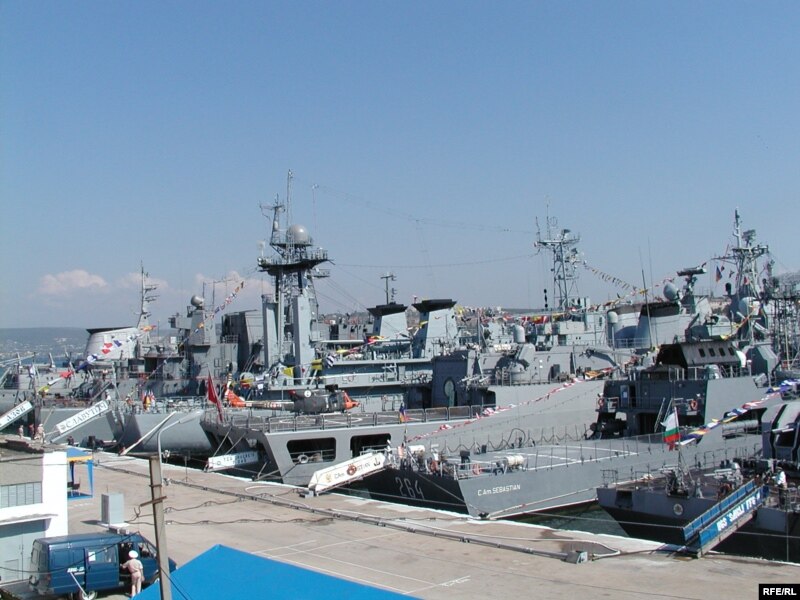
 The analysts argue Ukraine should be willing to consider the demilitarization of the Black Sea.Such ties cannot be developed in isolation. Instead, Ukraine must use "the possibilities offered by international organizations" like the Commonwealth of Independent States, the Organization for Security and Cooperation in Europe, the UN, and the Council of Europe. Kyiv must be willing to think outside the box by considering such possibilities as declaring the Black Sea a demilitarized zone.
In its relations with the United States, Kyiv should shift "the accent from the public and the official to the working level, above all in the sphere of security," and in ties with the EU, it should move from declarations to taking albeit limited practical steps. And Ukraine should, Horbulin and Lytvynenko argue, "expand its dialogue with China, [again] in the sphere of security, by making use of the fact that China became the first state guarantor of Ukrainian sovereignty and territorial integrity and confirmed this guarantee in 2006."
Even if such policies cannot lower tensions between Ukraine and Russia, the analysts conclude, they could at least gradually "limit the risk of conflict between them, and also minimize the potential damage to Ukraine's national interests." Perhaps more to the point, such actions will help those in Russia who want to organize their country "on the principles of freedom."
Paul Goble is a longtime specialist on the former USSR. The views expressed in this analysis, which was first posted on "Window On Eurasia," are the author's own and do not necessarily reflect those of RFE/RL.
The current issue of "Zerkalo nedeli" includes a 4,100-word discussion by academician Volodymyr Horbulin, director of the Kyiv Institute of Problems of National Security, and Oleksandr Lytvynenko, his adviser, of the security trap in which Russia and Ukraine find themselves.
The two analysts argue that Russia's domestic problems, including demographic decline, ethnic and religious challenges, and regional separatism (both ethnic and non-ethnic) have been compounded by its return to authoritarianism and by the impact of the global economic crisis. Those cumulative pressures, they write, are forcing Moscow to "concentrate on the resolution of questions of a primarily regional nature that it can't put off any longer."
'Subjagation Of Ukraine'
"The subjugation of Ukraine must be considered [Russia's] most crucial foreign policy objective," Horbulin and Lytvynenko write, noting that by means of "the subordination of Ukraine, or at least its southeastern part, the Kremlin [could] essentially improve the situation in the Russian Federation."
Ukraine's leaders must deliver on their repeated promises to protect citizens' constitutional rights and freedoms.

Those considerations, they continue, demonstrate that "the aggressive policy of the Kremlin with regard to Ukraine is the result not of Kyiv's actions, but of Russia's needs as the current leadership of that state understands them." For that reason, a shift in Ukrainian policy "will not lead to a significant revision of Russian policy."
At the same time, Horbulin and Lytvynenko argue, the Kremlin recognizes "that the historical 'window of opportunity' relative to Ukraine...is quite short and may close as early as 2015, by which time a new generation of Ukrainian elites" will have emerged and the West may have changed its approach either to Moscow or to Kyiv, or both. All these considerations suggest, the two Ukrainian security analysts argue, that Russia will launch a "decisive and pitiless" campaign against Ukraine in the very near future.
Horbulin and Lytvynenko then examine in greater detail Russian policy toward Ukraine and possible Ukrainian responses. With respect to the former, they make five points. First, Russia has repeatedly made clear that it recognizes the borders of Ukraine, but nonetheless demands that Ukraine defer to Russia on such issues as possible membership in NATO.
Second, "both legally and ideologically and in institutional terms" Russia today is the direct successor of the USSR and has inherited the latter's "institutional memory" with regard to "mechanisms for developing and taking decisions," in the first instance those involving "strategic" questions. Because of that continuity, they write, it is very likely the Kremlin has not developed "a precise, clearly formulated program of actions with regard to Ukraine," but rather is being guided by the need to determine "the main tasks, directions, and arsenal of instruments to be used."
Third, this lack of a specific plan does not mean that Moscow has not decided on its long-term "strategic vision" of relations with Ukraine. In fact, it did so at the December 25, 2008, meeting of the Russian Security Council and State Council of the Russian Federation. That vision, subsequently made public by State Duma Deputy Konstantin Zatulin in May, amounts to "an ultimatum" whereby respect by Russia for Ukraine's territorial integrity is contingent on Kyiv agreeing to "special relations" with the Russian Federation -- in effect, to a Russian protectorate over a weakened Ukraine.
Fourth, in the course of "almost 20 years of relations with independent Ukraine," the Kremlin has become "convinced" of the effectiveness of using "so-called pro-Russian elites" to advance its cause in Ukraine, and that a Russian protectorate will ultimately lead to "the territorial division of Ukraine into three parts," part of which will be subsumed into Russia.
And fifth, the Russian political elite is divided as to how best and how quickly to achieve these goals, with the "hawks" arguing that more pressure sooner is the best approach, while the "doves" favor less pressure over a longer time period. In recent months, because of economic problems, the hawks have gained the upper hand.
'Application Of Direct Force'
Moscow is using its security services to promote its goals in Ukraine, the two analysts say. But if these services are unable to achieve Moscow's goals, and if the January 2010 presidential elections in Ukraine do not yield the result Russia wants, "one cannot completely exclude the application of direct force."
Horbulin and Lytvynenko argue that in face of this Russian policy, which places at risk "the very survival of the Ukrainian state in its current borders," Kyiv must immediately adopt a number of "complex measures" encompassing both democratization and a new approach to its foreign partners.
Above all, they argue, Ukraine's leaders must deliver on their repeated promises to protect citizens' constitutional rights and freedoms and must "establish political stability on the basis of elite and social consensus regarding a European path of development." That will necessitate adopting a new constitution that defines Ukraine as either a presidential or a parliamentary republic, rather than trying to combine the two; the reduction of corruption in the bureaucracy; reform of the armed services; developing effective intelligence and counterintelligence services; and better articulation of Ukraine's goals.
In foreign affairs, the two analysts suggest, Ukraine must continue on its "strategic course" toward membership of NATO and the European community, but should show far more "tactical flexibility" in doing so, which would enable it to "accentuate" positive aspects of its ties with Russia as well.
In its relations with the United States, Kyiv should shift "the accent from the public and the official to the working level, above all in the sphere of security," and in ties with the EU, it should move from declarations to taking albeit limited practical steps. And Ukraine should, Horbulin and Lytvynenko argue, "expand its dialogue with China, [again] in the sphere of security, by making use of the fact that China became the first state guarantor of Ukrainian sovereignty and territorial integrity and confirmed this guarantee in 2006."
Even if such policies cannot lower tensions between Ukraine and Russia, the analysts conclude, they could at least gradually "limit the risk of conflict between them, and also minimize the potential damage to Ukraine's national interests." Perhaps more to the point, such actions will help those in Russia who want to organize their country "on the principles of freedom."
Paul Goble is a longtime specialist on the former USSR. The views expressed in this analysis, which was first posted on "Window On Eurasia," are the author's own and do not necessarily reflect those of RFE/RL.