


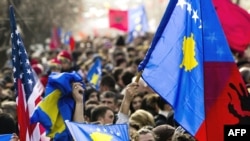
The streets of Moldova and Georgia are boiling with protest and anger, while Kosovo continues to grapple with its self-proclaimed statehood. All three situations originate in the departure from the Cold War-era agreements respecting borders. We are witnessing the repercussions of the "Kosovo precedent," and they're not pretty.
What is happening in Moldova? Is it another so-called "colored revolution," or simply an expression of rage by young people who demand to live better lives? It’s anyone's guess. There are certainly specific individuals who are interested in stirring up trouble in Moldova, both within the country and in Romania. Some Romanian nationalists want Moldova to be merged with Romania. And some people in Moldova see unification with Romania as the easiest way into the European Union.
Do the Moldovan protesters have a plan? If they do, it has been acted out in a very clumsy way. The charging and looting of government buildings showed sheer rage, not a plan to take control of the country or to bring about "regime change by force."
The fact is that the Moldovan Communists are popular with the electorate. The April 5 parliamentary elections may have been flawed, but not to the degree the opposition claims. International election observers admitted as much, but at the same time they gave the election a passing grade.
What's happening is a young people's revolt. Importantly, many of Moldova's youth feel like orphans because their parents have lived and worked abroad (many of them in Russia) for so long. An estimated 600,000 Moldovans (of a total population of 4.1 million) live outside the country and send home remittances each year equal to the entire state budget. How many of these workers have returned home without money or a job?
Those looking for a conspiracy theory are out of luck, at least until more evidence surfaces. Moldova under outgoing President Vladimir Voronin has pursued a balanced foreign policy, seeking to maintain simultaneously cordial relations with both Russia and the EU. Voronin may not be the most modern leader, but he understands both the realities of Russia's influence in the post-Soviet space and his countrymen's desire for closer relations with the EU.
Many in breakaway Transdniester are watching the recent events in Moldova with satisfaction, in that the unrest and violence only serve as a further reason why they should not agree, in the wake of Kosovo's independence, to once again become a part of Moldova.
Post-Soviet Purgatory
How do events in Georgia compare with Moldova? Georgians have had enough. President Mikheil Saakashvili is a big-time gambler, but he has finally failed. By force of personality and taking advantage of circumstances, he pulled off the Rose Revolution of 2003.
Emboldened by that victory, he then pressed to unify the country, even if this meant using force. Saakashvili threw the dice and lost, launching a preemptive war against the breakaway republic of South Ossetia in August 2008 that provoked a massive military retaliation by Russia and thus resulted in a disastrous political defeat for him personally.
What is happening in Moldova and Georgia at the moment is very different in many ways. I call this process "transiting the post-Soviet purgatory." All countries in the post-Soviet space have to find their own way to democracy and economic stability. This process may be slow, and some aspects of it may be unpalatable to the West, but it is nonetheless unavoidable.
So what does Kosovo have to do will all of this? Most of the world's population does not regard Kosovo as a state, but rather as an idea and inspiration for those who want to change borders and get away with it without complying strictly with international law. This is why the "Kosovo precedent" is haunting the international stage.
Moldovans and the peoples of South Ossetia and Abkhazia are inspired by Kosovo's so-called achievement of independence. That independence was forced upon the world by a small group of Western countries that claimed that Kosovo was an "exception." This was a serious error-- one country's exception becomes other countries' rule.
One of the key tenets of the so-called Helsinki Accords adopted in 1975 by the members of the Conference for Security and Cooperation in Europe (CSCE -- renamed the Organization for Security and Cooperation in Europe in December 1994) was that the borders of member states were inviolable and could not be changed unilaterally. The recognition of Kosovo's independence, however, constituted precisely such a unilateral change, and we are now witnessing the Kosovo domino effect.
For over a decade, South Ossetia and Abkhazia had strong cases for independence, even stronger, they argue, than Kosovo's. Today they have independence, even if it is not widely recognized. And now some Moldovans who would actually prefer to call themselves Romanians are demanding border changes that would make this desire a reality. After Kosovo, how can they be denied this?
The Kosovo precedent was a terrible mistake for the international system and it will continue to play itself out as others seek to apply it to their own country. Today it is Moldova and Georgia's former breakaway republics that are full of hope -- others will surely follow tomorrow. And none of this bodes well for the principles of self-determination and respect for national borders.
Peter Lavelle is a political commentator for Russia Today (RT) television. The views expressed in this commentary are his own, and do not necessarily reflect those of RT or RFE/RL
What is happening in Moldova? Is it another so-called "colored revolution," or simply an expression of rage by young people who demand to live better lives? It’s anyone's guess. There are certainly specific individuals who are interested in stirring up trouble in Moldova, both within the country and in Romania. Some Romanian nationalists want Moldova to be merged with Romania. And some people in Moldova see unification with Romania as the easiest way into the European Union.
Do the Moldovan protesters have a plan? If they do, it has been acted out in a very clumsy way. The charging and looting of government buildings showed sheer rage, not a plan to take control of the country or to bring about "regime change by force."
The fact is that the Moldovan Communists are popular with the electorate. The April 5 parliamentary elections may have been flawed, but not to the degree the opposition claims. International election observers admitted as much, but at the same time they gave the election a passing grade.
What's happening is a young people's revolt. Importantly, many of Moldova's youth feel like orphans because their parents have lived and worked abroad (many of them in Russia) for so long. An estimated 600,000 Moldovans (of a total population of 4.1 million) live outside the country and send home remittances each year equal to the entire state budget. How many of these workers have returned home without money or a job?
Those looking for a conspiracy theory are out of luck, at least until more evidence surfaces. Moldova under outgoing President Vladimir Voronin has pursued a balanced foreign policy, seeking to maintain simultaneously cordial relations with both Russia and the EU. Voronin may not be the most modern leader, but he understands both the realities of Russia's influence in the post-Soviet space and his countrymen's desire for closer relations with the EU.
Many in breakaway Transdniester are watching the recent events in Moldova with satisfaction, in that the unrest and violence only serve as a further reason why they should not agree, in the wake of Kosovo's independence, to once again become a part of Moldova.
Post-Soviet Purgatory
How do events in Georgia compare with Moldova? Georgians have had enough. President Mikheil Saakashvili is a big-time gambler, but he has finally failed. By force of personality and taking advantage of circumstances, he pulled off the Rose Revolution of 2003.
Emboldened by that victory, he then pressed to unify the country, even if this meant using force. Saakashvili threw the dice and lost, launching a preemptive war against the breakaway republic of South Ossetia in August 2008 that provoked a massive military retaliation by Russia and thus resulted in a disastrous political defeat for him personally.
What is happening in Moldova and Georgia at the moment is very different in many ways. I call this process "transiting the post-Soviet purgatory." All countries in the post-Soviet space have to find their own way to democracy and economic stability. This process may be slow, and some aspects of it may be unpalatable to the West, but it is nonetheless unavoidable.
So what does Kosovo have to do will all of this? Most of the world's population does not regard Kosovo as a state, but rather as an idea and inspiration for those who want to change borders and get away with it without complying strictly with international law. This is why the "Kosovo precedent" is haunting the international stage.
Moldovans and the peoples of South Ossetia and Abkhazia are inspired by Kosovo's so-called achievement of independence. That independence was forced upon the world by a small group of Western countries that claimed that Kosovo was an "exception." This was a serious error-- one country's exception becomes other countries' rule.
One of the key tenets of the so-called Helsinki Accords adopted in 1975 by the members of the Conference for Security and Cooperation in Europe (CSCE -- renamed the Organization for Security and Cooperation in Europe in December 1994) was that the borders of member states were inviolable and could not be changed unilaterally. The recognition of Kosovo's independence, however, constituted precisely such a unilateral change, and we are now witnessing the Kosovo domino effect.
For over a decade, South Ossetia and Abkhazia had strong cases for independence, even stronger, they argue, than Kosovo's. Today they have independence, even if it is not widely recognized. And now some Moldovans who would actually prefer to call themselves Romanians are demanding border changes that would make this desire a reality. After Kosovo, how can they be denied this?
The Kosovo precedent was a terrible mistake for the international system and it will continue to play itself out as others seek to apply it to their own country. Today it is Moldova and Georgia's former breakaway republics that are full of hope -- others will surely follow tomorrow. And none of this bodes well for the principles of self-determination and respect for national borders.
Peter Lavelle is a political commentator for Russia Today (RT) television. The views expressed in this commentary are his own, and do not necessarily reflect those of RT or RFE/RL